Product review · Behr · Updated August 7, 2026
Premium 1-Part Epoxy Concrete & Garage Floor PaintBehr paint review
7.6/10The easiest clean satin floor in the category — and about half the film thickness of a real 2-part kit.
Read the full name and you get the truth: this is an epoxy-fortified acrylic, not a 2-part kit. It is the easiest floor in the category and about 2 to 3 dry mils thick — and that one number is the whole hot-tire story.

Mark Thompson · Pro Contractor & Field Editor · Updated August 7, 2026
22 years running residential and light commercial repaints across the Midwest. Mark has etched and rolled a lot of garage slabs, and he prices the tire lanes as the part that fails first on every one-part floor. About the testing process →
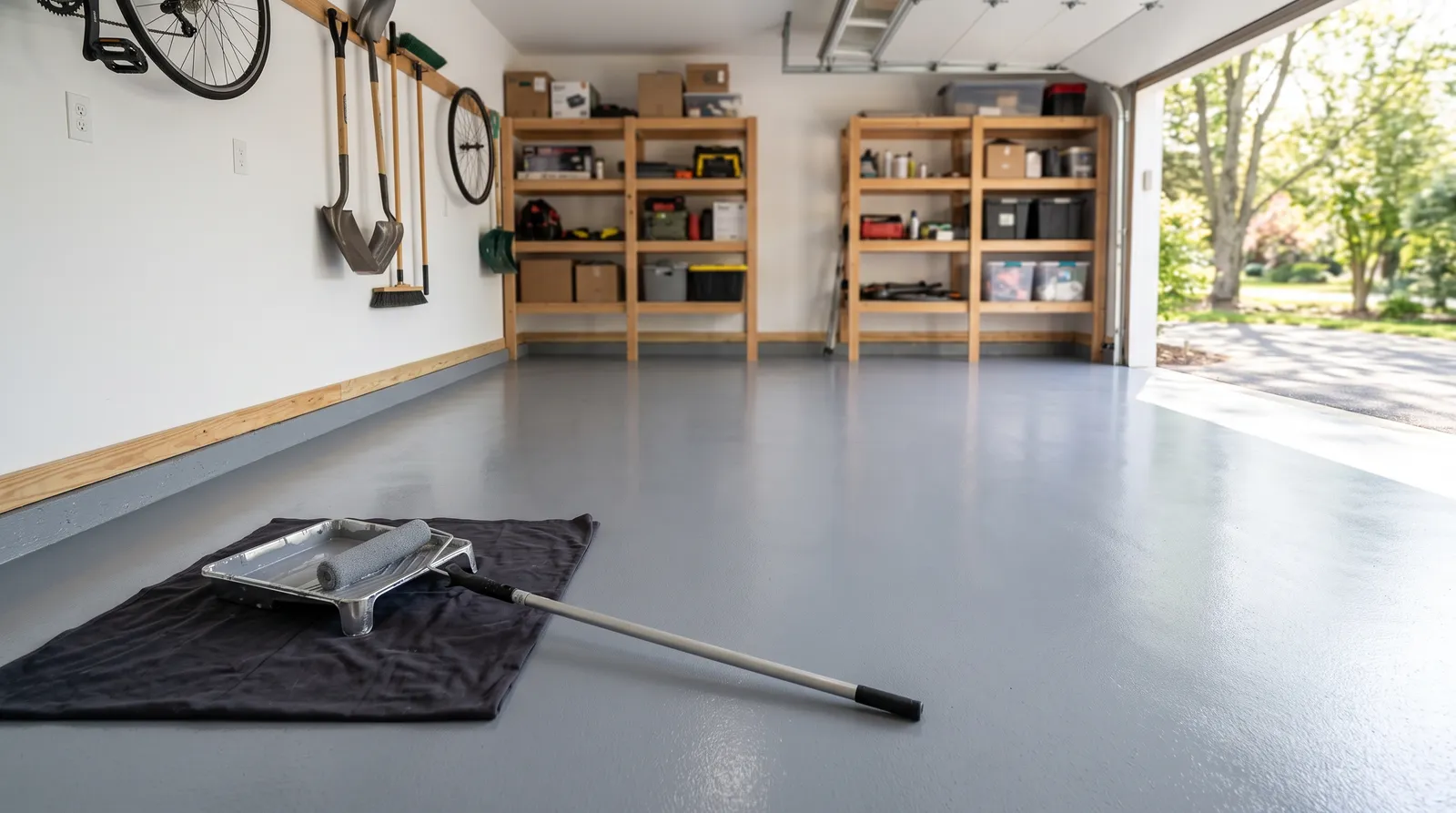
Behr Premium 1-Part Epoxy Concrete & Garage Floor Paint2 sheens
Coverage300-400 sq ft / gal rough
Dry / RecoatTouch dry 1h
VOCLess than 50 g/L
Sheens Deep Base No. 9308 OSHA safety colors
Read this first
The Fast Verdict
Yes for a basement floor, a patio, a porch, or a light-use garage, as long as you do the etch. About $48 a gallon buys one bucket, no pot life, water cleanup, low odor, and a satin film that evens out a tired slab. No for a garage that parks hot daily-drivers. This is an epoxy-fortified acrylic that finishes around 2 to 3 dry mils over two coats, against roughly 3-plus mils per coat from a true 2-part kit, and Behr itself expects annual touch-up in the tire lanes.
Best for
Basement floors · Patios, porches, and walkways · Light-use garages · Driveways and pool decks · Striping a shop floor in OSHA safety colors · Low-odor interior slabs
Skip if
You park hot daily-drivers · You wash gas and solvents off the floor · Your moisture test fogged · Industrial or forklift floors · Above-grade vertical surfaces
What it's good at
- Dead-simple application — one bucket, no part A and part B, no induction time, no pot life
- Low odor and water cleanup at under 50 g/L, which matters on a closed basement slab
- Evening out blotchy gray, old stains, and patch shadows that thin concrete paint telegraphs
- More color than the shelf suggests: about 75 PFC floor colors plus 8 OSHA safety colors for striping a shop
- Better hot-tire resistance than plain concrete floor paint, because there is more epoxy in the film
- Genuine self-priming on a properly etched slab, so a basement or patio needs nothing else in the cart
- Taking decorative flakes broadcast into the wet first coat, locked in by the second
What it's not good at
- Beating hot-tire pickup — Behr's own line is that tire areas may require annual touch-up
- Forgiving a skipped etch; a power-troweled slab is glass and the coating delaminates in sheets
- Film thickness, at roughly 2 to 3 dry mils against 3-plus mils per coat from a 2-part kit
- Standing up to brake fluid, gas, and harsh degreasers left sitting on it
- Rewarding impatience — touch dry at 1 hour but tires need a full 7 days
- Surviving a pressure washer or abrasive cleaner, both of which Behr names as failure causes
- Industrial and forklift floors, above-grade walls, and any slab under hydrostatic pressure
Numbers, not adjectives
Spec Sheet
- Coverage
- 300-400 sq ft / gal rough · 400-500 smooth, and two coats is the standard
- Finish
- Satin only; gloss 10-20 at 60 degrees
- Colors
- Silver Gray No. 901 and Slate Gray No. 902 premixed, plus White Base No. 900 and Deep Base No. 930 tinted to about 75 PFC floor colors and 8 OSHA safety colors
- Weight / solids
- 10.2 lb per gallon · 32 percent (±2) solids by volume
- Film build
- 1.6 dry mils per coat at 300 sq ft/gal — about 2-3 dry mils over two coats
- Dry / Recoat
- Touch dry 1h · recoat 4-6h, rated at 77°F and 50 percent RH
- Traffic
- Light foot 24h · furniture 72h · automotive tires 7 days (cardboard under tires allowed from 72h)
- Washing
- None for 30 days, then mild detergent only — no abrasives, no pressure washer
- VOC
- Less than 50 g/L
- Prep
- Clean and etch bare or sealed concrete to a 150-grit profile; new concrete cures 30 days first
- Not approved for
- Industrial or forklift areas, above-grade vertical surfaces, slabs under hydrostatic pressure
- Price
- About $48 / gal at Home Depot; 1-gallon and 5-gallon
Application Settings That Work
- Brush
- A nylon or polyester brush for cut-in and control joints. Cut the edges and joints first, then roll the field with a 3/8-inch to 1/2-inch nap — go to the 1/2-inch on rough or broom-finished slabs. On the second coat, roll a criss-cross pattern across the first; perpendicular passes even out the film and kill the lap lines you get from rolling both coats the same direction.
- Airless
- .015-inch to .021-inch tip, 60-mesh filter, 1,400 to 2,400 psi. Do not thin to make it spray easier — the solids are the film build, and you cannot spray back what you water out.
- Thinning
- Do not thin. Not with water, not for the sprayer. Spread at the rated 300 sq ft per gallon it lays 1.6 dry mils per coat; stretch it to 500 and you are down to 1.0. On a product this thin to begin with, thinning is the one mistake that costs you the most.
- Primer
- Self-priming on a properly etched slab, but that is the minimum spec, not the best one. Cure new concrete 30 days. Degrease, etch bare or sealed concrete with a muriatic acid etcher — No. 991 Concrete & Masonry Cleaner & Etcher qualifies — to a 150-grit profile, rinse, and dry. On a garage, buy one gallon of No. 880 Concrete & Masonry Bonding Primer and prime just the two tire lanes; Behr calls it highly recommended under vehicle tires, and it is about fifteen dollars against the area that fails first. Recoating an old painted floor, spot-prime wherever bare concrete shows through.
The Cure Reality, and the Cardboard Trick
Touch dry at 1 hour fools people badly. The real schedule is light foot traffic at 24 hours, furniture at 72, and automotive tires at a full 7 days — longer in cold or damp weather. A floor that feels dry in an hour and looks finished by dinner tempts you to park the next morning, and parking early is exactly how you pull the coating up at the tires. If you genuinely cannot keep the car out for a week, Behr's own workaround is corrugated cardboard under the tires from 72 hours; it spreads the load and keeps hot rubber off the film until day seven. Two more rules decide the lifespan: no washing at all for 30 days, then mild detergent only, and no abrasive cleaners or pressure washer ever — Behr names both as causes of premature failure. A pressure washer will find the edge of a 2-mil film and lift it. Mop it, do not blast it.
Mid-project panic
When It Goes Wrong, and How to Fix It
The coating lifted where the tires sit
Why it happens. Hot-tire pickup, and it is the number-one complaint on this product. The film resists it; it does not defeat it. At 32 percent solids the finished floor is roughly 2 to 3 dry mils, against 3-plus mils per coat from a 2-part kit. Hot rubber does not care how hard the film is — it grabs and pulls, and 2 mils has far less to hold with than 6.
The fix. Buy a gallon of No. 880 Concrete & Masonry Bonding Primer and prime just the two tire lanes before you coat. Behr calls it highly recommended where vehicle tires park. Keep tires off the full 7 days, cardboard from 72 hours if you must, and consider a clear sealer topcoat for extra film. If the garage parks hot daily-drivers, step up to a 2-part epoxy or a polyaspartic system.
It delaminated in sheets within a season
Why it happens. Self-priming makes people think they can skip the etch. A power-troweled slab feels like glass, and acrylic does not stick to glass. No etch means no profile, no profile means no bite. Etcher residue left on the slab does the same thing from the other direction.
The fix. Degrease, then etch bare or sealed concrete with a muriatic acid etcher to a 150-grit feel. Rinse and dry a full day, longer in a humid basement. Then run both readiness tests: wipe a finger across the dry floor and nothing chalky should come off, and sprinkled water has to soak in fast rather than bead. A bonding primer improves a properly etched slab; it will not rescue an unetched one.
Bubbles or blisters a couple of days later
Why it happens. The slab is pushing moisture up from below, or rain or heavy dew landed inside 24 hours on an exterior pour. Behr does not approve this over slabs under hydrostatic pressure for exactly this reason.
The fix. Tape a square of plastic to the slab overnight before you buy anything. Foggy or damp underneath means fix the moisture source or do not coat it. Outdoors, check the forecast for rain and heavy dew inside 24 hours, and never coat a slab that is hot to the touch or sitting in direct sun.
Two coats and the hide is still patchy
Why it happens. This is a thin film — 1.6 dry mils per coat at the rated spread, and less if you stretched it toward 500 sq ft per gallon. A thirsty slab or a dark color over a white base will not cover in two.
The fix. Add a third coat. Behr's current instruction is to let the first coat dry and then judge, because additional coats may be required for hide and durability — an older label said two and no more than two. Given how thin the film is, a third coat is doing you a favor. Roll the second coat in a criss-cross pattern across the first to even the film and kill lap lines.
The pail and the gallon dried two different grays
Why it happens. Batch variation between container sizes, on a color that covers a big continuous surface where any difference shows.
The fix. Buy every can at once and intermix them before you start. The label asks for it, and boxing your cans is the five minutes that prevents two shades of gray across one slab. Do not thin any of it either — the solids are set at 32 percent, and watering it down turns a 1.6-mil coat into a 1.0-mil coat you did not intend.
Side by side
1-Part Epoxy vs a 2-Part Kit vs Polyaspartic
Everyone says one is thinner than the other without numbers, so here they are. Film thickness is armor, and it explains almost everything about how these three behave under a hot tire.
| Behr 1-Part Epoxy | 2-Part Epoxy Kit | Polyaspartic / Polycuramine System | |
|---|---|---|---|
| What it is | Epoxy-fortified acrylic in one bucket. It rolls like paint because it mostly is paint. | A resin and a hardener you mix on a timer, cross-linking into a thick plastic shell. | A high-build polyurea-class system that cures harder and faster than epoxy. |
| Finished film thickness | About 2 to 3 dry mils over two coats (1.6 mils per coat at 300 sq ft/gal). | Roughly 3-plus mils per coat — about double the Behr floor. | About double a 2-part build again, so roughly four times this paint. |
| Hot tires | Better than plain floor paint, but daily-driver tires still lift it. Behr expects annual touch-up in tire lanes. | Real hot-tire resistance. The tier that survives a working garage. | Shrugs off hot tires and lasts a decade with proper prep. |
| Chemical resistance | Handles household chemicals, oil, and gas; brake fluid and harsh degreasers sitting on it will mark it. | Real chemical armor from the cross-linked film. | The most chemical-resistant of the three. |
| Application effort | The easiest in the category. No part A, no part B, no induction, no pot life. Water cleanup, low odor. | More prep and a pot life you cannot dawdle in. | Demands the cleanest, most profiled slab you can give it. |
| Cost | About $48 / gal | $70-120 / kit | $150-250 / kit |
What it is
Behr 1-Part EpoxyEpoxy-fortified acrylic in one bucket. It rolls like paint because it mostly is paint.
2-Part Epoxy KitA resin and a hardener you mix on a timer, cross-linking into a thick plastic shell.
Polyaspartic / Polycuramine SystemA high-build polyurea-class system that cures harder and faster than epoxy.
Finished film thickness
Behr 1-Part EpoxyAbout 2 to 3 dry mils over two coats (1.6 mils per coat at 300 sq ft/gal).
2-Part Epoxy KitRoughly 3-plus mils per coat — about double the Behr floor.
Polyaspartic / Polycuramine SystemAbout double a 2-part build again, so roughly four times this paint.
Hot tires
Behr 1-Part EpoxyBetter than plain floor paint, but daily-driver tires still lift it. Behr expects annual touch-up in tire lanes.
2-Part Epoxy KitReal hot-tire resistance. The tier that survives a working garage.
Polyaspartic / Polycuramine SystemShrugs off hot tires and lasts a decade with proper prep.
Chemical resistance
Behr 1-Part EpoxyHandles household chemicals, oil, and gas; brake fluid and harsh degreasers sitting on it will mark it.
2-Part Epoxy KitReal chemical armor from the cross-linked film.
Polyaspartic / Polycuramine SystemThe most chemical-resistant of the three.
Application effort
Behr 1-Part EpoxyThe easiest in the category. No part A, no part B, no induction, no pot life. Water cleanup, low odor.
2-Part Epoxy KitMore prep and a pot life you cannot dawdle in.
Polyaspartic / Polycuramine SystemDemands the cleanest, most profiled slab you can give it.
Cost
Behr 1-Part EpoxyAbout $48 / gal
2-Part Epoxy Kit$70-120 / kit
Polyaspartic / Polycuramine System$150-250 / kit
Buy this for what it is. On a basement floor, a patio, a porch, or a garage that mostly stores things, the 1-part is the right answer — it is genuinely the easiest, lowest-odor way to get a clean satin floor, and the thickness gap does not matter when nothing hot is parking on it. The moment hot daily-drivers are involved, the gap is the whole story: step up to a 2-part epoxy, or a polyaspartic if you want it done once. Buying a 1-part for a hot-tire garage is buying a touch-up schedule.
If not this one
Honest Alternatives
RO
Rust-Oleum EpoxyShield Garage Floor Kit$70-120 / kit
A true 2-part epoxy with a decorative chip option, real hot-tire and chemical resistance, and a harder, thicker cured film than any 1-part acrylic. You pay for it in more prep and a pot life you cannot dawdle in, but it is the floor that survives a garage that works for a living.
RO
Rust-Oleum RockSolid Polycuramine or a polyaspartic kit$150-250 / kit
A high-build polyurea-class system that cures harder and faster than epoxy, shrugs off hot tires, and lasts a decade with proper prep. Three to five times the cost of this paint and it demands the cleanest, most profiled slab you can give it. The move when you want it done once.
K1
KILZ 1-Part Epoxy Acrylic Concrete & Garage Floor Paint$30-40 / gal
The closest direct competitor and a few dollars cheaper, same epoxy-acrylic class, same etch-and-roll routine. Roughly the same real-world durability and the same hot-tire caveat — pick it on price or color, not on a meaningful performance gap.
Questions people actually ask
Premium 1-Part Epoxy Concrete & Garage Floor Paint Questions, Answered
Is 1-part epoxy as durable as a 2-part epoxy kit?
No, and the can's name oversells it. Behr's 1-part is an epoxy-fortified acrylic in one bucket — easy to roll, water cleanup, no pot life. A true 2-part epoxy mixes a resin and a hardener that chemically cure into a much thicker, harder, more chemical- and tire-resistant film. The 1-part is the easier DIY win. The 2-part is the floor that survives a working garage for a decade.
Do I have to etch the concrete first?
Yes, on bare or sealed concrete. The coating bonds to a clean, open, profiled surface, and a power-troweled slab feels like glass. Use a muriatic acid etcher until the slab feels like 150-grit sandpaper. Then test it: wipe a finger across the dry floor and nothing chalky should come off, and sprinkled water drops should soak in fast instead of beading. New concrete also needs a full 30 days to cure before you coat it at all.
How long before I can park a car on it?
Seven days, and that is in warm, dry conditions. Light foot traffic is fine at 24 hours, furniture at 72, but automotive tires need the full week so the film hardens enough to resist hot-tire pickup. Cold or humid weather stretches every one of those numbers. Park hot tires on it at day three and you will pull the coating up with them.
Can I park before the 7-day cure if I have to?
Behr's official workaround is to lay corrugated cardboard under the tires after 72 hours of curing. It spreads the load and keeps hot rubber off the fresh film until the full 7-day mark. Also hold off on washing the floor entirely for 30 days — the film keeps hardening long after it feels dry, and a pressure washer or abrasive cleaner before then can strip it.
Do I need a primer if it is self-priming?
The can primes itself on clean, etched bare concrete, but Behr sells and recommends No. 880 Concrete & Masonry Bonding Primer to increase adhesion, and calls it highly recommended for floors that see vehicle tires. Since hot-tire pickup is this paint's number-one failure, one clear coat of No. 880 under the tire lanes is cheap insurance. Behr's prep instructions also call for spot-priming any bare concrete patches when you recoat a previously painted floor.
One coat or two?
Two is the working answer, and it is what your coverage math should assume. The first coat soaks and primes the concrete; the second builds the film that gives you the color and the wear. Behr's current instruction is to let the first coat dry and then judge, because more coats may be needed for hide and durability. On a thirsty slab or a dark color over a white base, a third coat is allowed — and given how thin this film is, a third coat is more armor.
How thick is the finished floor?
About 2 to 3 dry mils over two coats — 1.6 mils per coat at the rated 300 sq ft per gallon, less if you stretch it. A 2-part epoxy kit lays down roughly that much in a single coat, and a polyaspartic system about double. That thickness gap is the whole reason hot tires can grab this and not those, and it is why a clear sealer over the top is a real upgrade rather than a cosmetic one.
What colors does it come in?
More than the shelf suggests. Two pre-mixed grays (Silver Gray No. 901 and Slate Gray No. 902), a White Base and a Deep Base, and Home Depot tints it to roughly 75 colors in Behr's PFC floor palette plus eight OSHA safety colors for marking shop zones. The finish is satin only — if you want a wet-look shine, that is a clear sealer over the top.
Can I put a clear sealer on top of it?
Yes. Behr pairs this paint with its Wet-Look Sealer and Low-Lustre Sealer as topcoats, and buyers who add a sealer report better wear in tire areas. A clear coat adds film thickness, which is exactly what a 1-part acrylic-epoxy lacks against hot tires. If you also want grip, mix the No. 970 anti-slip additive into the sealer coat rather than the color coat.
Can I use it on my porch or pool deck?
Yes to both — Behr lists porches, walkways, and pool decks as recommended uses alongside garages, driveways, and basements. On a pool deck, add the No. 970 anti-slip additive, because satin acrylic with water standing on it is slippery. Where you cannot use it: industrial or forklift floors, any above-grade vertical surface, and slabs pushing moisture up from below.
Keep exploring
Behr paint brand guide — every line, reviewedBehr Granite Grip — the textured floor siblingBehr anti-slip floor coating — the grip-first optionBest garage floor paint and coatingsDry time vs cure time, explained
We may earn a commission when you buy through the retailer link above. It never changes the score or the verdict.
Ask a Question