Product review · Behr · Updated August 7, 2026
Granite GripBehr paint review
7.0/10A budget grip-and-looks coating for a patio or a light-use garage — not the forever garage floor.
About $40 a gallon buys real dry traction and a stone look that buries a blotchy slab. The catch is coverage that runs short, a first coat that is supposed to look bad, and prep that decides everything.

Mark Thompson · Pro Contractor & Field Editor · Updated August 7, 2026
22 years running residential and light commercial repaints across the Midwest. Mark has rolled Granite Grip on patios and slick basement stairs, and has watched a beautiful job lift off a slab that never got a moisture test. About the testing process →
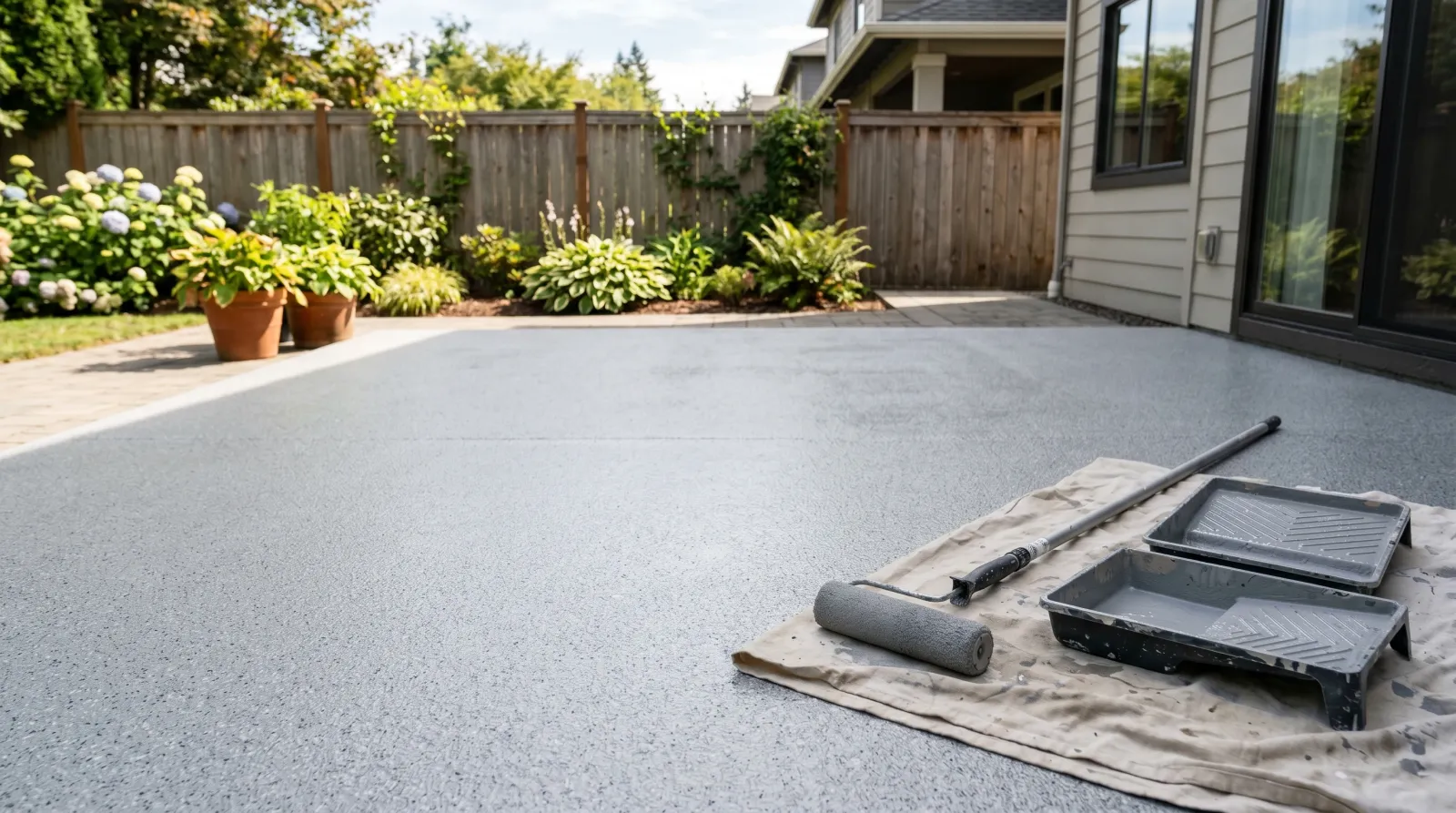
Behr Granite Grip1 sheen
Coverage40-50 sq ft / gal rough
Dry / RecoatTouch 1h
VOCLess than 50 g/L
Traffic / cureFoot 24h
Sheens Flat
Read this first
The Fast Verdict
For a patio, walkway, basement floor, or light-use garage, yes. About $40 a gallon buys real dry traction and a stone look that hides spall repairs, hairline cracks, and decades of oil shadow. One bucket, no pot life, a weekend job. It gets slick wet, touch-ups patch as an obvious island, and Behr's own label concedes annual touch-up in tire tracks. Coverage runs short, so buy 25 percent more than the math says. Etch honestly or do not open the can.
Best for
Patios and walkways · Basement floors · Pool surrounds · Light-use garages · Slick painted steps · Hiding a blotchy, stained slab
Skip if
You park hot daily-drivers · You need chemical resistance · The surface stays wet · You want a smooth mop-clean floor · Industrial or forklift traffic
What it's good at
- Dry traction — real non-slip bite on steps, walkways, and pool surrounds
- Hiding blotchy, stained concrete under a uniform speckle, including hairline cracks to 1/8-inch
- DIY application: one bucket, no pot life, no induction period, a two-car garage over a weekend
- Value for the look — $35-45 a gallon and the finished patio reads more expensive than the receipt
- Low odor and water cleanup at under 50 g/L, which matters rolling an interior basement floor
- More color range than the shelf suggests, with 16 custom GG- colors tinted from the two bases
What it's not good at
- Wet traction — standing water flips the grip, and a damp shaded porch needs an anti-slip additive broadcast into the second coat
- Coverage, which runs about 75 percent of the chart on rough concrete; buy 25 percent extra
- Marginal slabs — there is no bonding primer step to save an under-etched or damp surface
- Hot tires and chemicals; Behr's own label concedes annual touch-up in tire traffic areas
- Touch-ups, which patch as an obvious island because the speckle will not feather
- Industrial floors and forklift traffic, which Behr does not rate it for
Numbers, not adjectives
Spec Sheet
- Coverage
- 40-50 sq ft / gal rough · 50-60 smooth, at the required two coats
- Finish
- Flat, multi-speckled texture; gloss under 10 at 60 degrees
- Colors
- Gray No. 650 and Tan No. 655 premixed, plus 16 custom GG- colors tinted from either base
- Resin / solids
- Acrylic · 39 percent (±2) solids by volume · 11.0 lb per gallon
- Dry / Recoat
- Touch 1h · recoat 3-4h, rated at 77°F and 50 percent RH
- Traffic / cure
- Foot 24h · vehicles 72h · full cure 2 weeks · no rinsing or washing for 30 days
- VOC
- Less than 50 g/L
- Application temp
- 50-90°F air and surface, out of direct sun; no rain or heavy dew within 24h
- Prep
- New concrete cured 30 days, surface pH 10 or lower; clean and etch bare or sealed concrete; no primer coat
- Tint limit
- Maximum 1/16 fl oz colorant per gallon, which is why the palette is 16 colors
- Surfaces
- Horizontal concrete and masonry; not rated for industrial use or forklift traffic
- Price
- $35-45 / gal at Home Depot; 1-gallon and 5-gallon, 2-year shelf life unopened
Application Settings That Work
- Brush
- A nylon or polyester brush handles edges, control joints, and anything the roller cannot reach. Fill cracks up to 1/8-inch with the coating itself, brushed in, and let them dry before you roll the floor. The field goes down with a 1/4-inch adhesive roller cover — a specific heavy cover for texture and adhesive work, not a standard woven sleeve, which loads too little aggregate and lays it thin.
- Airless
- Not a standard airless — it will not push aggregate. The data sheet calls for a texture sprayer, a Graco RTX 1500 or equivalent with a 4 mm tip. Spray 4-by-4-foot sections in a circular motion and back-roll each section with the adhesive cover before it sets. The back-roll is what makes the texture consistent instead of stippled, and it is not optional.
- Thinning
- Do not thin it. The label says so and it matters more here than on ordinary paint: the aggregate is suspended at a specific consistency, and adding water drops the grit out of the film so it lands unevenly.
- Primer
- There is no primer coat in this system, which is exactly why the slab has to carry the load. Cure new concrete 30 days and confirm surface pH is 10 or lower. Degrease, scrub off old flaking sealer, and etch with a muriatic-acid cleaner-etcher until the slab feels like 150-grit sandpaper. Rinse fully and dry at least a day, longer in a humid basement. Behr's professional data sheet does publish a vertical system using Multi-Surface Primer & Sealer No. 436 under two coats of Granite Grip, but the homeowner label keeps it horizontal.
Dry, Cure, and When You Can Park
Recoat at 3 to 4 hours, foot traffic at 24, vehicles at a full 72. Every one of those numbers is rated at 77°F and 50 percent humidity, so a cold or damp day stretches all of them — park at 48 hours in a humid garage and the tires mar the film. And 72 hours is not full cure. Behr puts full cure at two weeks and asks you to keep the floor dry, no rinsing and no washing, for 30 days. After that, mild non-abrasive detergent only. Abrasive cleaners and pressure washers are called out by name as causes of premature coating failure, which is worth remembering the first spring you want to blast the patio clean. The second coat is where the color and the even speckle arrive, so the first pass looking thin is not a reason to recoat early.
Mid-project panic
When It Goes Wrong, and How to Fix It
The first coat looks thin, streaky, and blotchy
Why it happens. That is the design. Behr's own instructions say the first coat acts as a base coat and will not completely cover the surface, and they warn against over-applying it to compensate. Read the one-star reviews carefully and a striking number were written by someone standing over a half-finished first coat.
The fix. Leave it alone and recoat at 3 to 4 hours. The color and the even speckle arrive on the second coat. Piling material on to fix coat one gives you a thick film that traps solvent and bubbles later, which is a real problem instead of an imagined one.
It peeled or lifted in sheets within a season
Why it happens. Prep, nearly every time. A power-troweled slab feels like glass and acrylic will not stick to glass. Leftover etcher residue is just as bad — coating over it is a guaranteed peel. And there is no bonding primer step in this system to rescue a marginal surface.
The fix. Etch until the slab feels like 150-grit sandpaper. Then run the checks: sprinkled water has to soak in fast, not bead, and a finger wiped across the dry floor has to come back clean, not chalky. New concrete cures 30 days and needs surface pH at 10 or lower. Over sound existing paint, clean, scuff-sand the gloss, and spot-etch bare patches; anything already failing has to come off.
It bubbled a couple of days after coating
Why it happens. Water. Either the slab is pushing moisture up from below with no vapor barrier, or rain or heavy dew landed inside the first 24 hours. I have seen good-looking Granite Grip jobs lift off a basement floor in sheets eight weeks later, and every time the slab had a vapor problem the owner ignored.
The fix. Tape a square of plastic to the slab overnight before you buy anything. Condensation underneath means fix the moisture source or do not coat it. Outdoors, check the forecast for rain and heavy dew inside 24 hours, and do not coat a hot slab in direct sun — a hot slab skins the film before the aggregate can level.
The 5-gallon pail and the 1-gallon can dried different colors
Why it happens. Batch variation between container sizes. It is the single most repeated color complaint from buyers, and the fix is printed on the label where almost nobody reads it.
The fix. Buy every can at once and box them. Pour everything into one larger container, stir it together, and pour back before you start. Five minutes, and the problem disappears. Behr also states two coats are required for optimum color match, so do not judge a custom color off a single pass over bare concrete.
The worn patch you touched up reads as an obvious island
Why it happens. The texture does not feather. A speckled aggregate film has no way to blend into an aged, dirtier surrounding surface, so the repair sits there as a patch.
The fix. Recoat to a natural break — the whole bay, the whole slab section, the full walkway. In a garage, plan on refreshing the two parking strips rather than chasing individual spots, because Behr's label already concedes an annual touch-up may be needed in tire traffic areas. And remember an unopened can only lasts two years, so the half pail from three summers ago is not your touch-up material.
Side by side
Granite Grip vs Smooth Floor Paint vs a 2-Part Epoxy
Three tiers on the same aisle. What separates them is texture, chemical resistance, and how much a hot tire can do to the film.
| Granite Grip | Behr 1-Part Epoxy Floor Paint | Rust-Oleum EpoxyShield Kit | |
|---|---|---|---|
| What it is | One-bucket acrylic with fine aggregate suspended in it. A coating, not a system. | Same brand, smooth finish, no aggregate. Easier to roll. | A two-part epoxy with a decorative chip option and a harder cured film. |
| Dry traction | The headline feature. Real bite on steps, walkways, and pool surrounds. | None to speak of. It is a smooth painted floor. | Traction comes from the chips you broadcast, not from the resin. |
| Hiding an ugly slab | Buries spall repairs, hairline cracks to 1/8-inch, and decades of oil shadow. | Hides ugly concrete worse — a smooth film telegraphs what is under it. | Chips hide a lot; the film is thicker than either acrylic option. |
| Hot tires and chemicals | Acrylic, not epoxy. Expect lift over a few years; gas and degreasers mark it. | Also a one-part film, with the same hot-tire caveat. | Real hot-tire and chemical resistance. This is the tier that survives a working garage. |
| Application | Pour-and-spread in 3-by-3-foot sections with a 1/4-inch adhesive cover. No pot life. | Cheaper and easier to roll than the textured version. | More prep and a pot-life timer you cannot dawdle in. |
| Price | $35-45 / gal | $25-35 / gal | $70-120 / kit |
What it is
Granite GripOne-bucket acrylic with fine aggregate suspended in it. A coating, not a system.
Behr 1-Part Epoxy Floor PaintSame brand, smooth finish, no aggregate. Easier to roll.
Rust-Oleum EpoxyShield KitA two-part epoxy with a decorative chip option and a harder cured film.
Dry traction
Granite GripThe headline feature. Real bite on steps, walkways, and pool surrounds.
Behr 1-Part Epoxy Floor PaintNone to speak of. It is a smooth painted floor.
Rust-Oleum EpoxyShield KitTraction comes from the chips you broadcast, not from the resin.
Hiding an ugly slab
Granite GripBuries spall repairs, hairline cracks to 1/8-inch, and decades of oil shadow.
Behr 1-Part Epoxy Floor PaintHides ugly concrete worse — a smooth film telegraphs what is under it.
Rust-Oleum EpoxyShield KitChips hide a lot; the film is thicker than either acrylic option.
Hot tires and chemicals
Granite GripAcrylic, not epoxy. Expect lift over a few years; gas and degreasers mark it.
Behr 1-Part Epoxy Floor PaintAlso a one-part film, with the same hot-tire caveat.
Rust-Oleum EpoxyShield KitReal hot-tire and chemical resistance. This is the tier that survives a working garage.
Application
Granite GripPour-and-spread in 3-by-3-foot sections with a 1/4-inch adhesive cover. No pot life.
Behr 1-Part Epoxy Floor PaintCheaper and easier to roll than the textured version.
Rust-Oleum EpoxyShield KitMore prep and a pot-life timer you cannot dawdle in.
Price
Granite Grip$35-45 / gal
Behr 1-Part Epoxy Floor Paint$25-35 / gal
Rust-Oleum EpoxyShield Kit$70-120 / kit
For a patio, a walkway, a basement floor, or a garage that mostly stores things, Granite Grip is the value pick — it is the only one of the three that gives you grip and a stone look out of a single bucket. If the slab is already in decent shape and you just want a clean painted floor, the smooth 1-Part Epoxy is cheaper and easier. And if the garage works for a living, with hot daily-drivers and solvent on the floor, stop shopping acrylics and buy the 2-part kit.
If not this one
Honest Alternatives
BP
Behr Premium 1-Part Epoxy Concrete & Garage Floor Paint$25-35 / gal
Same brand, smooth finish, no aggregate. Cheaper and easier to roll, but it gives you none of the traction and hides ugly concrete worse. The right call when you want a clean painted floor and the slab is in decent shape, not when you need grip.
Full review →RO
Rust-Oleum EpoxyShield Garage Floor Kit$70-120 / kit
A two-part epoxy with a decorative chip option, real hot-tire and chemical resistance, and a harder cured film than any acrylic coating. More prep, a pot-life timer, and a smoother finish. The right call for a garage that actually works for a living.
DS
Daich SpreadStone or RollerRock Decorative Concrete Coating$60-90 / kit
A trowel-and-roll mineral-stone coating built for a thick, durable, slip-resistant decorative finish on patios and pool decks. More material, more cost, and more durable texture. The right call when the look is the whole point and you want it to last.
Questions people actually ask
Granite Grip Questions, Answered
Is Behr Granite Grip worth it?
On a patio, walkway, basement floor, or light-use garage, yes. About $40 a gallon buys real dry traction and a stone look that hides a blotchy slab, and a properly prepped patio holds three to five years. On a garage with hot daily-drivers it is the wrong tier — Behr's own label concedes annual touch-ups in tire tracks. And it is only worth it if you etch, rinse, and moisture-test the slab first, because prep decides the outcome far more than the coating does.
How many coats do I actually need?
Two is the minimum on the can, and two is the real number on smooth, etched concrete. On rough or porous slabs the texture eats product, and a lot of buyers end up doing a third pass to get even speckle. Buy 25 percent more than the coverage chart says. Running short mid-job and matching a second batch is a worse problem than a leftover gallon.
Is Granite Grip slippery when wet?
Dry, the speckled texture grips well. Wet, it can get slick, especially on a pool deck or a shaded porch that stays damp. The texture helps but it is not a true anti-slip aggregate floor. If the surface sees standing water, broadcast a fine slip-resistant additive into the second coat. Do not count on the speckle alone around a pool.
Does it hold up to hot tires?
It resists hot-tire pickup better than a plain concrete paint, but it is an acrylic coating, not a two-part epoxy. On a daily-driver garage where tires park hot, expect some lift over a few years. For real hot-tire and chemical resistance, a polyaspartic or epoxy floor system is the upgrade. This is the budget grip-and-look option, not the forever garage floor.
Do I need to etch the concrete first?
Yes, on bare or sealed concrete. The coating bonds to a clean, open, profiled surface. Skip the etch on a slick power-troweled slab and you will see peeling within a season. Clean it, etch it with a cleaner-etcher until it feels like 150-grit sandpaper, rinse, and let it dry fully. Most failures trace straight back to a slab that was never properly prepped.
How long before I can park on it?
Foot traffic at 24 hours, vehicle traffic at 72, and those numbers are rated at 77°F and 50 percent humidity. Cold or humid weather stretches every one of them. Park a car on it at 48 hours in a damp garage and the tires will mar the film. And 72 hours is not full cure — Behr puts full cure at two weeks, and says no rinsing or washing for 30 days.
What colors does Granite Grip come in?
Two premixed colors off the shelf, Gray No. 650 and Tan No. 655, plus 16 custom colors Home Depot tints from those bases with names like Sahara Canyon, Galaxy Quartz, Mineral Gray, Baltic Stone, and Copper Marble. The speckled texture stays the same; only the color shifts. Buy it all at once and intermix the cans, because buyers report visible color differences between 5-gallon and 1-gallon batches.
Why does the first coat look blotchy?
Because it is supposed to. Behr's own instructions say the first coat acts as a base coat and will not completely cover the surface by design, and they warn against over-applying it to compensate. The even speckle and full color only arrive with the second coat. A patchy, streaky first pass is normal, not a defect — a lot of one-star reviews are written between coat one and coat two.
Will it cover hairline cracks?
Yes, up to about 1/8-inch wide. Fill those with the coating itself, brushed in, and let them dry before you roll the floor — do not count on a roller pass to bridge them in one go. Anything wider than 1/8-inch, or a crack that is still moving, needs a real concrete patch first. Coat over a structural crack and it telegraphs back through within a year.
Can I put it over an existing coating?
Only over a sound, well-bonded one that you have scuff-sanded and cleaned, spot-etching wherever bare concrete shows through. Over a sealer, a glossy paint, or anything already peeling, it fails with the layer underneath it. When in doubt, strip to bare concrete and etch.
Keep exploring
Behr paint brand guide — lines and where they fitBest garage floor paint and coatingsDry time vs cure time, explained
We may earn a commission when you buy through the retailer link above. It never changes the score or the verdict.
Ask a Question