Product review · Behr · Updated August 7, 2026
Multi-Surface Stain-Blocking PrimerBehr paint review
8.0/10The right default primer for a mixed repaint, and the wrong one when the job is a single hard stain.
One styrene-acrylic can that seals a patched wall, blocks ordinary stains, and grips a glossy door. About $31 a gallon for work that usually takes three separate primers.

David Chen · Formulation Lead & Resident Chemist · Updated August 7, 2026
Polymer chemist by training, six years in industrial coatings R&D before joining CompositePaint's formulation team. David writes the binder pieces — why a styrene-acrylic blocks a stain a PVA sealer lets straight through. About the testing process →
Behr Multi-Surface Stain-Blocking Primer
Coverage250–400 sq ft / gal
Dry / recoatTouch 30 min
VOCLess than 50 g/L
Full cure2 weeks
Read this first
The Fast Verdict
Buy it when your job is mixed — a patched wall here, a glossy door there, a rusty rail outside — because one can at about $31 a gallon does the sealing, the stain blocking, and the bonding that would otherwise take three. It tints at the counter, recoats in an hour, and works down to 35°F on air and surface, which buys a month at each end of the exterior season. Skip it when the problem is one hard thing: heavy nicotine or fire smoke wants shellac, and slick factory cabinet doors want a dedicated bonding primer.
Best for
Mixed repaints with a little of everything · New and patched drywall and plaster · Ordinary water stains and tannin bleed · Glossy and oil-painted trim · Ferrous metal, galvanized, and aluminum · Masonry and stucco up to pH 13 · Cold-weather exterior priming
Skip if
Heavy nicotine or fire smoke · Set-in, reactivating water rings · Slick factory cabinet doors and melamine · A drastic dark color change that needs a deep-base undercoater · A job likely to stall past the 30-day topcoat window
What it's good at
- Doing three jobs in one can — sealing porous drywall and plaster, blocking medium stains and tannin, and bonding to glossy and metal surfaces
- Bonding where a sealer slides off: glossy and oil-painted trim, aluminum, galvanized and ferrous metal, fiberglass, vinyl and PVC, with rust resistance built into the film
- Fast turnaround — touch-dry in 30 minutes and recoatable in an hour, which collapses a two-day job into one
- Working cold, down to 35°F on both air and surface against the 50°F floor most waterborne primers hold
- Tinting up to 4 fl oz per gallon so you can shade it grey and cut a coat off a saturated topcoat
- Certification paperwork most big-box primers do not carry: GREENGUARD Gold, Declare Red List Free, published EPD and HPD, MPI approval
- True interior and exterior range, including masonry and concrete up to pH 13, with a high-hide mildew-resistant film
What it's not good at
- The worst stains — heavy nicotine, fire smoke, and reactivating water rings still want shellac spot-primed underneath
- Slick factory cabinet doors and melamine, where the data sheet still asks for a thorough sanding pass
- Loading up like a deep-base undercoater; the 4 fl oz colorant cap shades it grey and no further
- Waiting around — the 30-day topcoat window means a stalled job wants a fresh prime coat
- Looking good on the wall; the flat film reads streaky and patchy by design, which panics first-time users
- Surviving a freeze in storage, which kills a waterborne primer permanently
Numbers, not adjectives
Spec Sheet
- Coverage
- 250–400 sq ft / gal, substrate and method dependent
- Resin
- Styrene-acrylic
- Blocks
- Medium to heavy stains, tannin, rust and corrosion; two coats over heavy stains and tannin-rich wood
- Dry / recoat
- Touch 30 min · recoat 1 hr · over stains 4 hr · heavy stains 16 hr
- Full cure
- 2 weeks
- Topcoat window
- Within 30 days of priming
- Application temp
- 35–90°F (2–32°C) on air and surface
- VOC
- Less than 50 g/L; GREENGUARD Gold certified
- Tintable
- Yes, up to 4 fl oz colorant per gallon
- Warranty
- Lifetime limited to the original residential purchaser, non-transferable, receipt required
- Sizes
- Quart (43604), gallon (43601), 5-gallon
- Price
- About $30.98 a gallon at Home Depot, July 2026
Application Settings That Work
- Brush
- Nylon or polyester bristle. Natural bristle drinks water, swells, and drags. Roll with a 3/8-inch to 1/2-inch nap — thinner starves a porous wall, thicker piles on texture you did not ask for.
- Airless
- A .015 to .021-inch tip with a 60-mesh filter.
- Thinning
- None for brush or roller, and that is a flat rule. A primer earns its stain-blocking and adhesion from the resin-to-water ratio in the wet film. For spraying only, up to half a pint of water per gallon to help it atomize, and no more.
- Primer
- Prep changes with the substrate, and this is where most primer failures start. New masonry: cure 7 days, then test for pH 13.0 or lower. Efflorescence: scrub with 1-to-1 vinegar and water, rinse, dry. Galvanized: etch with a masonry cleaner and etcher. Glossy surfaces and bare metal: scuff-sand. Mildew: kill it with a mildew stain remover first, because primer covers the stain but not the growth. Chalk, dirt, and grease: wash with detergent, rinse, dry completely.
Dry Times, Cure, and the 30-Day Clock
Touch-dry in about 30 minutes and topcoatable in 1 hour at 77°F and 50 percent humidity. That is the easy case, on a clean surface, and it is what lets you prime and paint the same day. Over stained surfaces the wait is 4 hours, and over heavy stains it is a full 16 hours so the stain-blocking film can lock down before anything goes on top of it. Cold or humid air stretches every one of those numbers, because a waterborne film cannot form faster than the water can leave it. Full cure is 2 weeks. The number people miss sits at the other end: whatever you prime has to be topcoated within 30 days, or Behr asks you to prime again. That is fine on an active project and a trap on a job that stalls — the bond your topcoat makes is to a clean, fresh primer film, not to one that has been collecting dust since spring. And protect the can from freezing in storage; freezing kills a waterborne primer permanently.
Mid-project panic
When It Goes Wrong, and How to Fix It
A brown ghost crept through the fresh topcoat
Why it happens. Either the stain was past the waterborne ceiling, or you topcoated too soon. Every waterborne stain blocker works by drying into a film tight enough that a water-soluble stain cannot dissolve its way up through it — and deep nicotine, fire smoke, or a reactivating water ring can beat that film. Behr's own data sheet asks for 16 hours and sometimes two coats over heavy stains for exactly this reason.
The fix. Spot-prime the worst areas with a shellac primer like Zinsser B-I-N, which is non-aqueous and does not re-dissolve the stain, then follow with Multi-Surface or your topcoat over everything. Do this before the topcoat goes on, not after — once the ghost is in the finish, you are recoating anyway.
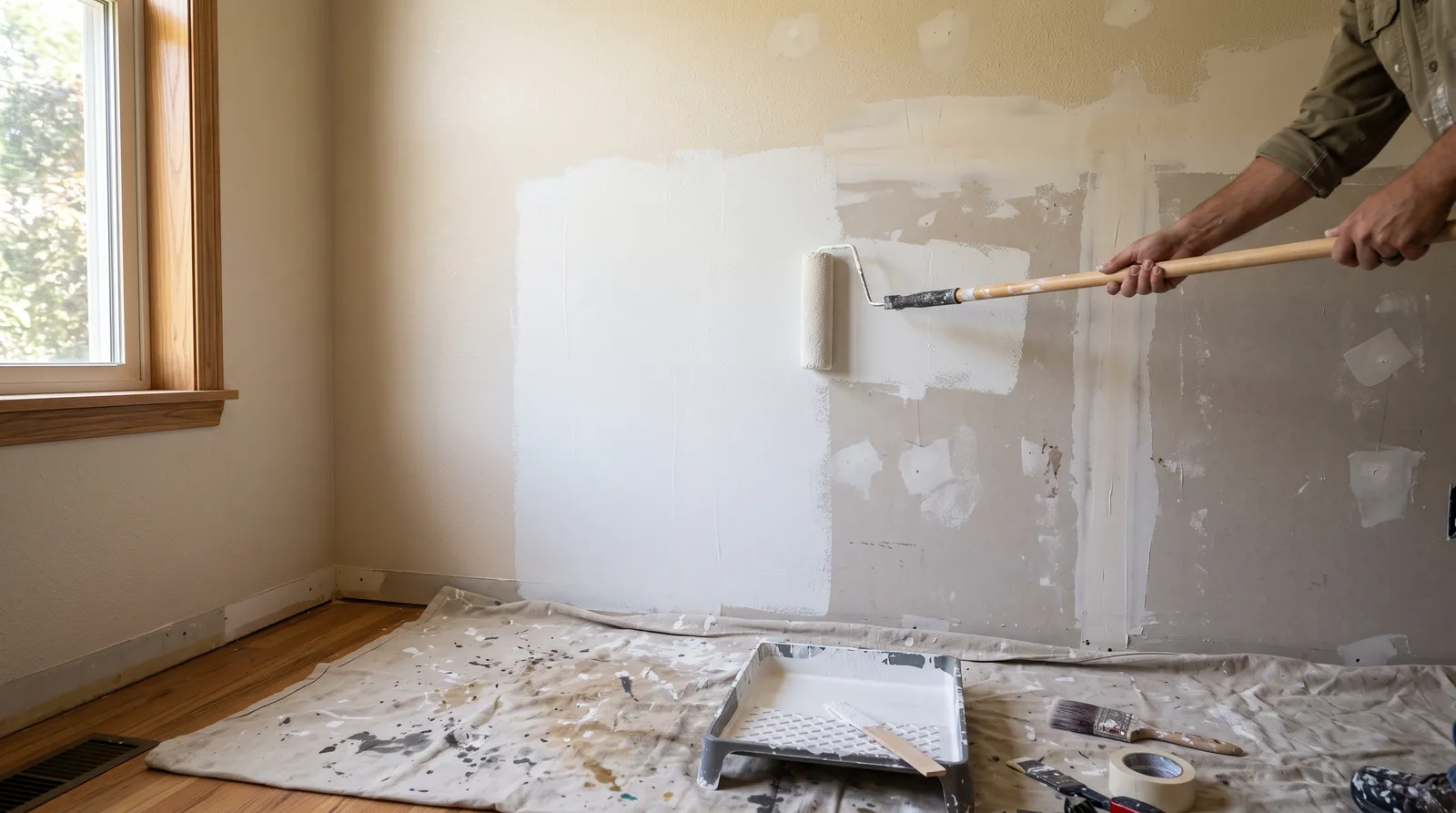
The primer coat looks streaky, patchy, and blotchy
Why it happens. Normal, and not a defect. Multi-Surface dries to a non-reflective flat film, which is the flattest thing you will ever roll onto a wall. Flat films scatter light in every direction, so they minimize surface imperfections and, in the same breath, show every variation in absorbency as a visible difference in tone. Patched spots drank more primer, spot-primed areas got two coats, and roller laps have no sheen to blend into.
The fix. Judge it by whether the film is continuous and whether you stayed inside the 250 to 400 sq ft per gallon spread rate — not by how it looks. The topcoat carries the color and sheen. The one real failure is seeing the old color, the stain, or bare drywall paper through the primer, which means you spread it too far and it wants another coat.
New paint let go on a glossy or oil-painted door
Why it happens. The styrene-acrylic grips slick substrates far better than a PVA sealer, but the data sheet still asks you to sand glossy surfaces thoroughly first, and on cured enamel that step is the difference between good adhesion and excellent. Bare metal wants the same treatment.
The fix. Scuff-sand, wash off chalk, dirt, and grease with detergent, rinse, and let it dry completely before priming. Wipe sanding dust with a damp cloth rather than dry-brushing it around. If the substrate is a slick factory cabinet door or melamine, buy a dedicated bonding primer instead — it keys on with less prep and a firmer long-term grip.
The coating let go on new block, stucco, or concrete
Why it happens. Alkali. Fresh masonry is strongly alkaline and still curing, and alkali attacks a coating film from underneath. Behr rates this primer for masonry up to pH 13, which is generous, but new work can read higher than that for weeks. Efflorescence — the white crystalline bloom on brick and block — is a second version of the same problem: salt pushed out by moisture moving through the wall.
The fix. Let new masonry cure a full 7 days, then test with pH strips and prime only when it reads 13.0 or lower. Scrub efflorescence off with a 1-to-1 vinegar-and-water solution, rinse, and let it dry. Etch galvanized metal with a concrete and masonry cleaner and etcher first, since galvanizing is a passive zinc layer with almost nothing to key into.
The last third of the bucket stopped blocking stains
Why it happens. Settling. The heavy stain-blocking pigments drop out of suspension over an afternoon of work, so the bottom of the can carries a different pigment load than the top did.
The fix. Stir the can occasionally while you work, not just once at the start. And follow the order of coats: spot-prime the patched and stained areas first, let them dry, then lay a complete primer coat over the whole surface. Over heavy stains and tannin-rich wood — cedar, redwood, knotty pine — plan on two full coats.
Side by side
Multi-Surface vs Behr Bonding Primer vs Shellac
Three primers cover three different problems, and picking the wrong one is the most common way a job fails before the topcoat is open. Multi-Surface is the generalist. The other two are specialists, and on their own ground they beat it outright.
| Behr Multi-Surface (No. 436) | Behr Bonding Primer (No. 432) | Zinsser B-I-N Shellac | |
|---|---|---|---|
| What it is built for | Sealing, stain blocking, and bonding in one styrene-acrylic can | Adhesion only, on the slickest substrates | Locking down the stains and odors nothing waterborne can hold |
| Stain blocking | Strong on water stains, tannin, and rust; 16 hr and two coats over heavy stains | None — it is not a sealer | The benchmark: nicotine, smoke, set-in rings, odors |
| Grip on slick substrates | Good, but the data sheet still asks you to sand glossy surfaces thoroughly | The whole point of the product — laminate, melamine, glazed tile, hard factory enamel | Bonds well to gloss too, which is why it doubles up on a stained glossy door |
| Substrate range | Drywall, plaster, masonry to pH 13, wood, metal, galvanized, fiberglass, vinyl and PVC, glossy — inside and out | Glossy and factory finishes, laminate, glass, PVC, fiberglass, metals, Kynar, chalky coatings | Broad, but you buy it for the stain, not the range |
| Odor and cleanup | Under 50 g/L, GREENGUARD Gold, soap and water | Under 100 g/L, warm soapy water | Alcohol fumes, serious ventilation, ammonia or alcohol cleanup |
| Price | About $30.98 / gal | About $55 / gal | $40–48 per quart equivalent |
| Where it wins | The ordinary homeowner repaint that has a little of everything in it | Cabinet doors and anything slick where adhesion is the whole concern | The one bad stain on an otherwise fine wall |
What it is built for
Behr Multi-Surface (No. 436)Sealing, stain blocking, and bonding in one styrene-acrylic can
Behr Bonding Primer (No. 432)Adhesion only, on the slickest substrates
Zinsser B-I-N ShellacLocking down the stains and odors nothing waterborne can hold
Stain blocking
Behr Multi-Surface (No. 436)Strong on water stains, tannin, and rust; 16 hr and two coats over heavy stains
Behr Bonding Primer (No. 432)None — it is not a sealer
Zinsser B-I-N ShellacThe benchmark: nicotine, smoke, set-in rings, odors
Grip on slick substrates
Behr Multi-Surface (No. 436)Good, but the data sheet still asks you to sand glossy surfaces thoroughly
Behr Bonding Primer (No. 432)The whole point of the product — laminate, melamine, glazed tile, hard factory enamel
Zinsser B-I-N ShellacBonds well to gloss too, which is why it doubles up on a stained glossy door
Substrate range
Behr Multi-Surface (No. 436)Drywall, plaster, masonry to pH 13, wood, metal, galvanized, fiberglass, vinyl and PVC, glossy — inside and out
Behr Bonding Primer (No. 432)Glossy and factory finishes, laminate, glass, PVC, fiberglass, metals, Kynar, chalky coatings
Zinsser B-I-N ShellacBroad, but you buy it for the stain, not the range
Odor and cleanup
Behr Multi-Surface (No. 436)Under 50 g/L, GREENGUARD Gold, soap and water
Behr Bonding Primer (No. 432)Under 100 g/L, warm soapy water
Zinsser B-I-N ShellacAlcohol fumes, serious ventilation, ammonia or alcohol cleanup
Price
Behr Multi-Surface (No. 436)About $30.98 / gal
Behr Bonding Primer (No. 432)About $55 / gal
Zinsser B-I-N Shellac$40–48 per quart equivalent
Where it wins
Behr Multi-Surface (No. 436)The ordinary homeowner repaint that has a little of everything in it
Behr Bonding Primer (No. 432)Cabinet doors and anything slick where adhesion is the whole concern
Zinsser B-I-N ShellacThe one bad stain on an otherwise fine wall
For a mixed repaint, Multi-Surface is the right default and the cheapest way to carry one can instead of three. Buy the specialist when the job is a specialist's job: shellac spot-primed on heavy nicotine, smoke, or a set-in water ring, and a dedicated bonding primer on slick factory cabinet doors. The smartest version of this is often not either-or — spot-prime the worst stains with B-I-N, then run Multi-Surface over the whole surface.
If not this one
Honest Alternatives
ZB
Zinsser B-I-N Shellac-Based Primer$40–48 / qt equivalent
The opposite chemistry on purpose. Shellac in alcohol dries to a tight, non-aqueous film that locks down heavy nicotine, smoke, set-in water rings, and odors any waterborne primer eventually lets pass. It smells, it demands ventilation, and it cleans up with ammonia or alcohol. Use it as a spot primer over the bad stains, then Multi-Surface or your topcoat over everything.
K2
KILZ 2 All-Purpose$20–26 / gal
A waterborne primer-sealer in the same chemical family, a few dollars under Multi-Surface and stocked at every big-box store. Its stain-blocking and adhesion sit a notch below Behr's styrene-acrylic, so it is the value play when the surface is mostly sound and the stains are light. When the job has glossy or metal substrates, Multi-Surface is worth the upcharge.
Full review →BB
Behr Bonding Primer (No. 432)About $55 / gal
Behr's adhesion specialist, also Home Depot exclusive. Built for the slickest substrates — laminate, melamine, glazed tile, hard factory enamel on cabinets and trim — gripping them with minimal prep. The right pairing when you are repainting cabinet doors and adhesion, not stain blocking, is the whole concern.
Full review →Questions people actually ask
Multi-Surface Stain-Blocking Primer Questions, Answered
Does Behr paint-and-primer mean I can skip a separate primer?
Sometimes, not always. A paint-and-primer-in-one is a topcoat carrying enough binder to self-seal a sound, already-coated wall, and on that easy case it works and saves you a step. It is not a stain blocker and not a bonding primer. Over stains, bare wood, glossy oil paint, or metal it fails, and you need a dedicated primer like Multi-Surface first. When the wall is clean and previously painted, skipping is fine.
Behr Multi-Surface or Behr Bonding Primer — which one?
Multi-Surface, No. 436, is the all-rounder: it blocks stains, seals porous substrates, and bonds well to most surfaces. Bonding Primer, No. 432, is the specialist for the slickest substrates — laminate, melamine, glazed tile, hard factory enamel on cabinets — where maximum grip with minimal prep is the whole job. Priming stained walls or mixed surfaces, buy Multi-Surface. Priming slick cabinet doors, buy Bonding Primer.
Which Behr primer number do I actually need?
The numbers are job codes, not a quality ladder. 436 is this one, the all-rounder that seals, blocks, and bonds inside and out. 432 is the Bonding Primer for slick substrates only. 435 is dedicated metal. 437 is the acrylic-alkyd enamel undercoater that levels under trim and cabinet enamel. 75 is the kitchen, bath, and trim stain blocker. 73 is the PVA-class drywall sealer. 880 is the concrete and masonry bonding primer. Mixed job, take 436; one thing done hard, take the specialist.
Can I tint Behr Multi-Surface Primer for a dark topcoat?
Lightly, yes. It is tintable at the Home Depot counter and the data sheet allows up to 4 ounces of colorant per gallon, which lets you shade it grey to help a saturated or dark topcoat cover in fewer coats. It will not load like a true deep-base undercoater, so for a near-black finish you still lean on the topcoat to do most of the burying.
How long does Behr Multi-Surface Primer take to dry?
Dry to the touch in about 30 minutes and ready for a topcoat in 1 hour under normal conditions of 77°F and 50 percent humidity. Over stained surfaces wait 4 hours, and over heavy stains a full 16 hours so the stain-blocking film can lock down. Cold or humid air stretches all of these. Whatever you prime must be topcoated within 30 days or Behr asks you to re-prime.
Can I spray it, and do I need to thin it?
Yes, with an airless sprayer, a .015 to .021-inch tip, and a 60-mesh filter. Never thin it for brush or roller work. For spraying only, Behr allows up to half a pint of water per gallon. With a brush or roller, use nylon or polyester bristle and a 3/8-inch to 1/2-inch nap cover.
What temperature can I apply it in?
Behr rates it when both air and surface temperatures sit between 35 and 90°F, 2 to 32°C. The 35°F floor is unusually low for a waterborne primer, and it makes early spring and late fall exterior priming genuinely possible when most house paints are off the table. Measure the surface, not the forecast — a shaded north wall in March is colder than the air around it.
Why does my primer coat look streaky and patchy?
That is normal and not a defect. Primer is an undercoat, not a finish: it dries to a flat, non-reflective film, and thin spots, roller streaks, and duller patches over spackle are expected as long as the film is continuous. Judge it by whether you stayed inside the 250 to 400 square feet per gallon spread rate, not by how it looks. The topcoat provides the uniform color and sheen.
What does the lifetime warranty actually cover?
A lifetime limited warranty to the original residential purchaser. Read the limits: it is non-transferable, so it does not follow the house to the next owner, and it needs your original receipt. The remedy is replacement product or a refund of the purchase price, not the labor to redo the wall, which is how nearly every coating warranty works. It is worth what it is worth, but a lifetime term on a primer says the formulator is confident in the film.
Is Behr Multi-Surface Primer worth it?
For a mixed repaint, yes. About $31 a gallon buys one styrene-acrylic primer that seals porous drywall, blocks ordinary stains and tannin, and bonds to glossy, oil-painted, and metal surfaces inside or out — three cans' worth of work in one, tinted at the counter and rated down to 35°F. It is not worth it when the job is one hard thing: heavy nicotine, fire smoke, or a set-in water ring wants shellac, and slick factory cabinet doors want a dedicated bonding primer.
Keep exploring
Behr brand hub — all lines reviewedBehr Premium Plus reviewedPrimer vs paint-and-primer-in-one: the real difference
We may earn a commission when you buy through the retailer link above. It never changes the score or the verdict.
Ask a Question