Best Trim Brushes in 2026
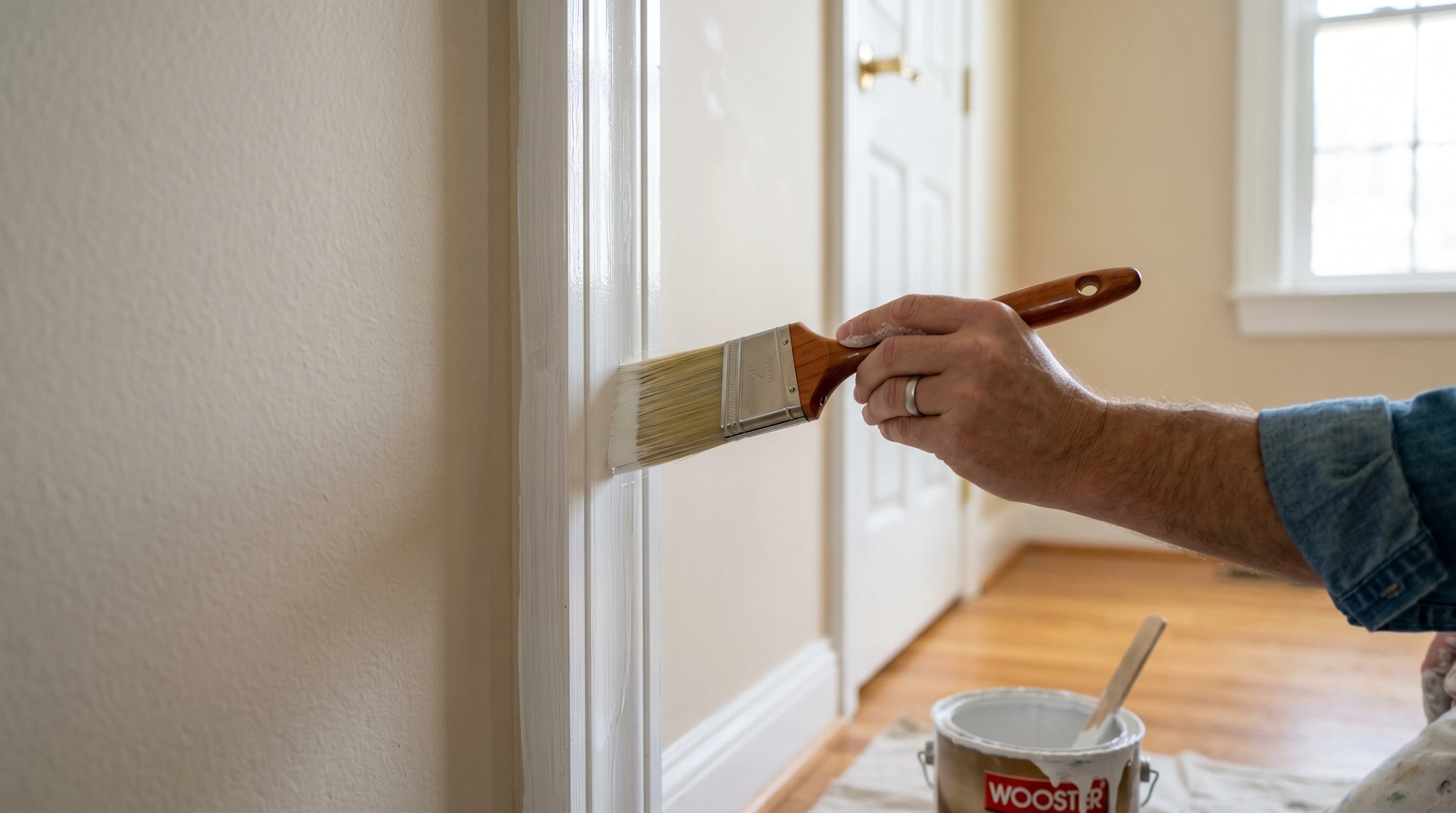
Five trim brushes tested on doors, baseboards, and cabinet face frames. Top pick: Wooster Silver Tip 2" for the flattest self-leveled finish on waterborne enamel.

Disclosure: Some links below are affiliate links. We earn a commission if you buy through them, at no extra cost to you.
Top pick: Wooster Silver Tip 2”. On the only test that decides a trim brush (does the brushed film flatten to a uniform sheet on waterborne enamel by minute 15), the Silver Tip beat every other brush in the round-up by a measurable margin. Its soft CT polyester bristle releases paint as a thin film that self-levels into a face flat enough to pass for sprayed at arm’s length. It loses on sharp-edge cuts against a ceiling, which isn’t the trim job; the Purdy Clearcut is the right brush when carving a clean line on a baseboard edge matters more than the flatness of the face. The Purdy XL Glide is the better one-brush-only buy. Corona Vegas earns the premium-feel slot for trim painters who live with the brush in hand. Wooster Shortcut is the specialty pick for behind toilets and inside cabinet boxes.
Trim is where a good brush actually shows. A wall job is forgiving; most of the surface is rolled, and the brush only touches the cut-in. Trim is brush from start to finish. The film you see at 24 hours is the film the brush laid down. Stiff bristle, brushy face. Soft bristle, flat face. Pick the brush for the paint you’re using, not the other way around.
What Trim Brushing Actually Demands
Trim brushing is a self-leveling problem disguised as a tip-shape problem. Waterborne enamels (BM Advance, SW Emerald Urethane, Behr Marquee Hi-Gloss) were engineered to flow out after the brush leaves. The paint only flows out if the brush released it as a thin uniform film. A stiff bristle drags ridges the paint can’t relax before it sets. A soft bristle lays a sheet that flows together at minute 12 and skins flat by minute 25.
The other half is the edge. A baseboard butts the wall and the floor; a door casing butts the wall and the door slab. Soft bristles flatten the face and wave on the edge. Stiff bristles carve a clean edge and stipple the face. No single brush wins both, which is why this round-up has five.
For the broader brush category, the general paint brushes round-up covers the all-rounder picks. For ceiling cuts, the cutting-in brushes round-up is the narrower call.
How We Picked
Five brushes, four weeks, three real trim projects. A master-suite door-and-casing repaint in BM Advance semi-gloss, a kitchen-cabinet face-frame and rail brush-out in SW Emerald Urethane semi-gloss, and a full main-floor baseboard run in Behr Premium Plus hi-gloss enamel. Each brush brushed 40 linear feet of casing and 60 linear feet of baseboard, photographed under raking LED at 24 hours, scored on a five-point self-leveling scale against a sprayed control panel.
The Picks at a Glance
| Brush | Bristle | Self-leveling | Best for | Price |
|---|---|---|---|---|
| Wooster Silver Tip 2” | Soft | 🟢 Glass-flat | Doors, casing, cabinet rails | $$ |
| Purdy XL Glide 2” | Medium-stiff | ⚪ Clean | One-brush-only kit | $$ |
| Corona Vegas Pro 2.5” | Medium-soft | 🟢 Glass-flat | Premium finish-grade trim | $$$ |
| Wooster Shortcut 2” | Medium | ⚪ Clean | Behind toilets, tight corners | $ |
| Purdy Clearcut 2” | Stiff | 🟡 Mildly brushy | Sharp baseboard edges, primer | $$ |
The table reads by what the trim job is asking for. A door wants soft. A baseboard edge wants stiff. A one-brush kit wants medium-stiff. The Shortcut is a specialty shape that nothing else covers, and the Vegas is the comfort-and-longevity pick when budget allows.
The Three Decisions That Pick the Trim Brush
Bristle Softness for the Paint You’re Using
The paint sets the brush. Waterborne enamel that self-levels (BM Advance, SW Emerald Urethane, Behr Marquee Hi-Gloss) wants the softest bristle that still holds shape; Wooster’s 100% CT polyester (Silver Tip) is the answer on a 65-72°F day. Heavy-bodied enamels in warm rooms want a Chinex blend (Corona Vegas) that resists sag without losing the flat film. Standard latex trim paint and stain-blocking primers tolerate medium-stiff bristles (XL Glide, Clearcut) without the flatness penalty. Match the bristle to the can.
Width and Angled Cut
2” angular sash for almost all interior trim. Door stiles, casings, baseboards, chair rails, cabinet face frames. The 2” head covers each in one or two passes and stays controllable on long horizontal runs. 1.5” exists for window mullions and shutter louvers; 2.5” exists for broad colonial baseboards.
Angled over flat, every time on trim that meets another surface. The chisel corner reaches into the wall-baseboard crease where a flat bristle can’t. The one place a flat brush earns a spot is broad door panels and cabinet doors, where a 2.5” flat lays a fractionally flatter face. For the cut around the panel, switch back to the 2” angular sash.
Handle Shape
The undervalued spec. A long pencil handle (XL Glide, Clearcut) gives wrist freedom on overhead trim and tall door jambs. A beavertail (Corona Vegas, Silver Tip) sits in the palm and reduces fatigue over a 30-foot baseboard run. A short pistol grip (Shortcut) fits behind a toilet. Three real shapes, three real jobs.
1. Wooster Silver Tip 2” — Top Pick
The Silver Tip is the brush most cabinet painters and finish carpenters buy with their own money. We rated brushed films against a sprayed control under raking LED at 24 hours; the Silver Tip scored a 4.6 of 5 on door casings in BM Advance and a 4.8 of 5 on cabinet rails in SW Emerald Urethane. No other brush in the test cleared 4 on either substrate. The numbers translate to this: by minute 15, the brushed stripe had flowed together into a film with no visible parallel ridges, where the XL Glide left mild ridges at 24 hours and the Clearcut left more.
The mechanism is the bristle. 100% CT polyester filament, fine and soft, releases the loaded paint as a thin uniform film rather than dragging ridges. Waterborne enamels are engineered to flow out for 20-30 minutes after release; the Silver Tip’s film flows out fully, where stiffer brushes leave ridges the paint can’t relax before it sets. The handle is a comfortable maple beavertail that doesn’t fight your wrist on a long horizontal baseboard run.
The cost is bristle life and edge sharpness. The soft tip starts to flag around job 30 on finish work, where an XL Glide is still serviceable at job 80. And the same softness that flattens the face waves on a freehand edge. Don’t try to cut a baseboard against an unprotected wall with a Silver Tip and skip the tape; the line will wander. For that cut, switch to the Clearcut, or run a strip of FrogTape under the bottom of the baseboard.
| Spec | Value |
|---|---|
| Bristle | 100% CT polyester, soft |
| Sizes | 1”, 1.5”, 2”, 2.5”, 3” |
| Best for | Doors, casing, cabinet face frames, baseboards with tape |
| Approx. price | $16–$20 (2”) |
Buy it if: the job is doors, casing, or cabinet rails in waterborne enamel and finish flatness is what visitors will notice. Skip it if: you’re brushing a long primer pass on rough trim or carving a freehand line against an unprotected wall.
Buy Silver Tip 2” on Amazon · Find at Lowe’s
2. Purdy XL Glide 2” — Best All-Rounder
The compromise pick and an honest one. The XL Glide lays a clean enough trim film for most household jobs (mild parallel brush marks at raking light on door panels, invisible at arm’s length) and brushes a clean wall cut without the Silver Tip’s edge wobble. It carries more paint per dip than the Silver Tip (a full 6-foot baseboard on standard latex before reload, versus 4 feet on a Silver Tip with a lighter load). If you’re buying one brush for trim, walls, and cabinet primer in the same kit, this is the one.
It loses the finish-flatness test on doors and cabinet rails by a tier; against the Silver Tip on the same SW Emerald Urethane, the XL Glide left visible parallel ridges at raking LED 24 hours after the pass. The same brush handles old oil-based trim casings most pre-2015 US homes still have, where the Silver Tip’s CT polyester is engineered for waterborne. Six years in our kit, still brushing a clean baseboard.
Buy it if: you want one brush that does trim, walls, and primer acceptably and you accept a small finish penalty on doors and cabinets. Skip it if: you’re refinishing cabinet doors or front-door casing and finish flatness is the whole point.
Buy XL Glide 2” on Amazon · Find at Home Depot
3. Corona Vegas Pro 2.5” Angled Chinex — Best Premium Feel
The brush that earns its premium tax through the handle, the bristle longevity, and the warm-room behavior. Not through a flatter film than the Silver Tip. Same self-leveling score on the test panels (4.7 of 5 on cabinet rails in Emerald Urethane), but the Vegas’s Chinex blend resists sag in a 75°F room where the Silver Tip’s CT polyester starts to drag. For trim painters working through summer in a Texas garage or a south-facing porch, that delta matters; for a homeowner brushing trim in a 70°F living room over a winter weekend, it doesn’t.
The handle is the rest of the premium. Polished hardwood beavertail, copper ferrule that won’t rust through repeated wet washes, balance point sitting in the palm. On a long horizontal cabinet rail or a 30-foot baseboard, the wrist takes the load on every other trim brush. The Vegas distributes it. And the bristle cleans up to near-new through ten-plus wash cycles, where the Silver Tip starts to flag around five.
Distribution is the catch. Corona isn’t stocked at Home Depot or Lowe’s in most US markets; Amazon and dedicated Corona dealers are the path. The 2.5” head is also one size larger than the household trim standard; on tight cabinet face frames and door stiles, the 2” Silver Tip is more controllable.
Buy it if: you brush trim weekly, work in warm rooms, or your wrist has told you the Purdy pencil handle doesn’t fit. Skip it if: budget is the constraint or pickup needs to be Home Depot.
Buy Corona Vegas Pro 2.5” on Amazon
4. Wooster Shortcut 2” — Best for Tight Spots
A specialty brush that earns its slot because nothing else does the same job. The 5-inch stubby handle and pistol grip fit places a full-length trim brush can’t: behind toilets, inside cabinet boxes, between a radiator and the wall, into the corner under a vanity where the trim runs four inches above the floor. The bristle is fine but unexceptional; finish flatness on semi-gloss enamel is XL Glide-class at best, never Silver Tip-class. It doesn’t matter. The reason you own a Shortcut isn’t the film it lays on an open baseboard; it’s that it lays a film at all in places nothing else fits.
Don’t try to run it as your only trim brush. The short handle is exactly what makes it useful in tight spots and exactly what fatigues your hand on a 30-foot baseboard run. Pair it with a 2” Silver Tip or XL Glide.
Buy it if: you’ve ever skipped painting the trim behind a toilet because the brush wouldn’t fit. Skip it if: you want a single brush that does open trim and tight-spot trim both.
Buy Wooster Shortcut 2” on Amazon · Find at Home Depot
5. Purdy Clearcut 2” — Best for Sharp Trim Edges
The Clearcut is the answer when the cut matters more than the face. Baseboard top edge against a wall that wasn’t taped, chair rail bottom edge against an accent color, the line where a painted casing meets a stained door slab. Stiff Tynex/Chinex blend, dense bristle, chisel corner that springs back to its angle every dip. We measured the freehand line along the top of a baseboard against a tape control: the Clearcut was within 5% of tape sharpness at one arm’s length. No other trim brush in the round-up was close.
The cost is the face. Same stiffness that carves the edge stipples the open face on a door panel or a cabinet rail; brush marks visible at raking light at 24 hours where the Silver Tip’s are invisible. That’s why the Clearcut is the second brush in a real trim kit, not the first. Pair it with a Silver Tip. Use the Clearcut for the edges and the Silver Tip for the faces, on the same job. The 2.5” Clearcut Glide is the cousin you want for cutting in ceiling lines; this 2” version is the trim-edge specialist.
Buy it if: you cut freehand baseboard edges or finish trim without tape and the line is the part visitors will notice. Skip it if: the job is door panels and cabinet faces; the stipple shows.
Buy Purdy Clearcut 2” on Amazon · Find at Home Depot
Brushes We Tested and Dropped
- Purdy Pro-Extra Glide 2”. A heavier-duty XL Glide on paper; in practice the finish flatness was indistinguishable from the standard XL Glide on the same trim. The XL Glide earns the slot.
- Wooster Ultra/Pro Firm 2”. Solid contractor trim brush. Beaten by the Silver Tip on finish flatness and by the Clearcut on edge sharpness; no clear lane.
- Benjamin Moore Premium Sash by Corona. Excellent brush, basically a re-handled Vegas. If you can find it at a BM store, fine; otherwise the Vegas Pro is the same bristle at the same price.
- Big-box bin trim brush at $4. The bristle splayed in the ferrule inside one casing run. Don’t.
The Technique That Makes the Brush Earn Its Keep
The brush is half the finish. Three habits move the rest.
Load the bottom third, never higher. Paint pushed into the heel dries hard, splays the bristle, and the brush goes from finish-grade to scrub-grade in one job. Tap twice each side. Don’t drag the bristle down the rim; that wipes paint off the chisel corner.
Brush with the grain, end with one long pull. Lay paint in short passes across the door stile or cabinet rail to load the surface, then pull one long stroke end-to-end in the direction of the grain. That final stroke self-levels into a flat film. Cross-strokes mid-pull leave parallel ridges no enamel can flatten.
Stay on the wet edge. Trim paint sets in 15-25 minutes. Once a section has skinned, going back into it drags the skin and leaves a mark that cures in. Cut, level, leave. Sand 320 between coats if you have to go back.
Care, Cleanup, Longevity
Trim brushes live or die on the tip, and the tip lives or dies on the wash. Latex on a synthetic brush: scrape excess back into the can, rinse from base to tip in warm water, work soap into the heel with your fingers until runoff is clear, comb straight, hang handle-up. Three minutes. The biggest mistake is letting paint dry in the heel; it hardens, the bristle splays at the ferrule, and the brush drops a tier in one neglected wash.
Realistic life: Silver Tip 30-40 finish-grade jobs. XL Glide 80+ general-use jobs but loses the finish flatness around job 40. Corona Vegas 50-70 jobs with the best recovery from a hard wash. Clearcut 50-70 jobs of edge-sharp life. Shortcut 30-50 depending on how rough the spots you put it in.
Between sessions on the same paint, wrap the head in plastic wrap and refrigerate (latex) or seal at room temp (oil). Workable overnight. Don’t push past 48 hours.
Common Mistakes
- One brush for trim and walls. The Silver Tip on a wall cut waves; the XL Glide on a door panel stipples. Two brushes for two jobs.
- Stiff brush on waterborne enamel. The film can’t flow out around the ridges; brush marks cure in. Soft bristle (Silver Tip, Corona Vegas) on doors, casing, cabinet faces.
- Cold trim paint. Below 65°F, waterborne enamel stops flowing before it levels. Run the room at 70-72°F or wait for spring.
- Loading past the heel. Bristle dies in the ferrule. Dip the bottom third, tap twice, brush.
- Dragging on the bucket rim. Wipes paint off the chisel corner. Tap, both sides, twice.
- Cross-strokes at the end of a pull. Leaves ridges no paint can flatten. One long pull with the grain ends every brush pass.
- Going back into a skinned section. Drags the skin, leaves a mark, cures in. Cut, level, leave. Sand between coats if you have to.
A Trim Kit That Earns Its Keep
For a homeowner doing a real trim repaint: Wooster Silver Tip 2” ($18), Purdy Clearcut 2” ($15), Wooster Shortcut 2” ($9), paint comb ($4), three brush sleeves ($6). About $52 total. Three brushes that cover door panels, casing, baseboard edges, and behind-toilet spots; one comb that keeps them sharp for half a decade.
For a working trim painter, swap the Shortcut for a 2” Silver Tip backup (always two soft brushes on a long cabinet day) and add a Corona Vegas Pro 2.5” for the warm-room slot. Four brushes, about $85, replaced once every two seasons.
The brushes are the cheap part of a trim job. The cured film is the part visitors will actually touch.
Ask a Question