Best Natural-Bristle Brushes for Oil Paint in 2026
Five natural-bristle brushes tested on oil enamel, spar urethane, and shellac. Top pick: Purdy Sprig 2.5" for the heaviest paint load and the flattest varnish flow in the round-up.

Disclosure: Some links below are affiliate links. We earn a commission if you buy through them, at no extra cost to you.
Top pick: Purdy Sprig 2.5”. On the only test that matters for a natural-bristle brush, the way it lays oil enamel and spar urethane at the wet edge, the Sprig held more paint per dip than any other brush in the round-up and self-leveled flatter at 30 minutes under raking light. It wins on paint load, tip flag, and handle ergonomics over a long horizontal pull. It falls short on price and on cleanup time, both of which come with the territory of premium natural hair. Wooster Yachtsman is the smarter pick when the job is mostly spar urethane on a glossy surface where lap marks would show. Corona Pacifica is the right call when the oil-paint line has to cut against a ceiling. Wooster Pro China is the honest budget answer for occasional oil work. Purdy XL Cub is the hybrid for kits that switch between oil and modern waterborne alkyds.
The right brush for oil paint is not the same brush you use for latex. Most homeowners learn this the wrong way, by ruining a $25 synthetic in their first BIN shellac job, or by trying to clean an oil-loaded natural-bristle brush with water and watching it go limp in the sink. Two brushes, two cleanup routines.
When Natural Bristle Is the Right Brush
Cleanup solvent is the test. If the can on your bench says “clean with mineral spirits” or “clean with denatured alcohol”, you want natural China hog hair. If it says “clean with water”, you want synthetic. The reason is mechanical, not historical. Each natural bristle tapers from base to tip and splits into fine flag at the end; each synthetic bristle is extruded with a blunt or chopped tip. The natural tip flag is what self-levels oil enamel and varnish into a glassy film at the wet edge. Synthetic stipples in the same paint.
Three jobs still belong to natural bristle in 2026. Oil-based enamel on doors, baseboards, exterior trim, and old garage floors. Spar urethane and marine varnish on wood that lives outside or under water. BIN shellac primer over knot-heavy pine and tannin-rich cedar where a waterborne stain blocker reanimates the tannin. The use case is shrinking as states tighten VOC rules and waterborne alkyds get better, but it isn’t gone, and on the jobs that still want oil, nothing synthetic matches the flow.
For the general-purpose brush round-up that mixes both worlds, see the full paint-brushes round-up. This article is narrower: only the oil and varnish work.
How We Picked
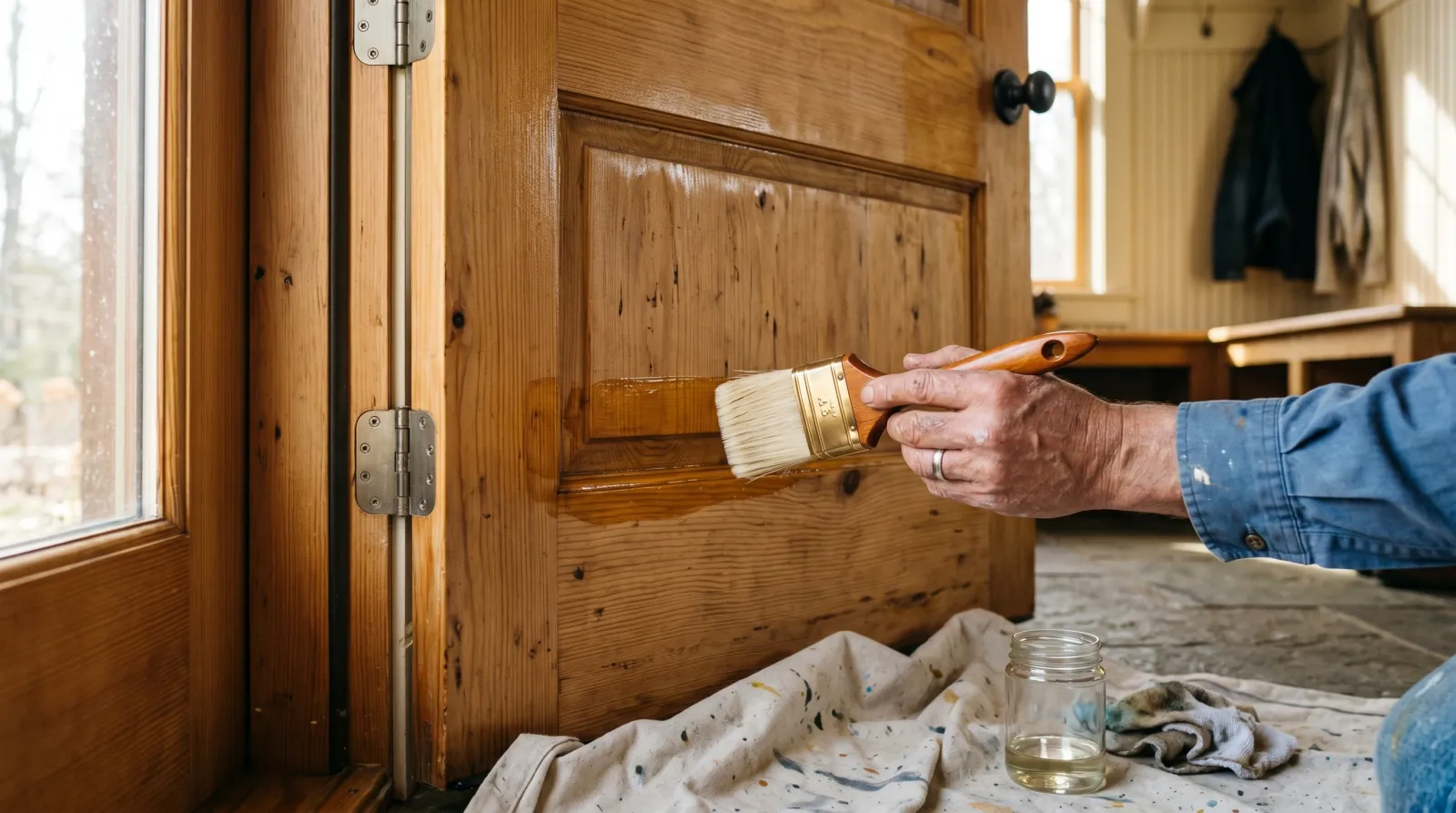
Five brushes, five weeks, three real oil-only projects. A solid pine entry door finished in Minwax oil stain plus three coats of Minwax Helmsman Spar Urethane. Twelve feet of original 1970s oak baseboards in Benjamin Moore Impervo Satin oil enamel. A knot-heavy cedar window sash sealed with Zinsser BIN shellac primer and topped with an alkyd semi-gloss. Each brush painted equivalent area, photographed at 30 minutes wet and at 24 hours under raking LED, and scored against a sprayed control on a five-point scale.
The Picks at a Glance
| Brush | Bristle | Best for | Paint load | Price |
|---|---|---|---|---|
| Purdy Sprig 2.5” | White China hog hair, medium | Oil enamel, general | 🟢 Heavy | $$$ |
| Wooster Yachtsman 2.5” | Long China hair, soft | Spar urethane, marine varnish | ⚪ Medium | $$ |
| Corona Pacifica 2.5” | China hair, angled cut | Oil cut-ins against ceilings, trim | ⚪ Medium | $$$ |
| Wooster Pro 2.5” China | Blended China hair, stiff | Budget oil, shellac primer | ⚪ Medium | $ |
| Purdy XL Cub 2.5” | Synthetic blend (hybrid pick) | Oil + waterborne alkyd kits | 🟡 Light | $$ |
The table reads by what the can asks for. Thick oil enamel wants heavy load. Long varnish runs want soft taper. Oil cut-ins want an angle. A switching kit wants synthetic. Pick by job, not by brand.
The Three Calls That Pick the Brush
Bristle Source and Length
White China hog hair is the premium of the natural-bristle category, the same way Tynex/Chinex is the premium of the synthetic side. The hairs are medium-length, graduated, and split naturally at the tip into a fine flag. Sprig and Pacifica are both white China; the Yachtsman uses a longer, softer blonde China bristle that was originally engineered for marine varnish work. The blended black-and-white China in the Wooster Pro is a step down on softness and flag uniformity, which is exactly where the price gap shows.
Shorter, stiffer bristle pushes thick oil enamel into wood grain. Longer, softer bristle floats varnish into a glassy film. The Sprig sits between them, which is why it’s the all-rounder; the Yachtsman is the specialist for clear coats and the Pro is the specialist for primer-and-knot work.
Cut and Width
Almost every natural-bristle brush sold for oil paint is cut flat, not angled. Flat is right for doors, baseboards, and broad trim runs where the bristle face lays paint as a uniform film. The Corona Pacifica is the odd one out: an angled-cut natural bristle for cut-ins against ceilings, around door casing, and at the wall-to-baseboard joint where a flat brush can’t reach the corner. If you cut in oil enamel, you need the Pacifica. If you don’t, the Sprig’s flat cut is the right shape.
Width follows the surface. 2.5” covers about 80% of household oil work: doors, baseboards, window sash on standard frames. Step up to 3” for full entry doors and exterior siding, where the heavier paint load saves dips. Step down to 2” for narrow window mullions and intricate trim. 1” exists for sash work and tight detail.
Handle Shape
Underrated. A beavertail handle (Sprig, Yachtsman, Pacifica) sits in the palm and reduces wrist fatigue over long horizontal pulls. A pencil handle (Wooster Pro) gives you control on detail work but cramps the hand after a 12-foot baseboard run. The short pencil handle of the XL Cub is the right shape for cabinet stiles and tight inside corners where a normal handle won’t fit, and the wrong shape for a full door.
1. Purdy Sprig 2.5” — Top Pick
The Sprig is the brush most cabinet shops and trim contractors keep in the oil drawer. We loaded it with Impervo Satin and pulled 12 feet of baseboard on three dips; the Wooster Pro China at the same width pulled the same baseboard on four. That delta in paint load is the headline. The mechanism is the white China bristle and the dense fill: more hair per square millimeter, more graduated flag at the tip, more paint per dip.
On the entry-door spar urethane test, the Sprig laid coat one at one-and-a-half mils thickness in a single pass, and the surface flattened to a near-glassy film by minute 30. The Yachtsman beat it on the second and third coats where the surface was already glossy and lap marks would show, but for general oil enamel on a primed surface, the Sprig wins on flow. Tip recovery after the fifth wash cycle was the best in the test; comb the bristle straight, hang handle-up, and the chisel is back the next morning.
The cost is real. $22–$26 retail at paint stores, the most expensive natural bristle in this round-up by a fair margin, and cleanup is eight to ten minutes of solvent work where a synthetic is three minutes under the tap. If you use oil paint twice a year, the Sprig is overkill; the Wooster Pro China is the smart call. If you’re refinishing an entry door or running pre-1980 trim through Impervo, the Sprig pays for itself by the second can of paint saved on flow alone.
| Spec | Value |
|---|---|
| Bristle | White China hog hair, medium stiffness |
| Sizes | 1”, 1.5”, 2”, 2.5”, 3”, 4” |
| Best for | Oil enamel on doors, baseboards, exterior trim |
| Approx. price | $22–$26 (2.5”) |
Buy it if: you’re refinishing a door, running pre-1980 oak baseboards, or coating exterior trim in real oil. Skip it if: oil work is occasional; the Wooster Pro at a third of the price does the same job adequately.
Buy Purdy Sprig 2.5” on Amazon · Find at Home Depot
2. Wooster Yachtsman 2.5” — Best for Varnish and Spar Urethane
The Yachtsman is the specialist for clear coats. Long blonde China bristle, graduated tip, copper ferrule that resists the marine-environment corrosion that rusts stainless. The brush was engineered for boat varnish and the engineering shows. On the teak offcut in our flow-test photos, the Yachtsman laid spar urethane as a glassy uniform film that read as sprayed at arm’s length, where the Sprig left a faint trace of bristle direction visible under raking light.
The mechanism is the bristle length. Longer hair holds more varnish at the wet edge, which means a longer working time before the brush stops self-leveling. On a 4-foot pine handrail in three coats of Helmsman, the Yachtsman finished each coat with no visible lap marks; the Sprig left one faint line halfway across the rail on coat three.
It’s the wrong brush for thick oil enamel on baseboards. The long soft bristle sags under the paint weight and the brush stroke loses its chisel. Load the Yachtsman with Impervo and it works, badly. Keep it in the varnish drawer and use it for what it was built for.
Buy it if: you’re varnishing wood that lives outside or near water, finishing furniture in clear coats, or want glassy spar urethane on an interior door. Skip it if: you’re brushing thick oil enamel on broad trim runs; the Sprig is the right tool for that job.
Buy Wooster Yachtsman 2.5” on Amazon · Find at Home Depot
3. Corona Pacifica 2.5” Angled — Best for Oil Cut-Ins
The only angled natural bristle in the round-up, and the only brush in this article that can cut a clean oil-enamel line against a ceiling without leaving the wavy edge a flat natural leaves. We cut 30 linear feet of oil semi-gloss baseboard against a flat ceiling and the Pacifica’s chisel corner laid an edge as sharp as a synthetic Clearcut on latex. The mechanism is the angled white China bristle: same self-leveling flow as the Sprig at the wet edge, plus the directional control of an angular sash.
The handle is the second feature buyers underrate. Beavertail hardwood, brass-tone ferrule, balanced weight forward toward the bristle. Long horizontal cuts on baseboards and door casing fatigue the wrist slower with a Pacifica than with a pencil handle. The Corona ergonomic story shows up again here, the same one we noted in the cutting-in brushes round-up: the brand earns its premium tax through the handle, not just the bristle.
Bristle longevity is the trade-off. The chisel corner wears on the part that matters most, and the Pacifica’s tip flag rounds at job 25 to 35 in heavy oil work, against 40 to 50 on the Sprig. For cabinet refinishers running oil weekly, that’s a faster replacement cycle. For homeowners cutting oil trim twice a year, it doesn’t matter.
Buy it if: you’re cutting oil enamel against a ceiling or around door casing where an angular tip is the only shape that fits. Skip it if: the cut is freehand on a flat door or baseboard where the Sprig’s flat cut is the right shape.
Buy Corona Pacifica 2.5” on Amazon
4. Wooster Pro 2.5” China Bristle — Best Budget
A natural-bristle brush at synthetic prices. Black-and-white blended China hog hair, plain alderwood pencil handle, stainless ferrule, $9–$12 retail. The Pro China is the call when oil work is a once-a-year project rather than a weekly habit, or when the job is shellac primer on knots where the brush is going to take a beating and you don’t want $25 of brush in BIN.
The blended bristle is stiffer than the Sprig’s all-white China, which has a counterintuitive upside on BIN shellac primer. Shellac is thin and aggressive, and a stiffer brush pushes the primer into the wood grain of pine knots and cedar siding where a softer brush would float over the surface. We sealed a 3-foot cedar window sash with two coats of BIN, and the Pro China laid it cleaner than the Sprig at half the price. For knot-heavy shellac primer work specifically, this is the right brush.
Cons are honest. Leaves faint brush marks on a long oil-enamel door panel that the Sprig laid flat, sheds more in the first 20 minutes than premium brushes, plain pencil handle fatigues the wrist on a full day of baseboards. But at $9, the Pro China is the natural-bristle entry point that lets you do oil work right without committing $25 to a brush that lives in solvent.
Buy it if: you paint oil twice a year, or you’re sealing knot-heavy pine and cedar with BIN shellac primer. Skip it if: you’re running oil enamel as a weekly job; the Sprig saves time on every dip and every wet edge.
Buy Wooster Pro China 2.5” on Amazon · Find at Home Depot
5. Purdy XL Cub 2.5” — Best Hybrid
The honest declaration first: the XL Cub is not a natural-bristle brush. It’s a Tynex/Orel/Chinex synthetic in the Purdy XL family, and it earns its slot in this round-up because the chemistry that was natural-only ten years ago is half-waterborne now. Benjamin Moore Advance, Sherwin-Williams Emerald Urethane, INSL-X Cabinet Coat — all waterborne alkyds that cure as hard as oil, clean up with water, and ruin a natural-bristle brush in one minute. A real natural-bristle Sprig in BM Advance waterlogs into a mop.
The XL Cub handles both. It carries oil enamel at about 70% of the Sprig’s load, lays it cleanly enough for cabinets and trim, and handles waterborne alkyd without sagging. The short handle is the second feature: it fits cabinet stiles, window mullions, and the inside corners of door panels where a long beavertail handle won’t enter. For a kit that switches between chemistries on the same project — oil exterior, waterborne interior — the XL Cub is the brush that doesn’t need a partner.
It’s the wrong brush for pure spar urethane work; synthetic bristle stipples on varnish where natural flag self-levels. If your entire job is clear coats on wood, the Yachtsman is the right tool and the XL Cub is overkill. If your job is mixed-chemistry interior trim, the XL Cub earns the slot.
Buy it if: your interior trim job uses both oil and waterborne alkyd, or you want one brush that does cabinets, sash, and tight inside corners across chemistries. Skip it if: you’re brushing pure spar urethane or oil enamel on broad surfaces.
Buy Purdy XL Cub 2.5” on Amazon · Find at Home Depot
Brushes We Tested and Dropped
- Purdy Black Bristle Adjutant 2”. Strong natural-bristle pick we still recommend on the general paint brushes round-up; at 2” it loses to the 2.5” Sprig on paint load.
- Generic 2.5” natural-bristle from a big-box bin. Bristle release was uneven, tip shed through the first two dips; not worth the $7 saved.
Cleaning a Natural-Bristle Brush
The cleanup routine is the part homeowners underestimate, and it’s where most natural brushes die before their time. The principle is solvent first, water last, comb every time.
Oil enamel and varnish. Scrape excess paint back into the can with a 5-in-1 tool. Swish the brush vigorously in a small glass jar of clean mineral spirits for 30 seconds. Press the bristle on a rag to wring out the dirty solvent. Repeat the swish in a second jar of clean mineral spirits for 30 seconds; the solvent should come out faintly tinted, not opaque. Run a brief warm-water and dish-soap wash to lift the last solvent film, rinse until runoff is clear, comb the bristle straight with a paint comb, hang handle-up overnight. Eight to ten minutes.
Shellac primer. Same routine but swap mineral spirits for denatured alcohol; shellac doesn’t dissolve in spirits and the brush sets like a rock if you skip the alcohol step. Keep a 16-oz bottle of denatured alcohol in the kit for BIN days.
The first solvent jar goes into a labeled “dirty solvent” jar that lives on a shelf. Paint settles to the bottom over a week and you pour the clean solvent off the top for the next cleanup. One quart of mineral spirits cleans a brush forty times this way.
Don’t leave the brush in solvent overnight. The hair compresses against the jar bottom and sets in a curl that won’t comb out. Hang dry.
Common Mistakes
- Water on a natural-bristle brush mid-job. Natural hair waterlogs in 60 seconds and goes mushy. Mineral spirits only; water only at the final wash, and briefly.
- Loading past the bristle midpoint. Pushes paint into the heel where bristle meets ferrule, dries hard, splays the bristle permanently. Dip the bottom third, tap twice on the can rim.
- Using a natural brush in waterborne alkyd. BM Advance, SW Emerald Urethane, and INSL-X Cabinet Coat clean up with water and ruin natural hair in one job. Use the XL Cub or a Silver Tip for waterborne alkyds.
- Skipping the shellac alcohol step. Mineral spirits doesn’t dissolve shellac. The brush sets overnight. Denatured alcohol is the only cleanup for BIN.
- Storing wet. Natural hair mildews if it stays damp in a sleeve for 48 hours. Hang dry first, then sleeve.
- Cutting in too long past the wet edge. Oil enamel skins slower than latex but still skins; cut in 8 feet, roll back into the cut, repeat. Past 15–20 feet of cut at temperature above 75°F, the wet edge is fighting you.
- Counterfeit Purdy on Amazon. XL Cub and Sprig at $7 are fakes. Buy at a paint store or Home Depot.
A Natural-Bristle Kit That Earns Its Keep
For a homeowner running one or two oil jobs a year: Purdy Sprig 2.5” ($24), Wooster Pro China 1.5” for primer and detail ($8), paint comb ($4), three small glass jars for solvent ($6), mineral spirits and denatured alcohol ($12). About $54.
The brushes are the cheap part of an oil-paint job. The flow at the wet edge is the part visitors notice.
Ask a Question