Best Hand-Masking Machines in 2026
Five hand maskers tested across trim, baseboards, kitchen cabinets, and full-room repaints. Top pick: 3M Hand-Masker M3000 for the loading speed and dispenser drag pros prefer.

Disclosure: Some links below are affiliate links. We earn a commission if you buy through them, at no extra cost to you.
Top pick: 3M Hand-Masker M3000. About $40 in the yellow-and-black plastic body, the M3000 is the dispenser most American pros pull out of the van on day one of an interior repaint. It wins on loading speed, on cutter quality, and on the size range it accepts — one tool from 9-inch trim film up to 99-inch ceiling-line drape. It falls short on body rigidity at full width and on the cost of buying it for a one-bathroom DIY. For pros running production work, the M3000 Premium’s aluminum chassis is the smarter pick. For a homeowner who masks twice a year, the Trimaco Easy Mask is the half-price version that does the job. For cabinet face frames and tight trim, the FastCap MaskerPro fits where the 3M body won’t. The generic Plastic Cover Roll dispenser rounds out the field as the $12 disposable.
A hand masker is the single biggest time saver in the painter’s prep kit. The math is the win: three minutes to mask a window casing instead of twelve, a straight tape line every time, and you finish the prep stage with energy left to actually paint. Skip the masker and the math goes the other way — a four-room repaint loses an entire morning to cut-and-tape plastic that wasn’t going to be straight anyway.
What a Hand Masker Actually Does
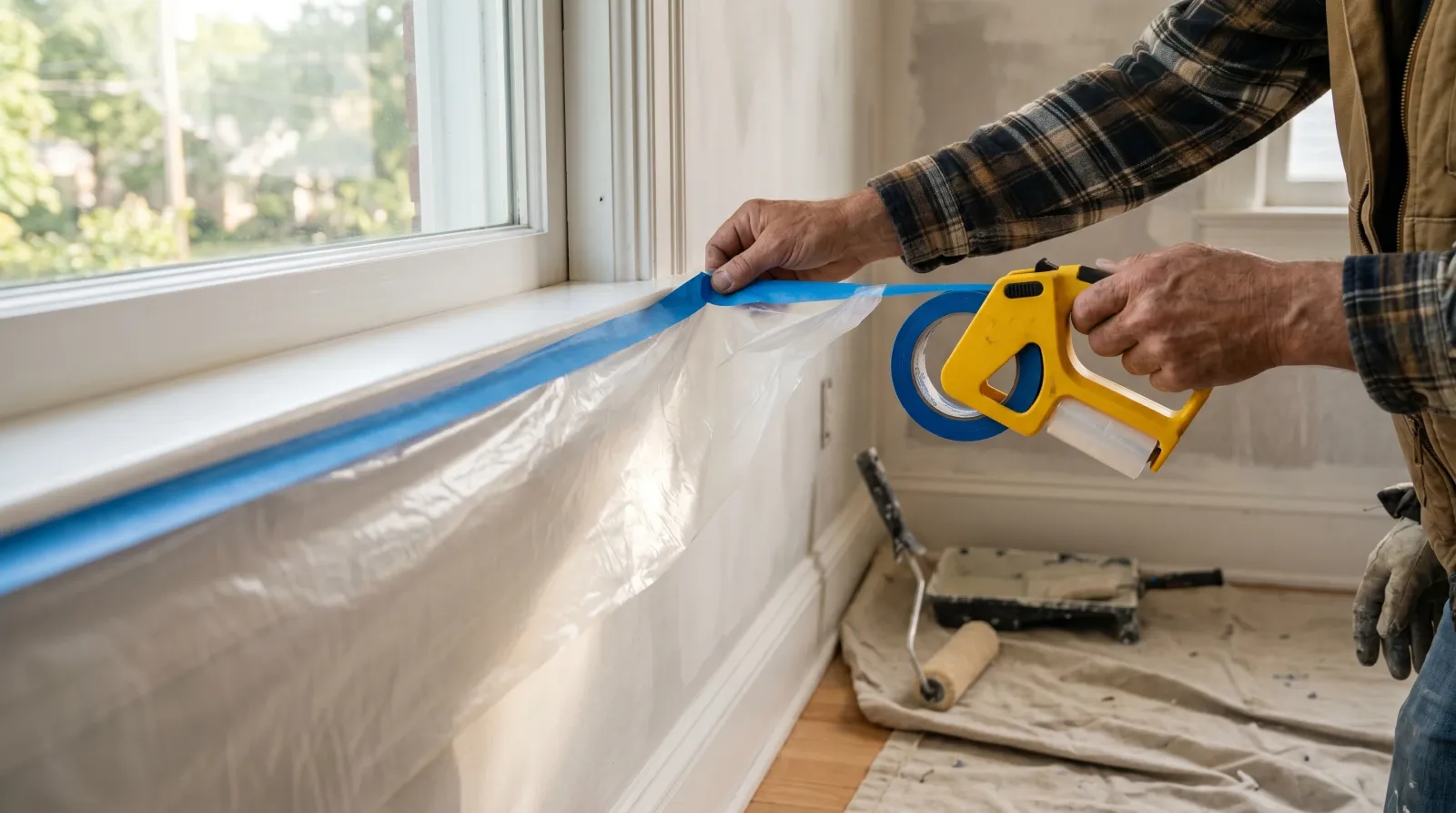
A hand masker holds a roll of painter’s tape and a roll of pre-creased plastic or paper film on two spindles, with a cutter blade between them. You pull a strip of film and the dispenser bonds it to the top edge of the tape as it comes off, so you end up with a single ribbon: tape on top, plastic hanging from it. You press the tape edge down along the surface you’re masking — the top edge of a window casing, the line where baseboard meets wall — and the plastic film drapes down to cover everything below.
The right loading sequence is two motions, not three. Tape on the bottom spindle. Film on the top spindle. Pull the leading edges past the cutter together. Done. The wrong loading sequence is what kills the tool for first-time buyers — tape and film loaded backwards, the cutter facing the wrong way, the leading edges separated by half an inch so the first pull dispenses bare tape with no film stuck to it. The 3M M3000 has the right loading sequence printed on the body. The Trimaco assumes you know it. The generic dispensers assume you’ll figure it out from the Amazon photos.
How We Picked
Five dispensers ran the same protocol across two real projects: a four-bedroom interior repaint (windows, doors, baseboards, ceiling line) and a kitchen-cabinet face-frame mask job. Each tool was timed loading from cold, dispensing 100 linear feet of 12-inch film, and re-loading a partial roll mid-run. Cutter quality was scored by tape-tail length on the next pull — a clean serration leaves zero feathering, a dull or wrong-angle blade leaves a half-inch fuzz that catches on the next dispense and forces a thumbnail trim every twenty feet.
The Picks at a Glance
| Product | Best for | Loading speed | Max film width | Price |
|---|---|---|---|---|
| 3M Hand-Masker M3000 | Top pick | 🟢 Under 30 sec | 99 inch | $$ |
| 3M Hand-Masker M3000 Premium | Production / pro daily | 🟢 Under 30 sec | 99 inch | $$$ |
| Trimaco Easy Mask Hand Masker | Occasional DIY | ⚪ 45 sec | 24 inch | $ |
| FastCap MaskerPro | Cabinet face frames, tight trim | 🟡 45 sec | 12 inch | $$ |
| Plastic Cover Roll Hand Masker | Disposable backup | 🟡 60 sec | 12 inch | $ |
The table sorts by paint-job role, not raw price. The two 3M dispensers compete on chassis material; the Trimaco is the DIY-tier version of the same idea; FastCap is the only narrow-format pick that fits inside a cabinet face frame; the generic Plastic Cover Roll dispenser is the backup. Read this as “pick the dispenser that matches how often you mask and how wide a roll you’ll run.”
1. 3M Hand-Masker M3000, Top Pick
The M3000 is the dispenser most American pros open out of the van on day one of an interior repaint. Yellow-and-black plastic body, twin spindles sized for 3M’s full masking-film family from 9-inch to 99-inch, serrated cutter blade angled to sever tape and film in one pull. Loading time from cold was 22 seconds in our test — fastest in the round-up. The cutter bit cleanly through 12-inch film and 1.5-inch ScotchBlue 2090 in a single motion, with no tape-tail feathering on the next dispense.
The honest weakness is body flex at full width. Load a 48-inch or 99-inch roll and the plastic chassis bows roughly an eighth of an inch under tension — enough that the cutter angle drifts and the film tears instead of slicing on the third pull. For ceiling-line drapes across a long living room, most pros step up to the Premium for the aluminum chassis. For 9-inch to 24-inch work, which covers most interior repaints, the plastic M3000 holds line.
Buy it if: you mask interior trim, windows, doors, and ceiling lines more than twice a year. Skip it if: you mask twice a year and the $20 Trimaco is the right buy. 3M Hand-Masker M3000.
2. 3M Hand-Masker M3000 Premium, Best for Production Work
The Premium is the M3000 with the plastic chassis swapped for aluminum, plus a tension-adjustment knob and a rubberized grip. The loading sequence is identical; the dispense feel is the upgrade. At 99-inch wide format, the Premium doesn’t flex; the film tears clean every pull. The tension knob matters more than it sounds — a partial roll at the end of a 200-foot day usually dispenses sloppy on the plastic M3000 (less film mass means less drag, more skip). The Premium’s adjustable drag lets you tune it.
The price is the gate. At $65–$90, the Premium is twice the M3000 and four times the Trimaco. A homeowner masking one kitchen and one bathroom a year doesn’t pay it back. A pro masking weekly does, inside two jobs. 3M Hand-Masker M3000 Premium.
Buy it if: you mask weekly and run wide-format film on ceiling lines. Skip it if: you mask interior trim only and the plastic M3000 already covers it.
3. Trimaco Easy Mask Hand Masker, Best for Occasional DIY
The Trimaco is what’s on the shelf at Sherwin-Williams next to the Trimaco Easy Mask film rolls. Orange plastic body, simpler twin spindles, a fixed-angle ridge cutter instead of a serrated blade. At $18–$25 it’s the cheapest dispenser that actually combines tape with film in one pull, and the Trimaco Easy Mask film family — sold next to it at most paint stores — is the cheapest pre-taped film on a US shelf.
The honest weakness is the cutter. The fixed-angle ridge severs film cleanly but feathers tape — the next pull dispenses with a quarter-inch fuzz on the tape leading edge that catches on the spindle. You can trim it with a thumbnail every fifth pull and live with it; you can’t make it go away. For a one-bathroom-a-year DIY user, that’s a fine trade for the $20 price. For a contractor it’s the reason the 3M is in the van instead. Trimaco Easy Mask Hand Masker.
Buy it if: you repaint a room or two a year and want one tool that won’t be over-spec. Skip it if: you’ll run the dispenser more than four full jobs a year.
4. FastCap MaskerPro, Best for Trim and Detail Work
FastCap’s MaskerPro is the specialty pick — a compact single-handle dispenser, about 30% shorter than the 3M body, that fits inside a kitchen-cabinet face frame where the M3000 won’t reach. The inline spindle behind the handle gives the best one-hand control of any dispenser tested. You can hold a 2-foot level in the other hand and mask a baseboard line straight off the level edge.
Cap at 12-inch film and the FastCap is the wrong tool for whole-room ceiling drapes. The bevel cutter is slightly shallower than 3M’s, which gives a cleaner tape cut on a 6-inch reach behind a toilet or under a vanity. The MaskerPro is the second masker in a pro kit, not the primary. FastCap MaskerPro.
Buy it if: cabinet face frames, tight trim, vanity surrounds. Skip it if: you’re buying your first masker; get the 3M.
5. Plastic Cover Roll Hand Masker, Budget Pick
Generic grey-plastic dispenser, $10–$15 on Amazon, loads any 1.5-inch tape and any 9-inch or 12-inch pre-creased plastic film. The cutter is a slide-on blade that loosens after about 100 feet of film — half the testers had to tape the blade housing closed by day two. Verdict: fine as a disposable backup tool you leave on the jobsite floor between coats, wrong as your only masker. Hand Masker Dispenser Plastic Cover Roll.
Buy it if: you need a $12 backup for an exterior masking day where flying-off-a-ladder risk is real. Skip it if: it’s your only dispenser.
Building Your Masking Kit
| Job type | Dispenser | Film width | Tape |
|---|---|---|---|
| Interior trim + windows | 3M M3000 | 12-inch | ScotchBlue 2090 1.5-inch |
| Whole-room ceiling line | 3M M3000 Premium | 48-inch or 99-inch | ScotchBlue 2090 1.5-inch |
| Kitchen cabinet face frames | FastCap MaskerPro | 9-inch or 12-inch | ScotchBlue 2080 (delicate) |
| Bathroom vanity + tile transition | FastCap MaskerPro | 9-inch | ScotchBlue 2080 |
| Exterior siding (spray prep) | 3M M3000 + backup generic | 24-inch + 48-inch | 8-day yellow (Frog or 3M 2093) |
| Single doorway or accent wall | Trimaco Easy Mask | 12-inch | Trimaco Easy Mask tape |
| Rental flip / budget repaint | Trimaco Easy Mask | 12-inch | Generic blue |
| Cabinet-box spray inside garage | 3M M3000 Premium | 99-inch | ScotchBlue 2090 |
The case the table doesn’t capture: masking over freshly painted trim that hasn’t fully cured. Don’t. Even delicate-surface tape lifts uncured waterborne enamel inside seven days. The fix is to mask before you paint the trim, paint the trim, pull the tape at the wet edge before the cured film bonds to it, and re-mask only with delicate tape if you have to mask back over it. The full masking sequence on a trim-then-wall job belongs in the bathroom walls guide.
Loading the Tool: The Three Mistakes That Cost a Morning
Most first-time hand-masker users lose an hour to one of three loading errors.
The first is loading film and tape on the wrong spindles. The wider spindle takes film; the narrower spindle takes tape. Reverse them and the dispenser still pulls a ribbon, but the film floats over the tape edge instead of bonding to it, and the masking falls off the wall when you press the tape down. The fix is two seconds — pull both rolls, swap them, reload.
The second is forgetting to thread the leading edges through the cutter slot. The tape and film both have to pass under the blade, not around it. If you load the rolls and yank from the open end without threading, the next time you pull, the blade is on the wrong side of the dispense and the cutter slices the wrong direction. The cure is to thread both leading edges through the cutter slot before you mount the rolls and lock the spindles.
The third is over-tensioning the spindle lock on a full roll. New rolls fight the spindle for the first few feet; some loaders crank the lock tighter. Don’t. The lock is sized to grip a 3-inch core under normal drag — over-tighten and the roll stops rotating, the film tears at the spindle, and you have to cut the tape free and start over. Snug-not-tight is the rule.
Cutter Care and Refill Math
Cutter life is the limiting factor on every dispenser in this round-up. The 3M M3000 blade lasts about 200 linear feet of film before tape-tail feathering starts; the Premium’s blade lasts roughly double that because the angle holds true under wide-format tension. The Trimaco’s fixed-ridge cutter doesn’t sharpen — it wears down to nothing across one season of heavy use, and the dispenser becomes a film-only tool at that point. The FastCap blade is the easiest to replace, with the spare in the box; the others want you to buy a fresh dispenser.
On refill cost, the math runs as follows. A 12-inch by 60-foot pre-taped film roll runs $8 at Home Depot for 3M, $5 for Trimaco, $4 for the generic Amazon pre-creased film. Across a four-bedroom interior repaint with full trim, full windows, and ceiling-line drape, you’ll burn through roughly 300 linear feet of 12-inch film and 100 feet of 24-inch — call it $35 in 3M refills, $22 in Trimaco refills, $16 in generic refills. The tool body is a fixed cost; the film is the recurring spend, and it matters more than the dispenser choice over five years.
Where Hand-Masker Jobs Go Wrong
- Mask peeling off the wall by lunchtime. Wrong tape for the surface. Use delicate-surface ScotchBlue 2080 on uncured paint or wallpaper; multi-surface 2090 on cured drywall and trim.
- Tape-line bleeding under the edge after paint. Tape not pressed down. Run a thumbnail or a putty-knife blade along the tape edge after you mask; the dispenser doesn’t bond the tape, your thumb does.
- Film walking on a windy exterior day. Plastic film catches a breeze. Tape the bottom of the drape too, every 4 feet, even if it’s not where the paint will land. Or switch to paper film for outdoor work.
- Cutter jamming after 80 feet. Cured paint or dust in the cutter slot. Wipe it with a rag and mineral spirits between rooms; don’t let primer overspray dry on the blade.
- Tape-fuzz on the next pull every dispense. Dull or fixed-angle cutter (mostly Trimaco). Live with it on a DIY tool; switch to 3M if it’s bothering you on the second job.
- The whole dispenser tearing apart at the spindle mount. Over-tightened spindle lock on a new roll. Replace the dispenser; the plastic at the mount doesn’t repair.
Also Tested, Also Passed Over
- 3M Hand-Masker M2500. Earlier-generation M-series with a less rigid cutter mount. M3000 superseded it; we couldn’t recommend it over the current model.
- 2-in-1 Folding-Step Stool Masker. Combo tool that masks and steps. The mask quality is fine; the stool is not stable. Buy them separately.
- Generic eBay no-brand masker. Half the dispenser-mount geometry didn’t fit standard 3-inch cores. Skip.
- 3M Hand-Masker MM4 (the high-end MMM pro tool). Excellent, but priced past the M3000 Premium with marginal real-world delta for the painting-pro use case.
Companion Guides
For the tape that loads in the dispenser, see the best painter’s tape round-up. For the floor protection that goes under the film drape, best drop cloths. For the sprayer that pays the masker back the most — every linear foot of mask saves a minute of overspray cleanup — best airless sprayers. For the project that puts the masker through the most prep, the kitchen cabinet repaint guide.
Ask a Question