What Is Matte Paint?
Matte paint reads 0–10 gloss units at 85° because its pigment volume sits above 40%. Here is the chemistry, why it hides drywall, and the one exception that does not burnish.

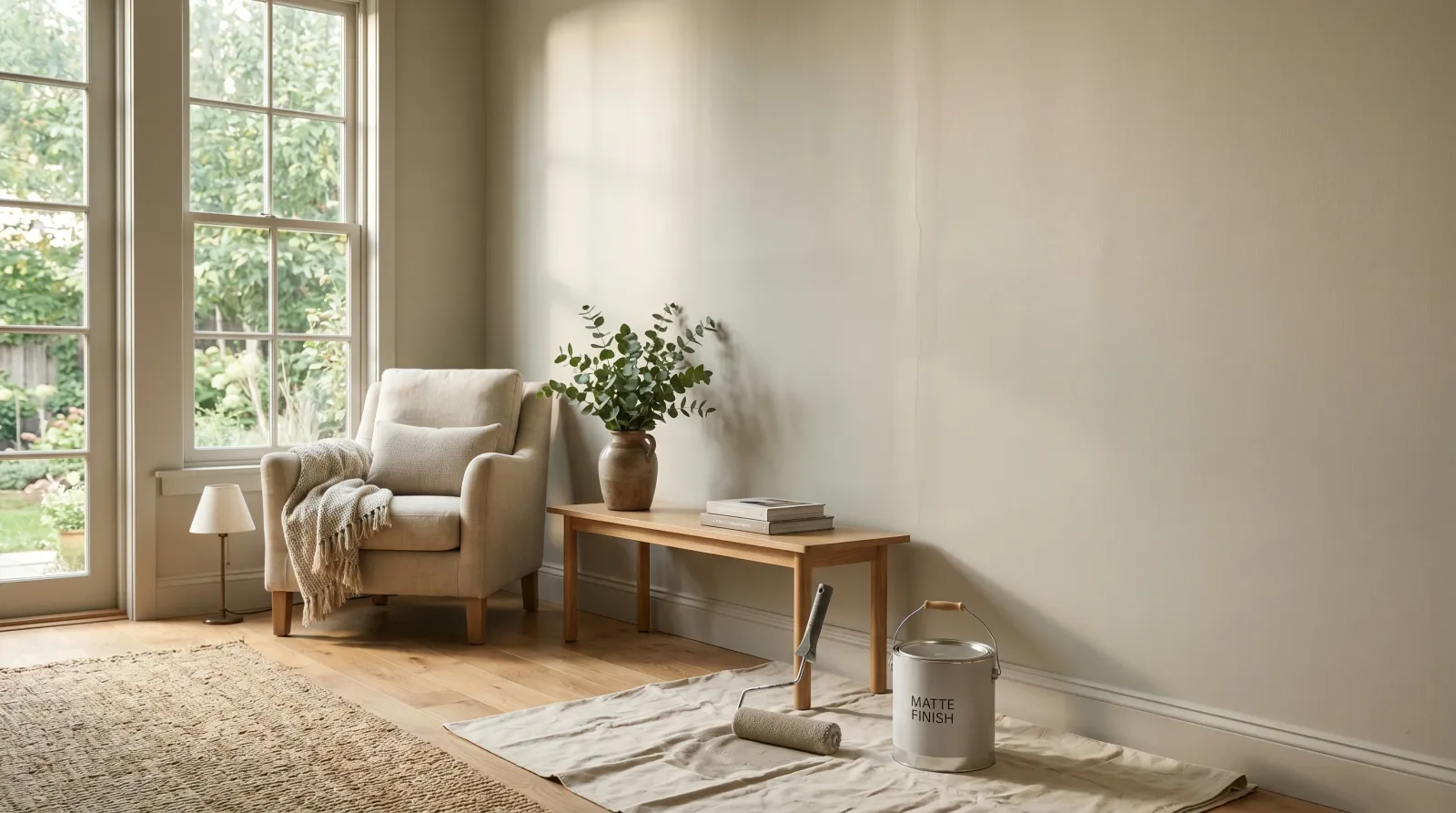
Most people pick matte for the same reason their painter recommends it. The wall looks soft, the seams disappear, the room reads quieter under afternoon light. Then six months in, a shiny smudge shows up by the light switch, and another one where a chair back rubs the wall, and the finish that hid everything on day one is now broadcasting every spot it has been touched. Both of those behaviors come from the same number on the data sheet. Pigment volume concentration, usually written PVC.
Matte paint is an interior wall finish formulated above roughly 40% PVC, which puts it in the 0–10 gloss-unit range when measured at 85 degrees off the surface. The high pigment load creates a microscopically rough dried film that scatters incoming light in every direction instead of bouncing it back at one angle. Coverage runs 350–400 sq ft per gallon, dry to recoat in two to four hours, full cure in 14 to 30 days. The porosity that gives matte its hiding power is the same porosity that makes it burnish under a damp sponge. You do not get one without the other.
Where the Gloss Number Comes From
Gloss is measured by aiming a light at the surface and reading how much of it bounces back at the matching angle. For low-sheen finishes the meter sits at 85 degrees off vertical, which is a grazing angle close to how raking daylight hits a wall. A true flat reads 0–5 GU at 85°. A matte reads 5–10 GU. Eggshell sits at 10–25 GU, satin at 25–40 GU, semi-gloss at 40–70 GU. Above 70 you are looking at full gloss.
The reason matte and flat read so low is that the binder is not the dominant ingredient in the dried film. A glossy enamel runs 15–25% PVC, with binder in excess and every pigment grain fully coated in polymer. The film dries smooth and reflective. A matte wall paint pushes above 40%, sometimes as high as 55% in a premium scrubbable line and 65% in a contractor flat ceiling.
There is a specific cliff in the chemistry called the critical pigment volume concentration. Below the CPVC, the binder is in excess and the film is continuous. Above the CPVC, the binder runs short, pigment particles touch each other, and tiny air voids form between them. The surface goes microscopically porous. That porosity is what scatters light, and it is also what lets liquids wick into the film instead of beading on top.
Why Matte Hides Drywall So Well
A bad drywall seam is geometry. There is a low spot where the tape sits, a high spot where the mud builds up, and a transition between them. Under a sheen finish, the high spot bounces light at one angle and the low spot bounces it at another. Your eye picks up the discontinuity and reads it as a defect. Paint a satin over a marginally taped wall and every seam telegraphs through under raking light.
Matte breaks that. Every patch of the wall scatters light diffusely in all directions. The geometry of the seam is still there, but the reflection is the same on either side of it, so the discontinuity disappears optically. The bump is invisible until you put a flashlight against the wall at a low angle. This is the reason painters spec matte or flat for new construction, for repaired walls, and for any ceiling that took a recent patch.
The trade-off lives on the other side of the same coin. The porous film that hides the seam also catches dirt, and the rough surface that scatters light also polishes when you scrub it.
The Burnish Problem and the One Exception
A matte wall film looks soft because its top layer is full of micro-peaks of binder and flatting pigment. Run a damp microfiber across that surface with any real pressure, and you crush the peaks. The high points flatten into a smoother plane. Smoother surfaces reflect light more directionally. The polished patch now reads at maybe 15 GU instead of 7, which is firmly inside the eggshell range. You wiped off a stain and traded it for a shiny smudge that lives in the wall until you repaint.
This is the reason the paint sheen guide keeps matte out of kitchens, baths, hallways, and kids’ rooms. Those walls see hands.
There is one honest exception worth naming. Benjamin Moore Aura Bath & Spa is the only matte-sheen interior I have seen survive a wipe-down without burnishing. The formula uses a harder acrylic resin and a finer flatting pigment than a standard matte, and the cured film reaches a hardness that resists mechanical polishing the way an eggshell does. You give up some of the hiding softness compared to a budget matte, but you get a finish that scrubs to 1,000+ cycles and still reads matte afterward. It is a real piece of formulation, not marketing language.
Premium scrubbable mattes from Sherwin-Williams Emerald and Behr Marquee close the gap part of the way. They burnish less than a contractor flat. They do not match Aura Bath & Spa under a wet sponge.
Common Mistakes
- Speccing matte on a wall that gets touched. The finish that looks best on day one is the worst choice for a hallway at sleeve height or a kid’s room below 40 inches. Eggshell or satin from the start.
- Scrubbing fresh matte inside the cure window. Latex film keeps hardening for 30 days. A wall scrubbed on day five burnishes far worse than the same wall scrubbed on day forty.
- Spot-touching a burnished patch with the original can. The new paint dries to its full matte sheen, the burnished area around it is now half a step shinier, and you have made the difference more visible, not less.
- Treating matte and flat as identical on a budget line. On a premium deck, matte is a step up. On a contractor line, they are often the same paint with different stickers.
How Matte Compares to Its Neighbors
| Matte | Flat | Eggshell | |
|---|---|---|---|
| Gloss (85°) | 5–10 GU | 0–5 GU | 10–25 GU |
| Hides drywall | Excellent | Best | Fair |
| Scrub cycles | 100–300 (premium) | <100 | 500–1,000 |
| Burnishes | Yes (except Aura Bath & Spa) | Yes, badly | Rarely |
| Best room | Bedrooms, living rooms | Ceilings | Kitchens, baths, halls |
For the head-to-head with eggshell, see the matte vs eggshell breakdown.
Where to Buy
For the burnish-resistant matte that actually survives a bathroom or a kitchen, the bathroom paint round-up leads with Aura Bath & Spa for the same reason this article does. The rest of the picks are eggshell and satin, which is the honest answer for most other rooms with hands.
Ask a Question