What Is Burnishing? Why Matte Paint Goes Shiny Where You Touch It
Burnishing is mechanical polishing of a paint film by repeated rubbing. Here is the chemistry behind those shiny patches on matte walls, and how to keep them off.

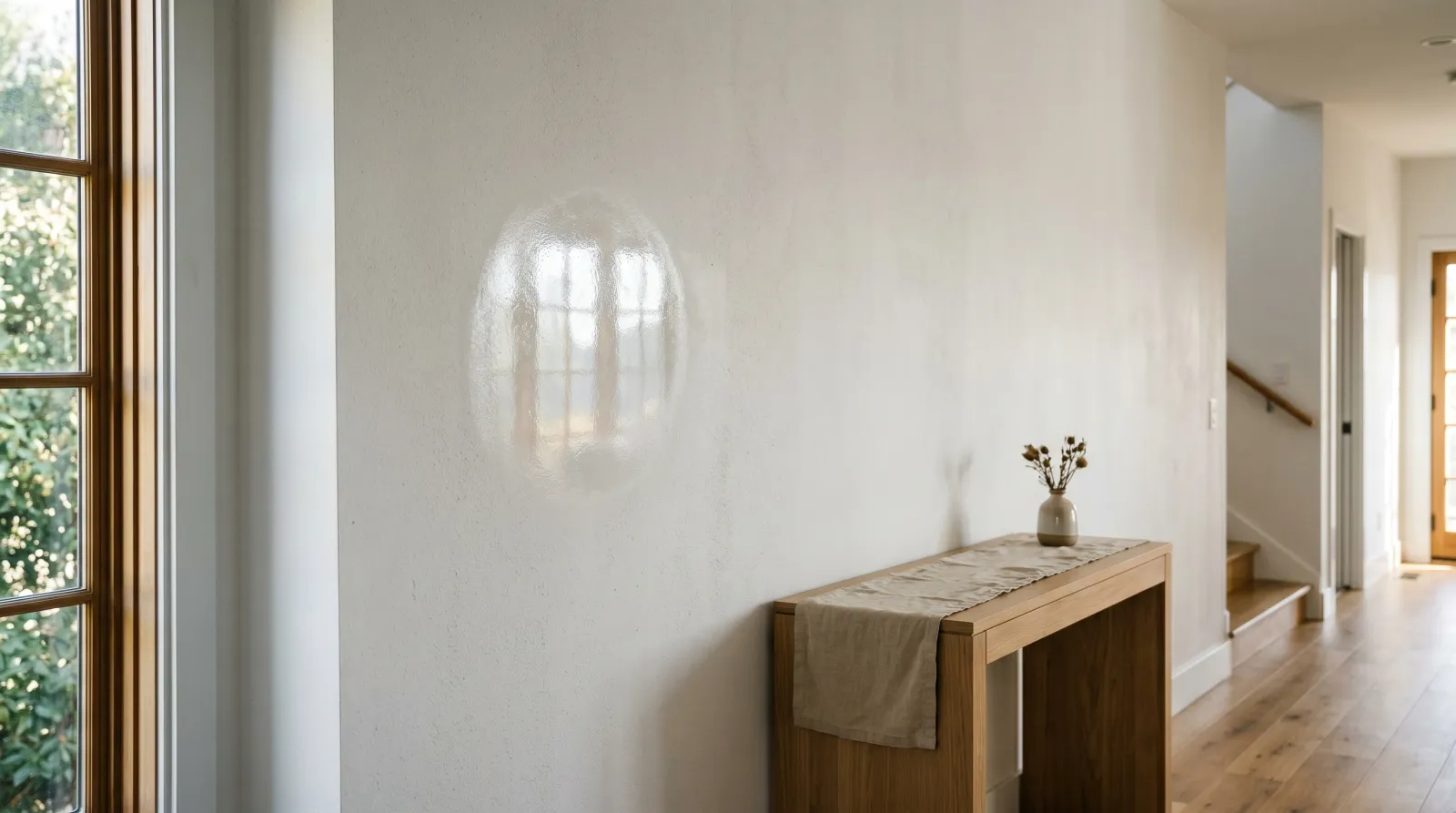
Most people notice it without naming it. The wall by the light switch looks slightly shinier than the rest. The corner where the dog squeezes past has a polished sheen the rest of the hallway does not. You touch it, you wipe it, the shine grows. That is burnishing, and it is one of the most common reasons a fresh matte paint job looks worn six months in.
Here is the working definition. Burnishing is the mechanical polishing of a paint film by repeated rubbing or wiping, which flattens the microscopic surface texture and raises the perceived sheen. It happens most on flat and matte finishes, mostly on walls that get touched, and it accelerates dramatically during the first 30 days while the film is still curing. The paint is not failing chemically. It is being polished by hand.
What Actually Happens to the Film
A flat paint looks flat because its surface is microscopically rough. The reason for that is the formula carries a high pigment volume concentration — somewhere in the 45–65% range, often higher than a sheen paint — and a portion of that pigment load is made up of flatting agents like fine silicas or diatomaceous earth. Those particles sit proud of the dried binder and scatter incoming light in every direction instead of bouncing it back at one angle. Scattered light reads as matte to the eye.
Now run a thumb across that surface a few hundred times over a year. The high points get knocked down. The micro-peaks of binder and flatting pigment flatten into a smoother plane. Smoother surfaces reflect light more directionally. The eye reads directional reflection as sheen. You have just turned a 5-gloss-unit matte into something closer to 15 GU, which is firmly inside the eggshell range. The paint did not change. The geometry did.
This is also why burnishing is permanent. You did not damage the binder, you reshaped its surface. There is no chemical process that re-roughens a polished film. Topcoats hide it, but only by adding a new film on top.
Why Sheen Paints Are Immune
Eggshell, satin, semi-gloss, and gloss are formulated with much lower pigment volume concentration and almost no flatting agent. The binder dominates the surface, and the binder dries smooth by default. The film already reflects light directionally. Polishing a smooth surface a bit smoother does not change how the eye reads it.
This is the entire reason the paint sheen guide puts satin in kitchens, bathrooms, and kids’ rooms. Those rooms see hands. Matte cannot survive hands.
Cure Time Is the Hidden Variable
A latex paint is dry to the touch in an hour and topcoatable in four. Most people read that and assume the film is done. It is not.
The film forms in two stages. Water evaporates first, which is the part that gets you to “dry.” Then the acrylic binder particles slowly fuse together and cross-link into a continuous, harder film. That second stage runs for about 30 days at typical room conditions, longer if the room is cold or humid. The hardness of the film keeps climbing across that window.
Burnishing is sensitive to film hardness because polishing a soft film is easy and polishing a hard film is hard. A wall that has cured for 48 hours burnishes faster than the same wall at day 30. The practical consequence is that the worst time to scrub off a kid’s handprint or a coffee splash is in the first two weeks. The mark comes off, but the patch where you scrubbed is now polished, and you have traded a stain for a sheen difference that lives in the wall forever.
If you have just painted a kid-height wall with matte, the discipline for the first month is light, dabbing pressure with a damp microfiber. Save real scrubbing for after day 30.
When Burnishing Shows Up
The pattern is consistent across jobs.
- Switch plates and door pulls. Every hand that flips the light touches the same six square inches of wall. Within a year that patch reads shiny.
- Stair walls at hand-rail height. The hand that steadies on the wall instead of the rail draws a polished band along the slope.
- Behind couches and chair backs. The fabric rubs at one height for years. You see the band when you finally move the furniture.
- Hallways with narrow shoulders. Sleeves brush the wall on the way past. The band sits around 50 to 55 inches off the floor.
- Kids’ rooms below 40 inches. Every height where small hands land — light switches, doorframes, the wall by the bed.
If you can predict where hands land, you can predict where matte will burnish.
How to Avoid It in the First Place
Three honest choices, in order of how much they help.
Step up the sheen. This is the real fix. Eggshell in hallways, satin in kitchens, bathrooms, kids’ rooms, and laundry. If a wall is going to be touched, do not put matte on it. The slight reduction in how forgiving the finish is on imperfect drywall is the price you pay for a wall that still looks like itself a year later.
If matte is non-negotiable, buy a scrubbable matte. Benjamin Moore Aura Matte, Sherwin-Williams Emerald Matte, and Behr Marquee Matte all use harder resins and more sophisticated flatting agents than budget flats. They burnish less. They do not burnish never. Expect them to outlast a builder-grade flat by three to four years in the same conditions, not forever.
Respect the cure window. Do not host the dinner party three days after painting the dining room. Do not scrub the toddler handprint off the matte playroom wall on day five. Twenty-eight to thirty days at 70°F and 50% relative humidity is the window the film needs to reach near-full hardness. Cooler or wetter rooms need longer.
Common Mistakes
- Treating burnish marks as paint failure. They are not a defect. They are the expected behavior of flat paint under repeated friction. A contractor who used the matte you specified did the job you asked for.
- Scrubbing harder to “even out” a shiny patch. You will only polish the rest of the wall to match, eventually, and the path there is uneven and ugly. Repaint the whole wall instead.
- Spot-painting a burnished mark with the original can. The patch reads flatter than the burnished area around it, then flatter still than the rest of the wall. You have made it more visible, not less.
- Choosing matte for a rental. Tenants move out, walls get cleaned, mattes burnish in the cleaning. Eggshell on rental walls is a much kinder spec for the next paint cycle.
A Quick Locator Against Its Neighbors
| Concept | What it is | Where it shows | Fix |
|---|---|---|---|
| Burnishing | Mechanical polishing of a flat film | Switch plates, hand height, kid height | Recoat in eggshell+ |
| Flashing | Uneven gloss from uneven absorption | Patched / unprimed spots | Prime, then recoat |
| Scrubbing failure | Binder lifting under wash water | Bathrooms, low-quality flats | Step up to scrubbable line |
| Roller marks | Lap lines in the wet edge | Whole wall in raking light | Re-roll with overlap |
For the full breakdown of how sheen choice prevents most of these, the paint sheen guide is the next read.
Where to Buy
For burnish-resistant matte options or the satin upgrade that solves the problem altogether, see the bathroom paint round-up — the same scrubbable-matte and satin lines win in any touched-wall application, not just bathrooms.