How to Fix Cracks in Walls Before Painting
Hairline settlement cracks get mesh tape and a skim. Seasonal expansion cracks get elastic caulk. Structural cracks get a flag and a phone call. Match the fix to the crack.

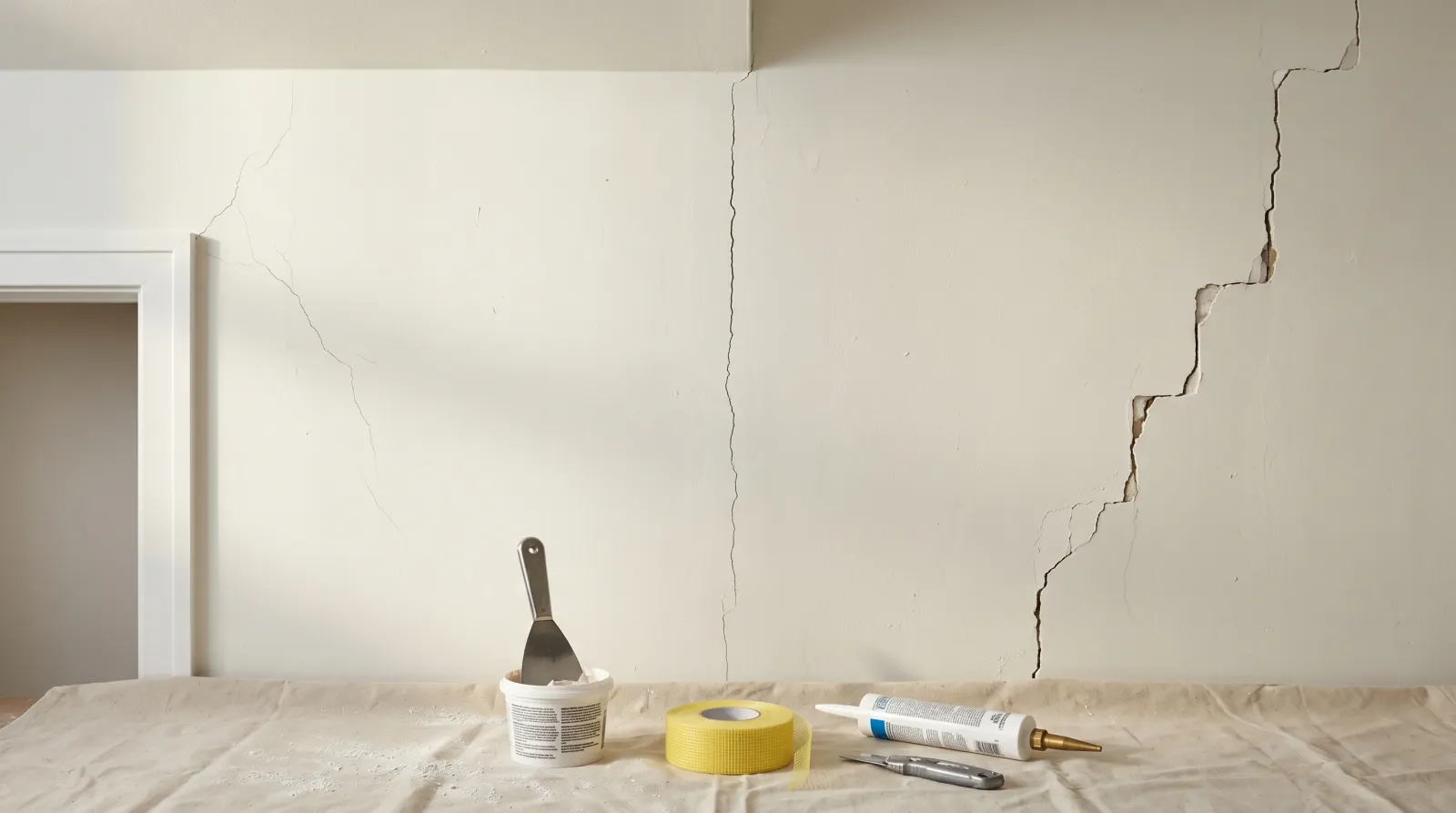
Hairlines, seasonal cracks, stair-steps. Three different problems wearing the same shape. Skim the wrong one with the wrong material and it reads through the topcoat by the next cold snap. Match the fix to the crack and it stays gone.
Does This Match What You’re Seeing?
Four patterns cover almost every wall-crack call:
- Hairline spider cracks. Thin as a pencil line, often radiating from a corner of a window, door, or above an outlet. Settlement and drywall paper movement. Cosmetic.
- Straight seam crack. Long, runs along a drywall butt or taper joint, sometimes following the line of the ceiling. Original tape failed or the joint compound shrank back. Cosmetic but it telegraphs.
- Seasonal corner crack. Opens in winter, closes in summer (or the reverse, depending on climate). Lives in inside corners and at wall-ceiling joints. Movement-driven. Cosmetic but recurring.
- Stair-step or diagonal crack. Wider than 1/16”, steps along drywall edges or runs diagonally across a wall. Often paired with sticking doors or out-of-square trim. Structural signal. Flag this one.
If the crack is wet, weeping, or stained brown around the edges, you have water finding its way in. Fix the leak first. Patching a crack with active moisture is patching twice and priming three times for nothing.
How Serious Is This?
Most wall cracks are cosmetic. Drywall is a finish layer; it telegraphs settlement and humidity swings whether or not the studs behind it are moving. A hairline in a 30-year-old house is normal. A new hairline in a 2-year-old house is normal too. That’s the framing finishing its settling cycle.
Two patterns are not cosmetic. Stair-step cracks in masonry or drywall that follow a clear diagonal across multiple walls in the same direction mean the foundation is moving. So do horizontal cracks in basement walls, doors that have started sticking, and trim joints that have opened by 1/8” or more in a season. Patch is decoration in those cases. Have a structural engineer or your builder look before you spend a Saturday on cosmetics.
Why This Is Happening (root Cause)
Drywall is a paper-faced gypsum sandwich, taped at the seams and skimmed flat. Three things crack that system.
The first is shrinkage. Joint compound loses water as it cures and pulls slightly inward. If the original finisher rushed coats or feathered too narrow, you get visible seam cracks within a year. These are static. They don’t grow once the compound is fully dry.
The second is movement. Houses breathe with the seasons. Framing lumber gains and loses moisture, drywall paper expands and contracts, and inside corners are the hinge. Corner cracks open in dry winter air, close when summer humidity comes back. The compound in that corner (a rigid material in a moving joint) fractures every cycle.
The third is settlement. New construction settles for 12 to 24 months. Older homes settle when the soil under the footings changes: drought, a new tree, a re-grade. Settlement cracks usually run diagonally from window and door corners because that’s where stress concentrates. They walk back if the underlying movement continues.
Knowing which of the three you have decides the fix. Static cracks take a rigid skim. Moving cracks take an elastic filler. Structural cracks take a phone call.
The Fix
Step 1 — Open the Crack Slightly
Sounds backwards. It isn’t. Drag the tip of a utility knife or a 5-in-1 corner of the blade down the crack to widen it into a shallow V, maybe 1/16” deep. You’re giving the filler something to grip. Compound pushed onto a closed hairline sits on the surface and pops off the first time the wall moves.
Blow the dust out with a puffer or vacuum it. Don’t wipe with a wet rag. Wet drywall paper tears at the edges of the cut, and you’ll widen the cosmetic problem instead of fixing it.
Step 2 — Match the Filler to the Crack Type
Hairline spider cracks and static seam cracks: lightweight joint compound for a single thin pass, or 20-minute setting-type compound (USG Easy Sand 20) if you want it sand-ready in 25 minutes instead of 4 hours. Press into the V with a 6-inch knife. Skim flush. Feather 4 inches past the crack on every side. Second coat 24 hours later (or 30 minutes if you used Easy Sand), feathered 8 inches. Sand with 220-grit. Don’t pile mud on. Two thin coats hold; one thick coat shrinks and cracks back.
Settlement cracks that follow a drywall seam: same as above, but add fiberglass mesh tape over the open V before the first compound coat. The mesh handles tensile load across the joint. The compound only has to fill and feather. Without tape, the crack walks back through both coats within two seasons.
Seasonal corner cracks and wall-ceiling cracks: don’t use compound. Paintable elastomeric crack filler (DAP Elastopatch, Sashco Big Stretch, or a flexible product like Krak-Patch) flexes with the joint. Cut the tube nozzle to a fine bead. Run it down the V, wet your finger or use a damp sponge to tool the bead flush, wipe clean. One pass. No sanding (you can’t sand elastic patch; it gums up paper). Dry per label, usually 1 to 4 hours before paint.
Step 3 — Prime the Patch
Every patch gets primed. Bare compound is thirsty and dries paint flat. Bare elastomeric is glossy in spots and absorbs unevenly. A skim of fast PVA primer over the patch (Zinsser Bulls Eye 1-2-3 or any drywall PVA) seals both. One coat. 1-hour dry. Then your wall paint.
If the crack ran through a smoke-stained or water-stained section, switch the primer to shellac-based Zinsser BIN. It blocks the brown ghost permanently, so it doesn’t bleed through your topcoat in six months.
Step 4 — Repaint
Two coats over the primed patch, blending into the surrounding wall. If your wall paint is more than two years old, the wall has shifted color slightly from UV and washing. A spot-patch will read a little brighter than the wall around it under sidelight. The fix is to cut in and roll out the full wall corner to corner, not just the patch.
Safety and Dust
Wear an N95 when sanding any compound. Gypsum dust is fine, gets into eaves and air returns, and irritates lungs. Eye pro too for overhead patches. Cover any nearby HVAC return with a furnace filter taped over the grille while you sand. Cheaper than vacuuming dust out of ductwork later.
Never mix joint compound with bleach or ammonia in the same bucket. If the crack runs near a previously moldy section that you treated with a spray biocide, let the treatment dry fully (at least 24 hours) before you skim over it. Wet biocide plus wet compound cures into a chalky slurry that powders off the wall.
Pre-1978 home with chipping paint around the crack: lead-test the loose paint before you sand or scrape. RRP rule still applies even on a hairline repair.
Compound, Spackle, or Krak-Patch: Which One?
The three get used interchangeably and they shouldn’t. Match the product to the joint.
| Product | What it is | Use it for | Skip it for |
|---|---|---|---|
| Lightweight spackle (DAP DryDex, 3M Patch Plus) | Vinyl-based, paste, no shrink on small fills | Nail holes, single screw dings, scuffs | Anything wider than 1/8”; cracks of any kind |
| Premixed joint compound | Vinyl-and-gypsum slurry, slow dry, light shrink | Wide skims, second-coat feathering, smooth-wall finish | Patches in a damp or unventilated room |
| 20-min setting compound (USG Easy Sand) | Chemical-set gypsum, mixed from the bag, low shrink | Hairline and seam crack fills, structural patch coats | Final feather (it’s hard to sand glass-smooth) |
| Paintable elastic patch (Krak-Patch, DAP Elastopatch) | Acrylic-elastomeric, stays flexible after cure | Seasonal corner cracks, wall-ceiling joints, any moving joint | Pin holes, full skim coats, anywhere you need to sand |
Spackle on a hairline cracks within a season because spackle has zero tensile strength. Joint compound in a moving corner cracks every winter. Krak-Patch on a nail hole stays a little soft and shows under raking light. The right material in the wrong joint fails. Match it.
Recommended Product
DAP Elastopatch for any crack that opens and closes with the season. Acrylic-elastomeric, paintable in 4 hours, stays flexible through framing movement for years. The cracks I patched with regular compound came back; the ones I switched to Elastopatch on are still sealed. One tube does dozens of cracks.
For static hairlines and seam cracks, USG Easy Sand 20 mixed from the bag. Sets in 20 to 25 minutes, low shrink, ready to sand and prime within an hour of mixing. The pail of premixed mud sitting in your basement has its place, but for crack work it shrinks too much in a thin V.
Prevention
Climate-control the cycle. Indoor relative humidity below 30% in winter and above 60% in summer is the framing-movement engine. A whole-house humidifier in winter (keep RH at 35-40%) and AC dehumidification in summer (keep RH below 55%) cuts the seasonal swing in half. Cracks still appear, just less often.
Use mesh tape on the first repair, not the third. The fix that holds is the one with reinforcement. Bare compound in a settling seam is patching twice.
In new construction, wait. A 12-month-old house is still settling. Patch cracks once with elastic filler the first winter and again in the second winter; by year three the framing has equilibrated and the third patch usually holds.
If a crack keeps coming back in the same corner after two elastic patches, that joint is moving more than corner caulk can handle. Cut the corner bead out, retape with paper tape bedded in compound, and re-skim. Slower fix, holds longer.
When to Call a Pro
- Stair-step cracks in drywall or masonry, especially diagonal across multiple walls in the same direction.
- Horizontal cracks in basement walls (foundation movement signal).
- Cracks paired with sticking doors, separating trim, or out-of-square window openings.
- Wet, weeping, or brown-stained cracks (active moisture; structural risk).
- Cracks in a fire-rated wall (garage-to-house, multi-family party walls); patching has to maintain the rating.
- Pre-1978 home with loose paint along the crack: lead test before sanding.
Ask a Question