Product review · INSL-X · Updated August 11, 2026
Cabinet CoatINSL-X paint review
8.6/10Most of the premium enamel film at half the premium price — if you can leave the doors alone for two weeks.
Benjamin Moore's specialty-brand cabinet enamel and the value pick pros lead with — roughly 80% of the Advance finish at about half the price. The whole review comes down to one unadvertised number: the film that feels dry in an hour needs 14 days to get hard.

Maya Patel · Reviews Editor & Product Tester · Updated August 11, 2026
Maya spent five years running comparative product testing at a consumer testing nonprofit before joining CompositePaint. She has priced INSL-X at Benjamin Moore dealers, on Amazon, and at online paint retailers, and read through the contractor threads where Cabinet Coat and Stix get argued about. About the testing process →
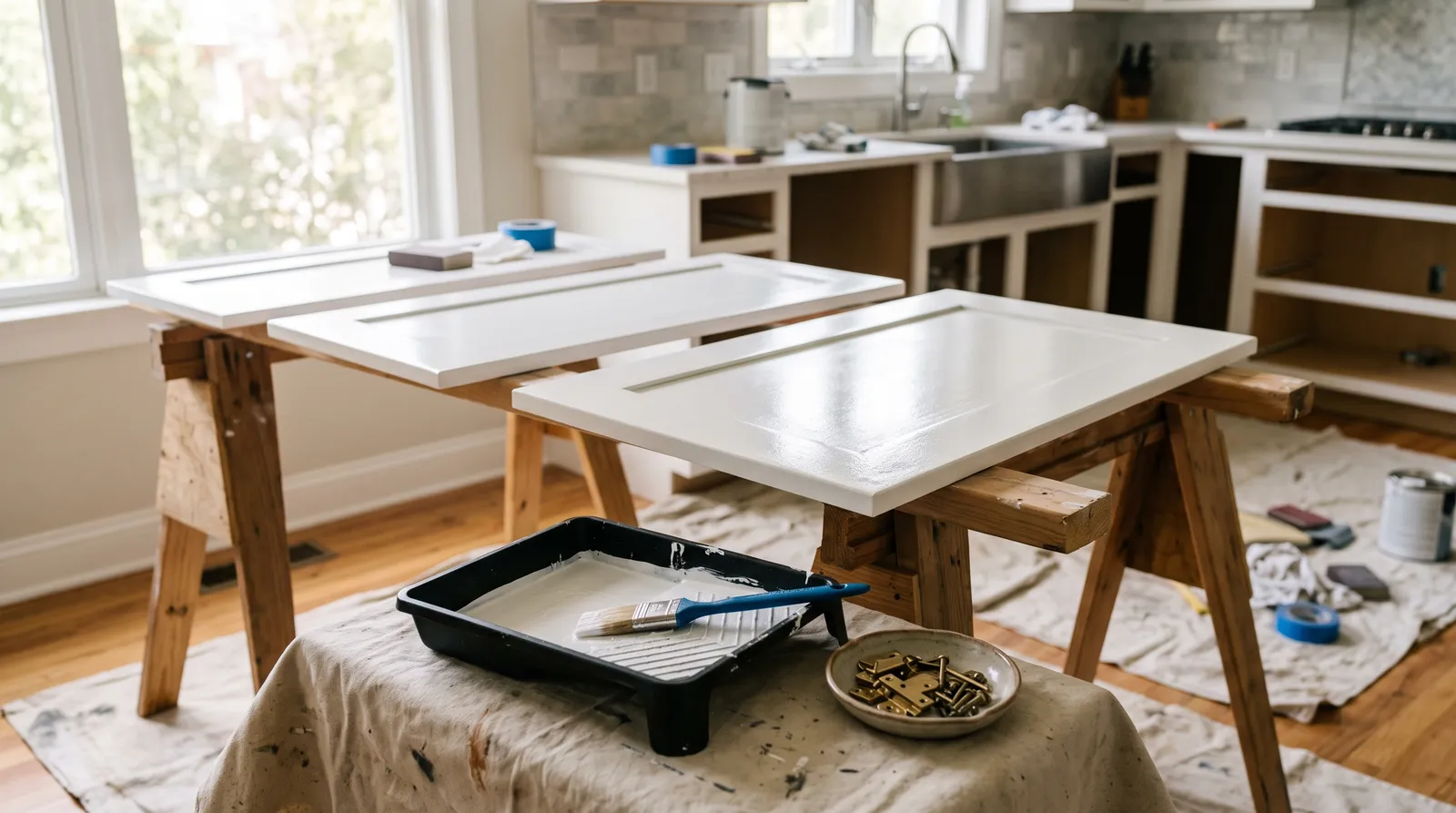
INSL-X Cabinet Coat2 sheens
Coverage350–450 sq ft / gal
Recoat6 hr
VOCUnder 50 g/L
Full cureAbout 14 days
Sheens SatinSemi-Gloss — no gloss
Read this first
The Fast Verdict
Worth it, and it is the best value in cabinet enamel right now. Cabinet Coat is a urethane-reinforced acrylic at 37% volume solids that levels out brush marks better than anything near its $45-60 price, recoats in 6 hours so two coats fit a working day, and cures into a hard film that does not block — the exact row where Emerald Urethane goes soft in dark colors. The honest costs: satin and semi-gloss only, a Benjamin Moore dealer trip for any tinted color because big boxes stock white-only, and about 14 days of gentle treatment while the film cures. Rehang doors on day two and the bumpers will print — that marring window is the single most reported complaint, and the only thing keeping this can from the premium tier's score.
Best for
Brush-and-roll kitchen refinishes · Bathroom vanities · Trim, doors, and built-ins · Furniture · Painting over sound old paint, poly, or varnish without primer · Two-gallon jobs where $35-plus per gallon saved matters
Skip if
You need true high-gloss · The kitchen must return to hard service within days · You are spraying a showpiece and the budget allows Advance or Emerald · No Benjamin Moore dealer nearby and the plan needs a tinted color · Countertops, sinks, or anything heat- or immersion-exposed
What it's good at
- A near-factory finish from a hand brush — the flow-and-level package that built its reputation, and the row where budget enamels visibly lose
- Real cured hardness with no blocking: doors do not stick to bumpers a month later, and pros pick it over Emerald Urethane in dark colors for exactly this
- A 6-hour recoat that puts two coats in one working day — Advance's 16 hours turns the same kitchen into a week of evenings
- Adhesion that earns most of its label: sound old paint, polyurethane, and varnish take it without primer after a clean and a scuff
- Thousands of real colors — four tint bases on the Gennex system at any Benjamin Moore dealer, not a 30-swatch specialty card
- Value: $45-60 against $80-110 for the premium pair, which on a two-gallon kitchen pays for the sprayer rental or the new pulls
What it's not good at
- The first two weeks — the film mars easily until the roughly 14-day cure completes, and rehung doors printing against bumpers is the complaint that follows this paint everywhere
- Forgiving a heavy hand: it tacks fast, and brushing back into setting paint leaves marks that never flow out
- Sheen range — satin and semi-gloss only, no gloss and no flat; the lacquered-island look belongs to Advance High Gloss
- Buying convenience for colors: big boxes stock white-only and Home Depot cannot tint it, so every real color means a Benjamin Moore dealer trip
- Immersion and heat — sinks, tubs, countertops, and stove surfaces are excluded by the label outright
- Sticker clarity online: marketplace listings mix old CC-45XX/CC-55XX codes with current stock at $70-plus markups over the dealer shelf
Same shelf, different cans
Satin or Semi-Gloss — and the Old Can Numbers
Two sheens, one product family — plus a shelf-code wrinkle worth knowing before you buy from a marketplace listing. Cabinet Coat has been reformulated over the years, and older product codes still circulate online alongside the current urethane-acrylic series.
Cabinet Coat Satin (CC-65XX) — the kitchen default
BaseUrethane-reinforced acrylic, 27–32 gloss units at 60 degrees
SheensSatin
Recoat6 hr
YellowingNo — waterborne film stays white
Buy it if
Shaker doors, painted kitchens, anything where a factory-smooth low-key finish should also hide brush texture, filler spots, and ten years of fingerprints.
Avoid if
You want maximum wipe-down sheen on a bath vanity — step to semi-gloss.
Cabinet Coat Semi-Gloss (CC-66XX)
BaseSame urethane-acrylic chemistry, higher sheen
SheensSemi-Gloss
Recoat6 hr
YellowingNo
Buy it if
Bath vanities, trim, and doors that get wiped daily — the extra sheen cleans a shade easier.
Avoid if
The prep is imperfect; semi-gloss spotlights every flaw satin would forgive. And if you want true high-gloss, this line does not make one — that is Advance High Gloss territory.
Older CC-45XX / CC-55XX coded stock
BaseEarlier acrylic and urethane-acrylic generations of the same product
SheensSatin, Semi-Gloss
Recoat6 hr on the labels
YellowingNo
Buy it if
Only knowingly — some marketplace listings and back rooms still carry old-code cans at odd prices.
Avoid if
You can get current CC-65XX/CC-66XX stock from a dealer instead. If a listing's code and price look stale, they probably are.
Numbers, not adjectives
Spec Sheet
- Resin
- Urethane-reinforced acrylic, titanium dioxide pigment
- Coverage
- 350–450 sq ft / gal; about 8 linear feet of uppers and lowers, two coats, per gallon
- Sheens
- Satin (27–32 @ 60°) and Semi-Gloss — no gloss, no flat
- Volume solids
- 37 ± 2%
- Film build
- 3.6–4.6 mils wet · 1.3–1.7 mils dry
- Touch dry
- 1 hr at 77°F / 50% RH
- Recoat
- 6 hr
- Full cure
- About 14 days — the marring window nobody prints on the can
- VOC
- Under 50 g/L; Federal, OTC, CARB, SCAQMD compliant; MPI 140
- Application temp
- 50–90°F, air, product, and surface
- Tint bases
- White (01) plus 1B, 2B, 3B, 4B — Gennex colorants, thousands of BM colors at dealers
- Primer
- None on sound painted or varnished surfaces; Aqua Lock Plus on bare wood; Prime Lock Plus on bleeding woods; acrylic metal primer on bare metal; degloss plus Stix on factory-slick finishes
- Cleanup
- Warm soapy water; give spray gear a final mineral-spirits rinse
- Price
- $45–60 / gal at Benjamin Moore dealers; Amazon and Lowe's white gallon runs $70+; quart and gallon sizes
Application Settings That Work
- Brush
- Where this paint made its name. High-quality synthetic bristle only, short-nap roller under 1/2-inch, and a light lay-off in one direction — it flows out brush marks better than anything near its price. The one rule: do not go back over setting paint. It tacks fast, and overworking is how good cans get bad reviews.
- Airless
- HVLP is INSL-X's preferred spray method: thin with up to 8-10 ounces of clean water per gallon, 1.8 tip, around 20 PSI, and it lays down a genuinely factory film. Airless runs 1,500-2,500 PSI with a 0.011-0.015 fine-finish tip, no thinning. Give spray gear a final mineral-spirits rinse so it does not rust.
- Primer
- Nothing needed over sound previously painted, polyurethaned, or varnished surfaces — clean, scuff-sand, paint; the claim holds. Bare wood wants Aqua Lock Plus or a first coat of Cabinet Coat itself; cedar, redwood, and stain-prone woods want Prime Lock Plus; bare metal wants an acrylic metal primer. Factory-slick thermofoil, melamine, and gloss conversion varnish: degloss and use a bonding primer like Stix. Not for sinks, tubs, or stove surfaces — the label excludes immersion and heat outright.
The 6-Hour Recoat and the 14-Day Cure
Touch dry in 1 hour and recoatable at 6, quoted at 77°F and 50 percent humidity — a schedule that puts two coats in one working day and makes this the fastest project of the three big cabinet enamels. Then comes the part the front of the can never mentions: full cure is about 14 days, and until then the film mars. Contractors call Cabinet Coat notorious for it — doors rehung on day two print where they touch their bumpers, a dish slid across a shelf on day three leaves a track. None of it means the paint failed; the urethane-acrylic film genuinely hardens into one of the tougher waterborne cabinet finishes, with less blocking than Emerald Urethane in dark colors. It just is not there on Monday. Rehang gently after 24 to 48 hours, keep hands and hardware light for two weeks, and remember the TDS's own caveat: cool rooms and high humidity stretch every one of these numbers.
Mid-project panic
When It Goes Wrong, and How to Fix It
Rehung doors printed against their bumpers, or shelves marked where things sat
Why it happens. This is the 14-day cure collecting its bill. The film that felt dry in an hour is still soft underneath for days, and Cabinet Coat's early-cure marring is the single most consistent complaint pros report about an otherwise loved product.
The fix. Wait — the marks are cosmetic and the film keeps hardening. Rehang doors gently after a day or two, leave bumpers off for the first week or swap in fresh soft ones, and give shelves two weeks before loading. Light marks often relax as cure completes; deep ones need a scuff and a quick recoat.
Brush marks that never leveled out
Why it happens. Cabinet Coat dries fast, and a brush dragged back through paint that has started to set leaves tracks that cannot flow back out. Overworking is the failure mode the TDS itself warns about.
The fix. Load the brush, lay the paint off in one direction, and walk away — no second pass. Keep a wet edge, work one door face at a time, and use a quality synthetic brush only. For a glassier result, switch to HVLP thinned 8-10 ounces of water per gallon.
Peeling or poor grip on factory-finish doors
Why it happens. The no-primer adhesion claim is real over sound old paint, poly, and varnish — but narrower than the label reads. Thermofoil, melamine, high-gloss conversion varnish, and laminate are the surfaces the TDS quietly says should be properly deglossed first.
The fix. Degloss thoroughly with a fine sanding, wipe clean, and put a bonding primer like INSL-X Stix under the enamel on anything factory-slick. One extra coat of the right primer is cheaper than stripping a peeled kitchen.
You cannot get it tinted at the big box
Why it happens. Home Depot lists INSL-X online only and store paint desks carry no tint formulas for it; Amazon and Lowe's stock the ready-mix white. The tint bases run on Benjamin Moore's Gennex system, which only BM dealers mix.
The fix. For any color beyond white, buy at a Benjamin Moore dealer — that is also where the honest $45-60 price lives. If white is the plan and no dealer is near, the online white gallon works; just expect the markup.
Side by side
Cabinet Coat vs Advance vs Emerald Urethane
The three-way decision nearly every cabinet repaint comes down to. All three are waterborne hybrid enamels; the real differences are schedule, cured film, and a $35-to-$60-per-gallon price spread on a job that usually takes two gallons.
| INSL-X Cabinet Coat | Benjamin Moore Advance | SW Emerald Urethane | |
|---|---|---|---|
| Street price per gallon | $45–60 at BM dealers | $80–95 at BM stores | $95–110 at SW stores; sales near $80 |
| Resin | Urethane-reinforced acrylic | Waterborne alkyd | Urethane-modified acrylic |
| Sheens | Satin, Semi-Gloss | Satin, Semi-Gloss, High-Gloss | Satin, Semi-Gloss, Gloss |
| Touch dry | 1 hr | 4–6 hr | 1–2 hr |
| Recoat | 6 hr | 16 hr | 4 hr |
| Full cure | About 14 days | 30 days | About 7 days |
| Blocking resistance | Strong — hardens without sticking, dark colors included | Excellent once cured; long soft window first | Weakest of the three in deep bases — pros report it stays soft |
| Leveling by brush | Excellent for the price | The benchmark | Good; happiest through a sprayer |
| VOC | Under 50 g/L | 100 g/L | Under 50 g/L |
| Buy it for | Value, brushwork, and a weekend schedule | The best brush finish available, high-gloss, deep colors | Sprayed kitchens and the fastest return to service |
Street price per gallon
INSL-X Cabinet Coat$45–60 at BM dealers
Benjamin Moore Advance$80–95 at BM stores
SW Emerald Urethane$95–110 at SW stores; sales near $80
Resin
INSL-X Cabinet CoatUrethane-reinforced acrylic
Benjamin Moore AdvanceWaterborne alkyd
SW Emerald UrethaneUrethane-modified acrylic
Sheens
INSL-X Cabinet CoatSatin, Semi-Gloss
Benjamin Moore AdvanceSatin, Semi-Gloss, High-Gloss
SW Emerald UrethaneSatin, Semi-Gloss, Gloss
Full cure
INSL-X Cabinet CoatAbout 14 days
Benjamin Moore Advance30 days
SW Emerald UrethaneAbout 7 days
Blocking resistance
INSL-X Cabinet CoatStrong — hardens without sticking, dark colors included
Benjamin Moore AdvanceExcellent once cured; long soft window first
SW Emerald UrethaneWeakest of the three in deep bases — pros report it stays soft
Leveling by brush
INSL-X Cabinet CoatExcellent for the price
Benjamin Moore AdvanceThe benchmark
SW Emerald UrethaneGood; happiest through a sprayer
Buy it for
INSL-X Cabinet CoatValue, brushwork, and a weekend schedule
Benjamin Moore AdvanceThe best brush finish available, high-gloss, deep colors
SW Emerald UrethaneSprayed kitchens and the fastest return to service
Advance still owns the last 20 percent of finish quality — it levels flatter, offers true high-gloss, and its 30-day cure ends in the hardest film of the three. Emerald Urethane owns speed and the sprayer: 4-hour recoats, service hardness inside a week — but its soft film in dark colors is exactly the row where the cheapest can here beats it. Cabinet Coat owns the middle, which for most readers is the win: 90 percent of either premium film, the friendliest brush behavior per dollar in the category, a 6-hour recoat that fits two coats into a Saturday, and $35-plus per gallon left over for hardware. Brushing a kitchen on a budget, buy Cabinet Coat. Spraying a showpiece or chasing deep-color perfection, spend up.
If not this one
Honest Alternatives
BM
Benjamin Moore Advance$80–95 / gal
The premium brush finish from the same corporate family. It levels a touch flatter, adds a high-gloss option, and cures rock hard — if you can wait out a 16-hour recoat and a 30-day cure. Buy it when the finish is the point and patience is in stock.
Full review →SE
SW Emerald Urethane Trim Enamel$95–110 / gal
The sprayed-kitchen pick: 4-hour recoat, service hardness in about a week, and the best atomization of the three. Its known weakness — a film that stays soft in dark colors — is the one row Cabinet Coat wins outright.
Full review →BP
Behr Premium Cabinet, Door & Trim Enamel$30–40 / gal
The budget seat, tinted at any Home Depot. Genuinely fine paint with two asterisks: a soft-film cure window measured in months, and higher yellowing risk on sunlit whites. The pick when budget rules and the kitchen can wait.
Questions people actually ask
Cabinet Coat Questions, Answered
Is INSL-X Cabinet Coat good for kitchen cabinets?
Yes — it is the value pick most pro painters name first. It is a urethane-reinforced acrylic enamel at 37% volume solids that levels out brush marks, recoats in 6 hours, and cures to a hard, non-blocking film that shrugs off grease and washing. At $45-60 a gallon it delivers most of the finish of Benjamin Moore Advance at roughly half the price. The trades: only satin and semi-gloss, a dealer trip to get it tinted, and about 14 days of gentle treatment while the film cures.
Do you need primer with Cabinet Coat?
Not on previously painted or varnished surfaces in good condition — clean, scuff-sand, and go; the adhesion claim is real there, even over polyurethane. You do need primer on bare wood (Aqua Lock Plus or a first coat of Cabinet Coat itself), a stain-blocker like Prime Lock Plus on cedar, redwood, or anything that bleeds, and an acrylic metal primer on bare metal. On factory-slick thermofoil, laminate, or glossy conversion varnish, degloss thoroughly and use a bonding primer like INSL-X Stix.
How long does Cabinet Coat take to cure?
Touch dry in 1 hour and recoatable in 6, but the film needs about 14 days to reach full hardness. That gap catches people: doors rehung on day two will mar where they touch bumpers, and a dish slid across a shelf leaves a print. Rehang gently after 24-48 hours, keep traffic light for two weeks, and it cures into one of the harder waterborne cabinet films.
Can Cabinet Coat be tinted to any color?
Close to it. Beyond the ready-mix white, it comes in 1B, 2B, 3B, and 4B tint bases and takes Benjamin Moore's Gennex colorants, so a BM dealer can mix thousands of colors including deep ones. The catch is where you buy: Amazon and big-box listings are essentially white-only, and Home Depot has no INSL-X tint formulas at the paint desk.
Cabinet Coat vs Benjamin Moore Advance, which should you buy?
Advance if you want the absolute best brush finish, high-gloss, or deep colors, and can wait out a 16-hour recoat, a 30-day cure, and an $80-95 price. Cabinet Coat recoats at 6 hours, resists blocking sooner, and costs $45-60. For most brushed DIY kitchens the finish gap is smaller than the price gap; Advance earns its premium on high-end, sprayed, or deep-color jobs.
Can you spray Cabinet Coat?
Yes. INSL-X recommends HVLP first: thin with up to 8-10 ounces of clean water per gallon, 1.8 tip, around 20 PSI. Airless works at 1,500-2,500 PSI with a 0.011-0.015 tip, no thinning required. It also brushes better than most sprayable enamels, which is most of its reputation.
Does Cabinet Coat come in gloss?
No. The line is satin (about 27-32 gloss units at 60 degrees) and semi-gloss. Most kitchens want one of those two anyway; a true high-gloss lacquered look means Benjamin Moore Advance High Gloss from the same family.
Where can you buy INSL-X Cabinet Coat?
Benjamin Moore dealers are the real channel — that is where it gets tinted and where the $45-60 shelf price lives. Amazon and Lowe's list the ready-mix white gallon at a markup, useful if white is the plan and there is no dealer nearby. Home Depot lists INSL-X online only, with no in-store tinting.
Keep exploring
INSL-X brand guide and product linesBenjamin Moore Advance review (the premium alternative)SW Emerald Urethane Trim Enamel reviewBest kitchen cabinet paints, ranked
We may earn a commission when you buy through the retailer link above. It never changes the score or the verdict.
Ask a Question