Product review · Behr · Updated August 11, 2026
Behr ProBehr paint review
6.8/10Honest production paint at an honest production price — and a bad substitute for the retail shelf the brand name makes you picture.
The contractor family at the Home Depot Pro desk — i100 and i300 inside, e500 and e600 outside — and almost certainly what a painter means when the quote says Behr. The whole review comes down to one question worth asking out loud: which series, in writing.

Maya Patel · Reviews Editor & Product Tester · Updated August 11, 2026
Maya spent five years running comparative product testing at a consumer testing nonprofit before joining CompositePaint. She has rolled every rung of the Behr ladder and priced the same gallons against Sherwin-Williams and Benjamin Moore at full retail. About the testing process →
Behr Behr Pro13 sheens
Coverage300–400 sq ft / gal interior
Dry / recoatInterior: touch 1 hr
VOCi300 under 5 g/L
Full cure2 weeks before washing, all series
Sheens i100 Dead FlatFlatEggshellSemi-Glossi300 Dead FlatEggshellSemi-Glosse600 FlatLow LustreSatinSemi-Glosse500 FlatSatin
Read this first
The Fast Verdict
As production paint, worth it. The i300 is a legitimate spray-grade contractor gallon — zero-VOC under 5 g/L, GREENGUARD Gold, a mildew-resistant film, and a two-hour recoat that beats ProMar's four — at about $21.80 a gallon in the 5-gallon. The e600 exterior is the sleeper of the family: 100% acrylic, applies down to 35°F, and it finished second in an independent three-year weathering test ahead of Marquee, Emerald, and Aura as the cheapest can in the group. The catch is the tier below: i100 is a thin PVA economy paint that only tints to whites and pastels, and it is what many homeowners unknowingly get when a contractor quotes Behr. Nothing in the family has primer in the can, and the warranty is one year against the retail lines' lifetime. If Behr Pro is going on your walls, insist on knowing which series — that single question is most of this review.
Best for
New-construction spraying · Apartment and rental unit turns · Builder spec and volume repaints · Ceilings in i100 dead flat · Occupied units on the zero-VOC i300 · Big exteriors and cold-season exterior work on e600
Skip if
You expected retail-Behr durability from the word Behr on a quote · Kitchens, baths, and hallways that get scrubbed · A color the i100 tint ceiling cannot mix · Buying single gallons at sticker without a Pro account · Any job where nobody will tell you which series is in the bid
What it's good at
- Production speed — one-hour touch and two-hour interior recoat, half the wait of ProMar and both Valspar contractor lines; two coats in a working day
- Spraying: rig-first data sheets, do-not-thin package consistency, and i100 flats that hold sheen uniformity sprayed without backroll
- The i300's paperwork — zero-VOC under 5 g/L, GREENGUARD Gold, MPI listings, mildew-resistant film — spec-binder credentials at a $22 price
- The e600 exterior outright: 100% acrylic, applies down to 35°F, and second place in an independent three-year weathering test as the cheapest can in the group
- Touch-up — both interior dead flats spot-roll a repair without a halo, the exact skill unit turns need
- Five-gallon economics: about $21.80 a gallon for i300 eggshell before account discounts, across a portfolio or a spec house
What it's not good at
- Being what the brand name implies — 'Behr' on a quote reads as Marquee and arrives as i100; no other gap costs more goodwill
- Priming: nothing in the family self-primes on the label, and unprimed patches flash straight through the thin films
- The i100 tint ceiling — 2 fl oz of colorant per gallon means whites and pastels only, full stop
- Scrubbed walls; even retail Premium Plus out-scrubs the Pro interiors, and i100 burnishes like the economy PVA it is
- Warranty — one year against lifetime on the shelf ten aisles over
- Casual buying: thin in-store stock, special orders, and pricing that only makes sense with a Pro account and volume
Same shelf, different cans
Which Behr Pro Are You Actually Getting?
Four paint series wear the PRO bucket, and the spread between the top and bottom of the family is wider than the spread between i300 and the retail shelf. When a contractor's quote says Behr, this is the table to check it against — and note there is no current SKU called Pro Mark; the marking paints at the Pro desk are Rust-Oleum's.
Behr Pro i100 Interior — the floor
BasePVA latex, under 50 g/L VOC; white base only, 2-fl-oz tint max (whites and pastels)
SheensDead Flat, Flat, Eggshell, Semi-Gloss
Recoat2 hr
YellowingNo
Buy it if
Ceilings, closets, and white-over-white unit turns at maximum speed — the flats hold sheen sprayed without backroll and touch up clean.
Avoid if
Anyone lives against the wall, the wall gets wiped, or your color is anything past a pastel. This is the bucket the brand-name confusion is about.
Behr Pro i300 Interior (the working tier)
BasePVA/acrylic blend, zero-VOC under 5 g/L, GREENGUARD Gold, mildew-resistant film; white + deep base
SheensDead Flat, Eggshell, Semi-Gloss
Recoat2 hr
YellowingNo
Buy it if
Anything with people in it — occupied units, offices, real colors. The one to insist on if Behr Pro is going on your walls.
Avoid if
A scrubbed family kitchen or hallway; the retail lines from Premium Plus up exist for those rooms.
Behr Pro e500 Exterior
Base100% acrylic, under 50 g/L VOC, ~2,500 colors, rated to 35°F
SheensFlat, Satin
Recoat4 hr
YellowingNo
Buy it if
New-construction siding sprayed at production pace — 5-gallon only, built for a consistent finish without backroll.
Avoid if
You need it today (special order in many stores) or in any sheen past satin.
Behr Pro e600 Exterior (the sleeper)
Base100% acrylic, under 50 g/L VOC, 33% solids in flat; white + deep base, rated to 35°F
SheensFlat, Low Lustre, Satin, Semi-Gloss
Recoat4 hr
YellowingNo
Buy it if
Almost any big exterior — it finished second in an independent three-year weathering test, ahead of paints costing three times as much.
Avoid if
You want a long paper warranty behind a premium exterior; e600 carries the family's 1-year limited.
Numbers, not adjectives
Spec Sheet
- Series
- i100 and i300 interior · e500 and e600 exterior
- Coverage
- 300–400 sq ft / gal interior · 250–400 e600 flat
- Volume solids
- i100 dead flat 29% · i100 eggshell 33% · i300 semi-gloss 35% · e600 flat 33%
- Resin
- i100 PVA · i300 PVA/acrylic blend · e500 and e600 100% acrylic
- Dry / recoat
- Interior: touch 1 hr, recoat 2 hr · e600: touch 2 hr, recoat 4 hr (77°F / 50% RH)
- Full cure
- 2 weeks before washing, all series
- VOC
- i300 under 5 g/L (zero-VOC), GREENGUARD Gold · i100, e500, e600 under 50 g/L
- Mildew resistance
- i300 and e600 dried films are mold/mildew resistant; i100 makes no such claim
- Primer
- None built in — Behr's system sheets specify separate primers on new drywall, masonry, wood, and metal
- Tint bases
- i100 white base only, 2-fl-oz max load (whites and pastels) · i300 / e600 add a deep base · e500 ~2,500 colors
- Spray specs
- Airless tips .015–.021 in · 60-mesh filter · 1,400–3,200 psi by product · do not thin
- Warranty
- 1-year limited — retail Behr lines carry lifetime limited
- Price
- Pro desk pricing: i300 5-gal near $109 (~$21.80/gal), i300 singles $22–28, i100 below that; volume accounts pay less
Application Settings That Work
- Brush
- Brushes and rolls fine at contractor pace with a 3/8 to 3/4 in nap, and the dead flats forgive lap marks. The films are production-thin, so keep the roller loaded and expect a firm two coats on anything but white-over-white.
- Airless
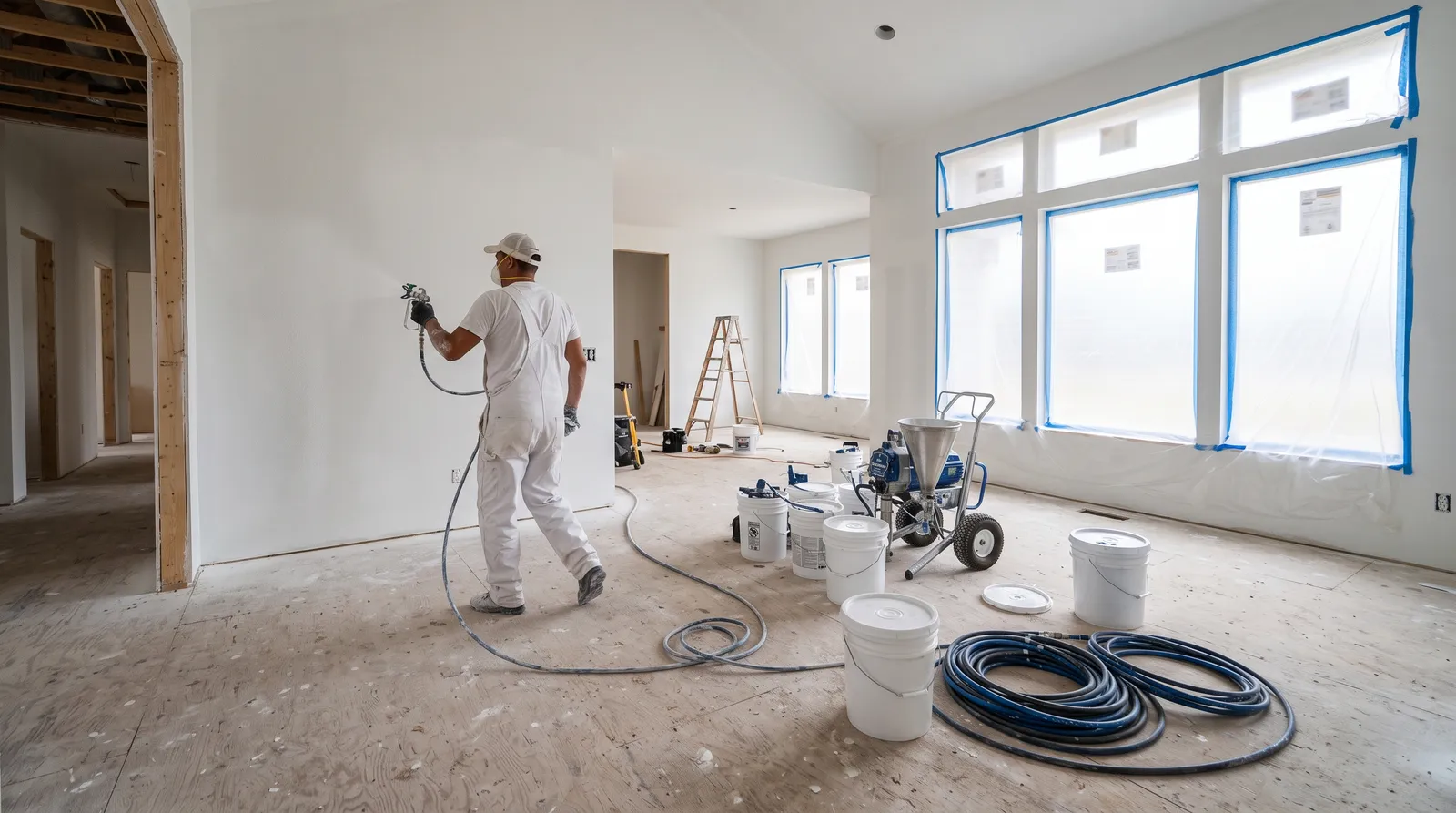
- The family's home turf — every data sheet reads rig-first: .015–.021 in tips by product, 60-mesh filter, 1,400–3,200 psi, and do-not-thin at package consistency. The i100 flats are formulated to hold sheen uniformity sprayed without backroll, which is the whole game on ceiling runs; the i300 and both exteriors spec spray-and-backroll for full coverage on porous substrates.
- Primer
- Nothing is built in, anywhere in the family. New drywall wants KILZ PVA (PX010) or Behr's PR040 high-build primer; stains want a dedicated blocker; masonry, wood, and metal each get their own primer per the system sheets. The i100 sheets allow two self-priming coats on new drywall as a budget route — patches and color changes still flash without real primer underneath.
Dry Times, Cure, and the Production Schedule
The interior numbers are the family's best argument: touch dry in one hour and recoat in two at 77°F and 50% humidity — half the recoat wait of SW ProMar 200/400 and both Valspar contractor lines — so a crew primes in the morning and double-coats by close. The e600 runs a normal exterior schedule at two and four hours but applies down to 35°F, stretching the exterior season weeks past most retail paints. The number nobody quotes: full cure is two weeks across the family, and the data sheets say not to wash the film before then. And on the i100 especially, dry and durable stay two different things permanently — the film that recoats in two hours is the same 29-percent-solids film a sponge burnishes in month six.
Mid-project panic
When It Goes Wrong, and How to Fix It
You paid for Behr and the walls feel like builder-grade paint
Why it happens. Because they probably are — and nobody lied, exactly. Behr Pro is a separate contractor line with thinner PVA-based films, no primer in the can, and a 1-year warranty against the retail shelf's lifetime. A quote that says Behr covers everything from a $17 i100 bucket to a $70 Marquee gallon.
The fix. Before the job: get the series and sheen in writing and price the upgrade to i300 or retail Ultra — usually a small line item. After the job: the can labels tell you what you got, and the practical fix for a burnishing i100 wall is a repaint in a retail line, not more scrubbing.
Every drywall patch flashed through the finished wall
Why it happens. Nothing in the family self-primes on the label. Behr's own system sheets put a PVA drywall primer or the PR040 high-build primer under both interior series on new board, and joint compound drinks paint at a different rate than the wall around it. At 29 to 35 percent solids there is not enough film to bury the difference.
The fix. Spot-prime every patch before the finish coats — the i100 sheets allow two self-priming coats on new drywall as a budget route, but patches and color changes still want real primer. If the bid says two coats total over raw patches, the flashing was pre-ordered.
The store cannot mix your color in the quoted paint
Why it happens. The i100 white base physically accepts 2 fluid ounces of colorant per gallon — whites, off-whites, and pastels are the entire menu. Mid-tones and saturated colors need the i300 or e600 deep base, or a retail line.
The fix. This is a tier decision disguised as a color problem. Move to i300 for the walls that carry the color and let i100 keep the ceilings — do not let the answer be changing your color to fit the cheapest bucket.
A shiny track appeared where the i100 wall gets touched
Why it happens. A 29-percent-solids PVA dead flat is the most burnish-prone film in the Behr catalog. Hands at switch height, furniture contact, or one enthusiastic sponge pass polishes a permanent sheen into it — the same physics as every economy contractor flat.
The fix. There is no cleaner for burnish; you re-roll to a corner or live with it. Upstream fix: i300 in the sheens people touch, retail Ultra in rooms cleaned on a schedule, and save the i100 for ceilings, where nothing touches it.
Fresh walls scuffed and marked within the first week
Why it happens. Two-hour recoat, two-week cure. The film that let the crew finish in a day keeps hardening for fourteen days, and the data sheets say not to wash it before then. Move-in traffic during week one prints into any paint in this family.
The fix. Schedule the move around the cure, not the recoat — furniture pads on day one, no wall washing for two weeks. Marks made during cure often wipe off gently once the film hardens; scrubbing them early makes them permanent.
Side by side
Behr Pro i300 vs SW ProMar 200 vs Behr Premium Plus
The two comparisons a Behr Pro decision actually runs against: the Sherwin-Williams can behind your other bid, and the cheapest retail Behr a homeowner could buy instead on a Saturday.
| Behr Pro i300 | SW ProMar 200 | Behr Premium Plus | |
|---|---|---|---|
| Positioning | HD Pro desk working tier | SW-store trade default | Retail floor, homeowner shelf |
| Resin | PVA/acrylic blend | Vinyl acrylic | 100% acrylic |
| Volume solids | Up to 35% (semi-gloss) | About 42% (eg-shel) | Heavier retail film |
| Built-in primer | No | No | Yes — self-priming |
| VOC / certs | Under 5 g/L, GREENGUARD Gold | Zero-VOC as tinted, GREENGUARD Gold | Under 5 g/L in wall sheens |
| Mildew package | Yes — dried-film resistant | Yes — antimicrobial additive | Standard retail |
| Recoat | 2 hr | 4 hr | 2 hr |
| Warranty | 1-year limited | Trade product | Lifetime limited |
| Street price per gallon | $22–28; 5-gal ~$21.80/gal | $38–48 with account | $33–43 retail |
| Where it wins | Speed, spray, price, air-quality paperwork | Film build and lived-in wall durability | Warranty, full color library, no account needed |
Positioning
Behr Pro i300HD Pro desk working tier
SW ProMar 200SW-store trade default
Behr Premium PlusRetail floor, homeowner shelf
Volume solids
Behr Pro i300Up to 35% (semi-gloss)
SW ProMar 200About 42% (eg-shel)
Behr Premium PlusHeavier retail film
VOC / certs
Behr Pro i300Under 5 g/L, GREENGUARD Gold
SW ProMar 200Zero-VOC as tinted, GREENGUARD Gold
Behr Premium PlusUnder 5 g/L in wall sheens
Mildew package
Behr Pro i300Yes — dried-film resistant
SW ProMar 200Yes — antimicrobial additive
Behr Premium PlusStandard retail
Street price per gallon
Behr Pro i300$22–28; 5-gal ~$21.80/gal
SW ProMar 200$38–48 with account
Behr Premium Plus$33–43 retail
Where it wins
Behr Pro i300Speed, spray, price, air-quality paperwork
SW ProMar 200Film build and lived-in wall durability
Behr Premium PlusWarranty, full color library, no account needed
ProMar 200 lays down more paint per pass and out-lasts i300 on a wall people live against; i300 recoats twice as fast, costs meaningfully less, and brings better air-quality certs to an occupied unit. That is the whole reason builders spec Behr Pro and repaint crews with SW accounts spec ProMar — and why i100's honest rival is ProMar 400, right down to the thin film and the excellent dead flat. For a homeowner buying their own paint, the third column ends the debate: Premium Plus is self-priming, tints to every Behr color, carries a lifetime warranty, and needs no account. The contractor aisle only wins when someone is buying it by the pallet.
If not this one
Honest Alternatives
SW
Sherwin-Williams ProMar 200$38–48 / gal with account
The trade default from the other counter: roughly 42 percent solids in eg-shel, an antimicrobial additive, and better long-term durability in lived-in rooms, at a higher price and double the recoat time. If your two bids are Behr and Sherwin, this is usually the can behind the second one.
Full review →BP
Behr Premium Plus or Ultra$33–52 / gal retail
The homeowner exit. Premium Plus buys self-priming, the full 3,000-color library, and a lifetime warranty for about $10 over i300 singles; Ultra adds the scuff and stain package that makes walls actually wipeable. If you are supplying your own paint, skip the contractor aisle entirely.
Full review →PS
PPG Speedhide$25–35 / gal
PPG's builder-spec line playing the same position from the PPG and supply-house side — acceptable hide, production speed, case pricing to property managers and new-construction crews. Worth a bid check in markets where PPG houses are strong.
Full review →Questions people actually ask
Behr Pro Questions, Answered
Is Behr Pro good paint?
For production work, yes. The i300 is a legitimate spray-grade contractor paint — zero-VOC, GREENGUARD Gold, mildew-resistant film, two-hour recoat — and the e600 exterior beat several premium paints in an independent three-year weathering test. The i100 below them is a thin PVA economy paint that only tints to whites and pastels, and it is what many homeowners unknowingly get when a contractor quotes Behr.
What is the difference between Behr Pro and regular Behr paint?
Behr Pro is a separate contractor line sold through the Home Depot Pro desk: PVA and PVA/acrylic films at 29–35 percent volume solids, no primer in the can, narrower tinting on the bottom tier, and a 1-year limited warranty. Retail Premium Plus, Ultra, Marquee, and Dynasty are self-priming 100% acrylics with heavier films and a lifetime limited warranty. Same brand name on the bucket, different product underneath.
Behr Pro i100 vs i300 — what is the difference?
i100 is the floor: PVA resin, 29 to 33 percent solids, under-50 g/L VOC, and a 2-fl-oz tint ceiling that limits it to whites and pastels. i300 is the working tier: PVA/acrylic blend, up to 35 percent solids, zero-VOC under 5 g/L, GREENGUARD Gold, a mildew-resistant film, and a deep base for real colors. They sit a few dollars apart, and on any wall someone lives against, that is the biggest quality jump in the family.
My contractor quoted Behr — which paint am I actually getting?
Most likely i100 or i300 inside and e600 outside, bought at the Pro desk — not the retail cans from the ads. Ask for the series and sheen in writing, ask what primer goes on first, ask whether your color can be mixed in that series, and price the upgrade to i300 or retail Ultra. On a whole-house repaint the material difference is usually tens of dollars per room.
Does Behr Pro have primer in it?
No tier of it carries the paint-and-primer label. Behr's system sheets specify a separate primer on new drywall, masonry, wood, and metal — KILZ PVA or the PR040 high-build on board. The i100 sheets allow two self-priming coats on new drywall as a budget route, but patches and color changes still flash without a real primer underneath.
What is Behr Pro e600?
The exterior workhorse: a 100% acrylic spray-first exterior paint in flat, low lustre, satin, and semi-gloss, rated for application down to 35°F at under 50 g/L VOC. In The Paint Pals' three-year outdoor weathering experiment it finished second overall — ahead of Behr Marquee, SW Emerald, and Benjamin Moore Aura — as the cheapest paint in the test.
Is Pro Mark a real Behr product?
No. Behr's current Pro catalog is the i100 and i300 interior series, the e500 and e600 exterior series, and supporting primers and coatings — there is no SKU called Pro Mark. The marking paints sold at the Home Depot Pro desk are Rust-Oleum's, not Behr's.
How much does Behr Pro cost?
Pro desk pricing that moves with account volume. Reference points: the i300 eggshell 5-gallon lists near $109 at Home Depot — about $21.80 a gallon — i300 singles run roughly $22–28, and i100 sits a few dollars under that. That is half to a third of the retail premium lines per gallon, which is the entire reason it exists.
Keep exploring
Behr brand guide and product linesBehr Premium Plus review (the retail floor)SW ProMar 200 review (the direct rival)SW ProMar 400 reviewBehr Marquee vs Premium Plus
We may earn a commission when you buy through the retailer link above. It never changes the score or the verdict.
Ask a Question