Best Corner Cut-In Tools in 2026
Five corner painting tools tested in real inside corners — wall-to-wall, wall-to-ceiling, behind toilets. Top pick: Shur-Line 2006559 Premium for the cleanest freehand corner line.

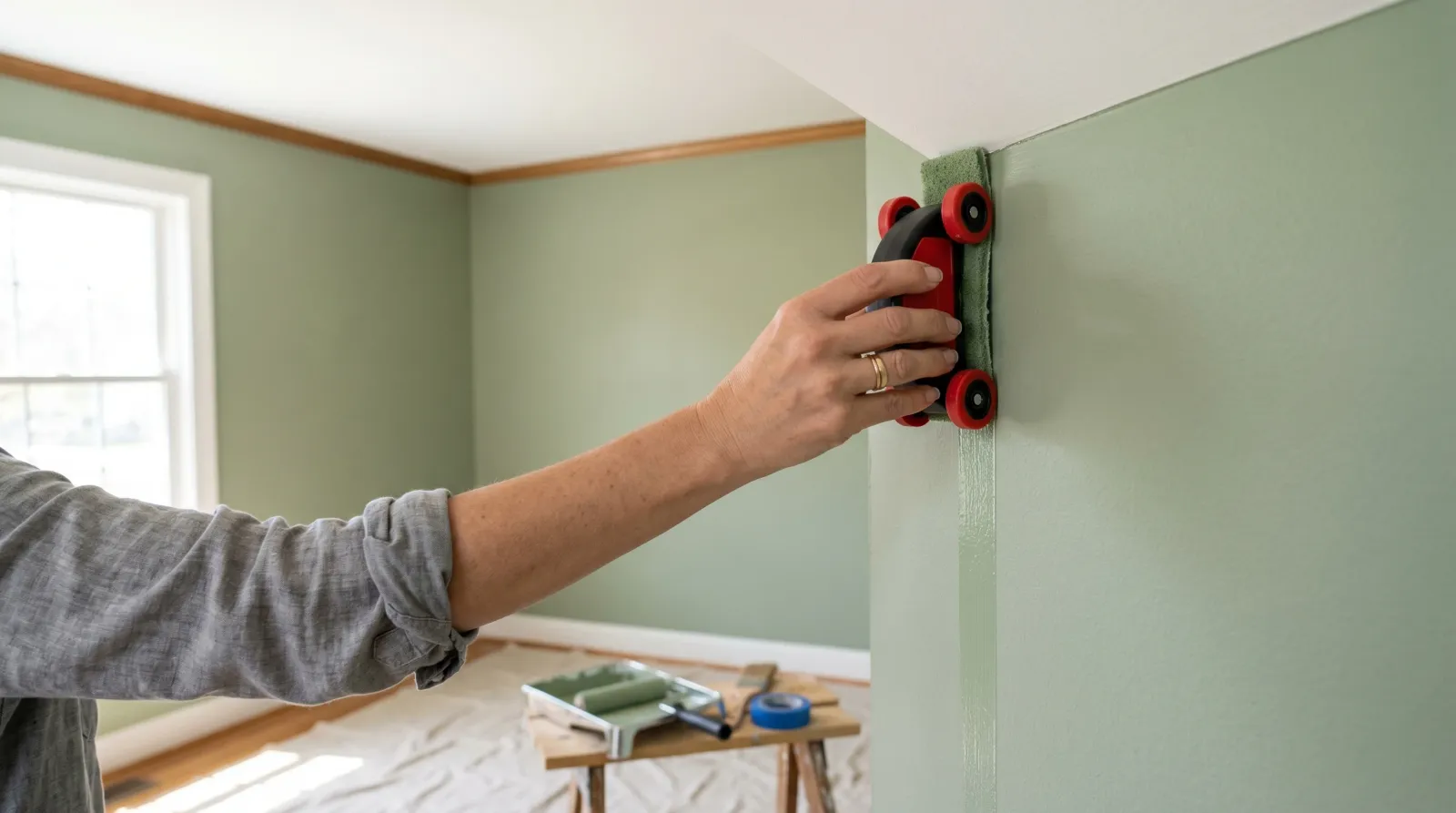
Disclosure: Some links below are affiliate links. We earn a commission if you buy through them, at no extra cost to you.
Top pick: Shur-Line 2006559 Premium Paint Edger. Inside corners are where most paint jobs fail visibly, and the Shur-Line is the only flock-pad tool we tested whose swivel head pivots into the corner crease without the wheels lifting and smearing the adjacent wall. It wins on corner geometry and on a $4 replaceable pad. It falls short on textured walls, where the pad bridges any orange-peel pit and the line waves. The Wagner SMART Edge Roller is the texture-wall answer. The Accubrush XL is the kit for a whole-house no-tape repaint where you’ll eat the learning curve once and recover it five rooms later. The HomeRight Quick Painter is the pick when the corner is behind a toilet tank or under a vanity. Bates earns the budget slot for a single powder-room job.
A heads-up. Inside corners are a different problem from wall-to-ceiling cut-ins. If you’re cutting the long flat line where a wall meets the ceiling, the paint edger round-up is the closer fit. This article is about the corner crease (wall meeting wall, wall meeting ceiling at the turn, the awkward fixture corners) where most edgers go from clean to smear in a single pull.
The Corner Is Where Paint Jobs Fail Visibly
A roller covers the field. A cut-in brush handles the long lines. The corner is the place a homeowner spots from across the room six months later and decides the paint job looks amateur. Two walls meet at a 90-degree crease. Wet paint on one side, the adjacent wall the wrong color, a tool that has to lay a sharp line right up to the crease without smearing across it. Most edgers were built for the flat run, not the turn. They smear at the corner because the wheels lose contact, the pad rotates, and fresh paint mashes onto a wall it was never meant to touch.
The five tools below either solve that problem or work around it.
How We Picked
Five corner tools, three weeks, three real rooms: a smooth-drywall bedroom, a hallway with light orange-peel, and a powder room with a tight behind-toilet corner. Each tool cut 30 linear feet of inside corner across wall-to-wall verticals, wall-to-ceiling horizontals, and behind-fixture geometry, then was photographed under raking LED at 24 hours and scored against a blue-tape control on corner sharpness, smear onto the adjacent wall, and paint creep into the crease.
The Picks at a Glance
| Tool | Format | Corner reach | Texture-wall use | Price |
|---|---|---|---|---|
| Shur-Line 2006559 Premium | Swivel flock pad + wheels | 🟢 1/8” from crease | 🔴 No | $ |
| Accubrush XL | Brush + guard roller | 🟢 At the crease | 🟡 Acceptable | $$ |
| HomeRight Quick Painter | Foam pad + reservoir | ⚪ 1/8” from crease | 🔴 No | $$ |
| Bates Choice Paint Edger | Flock pad + wheels | 🟡 1/4” from crease | 🔴 No | $ |
| Wagner SMART Edge Roller | Mini-roller + battery feed | ⚪ 1/16” feathering | 🟢 Yes | $$$ |
The table reads by corner geometry and wall surface. Smooth drywall and a swivel-head wheeled edger is the sweet spot. Add a real brush head if you want the cut to reach the actual crease. Switch to a mini-roller if your walls have any texture. Switch to a reservoir-fed pistol grip if the corner is behind plumbing.
The Three Decisions That Pick the Corner Tool
Where the Corner Lives in the Room
A wall-to-wall vertical corner in the open is the easy case. A wall-to-ceiling horizontal corner at the turn of a stairwell is harder. A corner four inches behind the back of a toilet tank is hardest. Match the tool body to the geometry. Wheeled-pad edgers need clearance to swing, so they fail behind toilets. A pistol-grip reservoir tool like the HomeRight reaches into spaces neither a wheeled edger nor a regular brush handle clears. A pole-fed tool like the Accubrush XL handles tall corners that a hand-held edger can’t reach without a ladder.
If your corner sits in the open and within arm’s reach, almost anything works. If the corner is awkward, the tool decides the job.
Wall Surface
The single biggest filter. A flock or foam pad bridges any wall texture above light orange-peel. On knock-down or popcorn-adjacent walls, no flat-pad corner tool here will work no matter what the box says. The Wagner SMART Edge Roller is the only format that handles texture because the mini-roller deforms into the texture instead of skipping across it. The cost is a softer cut at the crease (about 1/16 inch of feathering you’ll see under a vanity light). On smooth drywall, the Shur-Line cuts sharper.
Drag a fingertip up the wall with your eyes closed. If the texture catches your nail, it’s textured.
How Close You Need to Get to the Crease
This is the corner-specific call that the regular edger round-up doesn’t ask. A wheeled flock-pad tool gets to about 1/8 to 1/4 inch from the crease. A foam pad compresses slightly closer. The Accubrush XL is the only edger here whose brush head reaches the actual crease, because there’s a real bristle brush at the front instead of a pad. The mini-roller leaves the most feathering of any tool tested.
For most rooms, 1/8 inch from the crease plus a brush touch-up is fine. For a designer-spec primary bedroom or a powder-room accent wall where the corner sits under critical light, the Accubrush head earns its slot.
1. Shur-Line 2006559 Premium Paint Edger — Top Pick
Most “corner painting tool” articles default to the cheapest wheeled edger on the shelf and skip the corner test entirely. The Shur-Line Premium is the tool that survives the corner test. Two design choices make it work where the budget tools fail.
The first is the swivel head. The pad mounts on a small pivot so it rotates independent of the body. At an inside corner, you carry the pull through the turn and the pad pivots while the wheels stay planted. Cheaper edgers fix the pad rigidly to the body; at the corner the whole tool rotates, the wheels lift, and paint mashes onto the adjacent wall. The Shur-Line is the only edger we tested that didn’t smear at the turn.
The second is the wheel geometry. Shur-Line seats the guide wheels back about a quarter inch from the pad edge, which keeps paint creep off the wheel rim long enough to finish a full wall. Most flock-pad edgers seat the wheels right at the pad edge and the rim gets fouled by reload three. We pulled inside-corner cuts on smooth drywall in Hale Navy against a flat white adjacent wall and the Shur-Line laid a corner line sharp enough to pass for taped at arm’s length. Pad releases evenly across all four inches; no dry corners, no overloaded center bead.
The limits are real. The pad bridges texture above light orange-peel. The last 1/8 inch into the actual crease still belongs to a sash brush; no edger reaches the crease itself, the Shur-Line just gets closer than most. And the wheels need wiping every dip or paint creep eventually wrecks the line.
| Spec | Value |
|---|---|
| Format | 4-inch flock pad, swivel head, twin guide wheels |
| Refill pads | $4, Shur-Line Trim & Touch-Up refills |
| Best for | Smooth-drywall inside corners, wall-to-ceiling lines, freehand trim cuts |
| Approx. price | $10–$13 |
Buy it if: smooth drywall, hand-held reach, freehand corner work across single or multi-room repaints. Skip it if: any meaningful wall texture, or the corners you’re painting sit behind plumbing fixtures.
Buy Shur-Line 2006559 on Amazon · Find at Home Depot
2. Accubrush XL Paint Edger — Best for Whole-House Corner Cut-In
The Accubrush XL is the only edger on this list that uses a real bristle brush at the cutting head. The brush sits behind a small guard roller; the roller rides the adjacent surface, the brush rides the corner. The cut line is brush-quality, measurably sharper than the Shur-Line on the same wall, comparable to a freehand cut with a Wooster Silver Tip in less practiced hands. It loads from its own paint tray attachment, threads onto a standard extension pole, and once you’ve found the angle the tool wants, it cuts the corner faster than any other system here.
The cost is the learning curve. The guard roller has to ride the adjacent surface exactly. Too much pressure and the roller skids; too little and the brush touches the wrong wall. The first fifty feet of corner cutting with an Accubrush XL is genuinely worse than fifty feet with a Shur-Line. By foot one-fifty you’re outpacing the Shur-Line by a multiple. By the third room you’re outpacing a brush.
Don’t buy this for one bedroom; the learning curve eats the savings. Buy it for the eight-room repaint where you’ll cut several thousand linear feet of corner. The other catch: kit pieces are easy to lose. The small guard roller is the part that walks off, and the system doesn’t work without it.
Buy it if: multi-room repaint, willing to eat a room’s worth of learning curve, smooth drywall throughout. Skip it if: one room, or you can’t keep small kit parts organized.
3. HomeRight Quick Painter Edge Painter — Best for Behind-Toilet and Tight-Corner Work
A pistol grip with a six-ounce reservoir, a thumb trigger, and a flat foam pad. Squeeze the trigger, paint feeds to the pad. The corner-tools-specific case is tight-fixture geometry: the pistol-grip body sits flat against the wall and the foam pad reaches the 4–6 inch gap behind a standard toilet tank where neither a wheeled edger nor a regular brush handle clears.
The cut line is foam-soft. Slightly less sharp than the Shur-Line on an open corner, slightly more forgiving on an imperfect drywall joint where the crease isn’t a clean 90 degrees. On a powder-room accent wall behind a toilet, the Quick Painter laid a line clean enough that nobody asked which side was taped. Thread it onto a standard extension pole and you can also cut a stairwell corner from the floor.
Trigger feed is uneven for the first 30 seconds; prime on scrap. Cleanup is the reservoir tax: flush the chamber, pump the feed channel clear, scrub with a small bottle brush. Foam pads wear faster than flock; three to four rooms before you retire one.
Buy it if: behind plumbing, tall ceilings, or any corner a wheeled edger can’t reach. Skip it if: straightforward open corners on smooth drywall, or you won’t clean a reservoir the same day you painted.
Buy HomeRight Quick Painter on Amazon · Find at Home Depot
4. Bates Choice Paint Edger — Budget Pick
Same basic format as the Shur-Line (flock pad, two guide wheels, plastic palm grip) at about three-quarters the price. No swivel head, which is the difference that matters at the corner. Pulled at speed through an inside corner, the Bates wheels skip in a way the Shur-Line’s don’t and the pad rotates fixed against the adjacent wall. The result is a wavy corner line on the second half of every pull. Slow down and the line cleans up; at half-speed the Bates cuts a respectable corner on smooth drywall.
The pad is thinner than the Shur-Line’s, releases unevenly on the second pass, and leaves dry corners on a fresh dip. The bigger issue for corner work specifically is no published replacement-pad path. Once the pad softens, the tool is functionally done. Treat the Bates as a one-job corner tool and you got your money’s worth at $9.
Buy it if: one powder-room corner, the budget is tight, and you’ll never pull this tool out again. Skip it if: more than one room of corners ahead. The Shur-Line at $11 is a different category of tool for two extra dollars.
Buy Bates Choice Paint Edger on Amazon
5. Wagner SMART Edge Roller — Best for Textured Walls
Battery-powered handheld, three-inch mini-roller head, onboard reservoir. The roller deforms into orange-peel and knock-down texture instead of bridging it, which is why this is the corner tool for textured rooms. The battery feeds paint at a rate the roller releases, so you don’t get the dry-section problem reservoir tools can suffer when the feed lags behind the pull.
The corner-specific limit is the cut line. Roller-soft, not brush-sharp; about 1/16 inch of feathering at the corner crease. Under arm’s-length viewing in a living room, the corner reads clean. Under a vanity light bar in a powder room, the feathering shows. That’s the trade-off for the only tool here that works on textured walls at all. On smooth drywall, the Shur-Line cuts sharper at a fifth the price.
At $50–$60 the Wagner is the priciest pick in the round-up. The texture-wall slot justifies it; nothing else here works on knock-down. Cleanup is faster than the HomeRight (single straight feed channel, not a maze) and the mini-roller cover is replaceable at $5. Battery has to pop out before water touches the body. Keep it charged or keep a Shur-Line in the bag as backup.
Buy it if: orange-peel or knock-down walls and you’re willing to pay for the powered feed. Skip it if: smooth drywall throughout.
Buy Wagner SMART Edge Roller on Amazon · Find at Home Depot
Corner Tools We Tested and Dropped
- Generic $5 wheeled edger from a big-box bin. No swivel head, fixed pad, smeared every corner on the first pull. Don’t.
- Shur-Line Trim & Touch-Up (the no-wheels pad). Useful tool, wrong category. It’s a touch-up pad for inside corners and behind doors, not a freehand corner cutter that can carry a full pull.
- Mr. LongArm Paint Edger. Pole-fed but the pad geometry left a thick paint bead at the crease. Repaint to fix.
- Foam paint dauber on a stick. Sells as a “corner painter” in three colors at every big-box. It’s a sponge on a handle.
The Technique That Makes a Corner Tool Earn Its Keep
The right tool used wrong leaves a worse corner than the wrong tool used right. Four habits move the corner more than the brand on the handle.
Pull from the corner outward, never toward it. Pulling into an inside corner is what mashes wet paint onto the adjacent wall. Start the pull at the crease with the pad seated, then move away from the corner along the run. The corner stays clean, the adjacent wall stays dry.
Wipe the wheels every dip. Paint creep onto the wheel rim is the single most common cause of a wavy corner line. A wet rag in your off hand and a three-second wipe per reload keeps the Shur-Line’s wheels tracking through a full wall. Skip the wipe and the line waves by foot twenty.
Don’t overload the pad. Dip into the tray no more than a third of the pad’s thickness. Over-loaded pads squeeze paint out at the top edge and run it onto the surface you don’t want painted. At a corner, that surface is the adjacent wall. Tap excess off on the tray rim before pulling.
Finish the crease with a brush. No edger here reaches the absolute corner. The last 1/8 to 1/4 inch belongs to a 2.5-inch angled sash brush, loaded light, drawn into the crease in a single short stroke. The edger does the long run; the brush does the crease. Skip the brush step and the corner reads as visibly hollow under raking light.
Care, Cleanup, Longevity
Twenty-four hours and paint inside a reservoir or under a pad holder is functionally permanent. Clean the same day or replace the tool.
Wheeled-pad tools (Shur-Line, Bates): detach the pad, rinse front-to-back under warm water until runoff is clear, squeeze (don’t wring) and lay flat. Wipe the wheels and the swivel mechanism with a damp rag. Two minutes. Reservoir tools (HomeRight, Wagner): flush first, disassemble second. Fill the reservoir with clean water, pump until the discharge runs clear, pop the pad off, scrub the feed channel with a small bottle brush. Battery out of the Wagner before any water touches the body. Five to seven minutes. Accubrush XL: rinse the brush, the guard roller, and the tray separately; comb the brush back to its angle.
Realistic life: Shur-Line flock pad 4–6 rooms before it softens, $4 to replace. HomeRight foam pad 3–4 rooms. Wagner mini-roller cover $5. Accubrush brush head 6–8 rooms. Bates pad effectively one project. Replace pads before the cut goes soft; bodies last years.
Common Mistakes
- Buying a no-swivel edger and expecting clean corners. The pad has to pivot at the turn. Fixed-pad budget edgers smear the corner every pull.
- Using a flock-pad tool on textured walls. The pad bridges the texture and the corner waves. Wagner mini-roller or no edger.
- Loading the pad past the top edge. Paint creeps onto the wheels and onto the adjacent wall at the corner. Bottom third, every dip.
- Pulling into the corner instead of out of it. Out of the corner, every time. Pulling in is the most common amateur tell.
- Skipping the sash-brush finish at the crease. No edger reaches the absolute corner. The brush is not optional on jobs under critical light.
- Leaving paint to dry in a reservoir. HomeRight and Wagner. Twenty-four hours and the tool is done.
- Cutting corners two days before rolling the field. The cut paint skins, the roll won’t blend, you see a halo at the corner where the wet edge should be.
A Corner-Cut-In Kit That Earns Its Keep
Smooth-drywall house: Shur-Line 2006559 Premium ($11), two refill pads ($8), a 2.5-inch Purdy Clearcut Glide for the crease ($15). About $34. The edger does the run, the brush finishes the crease. Textured walls: swap the Shur-Line for a Wagner SMART Edge Roller ($55) and keep the brush.
Ask a Question