Product review · Sherwin-Williams · Updated August 7, 2026
Emerald Rain RefreshSherwin-Williams paint review
8.6/10Emerald durability plus one genuine maintenance feature — and the most common way people overbuy exterior paint.
Emerald Exterior with a hydrophobic surface on top, so rain rinses the siding instead of staining it. That is worth about $15 a gallon on a wall that gets dirty and stays dirty, and nothing at all on a wall that does not.

Maya Patel · Reviews Editor & Product Tester · Updated August 7, 2026
Maya spent five years running comparative product testing at a consumer testing nonprofit before joining CompositePaint. She built the round-up protocol the team uses, and she has priced the same Sherwin-Williams gallons at list and on sale to see what the discount is actually worth. About the testing process →
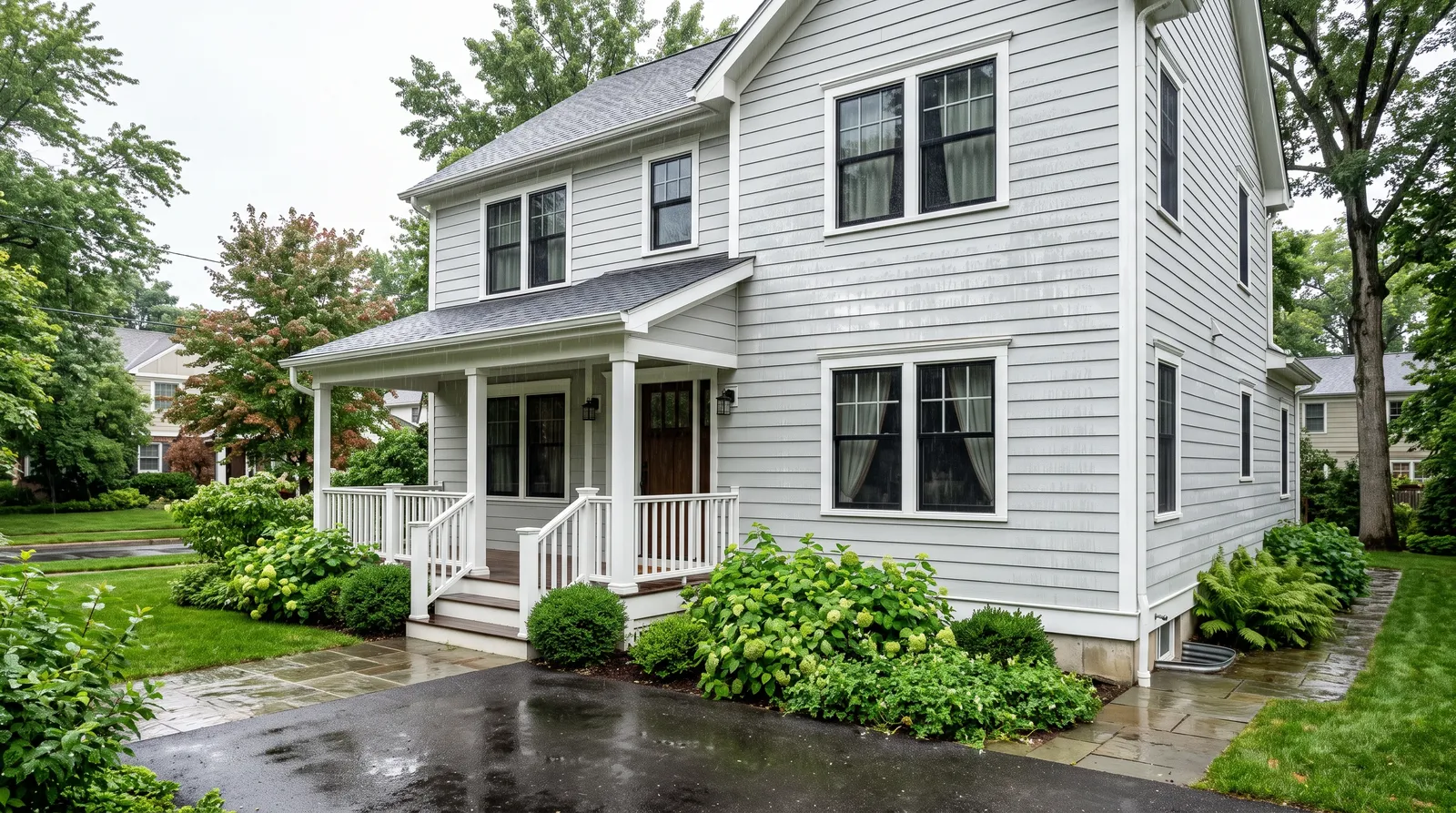
Sherwin-Williams Emerald Rain Refresh3 sheens
CoverageAbout 350–400 sq ft / gal per coat
Recoat4 hr between coats
VOCLow-VOC acrylic latex
Full cureAbout 30 days
Sheens FlatSatinGloss
Read this first
The Fast Verdict
Buy it only if you can point to a wall that gets dirty and stays dirty. On smooth, light-colored siding the hydrophobic film keeps pollen, road film, and loose grime from setting in, and a hard shower visibly freshens the wall — which is worth real money on a second story you cannot reach with a hose. Underneath, it is standard Emerald: the same color retention, self-priming, and 35°F floor. On a clean suburban wall you are paying about $15 a gallon extra for nothing.
Best for
Humid, coastal, or dusty climates · Walls that green up with algae · Tree drip and pollen zones · Light-colored siding that shows dirt · Second-story walls you cannot wash
Skip if
The house stays clean on its own · The dirty walls sit under eaves · You want the widest color deck · Budget matters more than maintenance · You are spraying with a small rig
What it's good at
- Shedding dirt with rain — a hard shower visibly freshens smooth, light-colored siding
- Resisting dirt pickup between rains, so light grays and whites stay cleaner-looking longer
- Emerald-grade color retention and chalk resistance on the sun side, with no durability traded for the feature
- Self-priming on sound, prepped surfaces, with blister and peel resistance at the top of SW's homeowner range
- Leveling — brush marks and roller stipple all but vanish in satin and flat
- Spraying clean through a 515 tip with noticeably less overspray than most exterior acrylics
- A 35°F application floor that stretches the painting season on both ends
What it's not good at
- The price — the costliest paint in SW's homeowner exterior line, and a four-figure bill on a two-story
- Paying off anywhere dirt is not the actual problem, which is most houses
- Working without rain — under eaves, soffits, and covered porches the feature does nothing
- Removing stains — it rinses loose dirt, not rooted mildew, algae staining, or grease
- Color choice, with a narrower deck and a short VinylSafe dark list
- Moving through a small rig, since the flat is close to cake batter in body
Numbers, not adjectives
Spec Sheet
- Coverage
- About 350–400 sq ft / gal per coat (Emerald-tier spread rate)
- Sheens
- Flat, Satin, Gloss
- Touch dry
- 30 min–1 hr
- Recoat
- 4 hr between coats; bare surfaces need two coats
- Full cure
- About 30 days
- Application temp
- 35°F and up
- VOC
- Low-VOC acrylic latex, under 50 g/L (Emerald family)
- Primer
- Self-priming on sound, prepped surfaces; prime bare wood, raw fiber cement, and chalky paint
- Surfaces
- Wood, fiber cement, hardboard, masonry, stucco, primed metal, vinyl, aluminum
- Bases
- Extra White, Deep Base, Ultradeep Base, Designer Ultra White; VinylSafe on a limited dark list
- Sizes
- Gallon, 5-gallon
- Price
- About $100–115 / gal — the priciest in SW's homeowner exterior line
Application Settings That Work
- Brush
- It levels unusually well. Brush marks and roller stipple all but vanish in satin and flat, which makes it a forgiving can for cut-ins and small elevations even though it is heavy to move around.
- Airless
- Runs clean through a standard 515 tip despite the body, and throws noticeably less overspray than most exterior acrylics. It is a slow, heavy paint at the pump and at cleanup, so size the rig and the day for it rather than the other way around.
- Primer
- Self-priming on sound, prepped surfaces, and that is a real coat saved on a repaint. It stops being true on bare wood, raw fiber cement, and chalky old paint — prime those. SW's own data page also calls for two coats on bare surfaces, four hours apart.
Dry Times and the Two-Coat Rule
Touch dry runs 30 minutes to an hour, which is fast for an exterior acrylic, and full cure is about 30 days. The number that matters on the schedule is SW's own instruction for bare surfaces: two coats with four hours between them. Do not treat the quick touch-dry as permission to stop at one on raw substrate. The 35°F application floor is real and useful — it buys you spring and fall mornings a 50°F paint makes you skip — but watch the dew point and stop early enough for the film to set before the temperature drops. Coverage is worth a caveat too: SW does not print a tidy per-coat spread number on the consumer page, and field reports run from full-build coverage on the low end up to 350 to 400 sq ft on a smooth wall. Buy for the low end and you will not run short.
Mid-project panic
When It Goes Wrong, and How to Fix It
No self-cleaning happening on some walls
Why it happens. The mechanism needs water. Under a deep eave, a soffit, a covered porch ceiling, or any elevation the weather never reaches, the hydrophobic surface just sits there doing nothing. Bone-dry climates get less out of it than rainy ones for the same reason.
The fix. Spec it only on walls rain actually hits, and put a cheaper can where it does not. Standard Emerald Exterior or SuperPaint on protected soffits and porch ceilings costs less and performs identically there, since the only thing you are giving up is a feature that was never going to fire.
Algae and mildew stains still on the wall after a rain
Why it happens. The film rinses loose dirt. It does not scrub off rooted mildew, algae staining, grease, or graffiti, and it will not rescue a wall that was already filthy when you painted over it.
The fix. Wash and treat the substrate properly before you paint — the self-cleaning feature is maintenance, not remediation. Existing biological staining needs a cleaning solution and a rinse first. Prep still decides how the wall looks in year two.
The pump struggling with how thick it is
Why it happens. This is the note the spec page never mentions and the painters lead with. It is heavy-bodied — one contractor who sprays it on real exteriors calls the flat close to cake batter, the heaviest exterior coating he has run through a pump.
The fix. Size the rig and the schedule for a thick paint. A standard 515 tip handles it and it throws noticeably less overspray than typical exterior acrylics. Plan slower pumping and longer cleanup, and do not try to learn this on a whole-house job with a small rig.
Masking tape not gripping the cured film
Why it happens. One painter reports that tape does not hold well on the slick cured surface and that high-adhesion tape is needed for multi-color or trim work. We could only source that once, so treat it as an unconfirmed field note rather than a known behavior.
The fix. If you are cutting a second color or trim against cured Rain Refresh, test your tape on a small run before you mask a whole elevation, and have a high-adhesion tape on the truck as backup. Cheap masking tape is the wrong thing to be discovering at the end of a day.
Side by side
Rain Refresh vs Emerald Exterior vs SuperPaint
All three come off the same Sherwin-Williams shelf and the decision is not about durability. It is about whether dirt is your actual problem and which walls you are painting.
| Emerald Rain Refresh | Emerald Exterior | SuperPaint Exterior | |
|---|---|---|---|
| Street price per gallon | About $100–115 | About $95 | $55–70 |
| Self-cleaning film | Yes — hydrophobic surface, low dirt pickup. The whole reason to pay more. | No | No |
| Color retention on the sun side | Emerald cross-linking. Identical to the parent line. | The same. This is not where Rain Refresh adds anything. | Fades faster on a south or west gable. |
| Durability and peel resistance | Top of SW's homeowner range. | Top of SW's homeowner range. | Mid-tier, and plenty on shaded walls. |
| Color deck | Narrower, with a short VinylSafe dark list. | The wider deck, including deep custom shades. | Wide. |
| Warranty | Lifetime Limited | Lifetime Limited on the Emerald tier | Mid-tier warranty |
| Where it wins | Humid, coastal, dusty, tree-shaded, or too-tall-to-wash walls that get dirty and stay dirty. | Sun-beaten walls where color hold is the point and the house already stays clean. | Shaded and north-facing elevations where you will not see the premium anyway. |
Street price per gallon
Emerald Rain RefreshAbout $100–115
Emerald ExteriorAbout $95
SuperPaint Exterior$55–70
Self-cleaning film
Emerald Rain RefreshYes — hydrophobic surface, low dirt pickup. The whole reason to pay more.
Color retention on the sun side
Emerald Rain RefreshEmerald cross-linking. Identical to the parent line.
Emerald ExteriorThe same. This is not where Rain Refresh adds anything.
SuperPaint ExteriorFades faster on a south or west gable.
Durability and peel resistance
Emerald Rain RefreshTop of SW's homeowner range.
Emerald ExteriorTop of SW's homeowner range.
SuperPaint ExteriorMid-tier, and plenty on shaded walls.
Color deck
Emerald Rain RefreshNarrower, with a short VinylSafe dark list.
Emerald ExteriorThe wider deck, including deep custom shades.
SuperPaint ExteriorWide.
Warranty
Emerald Rain RefreshLifetime Limited
Emerald ExteriorLifetime Limited on the Emerald tier
SuperPaint ExteriorMid-tier warranty
Where it wins
Emerald Rain RefreshHumid, coastal, dusty, tree-shaded, or too-tall-to-wash walls that get dirty and stay dirty.
Emerald ExteriorSun-beaten walls where color hold is the point and the house already stays clean.
SuperPaint ExteriorShaded and north-facing elevations where you will not see the premium anyway.
The whole decision is one question: can you point at a wall that gets dirty and stays dirty? If yes — algae, tree drip, road film, pollen, or a second story you cannot reach with a hose — Rain Refresh earns the roughly $15 a gallon premium and buys you maintenance by weather. If no, standard Emerald Exterior gives you identical durability and color retention for less, with a wider color deck. And on a big house the sensible spec is a mix: Rain Refresh on the dirty walls, SuperPaint on the easy shaded ones.
If not this one
Honest Alternatives
SW
Sherwin-Williams Emerald ExteriorAbout $95 / gal
Same durability, same color retention, same warranty — minus the self-cleaning surface and minus the premium. The default for most premium exterior jobs, and the right call any time dirt is not your specific problem.
Full review →SW
Sherwin-Williams Duration Exterior$75–90 / gal
SW's other heavy-duty exterior, a notch below Emerald in resin and in price. Thick-build, self-priming, strong on adhesion and moisture. No self-cleaning, but real durability for less money on a full-house repaint.
Full review →SW
Sherwin-Williams SuperPaint Exterior$55–70 / gal
The smart partner to a premium can. Self-priming, mildew-resistant, and plenty for shaded and north-facing walls. It fades faster on a sun-beaten gable, so the common-sense play is Rain Refresh on the dirty walls and SuperPaint on the easy ones.
Full review →Questions people actually ask
Emerald Rain Refresh Questions, Answered
Does the self-cleaning actually work?
Yes, within limits. The hydrophobic film makes water bead and run off fast, dragging loose dirt, pollen, and surface grime with it, and the low-stick surface picks up less to begin with. It works best on smooth, light-colored siding that rain actually reaches. It does not scrub off algae stains, mildew root, or grease.
Rain Refresh or regular Emerald Exterior?
Only pay up if dirt is your real problem. Both share Emerald's color retention and durability, so on a clean, sun-beaten wall you are spending roughly $15 a gallon extra for nothing. Pay up when the walls green up with algae, sit under trees, collect road film, or are too tall to wash by hand.
How is it different from a regular exterior paint?
Most exterior paints hold a static film that collects dirt until you wash it. Rain Refresh adds a hydrophobic, low-dirt-pickup surface so rain rinses the wall instead of staining it. Underneath you still get Emerald's UV resistance, self-priming, and blister-and-peel toughness — the self-cleaning layer is what the premium buys.
Does it work on walls under an eave or a porch ceiling?
No. No water, no self-cleaning. On protected soffits, covered porch ceilings, and any elevation the weather never reaches, the hydrophobic surface just sits there. Put a cheaper can on those and save the Rain Refresh for the walls rain actually hits.
Will it clean off existing algae or mildew stains?
No. The mechanism rinses loose surface dirt. Rooted mildew, algae staining, grease, and graffiti all stay, and painting over a filthy wall does not reset it. Wash and treat the substrate first — the self-cleaning is maintenance, not remediation.
What spray tip should I use?
A standard 515 handles it. The thing to plan for is body: it is a heavy paint, close to cake batter in flat, and it moves slowly at the pump and at cleanup. The upside is that it throws less overspray than typical exterior acrylics and levels so well that stipple and brush marks all but disappear.
How many coats does it need?
Two on bare surfaces, four hours apart, per SW's own data page. Over a close existing color on sound siding, two coats is still the honest plan — the quick 30-minute touch-dry is not permission to stop at one.
Can I use it on vinyl siding in a dark color?
Only inside the VinylSafe list, which is short here. Dark colors on vinyl absorb heat and can warp the substrate, which is why the safe list exists. If your color is deep and specific, standard Emerald Exterior gives you more room to work with.
How cold can I paint with it?
35°F and rising, same as the rest of the Emerald exterior tier. That is a genuine advantage over the 50°F floor most exterior latex carries, and it buys you spring and fall mornings you would otherwise skip. Watch the dew point and stop early enough that the film sets before the evening drop.
Keep exploring
All Sherwin-Williams paint reviewsEmerald Exterior (the parent line), reviewedDuration Exterior, reviewed
We may earn a commission when you buy through the retailer link above. It never changes the score or the verdict.
Ask a Question