Product review · Benjamin Moore · Updated August 7, 2026
INSL-X Stix Bonding PrimerBenjamin Moore paint review
8.8/10The category benchmark for adhesion on slick surfaces, and the wrong purchase on anything ordinary and porous.
The primer that decides whether cabinet paint stays on. Stix grips melamine, thermofoil, laminate, and glazed tile chemically, in the corners sandpaper cannot reach — and it will not hide your old color doing it.

David Chen · Formulation Lead & Resident Chemist · Updated August 7, 2026
Polymer chemist by training, six years in industrial coatings R&D before joining CompositePaint's formulation team. David writes the adhesion pieces — why a primer wets out on a slick door, and why the wrong one lets go in a curl. About the testing process →
Benjamin Moore INSL-X Stix Bonding Primer
Coverage300–400 sq ft / gal
Recoat3–4 hr at 77°F / 50% RH
VOCLess than 100 g/L
Full cure3–4 days for maximum scrape-off resistance
Read this first
The Fast Verdict
Buy it whenever the real question is whether the paint will stick at all. On cabinets, glossy trim, laminate, melamine, thermofoil, glazed tile, PVC, and fiberglass, nothing a homeowner can buy grips more reliably: it wets out and holds low-energy surfaces chemically, including the profiles and corners sandpaper cannot reach, and it recoats in three to four hours with soap-and-water cleanup. It is not worth $50 to $65 a gallon on ordinary drywall or raw lumber, and it will not hide a dark color or fill an imperfect surface.
Best for
Kitchen and bath cabinets · Thermofoil, melamine, and laminate · Glossy or oil-based trim · Glazed tile and glass · PVC, vinyl, fiberglass · Clean galvanized metal · Occupied kitchens, thanks to water cleanup
Skip if
Bare drywall, plaster, or raw lumber · Filling and leveling a rough surface · A dark-to-light change with no hiding coat · Siding and exterior wood, which need UV resistance · Rusted metal · Tub and shower surrounds
What it's good at
- Gripping the genuinely slick: melamine, laminate, PVC, vinyl, glazed tile, glass, fiberglass, galvanized metal, cured glossy enamel
- Reaching the inside corners, bead profiles, and routed edges where sandpaper cannot go and cabinet doors fail first
- Tack-free in 30 minutes and recoat in 3 to 4 hours, so you prime and topcoat the same day
- Enamel holdout that lets the topcoat sit up and level instead of sinking in
- Taking almost any topcoat — latex, acrylic, alkyd, waterborne alkyds like Advance, urethane, epoxy, and lacquer
- Low odor, under 100 g/L, and soap-and-water cleanup, which makes it usable in an occupied kitchen
What it's not good at
- Hiding a dark color — white only, light tints only, and a film under 2 mils dry
- Filling or leveling; it is a thin bonding film, not a sanding surfacer
- Bare wood without a follow-up sand, because the waterborne film raises the grain
- Stain blocking next to shellac — tannin, nicotine, and water rings bleed through
- Exterior siding and wood, where it has no UV resistance and is not a whole-house primer
- Rusted ferrous metal, tub and shower surrounds, and anything that has to wear as a floor coating
Numbers, not adjectives
Spec Sheet
- Coverage
- 300–400 sq ft / gal
- Chemistry
- Waterborne acrylic-urethane bonding primer
- Film build per coat
- 4.0–5.3 mils wet · 1.6–2.1 mils dry (40% ± 2% volume solids)
- Tack-free
- 30 min
- Recoat
- 3–4 hr at 77°F / 50% RH
- Full cure
- 3–4 days for maximum scrape-off resistance
- VOC
- Less than 100 g/L
- Thinning
- Do not thin, per the TDS
- Application temp
- 35–90°F surface temp; store 40–90°F
- Surfaces
- Glossy paint, laminate, thermofoil, melamine, PVC, vinyl, glazed tile, glass, fiberglass, galvanized metal, masonry, drywall, plaster
- Color
- White only; tintable to light shades, max 2 fl oz colorant per gallon
- Price
- $50–65 / gal at BM dealers; quart about $20–25
Application Settings That Work
- Brush
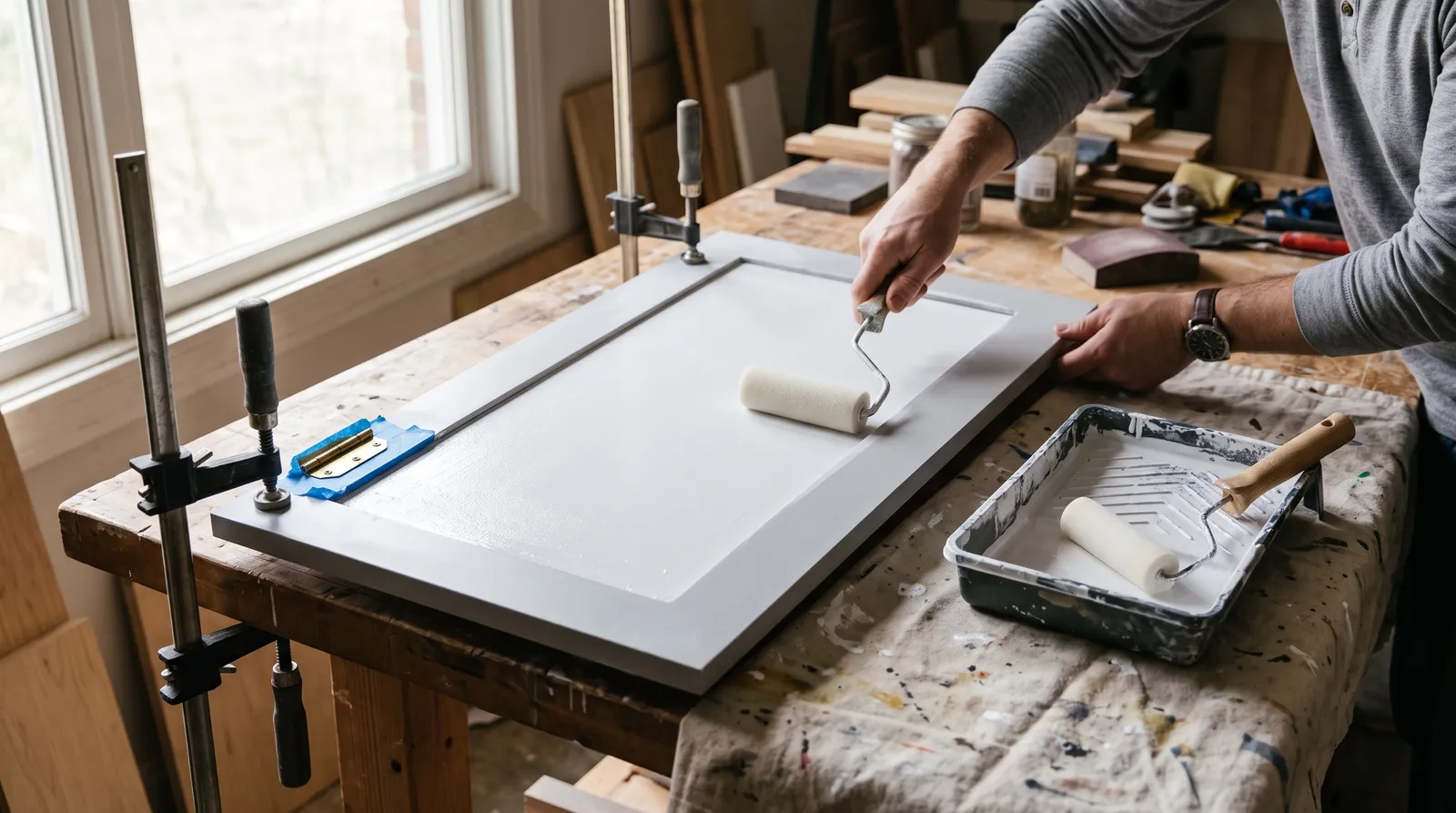
- A good synthetic brush for profiles and a foam or microfiber roller for flats. Expect a slight stipple you will want to knock down — scuff lightly with 220-grit between coats and again before the enamel, just to flatten the texture, not to remove material.
- Airless
- The best way to prime cabinet doors: the smoothest base and the most even mil build, which is the whole point of priming for a fine finish. Target 4.0 to 5.3 mils wet per coat, which dries to 1.6 to 2.1.
- HVLP
- Also a good gun for doors. It comes out of the can around 93 KU — chocolate-milk thin next to a wall paint — and the TDS still says do not thin it to spray.
- Thinning
- Do not thin, and this is not boilerplate. The formulator set the viscosity where the wetting agents do their work; adding water dilutes the adhesion promoters at the exact interface where they matter.
Recoat in Hours, Cure in Days
Tack-free in 30 minutes and recoatable in three to four hours at 77°F and 50 percent relative humidity, which is why you can prime in the morning and enamel in the afternoon. Tack-free is not the same as ready. In a cool garage in October or a humid basement in August, a waterborne film releases its water more slowly and that recoat window stretches — topcoating a primer that still holds water is how you get a soft finish that looks fine for a week and marks in two. The other clock is the cure: the TDS calls for three to four days before Stix reaches maximum scrape-off resistance. Recoat at three to four hours, but treat the doors gently for the first few days, and give the full cure before you hit it with a hot-solvent lacquer or a two-component epoxy.
Mid-project panic
When It Goes Wrong, and How to Fix It
The old cabinet color reads straight through the primer
Why it happens. That is the product working as designed. Stix is white only, accepts at most 2 fluid ounces of colorant per gallon, and dries to 1.6 to 2.1 mils. Every bit of the formulation budget went to adhesion promoters and the urethane binder rather than to titanium dioxide. Prime dark cherry and you get a translucent milky haze.
The fix. Plan the system, not the coat. Use Stix as the bond coat, then get coverage from a hiding primer over it — Fresh Start 046 is the natural second can inside this family — or from an extra coat of your enamel. Budget three finish passes, not two.
Bare oak or maple comes up fuzzy after the first coat
Why it happens. Stix is waterborne, and water swells wood fibers. Every waterborne primer raises grain on raw wood; it is not a defect and it is not a bad batch.
The fix. Sand lightly with 220-grit after the first coat to knock the raised grain back down, vacuum, then recoat or topcoat. Doing it before the enamel is what separates a smooth door from a rough one.
The new finish peeled anyway
Why it happens. Stix bonds to the surface it touches. If that surface was a coat already lifting off the substrate underneath, you bonded a good new film to something on its way off the wall. No chemistry fixes that.
The fix. Scrape, sand, or strip back to sound material, feather the edges, degrease, then prime. And degrease first regardless — kitchen cabinets are the greasiest substrate in the house, and warm soapy water, or TSP on tile and glass, is the difference between priming the door and priming the grease.
The primer stayed soft, or split inside itself under the topcoat
Why it happens. Almost always a heavy coat. Stix bonds chemically, not through film build, and the TDS targets only 4.0 to 5.3 mils wet. A thick coat takes longer to release its water, stays soft underneath, and can fail cohesively even when its bond to the substrate is perfect. Thinning it makes things worse by diluting the adhesion promoters at the interface.
The fix. Two thin coats beat one heavy one, and do not thin it at all. Give the full three to four hours between coats, longer in a cold or humid room, and scuff lightly with 220-grit before the enamel.
Rust came back through the primed metal
Why it happens. Stix has no corrosion inhibitors, and the TDS cautions against using it over rust. Rust is a loose, expanding, oxygen-and-moisture-fed layer, so a bonding primer simply seals it in to keep growing underneath a good-looking film.
The fix. Use a dedicated rust-inhibitive metal primer on ferrous metal that has corroded. Save Stix for clean galvanized metal, which is a different problem entirely and one it handles well.
Side by side
Stix vs KILZ Adhesion vs SW Extreme Bond
Three waterborne bonding primers aimed at the same slick substrates. All three beat a wall primer on a cabinet by a wide margin; the differences show up on the hardest factory finishes and at the counter you actually shop.
| INSL-X Stix | KILZ Adhesion | SW Extreme Bond | |
|---|---|---|---|
| Grip on the hardest factory finishes | The benchmark. Wets out and bonds a hair more reliably on thermofoil, melamine, and cured conversion varnish. | Grips glossy and laminate surfaces well; a legitimate alternative. | A capable equal on all but the very hardest factory finishes. |
| Where you buy it | Benjamin Moore dealers, Ace, and third-party sellers online. | Big-box stores, easy to find on a Saturday. | Sherwin-Williams stores, alongside your topcoat and tinting. |
| Cleanup and recoat | Soap and water, under 100 g/L, tack-free in 30 min, recoat 3–4 hr. | Waterborne, same-day recoat. | Water cleanup and a same-day recoat. |
| Hide | Almost none by design — white only, light tints, under 2 mils dry. | A bonding primer as well, not a hiding coat. | A bonding primer as well, not a hiding coat. |
| Stain blocking | Light only. Tannin, nicotine, and water rings migrate through — spot-prime with shellac first. | Waterborne, same limitation. | Waterborne, same limitation. |
| Buy it when | The substrate is the slickest thing in the house and a failure would hurt most. | Stix is not on the shelf and the job is a normal glossy or laminate surface. | Your topcoat and tinting are already happening at a Sherwin-Williams store. |
Grip on the hardest factory finishes
INSL-X StixThe benchmark. Wets out and bonds a hair more reliably on thermofoil, melamine, and cured conversion varnish.
KILZ AdhesionGrips glossy and laminate surfaces well; a legitimate alternative.
SW Extreme BondA capable equal on all but the very hardest factory finishes.
Where you buy it
INSL-X StixBenjamin Moore dealers, Ace, and third-party sellers online.
KILZ AdhesionBig-box stores, easy to find on a Saturday.
SW Extreme BondSherwin-Williams stores, alongside your topcoat and tinting.
Cleanup and recoat
INSL-X StixSoap and water, under 100 g/L, tack-free in 30 min, recoat 3–4 hr.
KILZ AdhesionWaterborne, same-day recoat.
SW Extreme BondWater cleanup and a same-day recoat.
Hide
INSL-X StixAlmost none by design — white only, light tints, under 2 mils dry.
KILZ AdhesionA bonding primer as well, not a hiding coat.
SW Extreme BondA bonding primer as well, not a hiding coat.
Stain blocking
INSL-X StixLight only. Tannin, nicotine, and water rings migrate through — spot-prime with shellac first.
KILZ AdhesionWaterborne, same limitation.
SW Extreme BondWaterborne, same limitation.
Buy it when
INSL-X StixThe substrate is the slickest thing in the house and a failure would hurt most.
KILZ AdhesionStix is not on the shelf and the job is a normal glossy or laminate surface.
SW Extreme BondYour topcoat and tinting are already happening at a Sherwin-Williams store.
Buying the system where you buy the paint is real logic, and Extreme Bond is the sensible pick if you are already standing at a Sherwin-Williams counter. KILZ Adhesion is the sensible substitute when Stix is not on the shelf and the surface is ordinary gloss or laminate. Stix stays the default for the hardest cases — thermofoil, melamine, conversion varnish, glazed tile — because it is the one painters report has simply not failed on them. On a cabinet job, any of the three beats reaching for a wall primer by a wide margin.
If not this one
Honest Alternatives
ZB
Zinsser B-I-N Shellac-Based Primer$40–48 / qt equivalent
The opposite chemistry on purpose. Shellac in alcohol locks down tannin, knots, nicotine, water rings, and odors that Stix lets pass, and it bonds well to gloss, so on a slick surface that is also stained it does both jobs. The trade-offs are fumes, hard ventilation, and a brittler film.
ZB
Zinsser Bulls Eye 1-2-3$22–28 / gal
A waterborne acrylic primer-sealer at roughly half the price, at every big-box store. It seals, hides, and bonds well enough for ordinary interior priming and lightly glossy surfaces. What it does not do is grip the genuinely slick the way Stix does.
Full review →KA
KILZ Adhesion Bonding PrimerUsually a few dollars under Stix
The closest head-to-head rival — a waterborne bonding primer aimed at the same slick substrates and easy to find big-box. It grips glossy and laminate surfaces well. In side-by-side use Stix wets out and bonds a hair more reliably on the hardest factory finishes.
Full review →SW
Sherwin-Williams Extreme Bond PrimerAt the Sherwin-Williams counter
Sherwin's waterborne bonding primer for the same substrates — laminate, melamine, glazed tile, glass, PVC, glossy enamel — with water cleanup and a same-day recoat. The natural pick when your topcoat and tinting already happen at an SW store.
Full review →Questions people actually ask
INSL-X Stix Bonding Primer Questions, Answered
Is INSL-X Stix worth it?
Yes, whenever the question is whether the paint will stick at all. On cabinets, glossy trim, laminate, melamine, thermofoil, glazed tile, PVC, and fiberglass, Stix is the category benchmark — it wets out and grips low-energy surfaces chemically, including the corners and profiles sandpaper cannot reach, and it recoats in 3 to 4 hours with soap-and-water cleanup. It is not worth $50 to $65 a gallon on ordinary porous drywall or raw lumber, and it will not hide a dark color or fill an imperfect surface.
Do I really need a bonding primer or can I just scuff-sand?
On a factory finish — melamine, laminate, cured cabinet enamel — scuff-sanding alone is not enough. You can rough the broad flat faces, but you cannot reach the profiles and corners, and the cured film is too hard to develop real tooth. Scuff-sand for cleanliness and minor profile, then let Stix do the chemical gripping the sandpaper cannot.
Do I have to sand before applying Stix?
Officially no — the TDS rates Stix for use over most glossy surfaces without sanding, and painters report strong adhesion on unsanded cabinet doors. In practice, degrease first with warm soapy water, or TSP on tile, then degloss the hardest cases: a scuff pad on glossy enamel, 220-grit on laminate, 80 to 100 grit on glazed tile or glass. Sanding is cheap insurance where a failure would hurt most.
How many coats of Stix do cabinets need?
One thin coat is enough on most previously painted or glossy surfaces; use two thin coats on the slickest factory finishes like thermofoil, melamine, and laminate. Thin is the rule — Stix bonds chemically, not by film build, and the TDS targets only 4.0 to 5.3 mils wet per coat with no thinning allowed. Scuff lightly with 220-grit between coats and recoat in 3 to 4 hours.
Will Stix hide the old color?
No. Stix is a thin, low-hide bonding film — white only, tintable just to light shades with up to 2 oz of colorant per gallon — so a dark cabinet color will show through one coat. That is by design: its job is grip, not coverage. Going dark to light, follow the Stix coat with a hiding primer or budget an extra coat of your enamel.
Can I topcoat Stix with any paint?
Effectively yes. Stix has excellent enamel holdout and the TDS clears it for almost any coating — latex, acrylic, alkyd, waterborne alkyds like Advance, urethane, epoxy, and lacquer. Quality latex and oil-based finishes can go on after 3 to 4 hours at normal temperature. Hot-solvent lacquers and two-component epoxies are the ones to slow down for: give the primer its full 3-to-4-day cure first.
Does Stix block stains and tannin bleed?
Only lightly. Stix is built for adhesion, not stain encapsulation. It seals everyday marks, but tannin from cedar or knotty pine, nicotine, and set-in water rings will migrate up through a waterborne film. For those, spot-prime with a shellac primer like Zinsser BIN first, then bond-coat or topcoat over it.
Can I use Stix outside?
Only as a spot bond coat. The can is rated interior and exterior, but Stix has no UV resistance and none of the flexibility an exterior wood primer needs, and Benjamin Moore does not recommend it as a whole-house primer over wood. Use it on slick trim, PVC, or previously coated metal that a proper exterior finish covers the same day, and do not apply it with rain coming.
Can I use Stix on rust or in a shower surround?
No to both. The TDS cautions against using it over rust — a bonding primer with no corrosion inhibitors just seals the rust in to keep growing. And a wet surround is constant-immersion service that a waterborne primer plus a normal enamel is not built for. Use a rust-inhibitive metal primer on corroded steel and a purpose-made tub-and-tile epoxy kit in the wet zone.
How soon can I use the cabinets after priming and painting?
Recoat at 3 to 4 hours, but respect the primer's own clock underneath: the TDS calls for 3 to 4 days before Stix reaches maximum scrape-off resistance. Treat the doors gently for those first few days, and remember that your enamel has its own cure on top of that. Rehanging early is fine; slamming and stacking is not.
Keep exploring
Benjamin Moore brand reviews and color decksBenjamin Moore Advance — the cabinet enamel Stix primes forINSL-X Cabinet Coat — the budget enamel that pairs with StixBenjamin Moore Fresh Start — the hiding primer to pair with Stix
We may earn a commission when you buy through the retailer link above. It never changes the score or the verdict.
Ask a Question