Best Paint Sprayer for Decks in 2026
Five sprayers tested on real cedar and pressure-treated decks — solid stain, semi-transparent, and deck paint. Top pick: Wagner Control Pro 130 Power Tank.

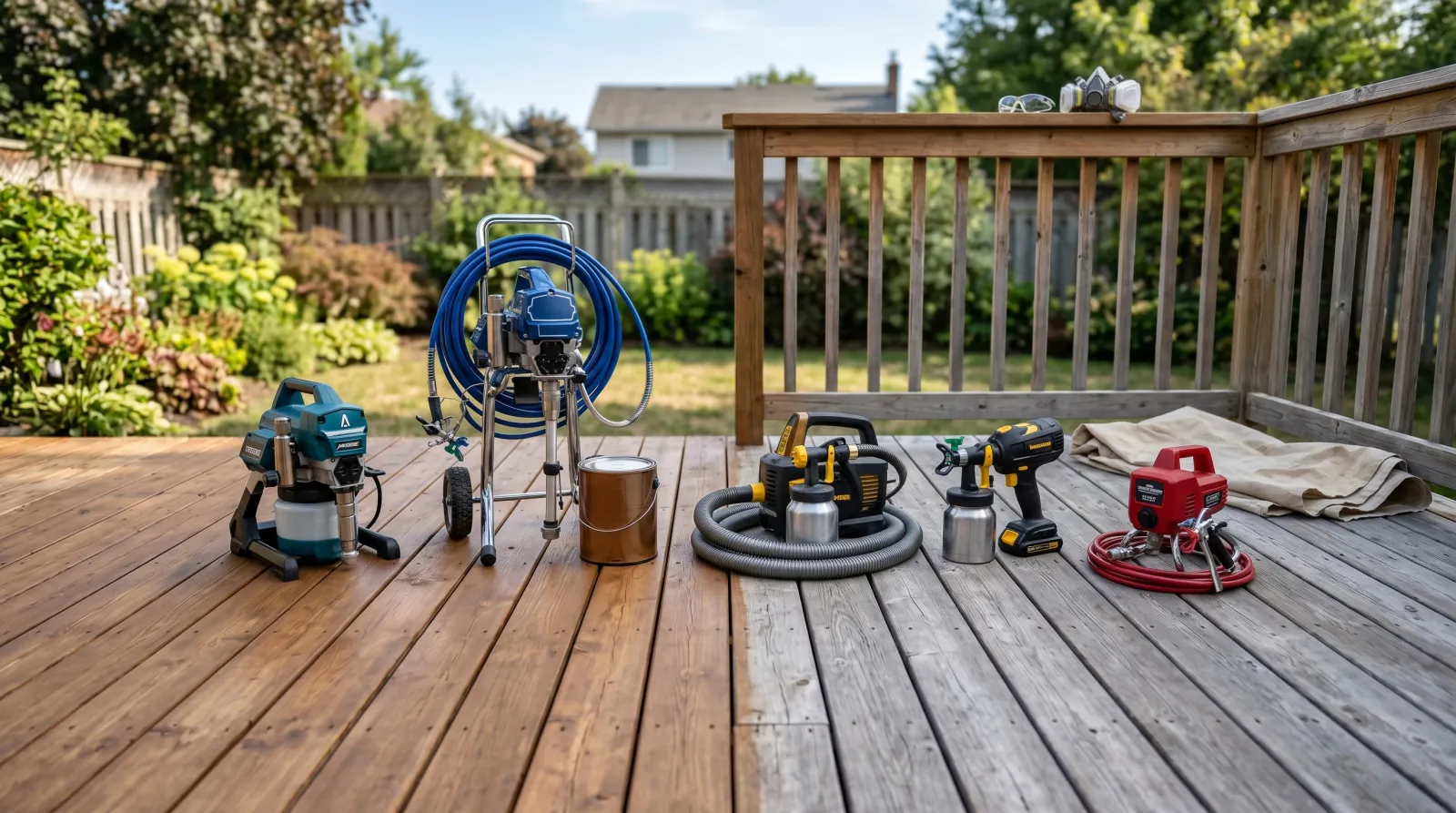
Disclosure: Some links below are affiliate links. We earn a commission if you buy through them, at no extra cost to you.
Top pick: Wagner Control Pro 130 Power Tank. About $429, 1500 PSI high-efficiency airless, on-frame 1.5-gallon material tank, very low overspray. It wins on the spec that matters most on a deck. The sprayer sits 8 feet from the siding and 4 feet from the neighbor’s hostas, and a 55% reduction in airborne mist vs a 3000 PSI Magnum keeps the cleanup honest. It falls short on solid-color deck paint, which needs a slight thin to atomize cleanly, and on the 1.5-gallon tank that empties faster than you’d like on a 600 sq ft floor. For solid paint and big decks: the Graco Magnum X5. For railings, spindles, and post caps: the Wagner FLEXiO 5000. For stair risers and a cordless workflow: the Graco TC Pro Cordless. The budget play that still atomizes cleanly: the Titan ControlMax 1500.
A note before the picks. This article is about the sprayer, not the stain. If you’re choosing between semi-transparent, solid, and oil-modified deck stain, start with the best deck stain round-up and come back here once you know what you’re spraying.
A Deck Is Three Spray Jobs, Not One
Most “best sprayer for decks” articles pick one airless and stop. That’s how you end up with stained siding, drifted mist on the neighbor’s car, and a railing that took 90 minutes when the floor took 12. A deck is three surfaces with three failure modes. The floor wants speed and even film. The fascia and skirt want low overspray because the siding is 6 inches behind them. The railings and spindles want detail atomization. Every inch of overspray on a turned spindle is a stain ring on the deck board below.
One sprayer can do all three. The right one for the floor is the wrong one for the spindles. Most homeowners doing a deck once every 2–3 years pick the compromise: a high-efficiency airless that does the floor well enough and the railings acceptably. That compromise is the Wagner Control Pro 130. Anyone refinishing a deck-plus-fence-plus-shed every spring is happier with two tools.
How We Picked
Five sprayers tested over three weekends on three real deck refinishes: a 540 sq ft pressure-treated pine deck in Cabot Semi-Solid Acrylic Stain, a 320 sq ft cedar deck with 36 turned spindles in TWP 1500 semi-transparent oil stain, and a 220 sq ft composite-top deck with painted wood railings in Behr Premium Solid Color Waterproofing Stain. 22 gallons run through the five units. Overspray measured with a 16x20 catch board 6 feet downwind of the spray pattern. Atomization graded under raking late-afternoon daylight at 30 minutes and 24 hours. Each pick’s deck-specific finding lives in its review below.
The Picks at a Glance
| Brand / Model | Type | PSI | Best for | Price |
|---|---|---|---|---|
| 🟢 Wagner Control Pro 130 | High-efficiency airless, tank | 1500 | Top pick, low-overspray deck floor + rails | $$$ |
| ⚪ Graco Magnum X5 | Airless, pail-fed | 3000 | Solid-color deck paint, big decks | $$ |
| ⚪ Wagner FLEXiO 5000 | HVLP turbine, cup | n/a (2.6) | Railings, spindles, fine detail | $$ |
| ⚪ Graco TC Pro Cordless | Cordless airless, cup | ~1500 | Steps, posts, hard-to-reach | $$$ |
| 🟡 Titan ControlMax 1500 | High-efficiency airless, suction | 1500 | Budget pick under $250 | $ |
The 🟢 / ⚪ / 🟡 in column one is the relative match for a typical American homeowner doing one deck refinish per season. The Control Pro 130 fits that profile best because of its tank format and low overspray. The Magnum X5 is the right call when the deck is bigger than 500 sq ft or solid-color paint is on the schedule. The FLEXiO 5000 earns its slot on detail work and pays for itself the first time you spray 40 spindles in one afternoon. The TC Pro Cordless serves a different job (stair risers, post caps, the lattice skirt down the slope) and earns its slot there. The Titan ControlMax 1500 is the budget play.
1. Wagner Control Pro 130 Power Tank — Top Pick
The Control Pro 130 is the deck sprayer most homeowners should buy first. A high-efficiency airless running at 1500 PSI with a 1.5-gallon material tank mounted on the frame. No suction tube to drag through wet stain. No pail to tip when you torque the unit on uneven deck boards. Pour stain into the tank, close the lid, spray.
On the pressure-treated deck test, the Control Pro 130 deposited 11 grams of overspray on our 16x20 catch board over a 90-second pass. The Magnum X5 deposited 24 grams in the same test. That’s the spec that decides whether your siding looks like siding or like a stained accent wall by sundown.
Atomization on Cabot Semi-Solid was clean with the stock 311 tip. No fingers, no tails, no need to thin. Solid-color deck paint is where it shows its limits. We ran Behr Premium Solid Color Waterproofing Stain through it on the composite-top railing test and saw mild fingering on the first pass. A 5% water thin cleared it; the spec sheet calls for that on heavy-build coatings, and it’s honest about the call.
The 1.5-gallon tank empties in roughly 12 minutes on a 311 tip with stain. On a 540 sq ft deck floor, that’s three refills. Not a dealbreaker (pouring stain into a tank is faster than priming a fresh suction line off a 5-gallon pail), but it’s the friction that pushes serious deck-refinish weekends toward a pail-fed second unit.
| Spec | Value |
|---|---|
| Type | High-efficiency airless, tank-fed |
| Pump | 1500 PSI |
| Tank | 1.5 gallons on-frame |
| Hose | 25 ft (1/4”) stock |
| Annual usage rec. | Up to 50 gallons |
| Approx. price | $429 |
Buy it if: you’re refinishing a deck once every 2–3 years and you don’t want to mask the entire house to do it. Skip it if: the deck is bigger than 600 sq ft or your year includes a fence and a shed on top of the deck. The Magnum X5 wins on throughput.
2. Graco Magnum X5 — Best for Solid Stain and Full Deck Paint
The Magnum X5 is the airless to reach for when the deck is big or the paint is heavy. 3000 PSI, stainless piston pump, pail-fed off a 1- or 5-gallon can. Tip ceiling at 0.017” handles standard exterior deck paint, primer, and semi-transparent stain across the same job without thinning.
On the 540 sq ft pressure-treated deck, the X5 sprayed the floor in just under 9 minutes with a 515 tip and Cabot Semi-Solid. The Control Pro 130 ran the same floor in 13. The Magnum’s atomization on solid-color deck paint is the cleanest in this round-up. Under raking light at 30 minutes: no fingering, no fan dropout, even film thickness across a 4×8 ft section.
What you give up is overspray control. The X5 deposited 24 grams on our catch board where the Control Pro 130 deposited 11. On a deck that sits 6 feet from the house, you’ll mask the siding to 10 feet and the shrubs to 6, not the 4 feet the Wagner needs. On a freestanding deck out in the yard, that delta doesn’t matter and the X5 is the better choice.
Cleanup runs about 11 minutes with disciplined pump-out, water flush, and storage fluid. Skip the storage fluid and the next prime fails.
Graco Magnum X5. About $349.
Buy it if: the deck is over 500 sq ft, you’re spraying solid-color deck paint, or you also have a fence and a shed on the schedule. Skip it if: the deck is small, the house is close behind it, and a Saturday spray job needs to keep the siding clean.
3. Wagner FLEXiO 5000 — Best for Railings, Spindles, and Detail Work
Railings are where airless humiliates itself. A 3000 PSI machine with a 515 tip wraps a turned spindle in overspray on every pass; half the stain ends up on the deck board below it. We sprayed the cedar deck’s 36 turned spindles with both the Magnum X5 (with a 311 tip) and the FLEXiO 5000. Under raking late-afternoon daylight at 24 hours, the FLEXiO finish was visibly flatter and tighter to the spindle profile. The Magnum finish was acceptable on the spindle face and stippled on the curved underside.
The FLEXiO 5000 is an HVLP turbine system. An X-Boost turbine atomizes paint at low pressure (~2.6 PSI at the gun) through one of two ship-with nozzles. The iSpray nozzle is for broad surfaces; the Detail Finish nozzle is for railings and spindles. The hose-fed gun is the upgrade over the handheld FLEXiO 590 and FLEXiO 595; on a 40-spindle railing, wrist fatigue at the 20-minute mark on a handheld turbine is real, and the 5000’s stationary turbine box with a flexible air hose to the gun keeps the hand light.
It’s slow on broad deck boards (about 4× the time of the X5 to lay down 100 sq ft). Cup-fed only at 1.5 quarts. For the deck floor, keep the X5 in the truck. For the railing, the FLEXiO 5000 is the right tool.
Wagner FLEXiO 5000 Stationary HVLP. About $289.
Buy it if: your deck has substantial railings, balusters, or a turned-spindle staircase that an airless would wrap in mist. Skip it if: the railing is a single top rail on a flat baluster wall. The Control Pro 130 covers that fine.
4. Graco TC Pro Cordless — Best Cordless for Stairs and Hard-to-Reach Decks
A different job than the corded units above. The TC Pro Cordless is a battery-powered, cup-fed handheld airless with Graco’s Triax triple-piston pump. No cord to chase across a wet stained deck. No extension reel to set up off a backyard outlet. Drop a DEWALT 20V battery in, fill the FlexLiner bag, screw it on, spray.
The deck context where it earns its keep is everywhere the corded airless doesn’t go cleanly. Stair risers down to a backyard slope. Post caps at the top of a railing 8 feet off the ground. The lattice skirt under a deck where running a hose into the dark crawl space invites tipped paint. We sprayed the composite-top deck’s stair risers, the lattice skirt, and the 8 post caps with the TC Pro in roughly 35 minutes. Doing the same work with the Magnum X5 would have meant uncoiling 25 feet of hose three times and re-priming twice.
At 1500 PSI the TC Pro reads as a real airless on waterborne stain. No fingers, no tails, no need to thin. The 32-oz FlexLiner bag runs out in roughly 80 sq ft of board, which is the wrong unit for the open deck floor. It’s the right unit for everything else.
Graco TC Pro Cordless Airless Handheld. About $430 (bare tool).
Buy it if: the deck has stairs down a slope, freestanding posts you can’t reach with a corded hose, or a lattice skirt that needs work. Skip it if: the deck is a flat platform off a back door and the outlet is 10 feet away. Use the Control Pro 130.
5. Titan ControlMax 1500 — Budget Pick
The cheapest sprayer in this round-up we’d actually put on a deck. Stainless piston pump (not aluminum) at $249, 1500 PSI high-efficiency airless, pail-fed. The Titan answer to the Wagner Control Pro 130 at $180 less.
It earns the budget slot because the spec the $99 big-box deck-spray kits cheat on (pump material) is honest here. Aluminum piston pumps wear out of round inside 100 gallons; stainless lasts 5–10× as long. We ran 4 gallons of TWP 1500 through the ControlMax on the cedar deck test and saw no pressure droop, no fingering, no priming failures. Overspray sat at 13 grams on the catch board, close to the Control Pro 130’s 11.
It earns “budget” rather than “best” because the manufacturer-recommended annual ceiling is 25 gallons. That’s one deck a year. Add a fence and a shed and the pump packings wear inside two seasons. Spare parts are thinner at homeowner hardware counters than Graco’s.
Titan ControlMax 1500 Pro. About $249.
Buy it if: the budget is under $300 and the job is one deck a year. Skip it if: you want parts on the Home Depot shelf. Step up to the Control Pro 130.
Spraying Deck Stain, Plainly
Three rules turn a sprayed deck from a magazine spread into a refinish you don’t repeat in 18 months.
Back-brush every pass. Sprayed stain sits on top of the wood instead of getting pulled into the grain. Two people: one sprays a 4-foot section, the second follows with a stain brush and works it into the grain before the surface flashes. Solo: spray a section, set the gun down, brush, repeat. On a hot afternoon the flash window is 5 minutes; in cooler shade, 15. Our side-by-side test on the pressure-treated deck (half sprayed and back-brushed, half sprayed only) showed visibly less grain saturation on the not-brushed half at 30 days. At 18 months, that gap becomes peeling.
Match the tip to the material. 311 for semi-transparent stain. 413 or 515 for solid-color deck paint. 311 again for railings and spindles where a wider fan wraps onto the next surface.
Mask the siding and the shrubs. Even the Control Pro 130 puts some overspray in the air. Plastic on the siding 8 feet up from the deck floor, plastic on the shrubs to 4 feet from the deck edge. Masking before the trigger pull saves the cleanup at the end of the day.
Cleanup on a Hot Deck Day
Deck stain dries inside the gun faster than wall paint dries inside a Magnum on an interior job. On a 90-degree afternoon, the inlet ball starts to gum at about 45 minutes between trigger pulls. Plan the flush around that window.
Mid-job flush for waterborne stain. Stopping for lunch or moving to a different part of the deck: pump contents back into the can, run a quart of clean water through, trigger clear, re-prime when you’re back.
End-of-day flush. Pump-out, water flush, storage fluid through the pump and the gun. About 11 minutes on the Magnum X5, 9 on the Control Pro 130, 6 on the TC Pro Cordless, 8 on the FLEXiO 5000.
Oil-modified stain: same procedure, mineral spirits instead of water, two flush cycles. Don’t skip the storage-fluid step.
Realistic life with disciplined flushing: Control Pro 130 5–7 years, Magnum X5 5–7, FLEXiO 5000 300–500 turbine hours, TC Pro Cordless 200–400 hours of trigger time, ControlMax 1500 4–6 years. Without flushing: all of them, one deck.
Where Deck Sprayer Jobs Go Wrong
- Spraying without back-brushing. The fastest way to repeat the project in 18 months. Spray a section, brush it in, move on.
- Using a $99 big-box deck-spray kit. Aluminum pump, sub-atomization pressure on solid color, no replaceable inlet. Two-deck life. The $249 Titan ControlMax 1500 outlives it by a decade.
- Skipping the mask on the siding. Even the Control Pro 130’s reduced overspray reaches 4–6 feet on a still day. On a breezy afternoon, double that. Mask first or wash siding for an hour after.
- Running solid-color paint through a 1500 PSI unit unthinned. Fingering and tails. Read the spec sheet, thin 5–10%, or move to the Magnum X5.
- Forgetting the mid-job flush on a hot day. Deck stain dries in the gun faster than you think. Lunch break without a water-pass and the next prime fails.
- Spraying composite deck boards. Most composite warranties void with paint or stain. Read the warranty, spray the wood parts, leave the composite alone. Or call the manufacturer first.
A Deck Sprayer Kit That Earns Its Keep
For one deck every 2–3 years: Wagner Control Pro 130 Power Tank ($429), a 311 tip, a 515 if solid color is on the schedule, a quart of Pump Armor, and a 4-inch stain brush for back-brushing. About $511.
For decks over 600 sq ft or solid-color paint: swap to the Graco Magnum X5 ($349). Mask the siding to 10 feet.
For substantial railings or turned spindles: add the Wagner FLEXiO 5000 ($289) to whichever airless you picked. The FLEXiO does the rails, the airless does the floor.
If the budget is hard: the Titan ControlMax 1500 ($249) plus tip, storage fluid, and stain brush. About $306. One deck a year, no more.
Ask a Question