Best Roller Washers and Spinners in 2026
Five paint roller washers and spinners tested over a winter of premium covers. Top pick: Wooster Sherlock for the dry-in-30-seconds spin that brings a $9 cover back to new.

Disclosure: Some links below are affiliate links. We earn a commission if you buy through them, at no extra cost to you.
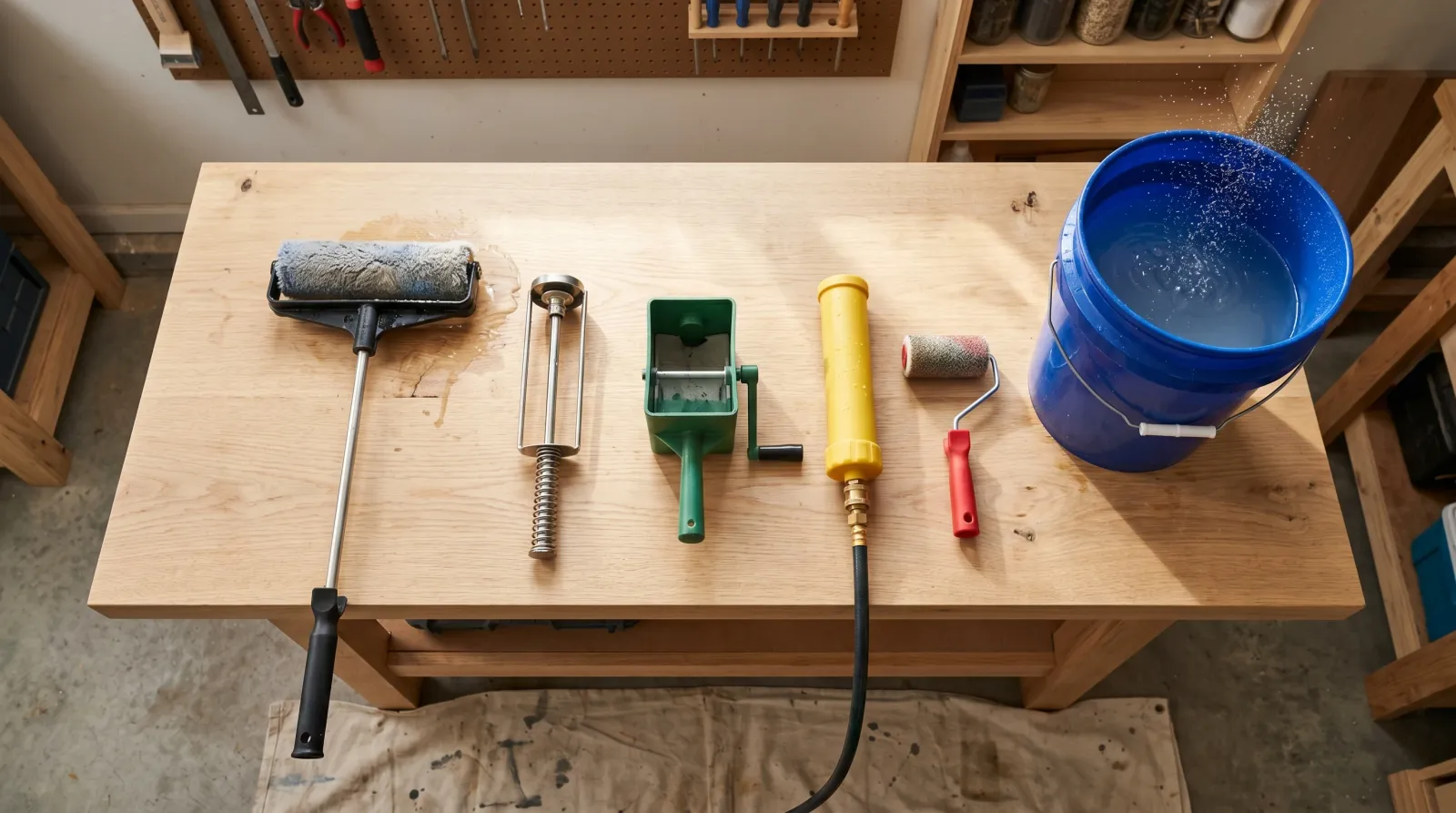
Top pick: Wooster Sherlock Roller Spinner. About $25, all-metal shaft, pump-action centrifugal spin that clears a saturated 9-inch microfiber in three pumps. The Sherlock wins on durability and on the dry-in-30-seconds spin that brings a $9 Pro/Doo-Z back to fluffy for the next coat. It falls short on the wash step. This is a spinner, not a washer, so you still need a bucket or a hose for the rinse. For an all-in-one wash-and-spin unit, the Wagner Spraytech Pro Roller Cleaner is the smart call. For a budget weekend tool, the HYDE Pro Spinner is half the price. For heavy 3/4” naps loaded with ceiling paint, the Linzer hose-fed wash chamber rescues covers that hand-rinsing leaves cloudy. For mini-rollers and foam covers, the FoamPRO Mini Spinner is the right size.
A note up front. This article is about saving premium covers. Spinning a $1.50 polyester three-pack from the bargain bin is a losing proposition; the shedding gets worse with every wash. The math only works on real microfiber, real woven synthetic, and the lambswool covers you’d otherwise replace at $10+ a pop.
What a Spinner Does That a Bucket Doesn’t
A bucket rinse pulls paint off the surface of the fibers. A centrifugal spin pulls water (and the suspended paint with it) out of the core. Premium covers fail two ways: the sheath glue weakens from repeated wet-dry cycles, or the cardboard core stays loaded with dried paint between jobs and the cover comes out of storage as stiff as a board. A real spin step solves both. Less time wet means less glue degradation. A clear-water spin at the end of the wash means the cover dries clean instead of dirty.
The reason this tool category exists at all is that hand-shaking a wet roller cover throws water about three feet horizontally across whatever floor you’re standing on, and still leaves the cover at 40% of its saturated weight. A Sherlock spin clears it to about 8%. Twelve hours later, the cover hangs dry and round. That’s the difference between a cover you can use again next weekend and a cover you toss.
How We Picked
Five tools, six months, nine real interior repaints. Each tool ran at least 12 wash-spin cycles on premium covers (Pro/Doo-Z 1/2” microfiber, White Dove 3/4” woven, Jumbo-Koter 4-1/2” foam) after Benjamin Moore Regal Select, SW Emerald Interior, and SW Emerald Urethane. Spin effectiveness was measured by weighing covers saturated, post-spin, and at 12-hour true-dry. Recovery was measured by counting lint specks at the next coat against a fresh-cover baseline. Build durability tracked the mechanism itself across the winter.
The Picks at a Glance
| Tool | Best for | Wash? | Spin? | Price |
|---|---|---|---|---|
| Wooster Sherlock | Premium covers, daily use | No | 🟢 Excellent | $$ |
| Wagner Spraytech Pro | All-in-one station | 🟢 Hose-fed | 🟡 Adequate | $$ |
| HYDE Pro Spinner | Weekend / mid-price | No | ⚪ Good | $ |
| Linzer Roller Washer | Heavy 3/4” naps | 🟢 Hose-fed | 🔴 None | $ |
| FoamPRO Mini Spinner | Mini & foam covers | No | 🟢 Excellent | $ |
The table reads two ways. By tool job: spinner-only on rows 1, 3, and 5; wash-only on row 4; both on row 2. And by cover size: full-size 9” covers on the first four rows, mini-roller and foam on the last. A homeowner doing a normal interior repaint needs the Sherlock plus a bucket. A homeowner doing cabinets and walls needs the Sherlock and the FoamPRO. A contractor cleaning four covers at end-of-day needs the Wagner or the Linzer-plus-Sherlock combo.
1. Wooster Sherlock Roller Spinner, Top Pick
The Sherlock is the cover-cleaning tool that does what it says, mechanically, every time, for years. All-metal shaft, all-metal pump mechanism, all-metal spring. The pump action is centrifugal: you slide the handle down, the inner shaft spins the loaded cover at high RPM, the water flies off in a fine corona. Three pumps clears a 1/2” microfiber back to roll-ready damp. Five pumps clears a 3/4” woven. We ran 60 cycles over the winter without a single mechanical failure.
What it doesn’t do is wash. Load the cover dirty, spin it, and you fling diluted paint across your garage. Use the Sherlock at the end of a hose-rinse or a clean-bucket dunk, never on a paint-loaded cover. The universal end fits Wooster, Purdy, and most third-party 9” covers; an included sleeve adapts for 6-1/2”. A common mix-up: Wooster also sells a Sherlock-branded extension pole. Check the SKU on the page. The spinner is the Sherlock Roller Spinner, not the pole.
Buy it if: any homeowner who buys premium covers. Skip it if: you only ever paint with throwaway value-pack covers.
2. Wagner Spraytech Pro Roller Cleaner and Spinner, Best Combo Unit
This is the tool a contractor reaches for at the end of a long day. Hose-in on one side, spinner-out on the other, internal scrubbing brushes recover covers that would mat permanently from hand-rinsing. We ran four 1/2” Pro/Doo-Z covers through it back to back in under six minutes and all four came out clear-water-clean and 90% dry.
The trade-off is durability. The housing is plastic, the gears are plastic, and the mechanism that felt crisp at month one felt loose at month six. The Sherlock at twelve months still felt new. The Wagner is the right tool for someone who’ll wear it out and replace it; if you want one cleaning tool for a decade, the Sherlock plus a Linzer is the longer answer.
A real consideration: the Wagner sends paint-water down whatever drain you point it at. Many counties prohibit paint runoff into storm drains. Bag the runoff in a 5-gallon bucket and let the solids settle, then decant the clean water and dispose of the sediment per local rules. Wagner Spraytech product line.
Buy it if: contractor or daily painter with a hose bib. Skip it if: apartment, no outdoor water source, or you want a tool that outlasts the warranty.
3. HYDE Tools Pro Roller Spinner, Mid-Price Pick
The HYDE Pro Spinner is the answer when the Sherlock is more tool than the job needs. Plastic body, similar centrifugal spring mechanism, about $14. A 1/2” microfiber clears in five pumps where the Sherlock clears in three. On a weekend repaint where you wash one or two covers, that’s a meaningless difference. On a daily-use cycle, the Sherlock’s metal mechanism stays crisp longer.
We had one HYDE shaft snap mid-pump when a cover jammed; warranty replacement came in a week. That’s a known plastic-tool failure mode, not a design defect. Spring tension drops measurably between month one and month four. Recovery is slower as the tool ages. For the price, it’s the right call for a homeowner who’ll use it occasionally. The adapter sleeve handles 4-1/2” mini-rollers, which the Sherlock won’t. HYDE Tools roller spinners.
Buy it if: weekend painter who wants the spin function without paying for metal. Skip it if: daily use; the metal Sherlock is the long-haul tool.
4. Linzer Roller Washer, the Wash Chamber Move
The Linzer is the missing half of the Sherlock. It doesn’t spin. It washes, with a hose-fed spray manifold inside a translucent tube. Load the cover, connect the hose, run the water, watch the runoff. When it runs clear, the cover is clean. That clarity is the headline feature. You stop guessing.
Heavy-nap covers (3/4” White Dove after a popcorn ceiling job, 1” Marathon after exterior cedar) come back from the wall loaded with paint that a bucket-rinse leaves embedded in the core. The hose-fed scrub pulls that paint out. Two-tool stack: Linzer first to wash, Sherlock second to spin. Total cost about $36, total cycle time about 90 seconds per cover, and the covers come out cleaner than anything one tool achieves alone. Linzer Products.
Buy it if: heavy-nap covers, ceiling work, exterior siding work. Skip it if: smooth-wall-only repaints; a Sherlock plus a bucket is enough.
5. FoamPRO Mini Roller Spinner, the Cabinet Shop Tool
Cabinets get foam covers and 4-1/2” microfiber mini-rollers, neither of which fits a 9” Sherlock. The FoamPRO spinner is sized for them. Gentle spin tension, compact enough to use inside a 1-gallon bucket of water, the right tool for the right cover.
Honesty check: most foam covers don’t warrant washing. FoamPRO’s own Hot Dog yellow-foam covers are disposable by design and cost about $2.50 each. The case for this spinner is the 4-1/2” microfiber covers used on cabinet doors (Wooster Jumbo-Koter, Purdy WhizzFlex), which run $5–$8 each and survive 6–8 wash cycles with care. On those, a $12 mini-spinner pays back fast. FoamPRO product line.
Buy it if: cabinet refinishing or trim work with reusable mini-rollers. Skip it if: disposable foam-only workflow.
Tools We Considered and Cut
A few we tried and didn’t keep. The Shur-Line plastic spinner is a $7 tool that feels like a $7 tool. The spring failed inside the first month and the spin RPM wasn’t enough to clear a 1/2” microfiber. We retired it after eight cycles. The generic Amazon-brand “roller cleaner kit” that bundles a wash tube and a spinner together comes in around $20 but the spinner half is a softer copy of the HYDE design without the metal end-cap, and the wash tube doesn’t seal against the hose. Buy the components separately. The Purdy Power Lock metal spinner exists and works fine; we didn’t pick it because the Wooster Sherlock is the same idea, costs the same, and Purdy’s tool is harder to find in stock. If you see the Power Lock on a shelf, it’s a legitimate substitute.
How to Wash a Roller Cover Without Wrecking It
The right sequence saves covers; the wrong sequence shortens their life.
- Pre-roll dry. Before any water hits the cover, roll out the remaining paint onto a piece of cardboard until the cover stops releasing pigment. This step alone removes 60% of the paint and protects the wash water.
- First rinse, dirty bucket. Dunk the cover in a 5-gallon bucket of clean water. Work it. The water clouds fast. Pull the cover, dump the bucket, refill.
- Wash, hose or chamber. Run a hose through the cover in the Linzer chamber, or hand-rinse under a tap, until the runoff is clear. This is the step where the Wagner shines for contractors.
- Spin, clean water. Load the cover on the Sherlock or HYDE inside a clean-water bucket. Three or four pumps. Watch the water level rise as the cover clears.
- Hang, fluffy end up. A premium cover dries round and fluffy in 12 hours hanging from a hook. Lay it flat and it dries with a flat spot. Lay it on a paper towel and it dries with paper fiber stuck to it.
The most common mistake is skipping step 1. People dunk a paint-loaded cover straight into the bucket and the bucket becomes a sludge. Pre-rolling onto cardboard is the unglamorous step that makes the rest of the wash work.
Common Mistakes
- Spinning a paint-loaded cover. Throws diluted paint across your garage. Pre-rinse, then spin.
- Letting a washed cover dry flat. Creates a flat spot that you’ll feel on the next coat. Hang it.
- Storing a washed cover in plastic. Traps moisture, grows mildew on the fibers. Open shelf, hook, ambient air.
- Cranking the Linzer hose fitting tight. Strips the threads. Finger-tight only.
- Skipping the cardboard pre-roll on dark paint. Tints your rinse water permanently and stains the spinner mechanism. Always pre-roll.
- Trying to clean a polyester value-pack cover. Sheds worse every cycle. Toss those.
How Long Premium Covers Last with and Without a Spinner
Without any wash routine, a Wooster Pro/Doo-Z gets one job. Maybe two if you wrap it in plastic between coats inside a 12-hour window. After that, the paint sets in the core and the next dip stipples.
With a Sherlock spin routine, the same cover gets 8–12 honest uses across multiple jobs. That’s the math. Twelve covers a year at $9 each is $108. A $25 spinner that extends those covers across two seasons cuts the spend to $35. Pay the spinner back twice, then keep the savings.
The 3/4” naps live shorter. Heavy-nap covers come back from a ceiling job loaded deep at the core, and even a hose-fed wash leaves some residue. We get 5–7 cycles out of a White Dove before the nap mats permanently. The 1” Marathon on exterior cedar is closer to 3–4 cycles; rough siding chews up the synthetic fiber regardless of how clean you keep it. The Jumbo-Koter mini-rollers split the middle at 6–8 cycles on cabinet enamel.
Cover storage matters as much as the wash. A clean cover hung from a garage hook in 60–70°F ambient air lasts indefinitely between jobs. A clean cover stored in a plastic bag develops a musty smell inside two weeks and the fibers stiffen. Open shelving, ambient airflow, hook through the core.
A Cleaning Station for Under Forty Dollars
Wooster Sherlock Roller Spinner ($25), Linzer Roller Washer ($11), 5-gallon bucket ($6), a hook screwed into a garage stud (free). Total about $42. That’s the kit that saves $80 a year in covers for a homeowner who paints two weekend projects, and far more for a daily painter. Pre-roll on cardboard, rinse in the Linzer, spin on the Sherlock, hang on the hook. Twelve hours later the cover is round, fluffy, and ready for the next job.
Ask a Question