Best Mineral Paint in 2026: Silicate, Sol-Silicate, and Lime Tested
Seven real mineral paints tested on lime plaster, exterior masonry, and historic facades — silicate, sol-silicate, and lime. Top pick: Romabio BioDomus I.

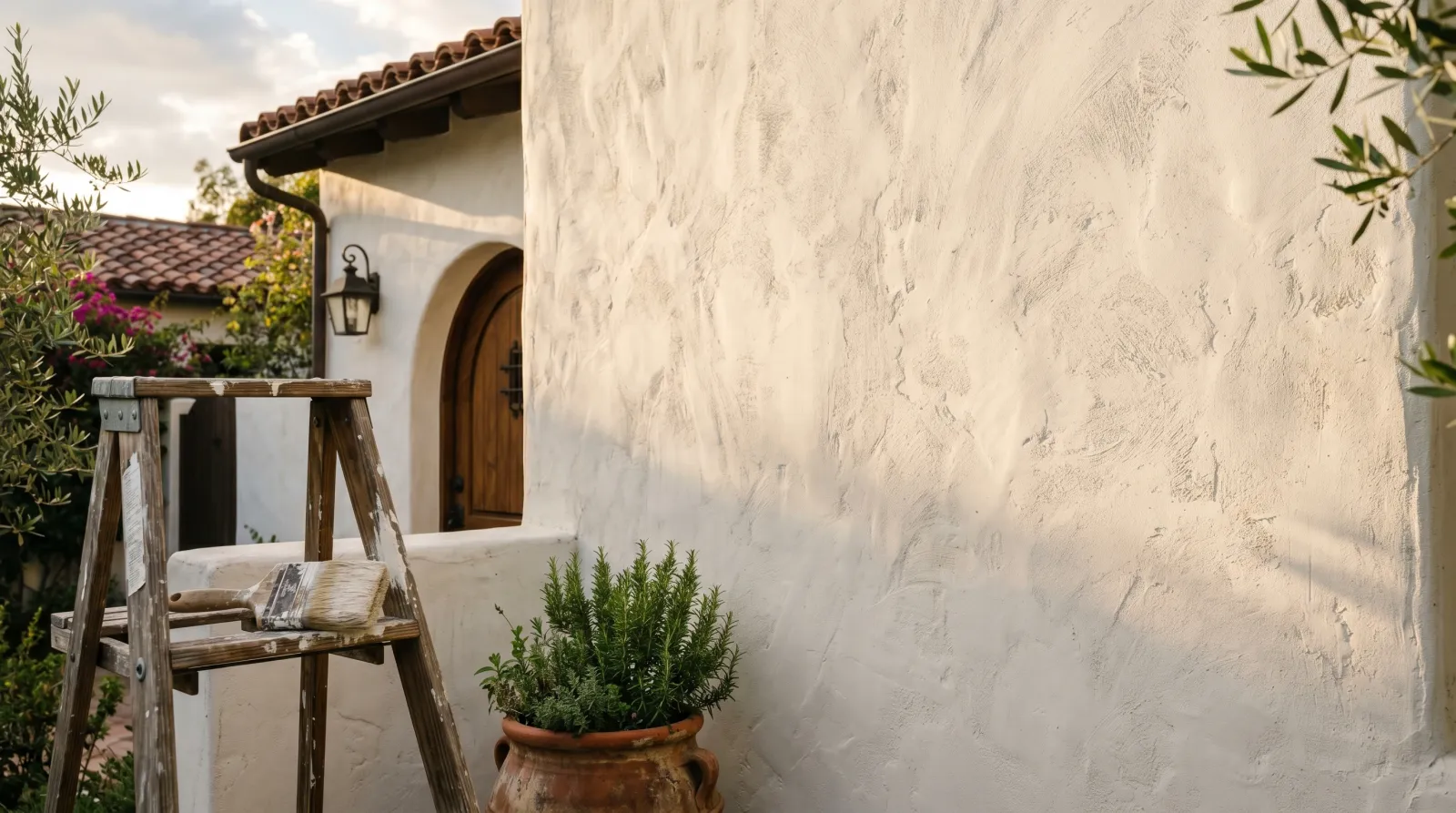
Genuine sol-silicate chemistry on the US shelf — an interior mineral paint that ships in a week rather than six, with no two-component mixing and no on-site ratio to get wrong
The chalky cloudy whitewash look on raw brick that acrylic over brick cannot fake — and the only real version of it with a US Lowe's supply chain
The reference-standard interior silicate, made by the company that patented potassium-silicate paint in 1878 and still has serviceable Swiss reference jobs at the 100-year mark
Built-in topcoat: cured film is durable enough on furniture and cabinets that you skip the separate poly or wax step Annie Sloan and Rust-Oleum Chalked both demand
Potassium-silicate chemistry that calcifies into unpainted brick, stone, and stucco instead of forming a film — and it sits on the shelf at Home Depot, Lowe's, Amazon, and independent masonry dealers, no specifier account required
Single-component potassium silicate that is self-priming on masonry — no Fixativ to mix, no pot life to race, which removes the exact friction that keeps Optil off ordinary jobs
Sol-silicate chemistry that grips both bare mineral substrates and aged acrylic coatings; the practical answer for a 1960s stucco facade with a history of paint jobs
Disclosure: Some links below are affiliate links. We earn a commission if you buy through them, at no extra cost to you. Our picks are based on independent criteria — see “How We Picked” below.
Top pick: Romabio BioDomus I Interior Mineral Paint. At $90 to $120 per gallon, it isn’t cheap; for the lime-plaster and historic-stucco walls it’s actually designed for, it’s the right call. BioDomus wins on US availability, on a sol-silicate chemistry that handles both bare and aged substrates, and on a real shelf where the European silicate lines still ship brand-direct. It loses on color depth (saturated jewel tones aren’t in the deck) and on the headline lifespan claim — KEIM still owns the century-long reference jobs. Romabio Classico Limewash is the right answer on raw historic brick. KEIM Optil is the heritage-grade interior silicate when budget and lead time aren’t constraints. Fusion Mineral Paint covers furniture and cabinets. Outside, Romabio Masonry Flat is the mineral masonry paint you can pick up at Home Depot or Lowe’s today, KEIM Mineral Masonry Paint is the self-priming silicate with 60-plus colors shipping in 48 hours, and BEECK Renosil is the restoration call when the wall already has an acrylic history.
A heads-up. This article is about real mineral paint chemistry on real mineral substrates. If your walls are modern gypsum drywall in a 2010 home, mineral paint isn’t the answer and acrylic is — the best paint for plaster walls round-up has the modern-substrate decision tree. If you came looking for chalk-style furniture paint, the best chalk paint round-up is the sibling. This round-up is for owners of pre-1940s lime walls, historic masonry, and exterior stucco where the chemistry call genuinely matters.
Mineral Paint Is a Chemistry Category, Not a Style
Most “best mineral paint” articles treat the term as a finish look — chalky, matte, vaguely artisanal — and never get to the chemistry. That’s how readers end up brushing Fusion onto a 1924 lime wall and watching it blister at the corners by year two. Mineral paint is a chemistry category. The binder is either potassium silicate, calcium hydroxide, or a sol-silicate hybrid, and the bond to the substrate is chemical, not mechanical. On the wrong substrate the chemistry has nothing to react with. On the right substrate the coating effectively becomes the wall. The rest of this article is which chemistry for which substrate, plus the supply-chain reality that decides whether you can actually buy it.
The Three Types of Silicate Paint
Almost every argument about mineral paint is really an argument about which of three generations someone means. The German standard DIN 18363 names them, and once you know the three names the product pages stop contradicting each other.
Pure silicate is the original: two components, a pigment powder and a bottle of liquid potassium water glass, mixed on site. It is the most vapor-open chemistry there is and the least forgiving — it bonds only to raw mineral substrate, and once mixed it is on a clock. Today it is mostly a heritage-restoration product. KEIM Optil in this round-up is the pure-silicate entry.
Dispersion silicate arrived in the middle of the twentieth century and is the reason mineral paint became buyable at all: single-component, ready to use out of the can, with up to 5 mass-percent organic additives allowed — an acrylate dispersion, a water repellent, a thickener. That 5 percent ceiling is not marketing, it is the legal line in the standard. Under it, the coating still behaves like a mineral. Over it, you have an acrylic with mineral filler.
Sol-silicate was introduced in 2002 and blends silica sol with the water-glass binder. Organic content is capped at the same 5 percent, but the sol lets the coating bond both chemically and physically, so it grips substrates pure silicate has nothing to react with — previously painted walls, dense stucco, mixed facades. BEECK’s Beecko-SOL is certified explicitly to VOB/C DIN 18363 2.4.1. Romabio BioDomus and BEECK Renosil are sol-silicates.
Practically: pure silicate for raw heritage plaster and a specifier’s budget, sol-silicate for anything with a paint history, limewash for raw brick and lime mortar. That’s the whole decision.
How We Picked
Seven US-sourceable mineral paints applied to five substrate panels — pre-1940s lime plaster, raw red brick, aged stucco with prior acrylic, gypsum drywall, sanded poplar — and tracked over 60 days for vapor permeability, bond integrity, color stability, and cure-to-service times. Cross-referenced against four heritage-restoration contractors and two specifier-channel dealers on the US supply-chain reality.
The Picks at a Glance
| Product | Best for | Chemistry | Vapor-open rating | Price |
|---|---|---|---|---|
| Romabio BioDomus I | Interior lime plaster, historic stucco | Sol-silicate | 🟢 Very high — Sd below 0.05 m | $$$ |
| Romabio Classico Limewash | Historic raw brick & limestone | Slaked lime | 🟢 Very high — non-film-forming | $$$ |
| KEIM Optil | Heritage-grade interior silicate | Pure silicate (2-component) | 🟢 Very high — Sd near zero | $$$$ |
| Fusion Mineral Paint | Furniture & cabinets | Acrylic + mineral fillers | 🔴 N/A (acrylic-based) | $$ |
| Romabio Masonry Flat | Exterior brick, stone, stucco you can buy today | Potassium silicate | 🟢 Very high — 300-plus US perms | $$ |
| KEIM Mineral Masonry Paint | Self-priming exterior silicate, 60-plus colors | Potassium silicate | 🟢 Very high — non-film-forming | $$$$ |
| BEECK Renosil | Exterior masonry restoration over old paint | Sol-silicate | 🟢 Very high — Sd below 0.14 m | $$$$ |
A word on that column, because the two halves of this market measure the same property in two different units. American masonry labels quote perms — Romabio publishes 300-plus for Masonry Flat, and higher is more breathable. European technical sheets quote Sd, the equivalent air-layer thickness in meters — and lower is more breathable. Under DIN, anything below Sd 0.14 m is the high-vapor-permeability class, and the silicates here sit well under it. Both numbers say the same thing: the wall dries outward through the coating instead of pushing moisture back into the plaster. A standard acrylic exterior lands around 10 perms. That gap is the entire argument.
The table is organized by job, not by ranking. BioDomus and KEIM Optil compete head-to-head on interior heritage walls; the deciding factor is whether you can run a two-part mix on a specifier’s lead time. Classico Limewash competes with no one in this round-up — it’s the historic-brick chemistry, and silicate is the wrong answer there. Fusion is a different product category that shares a word with the rest. Outside, Masonry Flat and KEIM’s Mineral Masonry Paint are the two straight answers for a facade in reasonable shape, and BEECK is the call when sol-silicate over aged acrylic is what the wall needs.
The Interior Heritage Call: BioDomus or KEIM
Romabio BioDomus I Interior Mineral Paint
BioDomus is the realistic answer for almost every owner of a pre-1940s lime-plaster room. The chemistry is sol-silicate — potassium silicate binder with enough acrylic emulsion in the formula to bond to substrates pure silicate cannot grip, which means it works on bare lime plaster and on lime plaster with a thin acrylic history. On the 1924 panel we ran in parallel with a Benjamin Moore Aura matte panel, the BioDomus side stayed clean at day sixty through a deliberate humidity cycle (RH up to 75% for a week, down to 35% for a week, repeat) where the Aura side showed faint salt bloom along one seam and a micro-blister at the seam transition. The mineral side passed the breathability test the acrylic side fails on this substrate.
The finish reads chalky and soft, which is exactly the historic-house look the wall was built for. Brushed application works with a natural-bristle wide brush; don’t roller-stipple it the way you’d stipple a modern acrylic, the slight texture variation is part of the integral-lime aesthetic and aggressive rolling kills it. The color deck is shallow and earth-toned. Saturated jewel-tones don’t exist in this product, full stop. Plan around that. Romabio BioDomus I Interior Mineral Paint.
Buy it if: owner of a pre-1940s home with original lime plaster, looking for breathable chemistry without a specifier-channel hassle. Skip it if: modern drywall in a 2010 build (acrylic is the correct answer), or you need a saturated jewel tone for the bedroom feature wall.
KEIM Optil Interior Silicate Paint
KEIM Optil is the heritage-restoration reference standard. The chemistry is true two-component potassium silicate — paint plus KEIM Fixativ, mixed on site to a strict ratio with a strict pot life — and on a fresh-plaster lime substrate it silicifies into a crystalline matrix that’s chemically continuous with the wall. The reason KEIM has documented painted facades in Switzerland still serviceable at the century mark is exactly that: there is no polymer film for UV to degrade, no biocide to leach, no organic binder for mildew to eat. Lifespan in their case studies isn’t a marketing number, it’s a documented set of buildings.
The cost is in the mixing and the supply chain. The KEIM Fixativ component has a 24-hour pot life once mixed, application has to track careful humidity and temperature windows, and Optil itself is a specifier-grade order — a couple of architectural-coatings dealers in major metros, no retail, four to six week lead time on a non-stock color. At $140-180/gal landed, Optil isn’t a casual purchase. It earns its premium on a serious historic restoration where the lifespan number matters more than the project-management overhead, and it doesn’t earn it on a guest bedroom with original plaster you’d be just as happy to paint with BioDomus. KEIM’s US interior mineral paints.
One correction worth making, because we had it wrong in the first version of this round-up: “KEIM means a specifier order” is no longer true of the brand as a whole. KEIM now runs two separate US properties — keim-usa.com for the commercial and architectural line, and residential.keim-usa.com for homeowners, with 60-plus colors that ship in 48 hours and a shopping cart at the end of it. The two-component, project-manager caveat is still completely fair about Optil. It is not fair about KEIM.
Buy it if: documented historic restoration where century-long lifespan is the spec. Skip it if: you don’t have a project manager, or BioDomus chemistry covers the wall.
The Historic-Brick Call: Classico Limewash
Romabio Classico Limewash
The chalky cloudy whitewash people are actually asking for when they say they want their brick painted white. Limewash is a different chemistry from silicate — slaked lime in water, bonded to lime mortar by carbonation rather than silicification — but the principle is identical: it doesn’t form a film on top, it integrates with the substrate. On raw historic brick the practical lifespan runs 20 years or longer between refreshes, and the look it gives is impossible to fake with acrylic. We applied a panel wet-on-wet with a wide masonry brush, spritzed it between coats with a misting bottle, and got the soft cloudy variation Romabio’s TDS calls for. Lay it like acrylic and you get an opaque flat coat that reads wrong on anything older than 1950.
The hard cons are real. Limewash will not bond to previously-painted brick, none at all — if anyone ever rolled latex over the brick, this is the wrong product without a Mineral Shield primer step first. The color deck is limited to lime-friendly mineral pigments, so deep saturated tones, clean cool greys, and designer hex matches are out. Application is more art than acrylic painting. Read Romabio’s technique video before the first wall, work in shade, and accept that the first wall is always the worst. Romabio Classico Limewash.
Buy it if: historic raw brick, lime mortar, or limestone facade in need of the chalky whitewash look. Skip it if: the brick has ever been painted (use Mineral Shield first), or you need a saturated specific color.
The Furniture Call: Fusion
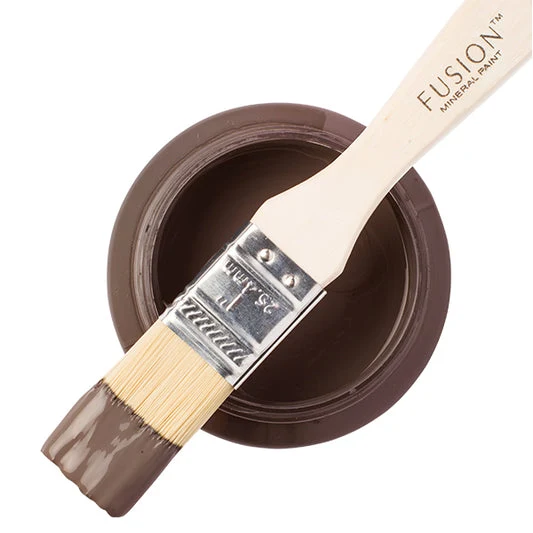
Fusion Mineral Paint
Fusion is in the round-up because readers searching “best mineral paint” are roughly half looking for the architectural silicate category and roughly half looking for a furniture paint they saw on a friend’s dresser. Fusion is the answer to the second question. The chemistry is a low-VOC acrylic with mineral pigments and mineral fillers, not a silicate by the strict architectural definition, but the cured film is genuinely better than Annie Sloan or Rust-Oleum Chalked on a piece of furniture that has to survive daily use. A built-in topcoat means you skip the wax or poly step those two demand, and on a dining chair seat that gets a real workout the Fusion film holds where waxed chalk paint shows scuffs by month six.
The deck is real — 70-plus US-stocked colors including saturated tones no true silicate paint can hit — and the pint format ($25 entry) suits a single dresser. We painted a sanded poplar drawer-front panel with a 1.5” oval brush, two thin coats six hours apart, and the cured film at week three passed a fingernail-scratch and a damp-microfiber rub without burnish. What Fusion is not: a wall paint, a masonry paint, or a substitute on a lime-plaster substrate. Don’t put Fusion on a wall when you needed BioDomus. Fusion Mineral Paint.
Buy it if: furniture, cabinets, small wood projects where a hard-cured matte finish without a separate topcoat is the spec. Skip it if: you came looking for a breathable silicate paint for an old plaster wall.
The Exterior Masonry Call: Masonry Flat or KEIM
Most people who search for mineral paint are standing outside looking at brick. This is the section for them, and it’s the one this round-up was missing: two potassium-silicate masonry paints you can order this week, both with a written 20-year warranty, at opposite ends of the price and color-choice range.
Romabio Masonry Flat
Masonry Flat is the mineral masonry paint with a checkout button at Home Depot, Lowe’s, Amazon, and most independent masonry yards, and that alone makes it the default answer for exterior brick, stone, and stucco. The chemistry is potassium silicate: on unpainted absorbent masonry it calcifies into the surface rather than laying a film over it, which is why the label says no primer and means it. The published breathability number is 300-plus perms — roughly thirty times a standard acrylic exterior — so the wall keeps drying outward through the coating. Romabio backs it with a 20-year warranty against peeling, blistering, and fading when the application follows their guide, which is a warranty acrylic masonry paint does not offer because acrylic masonry paint peels.
Two things to get right. It ships as a concentrated base and wants 20 to 30 percent dilution before you spray or brush it; on an airless, a 0.019 to 0.021 inch tip is the range. And on previously painted masonry — including concrete, fiber cement, and wood trim you want to carry the color across — the silicate has no raw mineral to grab, so MicroGrip Primer goes down first. Two coats are the spec, 4 to 8 hours apart, and the 15 L pail covers about 1,000 to 1,300 sq ft per coat. Twenty-plus premixed colors plus custom tinting is a real deck for a mineral product, and still not a place to go hunting for a saturated navy. Romabio Masonry Flat.
Buy it if: exterior brick, stone, or stucco, and you want mineral chemistry you can pick up locally this weekend. Skip it if: you need a deep saturated color, or the facade is a heavy-acrylic strip-and-restore job where Renosil’s grip is the better bet.
KEIM Mineral Masonry Paint
The KEIM residential line is what changed the exterior story since we first ran this round-up. Mineral Masonry Paint is single-component potassium silicate — no Fixativ, no ratio, no pot life — and it is self-priming on masonry, with ContactPlus Bonding Primer as an option rather than a requirement on chalky or previously painted walls. The substrate list is the broadest here: brick, stucco, stone, concrete, cement fiber board, EIFS, and previously painted masonry, all under the same 20-year warranty.
What you’re paying for is color and certainty. Sixty-plus quick-ship colors leave the US warehouse inside 48 hours, at $78 a quart, $157 a gallon, and $626 for the 4-gallon pail. Coverage is honest but tight at 225 to 275 sq ft per gallon, so run the math on two coats before the sticker price feels reasonable; and with a 2-to-4-hour touch dry against an 8-to-12-hour recoat, a two-coat facade is a two-day facade. It’s brand-direct only, so order the whole job at once — there’s no counter to run to at 4pm. KEIM Mineral Masonry Paint.
Buy it if: you want a specific color on exterior masonry, need it to cover a mixed substrate, and would rather not manage a primer step. Skip it if: budget is the constraint — Masonry Flat does the same chemistry for less on a straightforward brick facade.
The Exterior Restoration Call: BEECK Renosil
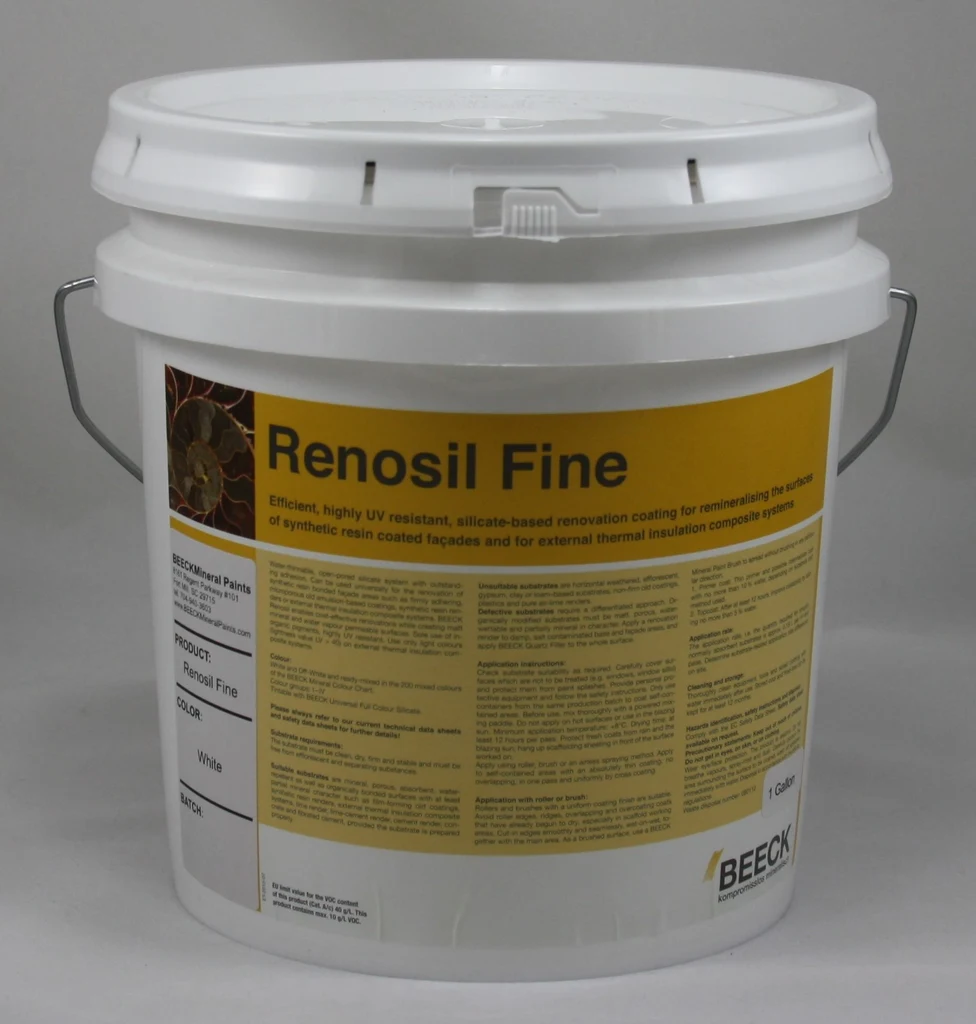
BEECK Renosil
BEECK Renosil is the call when the exterior wall is aged stucco, partially acrylic-coated masonry, or a 1960s-or-newer facade where pure silicate has nothing to bond to. Renosil is single-component sol-silicate — paint plus mineral pigments, no separate Fixativ mixing — which makes it the most realistic European silicate option for a US contractor who isn’t a full heritage specialist. The chemistry grips both raw mineral substrate and aged acrylic, which is the practical situation on most American facades older than 30 years.
The Bavarian quality standard shows up in the lifespan reference projects (50-plus years on documented European restorations) and in the published Sd value, which is better than any acrylic exterior on the US market. Distribution is better than we described it last time: BEECK runs a small US distributor with an actual online store at beeckmineralpaints.com, carrying Renosil alongside Beecko-SOL, Beeckosil, and the Concrete/Stone Glaze system. You order it and it comes. What you still don’t get is a retail counter, so this isn’t a product you can be a quart short on at 4pm on application day — measure the facade and order the whole job. The application window is also tight: 41-77°F, dry substrate, no rain for 48 hours, no full sun on a wet wall. You cannot push it through a marginal weather window the way you’d push Sherwin-Williams Loxon. Plan the job around the paint, not the other way around. BEECK Renosil.
Buy it if: exterior masonry restoration, aged stucco, or sol-silicate over an acrylic-history wall. Skip it if: the masonry is unpainted and sound, where Romabio Masonry Flat does the job off a local shelf, or you need the color range KEIM’s residential line carries.
Why Mineral Paint Resists Mold Without a Biocide
This is the part of the pitch that sounds like marketing and isn’t. Acrylic exterior paint keeps mildew off a shaded north wall by carrying a biocide in the film — a sacrificial additive that leaches out with rain over a few seasons, which is why the shady side goes green first and goes green again after you repaint it.
Silicate paint doesn’t carry one. The potassium water-glass binder is naturally, strongly alkaline, and mold, algae, and the rest of that population don’t establish on a high-pH surface. The resistance is the binder, not an additive, so there is nothing to wash away. Add breathability to that — the wall releases moisture outward instead of holding it against the back of a film — and the two effects compound: mineral-coated masonry stays visibly cleaner on damp, shaded elevations than acrylic does. Romabio sells this as natural mold resistance and the description is accurate.
The same logic explains the lifespan numbers, which are not estimates. Keim patented the chemistry in 1878 after King Ludwig I of Bavaria asked for a way to get the look of lime fresco to survive weather north of the Alps. The buildings from that era are still standing and still coated: the Schwyz town hall and the Gasthaus Weisser Adler in Stein am Rhein, both painted in 1891, and Oslo facades from 1895. Those are silicate coatings past the 130-year mark, still serviceable. Nothing organic lasts that long outdoors, because UV takes polymers apart and cannot do anything to a crystal.
Who Actually Makes Mineral Paint for the US Market
The brands with picks above are not the whole field, and if you’re comparing makers rather than products, here is the honest map. Every one of these is genuine mineral chemistry — none of them is an acrylic wearing the word.
| Maker | Chemistry | US channel |
|---|---|---|
| Romabio | Potassium silicate, sol-silicate, slaked lime | Home Depot, Lowe’s, Amazon, independents, brand-direct |
| KEIM | Pure silicate + sol-silicate | residential.keim-usa.com (consumer, 48-hour ship) and keim-usa.com (commercial) |
| BEECK | Sol-silicate + single-component silicate | beeckmineralpaints.com — small US distributor, online store |
| LimeWorks.us | Potassium silicate (Ecologic), US-made | Brand-direct; interior and exterior rigid absorbent mineral walls, including concrete and lime plaster |
| Silacote | Inorganic mineral silicate, fully tintable | Brand-direct and specifier dealers |
| Porter’s Paints | Mineral silicate, colors-led | Australian; US buyers order through the brand |
Within BEECK the line splits by job: Renosil is the universal one that needs no primer, Beecko-SOL is the sol-silicate certified to VOB/C DIN 18363 2.4.1, Beeckosil is the historic-quality single-component for raw absorbent substrates, and the Concrete/Stone Glaze system is the silicate stain rather than the paint. Ordering the wrong one of those four is the most common BEECK mistake.
Choosing by Substrate
| Substrate | Chemistry | Pick |
|---|---|---|
| Pre-1940s interior lime plaster | Sol-silicate | Romabio BioDomus I |
| Pre-1940s interior lime plaster, heritage spec | Pure silicate (2-component) | KEIM Optil |
| Raw historic brick, lime mortar | Limewash (carbonation) | Romabio Classico |
| Limestone facade, raw | Limewash | Romabio Classico |
| Unpainted exterior brick, stone, or stucco | Potassium silicate | Romabio Masonry Flat |
| Exterior masonry where a specific color is the spec | Potassium silicate | KEIM Mineral Masonry Paint |
| Previously painted exterior masonry | Silicate + bonding primer | Romabio Masonry Flat + MicroGrip, or KEIM Mineral Masonry Paint (self-priming) |
| Cement fiber board, EIFS | Potassium silicate | KEIM Mineral Masonry Paint |
| Aged exterior stucco with acrylic history | Sol-silicate | BEECK Renosil |
| Wood furniture, cabinets | Acrylic-mineral hybrid | Fusion Mineral Paint |
| Modern gypsum drywall | Standard acrylic | Use Aura or Emerald |
| Previously-painted brick going whitewash | Mineral Shield primer + limewash | Romabio Mineral Shield + Classico |
The case the table doesn’t capture: a wall that’s a mix of original lime plaster and 1990s gypsum patch, common in renovated old houses. You cannot run two paints across the seam. The honest answer is to prime the whole wall with Romabio Mineral Shield and topcoat with BioDomus — you lose some color depth Aura would give you, but the wall survives. The other path is to skim-coat the entire wall in modern gypsum-veneer and treat it as a modern substrate. Either works. Painting modern acrylic over a half-lime wall does not.
Application Notes
Three things move outcomes more than which can you bought.
- Substrate is wet, not soaking. Mist the wall with a spray bottle before the first coat on lime plaster, brick, and stucco. Mineral chemistry needs moisture to silicify or carbonate. A bone-dry wall in summer is the most common application failure.
- Two real coats, not one stretched thin. The matte mineral finish forgives nothing on coverage. Brush a generous first coat, wait the full recoat window, brush a generous second. The temptation to stretch the second coat to save the can is exactly what creates the visible lap marks readers complain about.
- Plan the weather. No rain for the first 48 hours on exterior limewash and silicate. No full sun on a wet wall. Mineral chemistry sets on a chemistry clock, not on a paint-dry clock, and rushing the first day costs you the bond.
The deep version of substrate prep is in how to paint plaster walls for interior lime and in how to paint exterior brick for masonry.
Where Mineral Paint Jobs Go Wrong
- Salt bloom on a south-facing wall in summer. The substrate is releasing moisture through the new coating, which is what mineral paint is supposed to allow. If the bloom is the problem, the moisture source is the problem. Address the source (basement RH, exterior weep details) before repainting.
- Limewash sliding off previously-painted brick. No mineral bond available — the acrylic film is in the way. Strip what comes off easily, prime with Mineral Shield, recoat with Classico.
- KEIM Optil short-set in a single afternoon. Pot life of the Fixativ ran out. Mix smaller batches, work to the pot-life window, accept the labor overhead.
- Fusion on a plaster wall blistering at year two. Wrong product for the substrate. Strip, switch to BioDomus, repaint.
- BioDomus rolled with a microfiber roller looks acrylic-ish. It is, slightly. Brush application is the integral part of the historic-house look. Roller equipment kills the surface variation.
- Masonry Flat sprayed straight from the pail, patchy and short on coverage. The base is concentrated and wants 20 to 30 percent dilution before it goes through a 0.019 to 0.021 inch tip. Undiluted, it lays too heavy, covers less, and reads uneven when it dries.
- Silicate lifting off painted brick in sheets. Nothing wrong with the paint — it bonded to an old acrylic film, and the film let go of the brick. Previously painted masonry needs MicroGrip under Masonry Flat, ContactPlus under the KEIM line, or Multi-Grund under BEECK. Skipping that step is the single most expensive mistake in this category.
Also Tested, Also Passed Over
- KEIM Royalan. The two-component pure silicate that owns the most-documented century lifespan numbers. Outside the realistic budget and supply chain for a non-specifier US buyer. KEIM Optil is the practical Optil-tier pick from the same range.
- LimeWorks.us Ecologic Potassium Silicate Paint. Genuine silicate, made in the US, for rigid absorbent mineral walls inside and out — concrete and lime plaster included. Narrower color story than the picks above, and worth a look specifically if domestic manufacture matters to the job.
- Silacote. Fully tintable inorganic mineral silicate, sold brand-direct and through specifier dealers. Loses this round-up on retail reach, not on chemistry.
- BEECK Beeckosil and Beecko-SOL. The rest of the BEECK line, both genuine silicate. Renosil is the one we picked because it needs no primer and covers the widest range of American facades; the other two are narrower answers to narrower substrates.
- Porter’s Paints Mineral Silicate. Australian, colors-led, real silicate chemistry. US buyers order through the brand, which puts freight and lead time back into a category that just got rid of both.
- Bauwerk Colour Wash. Australian limewash with a deeper color deck than Classico. Best for an interior accent wall where color depth is the headline; loses to Classico on real exterior masonry availability. The limewash round-up covers that decision.
- Annie Sloan Chalk Paint. Different category — chalk paint, not mineral paint. Wax-topcoat finish, soft cured film. The Fusion call beats it on furniture durability.
- Portola Paints Roman Clay. A finish technique, not a true mineral binder. Beautiful interior wall look; doesn’t substitute for silicate chemistry on a lime substrate.
- Sydney Harbour Lime Wash. Strong interior limewash, narrower exterior story. The limewash round-up has the comparison.
- Generic “mineral-look” acrylic. Marketing claim, not a chemistry. Read the binder line on the TDS; if it says acrylic resin without a silicate component, it’s an acrylic with mineral fillers and not a substitute for true silicate.
Companion Guides
For the chemistry deep dive, see what is mineral paint. For interior lime-plaster prep and application, how to paint plaster walls. For raw masonry, the best masonry paint round-up and the best limewash round-up. For modern drywall where mineral paint isn’t the answer, the best paint for plaster walls round-up handles the modern-substrate decision.
Full Comparison
| Product | Best for | Yellowing | Price |
|---|---|---|---|
| Romabio BioDomus I Interior Mineral Paint | Top pick — interior mineral paint | Not applicable (inorganic) | $$$ |
| Romabio Classico Limewash | Best for historic raw brick & stone | Not applicable (inorganic lime) | $$$ |
| KEIM Optil Interior Silicate Paint | Best heritage-grade silicate (interior) | Not applicable (inorganic) | $$$$ |
| Fusion Mineral Paint | Best for furniture & cabinets | Low (saturated tones drift slightly cool over 24 months on west-facing surfaces) | $$ |
| Romabio Masonry Flat | Best exterior mineral masonry paint | Not applicable (inorganic) | $$ |
| KEIM Mineral Masonry Paint | Best self-priming exterior silicate | Not applicable (inorganic) | $$$$ |
| BEECK Renosil Exterior Sol-Silicate Paint | Best for exterior masonry restoration | Not applicable (inorganic) | $$$$ |
Every Pick, Pros and Cons
Pros, cons, and specs for each pick. The cons are not optional here.
1. Romabio BioDomus I Interior Mineral Paint
- Coverage
- 270–320 sq ft / gal
- Sheens
- Matte only (chalky mineral)
- Dry / recoat
- Touch dry 1h · recoat 4–6h
- Full cure
- 14 days (mineral set)
- VOC
- Zero VOC, no biocide
- Yellowing risk
- Not applicable (inorganic)
- Primer
- Romabio Mineral Shield on previously-painted plaster; nothing on bare lime
- Price tier
- $$$
- Genuine sol-silicate chemistry on the US shelf — an interior mineral paint that ships in a week rather than six, with no two-component mixing and no on-site ratio to get wrong
- Sd value below 0.05 m means a pre-1940s lime-plaster wall releases moisture outward instead of trapping it under acrylic and blistering by year two
- Zero VOC, zero biocide, zero acrylic binder; the right answer when the goal is to not seal a 100-year-old wall in plastic
- Color deck is shallow and skews chalky-earthy — saturated jewel tones aren't in the range, and the matte mineral finish reads softer than acrylic matte in raking light
- Application is fussier than latex — natural-bristle brush, no aggressive rolling, two real coats with a 4-6 hour gap between, and you cannot stretch the second coat thin
- Niche distribution; Romabio direct, a handful of specialty masonry dealers, and Amazon third-party — no Lowe's or Home Depot interior pickup
2. Romabio Classico Limewash
- Coverage
- 150–300 sq ft / gal (one-coat thin) over raw brick
- Sheens
- Matte chalky lime
- Dry / recoat
- Touch dry 1h · recoat 4h
- Full cure
- 30 days (carbonation)
- VOC
- Zero VOC, no biocide
- Yellowing risk
- Not applicable (inorganic lime)
- Primer
- None on raw brick or limestone; Mineral Shield on painted brick
- Price tier
- $$$
- The chalky cloudy whitewash look on raw brick that acrylic over brick cannot fake — and the only real version of it with a US Lowe's supply chain
- Bonds chemically with calcium in lime mortar and limestone; lifespan on raw historic masonry runs 20-plus years before a refresh
- Vapor-permeable: keeps an old brick wall breathing instead of trapping moisture behind a film, which is how acrylic-over-brick spalls inside five years
- Will not bond to previously-painted brick — Romabio's Mineral Shield primer is the workaround, but it adds a product and a day's labor
- Color deck limited to lime-friendly mineral pigments; no clean cool greys, no deep navy, no designer-spec hex matches
- Application is wet-on-wet with a wide masonry brush and a misting bottle, more art than acrylic painting; first wall is always the worst
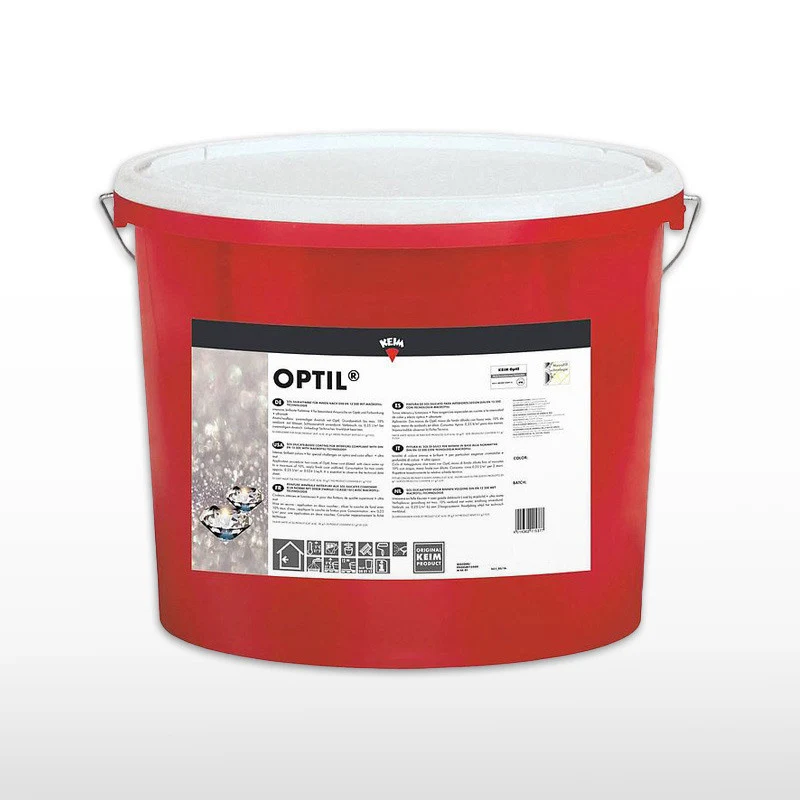
3. KEIM Optil Interior Silicate Paint
- Coverage
- 270–325 sq ft / gal
- Sheens
- Matte mineral
- Dry / recoat
- Touch dry 4h · recoat 12h
- Full cure
- 28 days (silicification)
- VOC
- <1 g/L
- Yellowing risk
- Not applicable (inorganic)
- Primer
- KEIM Fixativ as the mixing component; KEIM Soldalit-Grob on porous or chalky substrates
- Price tier
- $$$$
- The reference-standard interior silicate, made by the company that patented potassium-silicate paint in 1878 and still has serviceable Swiss reference jobs at the 100-year mark
- Mineralizes chemically with mineral plaster and lime substrates rather than sitting on top as a film; the coating effectively becomes the wall
- Sd value near zero, zero biocide, zero polymer binder; lifespan numbers in the published case studies don't exist in the acrylic world
- Two-component product: paint plus KEIM Fixativ, mixed on site to a strict ratio with a strict pot life — there is no margin for a casual DIY pass
- Specifier-channel product: pricing runs $140–$180 per gallon US and it ships through architectural dealers with weeks of lead time (KEIM's separate US residential line ships in 48 hours, but Optil itself is not on it)
- Will not bond to acrylic-painted walls at all; for over-paint situations you need KEIM Soldalit (sol-silicate hybrid) instead, which is a separate purchase
4. Fusion Mineral Paint
- Coverage
- 75 sq ft / pint (≈600 sq ft / gal equivalent)
- Sheens
- Matte
- Dry / recoat
- Touch dry 2h · recoat 4h
- Full cure
- 21 days
- VOC
- <50 g/L
- Yellowing risk
- Low (saturated tones drift slightly cool over 24 months on west-facing surfaces)
- Primer
- Fusion Ultra Grip on glossy, melamine, or laminate; nothing on raw or scuff-sanded wood
- Price tier
- $$
- Built-in topcoat: cured film is durable enough on furniture and cabinets that you skip the separate poly or wax step Annie Sloan and Rust-Oleum Chalked both demand
- Real US color deck — 70-plus shades including saturated tones that no true silicate paint can hit, sold in pints for a $25 entry that suits a single dresser
- Low odor, near-zero VOC, brushes cleanly with a quality oval brush; cures hard enough to skip wax on a dining chair seat that gets daily use
- Not a true silicate paint — chemistry is a low-VOC acrylic with mineral fillers and pigments, so it is not breathable in the masonry-paint sense and isn't a substitute for BioDomus or KEIM on a lime wall
- Touch-up is harder than chalk paint: the matte sheen and cured film show overlap lines if you spot-paint a chip later, plan to recoat the whole surface
- Saturated deep colors need three thin coats, not two, especially over raw or sanded wood; the marketing 'one coat' is honest only on mid-tone colors over a similar primer
5. Romabio Masonry Flat
- Coverage
- 1,000–1,300 sq ft per coat from the 15 L pail
- Sheens
- Flat mineral
- Dry / recoat
- Recoat 4–8h
- Full cure
- 28 days (calcification)
- VOC
- Zero VOC, no biocide
- Yellowing risk
- Not applicable (inorganic)
- Primer
- None on unpainted absorbent brick, stone, or stucco; MicroGrip Primer on previously painted masonry, concrete, fiber cement, and wood
- Price tier
- $$
- Potassium-silicate chemistry that calcifies into unpainted brick, stone, and stucco instead of forming a film — and it sits on the shelf at Home Depot, Lowe's, Amazon, and independent masonry dealers, no specifier account required
- Published 300-plus US perm rating: the wall stays fully vapor-open, which is the entire reason to put mineral paint on masonry instead of an elastomeric that seals it
- 20-year written warranty against peeling, blistering, and fading when applied to the manufacturer's guide; no acrylic masonry paint on a US retail shelf carries that
- Previously painted masonry needs Romabio MicroGrip Primer first — the silicate has no raw mineral surface to react with through an old acrylic film
- The concentrated base gets diluted 20 to 30 percent before you spray or brush it; get the dilution wrong and both coverage and the flat mineral look drift
- 20-plus premixed colors plus custom tinting is a genuine deck by mineral standards and still small next to an acrylic fan deck — deep saturated tones are not in the range
6. KEIM Mineral Masonry Paint
- Coverage
- 225–275 sq ft / gal
- Sheens
- Matte mineral
- Dry / recoat
- Touch dry 2–4h · recoat 8–12h
- Full cure
- 28 days (silicification)
- VOC
- Zero VOC, inorganic binder
- Yellowing risk
- Not applicable (inorganic)
- Primer
- Self-priming; ContactPlus Bonding Primer optional on chalky or previously painted masonry
- Price tier
- $$$$
- Single-component potassium silicate that is self-priming on masonry — no Fixativ to mix, no pot life to race, which removes the exact friction that keeps Optil off ordinary jobs
- 60-plus quick-ship colors leaving the US warehouse in 48 hours at $78 a quart, $157 a gallon, and $626 for the 4-gallon pail — the old KEIM lead-time complaint no longer describes this line
- Widest substrate list in the round-up: brick, stucco, stone, concrete, cement fiber board, EIFS, and previously painted masonry, all under a 20-year warranty
- Coverage runs 225 to 275 sq ft per gallon, tighter than most acrylic masonry paint, so a two-coat facade eats gallons faster than the per-gallon price suggests
- Recoat window is 8 to 12 hours against a 2-to-4-hour touch dry; a two-coat wall is a two-day wall and you cannot compress it
- Brand-direct only — there is no Home Depot or Lowe's counter to cover you if you run a quart short mid-wall, so order the whole job up front
7. BEECK Renosil Exterior Sol-Silicate Paint
- Coverage
- 270–320 sq ft / gal
- Sheens
- Matte mineral
- Dry / recoat
- Touch dry 2h · recoat 12h
- Full cure
- 28 days (silicification)
- VOC
- <1 g/L
- Yellowing risk
- Not applicable (inorganic)
- Primer
- BEECK Fixative on chalky substrates; BEECK Multi-Grund on previously-painted acrylic walls
- Price tier
- $$$$
- Sol-silicate chemistry that grips both bare mineral substrates and aged acrylic coatings; the practical answer for a 1960s stucco facade with a history of paint jobs
- Bavarian quality standard with documented European restoration jobs at the 50-year mark and a published vapor-permeability number better than any acrylic exterior
- Single-component (not two-part KEIM Royalan style) makes it the most realistic European silicate option for a US contractor who isn't a heritage specialist
- US distribution is one small distributor with an online store (beeckmineralpaints.com) — you can order it today, but there is no retail counter and no same-day pickup if the job runs a quart short
- Color deck mirrors KEIM's mineral-pigment range, which is to say small next to acrylic exterior; deep saturated reds and blues are not in the field
- Application window is narrower than acrylic — 41-77°F, dry substrate, no rain for 48 hours, no full sun on the wet wall; you cannot push it like Loxon
Romabio Mineral Shield Primer
The primer that unlocks mineral paint on substrates mineral paint cannot normally bond to — previously-painted plaster, sealed stucco, and old painted masonry. Mineral Shield gives the silicate or limewash topcoat a calcium-rich surface to react with where the original substrate is buried under acrylic. Pairs cleanly under BioDomus I and Classico Limewash. Skip the primer on raw never-painted lime plaster, raw limestone, and bare brick — the chemistry bonds direct there and the primer just adds a step. For KEIM and BEECK, use each brand's own fixative or Multi-Grund instead — the chemistries are tuned to the manufacturer's binder.
BUY ON AMAZON
Ask a Question