Best Paint Touch-Up Pens
Five paint touch-up pens tested on walls, trim, cabinets, and a car door. Top pick: the Slobproof Refillable Touch-Up Paint Pen for exact color matches.

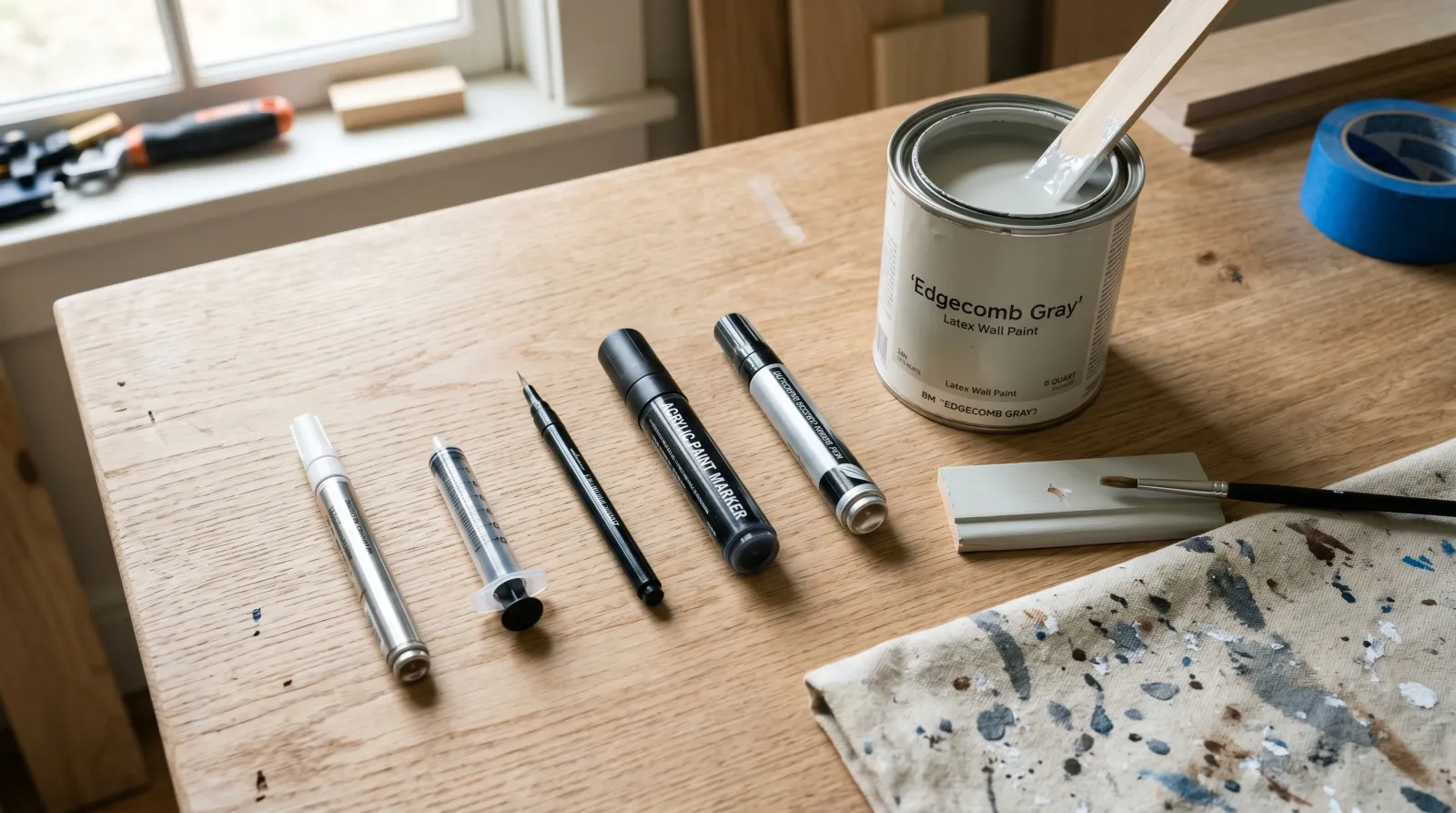
Disclosure: Some links below are affiliate links. We earn a commission if you buy through them, at no extra cost to you.
Top pick: the Slobproof Refillable Touch-Up Paint Pen. You load it with your own wall paint, so the color and the sheen match the wall exactly, and the fine nylon brush feathers a scuff repair until it disappears at arm’s length. It wins on the one thing that matters most for a touch-up: the match. It falls short on convenience, since you spend two minutes loading it with the little syringe that a pre-filled marker skips. For the cheapest way into refillable pens, the Amy Howard At Home 8-pack gives you a pen per paint color for about the price of one Slobproof 2-pack. For raw wood, glass, and craft detail, the uni POSCA PCF-350 brush marker is the precise pigment pen. For metal and sealed wood, Molotow ONE4ALL is the most opaque marker here. For a car door ding, none of them touch the Dupli-Color Scratch Fix.
There is no single right touch-up pen.
Most homeowners need exactly one: a refillable pen, loaded with the wall paint they already own, kept in a drawer for the next scuff.
The Shortlist and Why These Five
I touched up four surfaces with each pen over four weeks. A hallway wall in Benjamin Moore Regal Select eggshell that had a heel scuff and two nail-pops. A run of semi-gloss trim and a primed MDF cabinet door in Benjamin Moore Advance, both with chipped edges. A craft test on raw pine and a glass jar. And a real chip on a car door in factory silver, because “paint touch up pen” pulls in two different jobs and the answer isn’t the same pen for both.
The refillable pens got loaded with the actual wall paint. The pre-filled markers got judged on their own color range, which is the honest way to test them, because that’s all a buyer gets.
Four axes, weighted in this order: color match under raking daylight at 24 hours, tip control on a 1/4-inch scratch, edge feathering so the repair vanishes at arm’s length, and storage life against what the seller claims. The surface anchors the role. A wall pen and a car pen are not competing for the same slot.
One thing became obvious in the first hour. The refillable pens beat every pre-tinted marker on a custom-tinted wall, every time, because you can’t buy a marker in your wall’s exact color. That’s the whole reason the category exists.
How to Choose a Touch-Up Pen
Refillable or Pre-Filled
This is the first fork, and it decides the match.
A refillable pen is an empty barrel with a brush tip. You load it with your own paint using a small syringe. Because it’s the same paint that’s on the wall, the color and the sheen match exactly. This is the only way to touch up a custom-tinted wall and have the repair disappear. The Slobproof and the Amy Howard kit are both refillable.
A pre-filled marker comes tinted from the factory. Faster, no loading, but you’re matching your wall to the closest of a fixed set of colors. On a builder-white wall you might get lucky. On a gray-green you had tinted at the paint desk, you won’t. Pre-filled markers earn their keep on non-wall surfaces: raw wood, glass, metal, craft pieces, where there’s no “wall color” to match. POSCA and Molotow live here.
If you still have the original can, buy refillable. If you’re fixing a craft project or a metal railing, buy a marker.
Tip: Brush or Nib
A soft nylon brush tip is what lets a touch-up vanish. You can feather the edge of the dab so it blends into the surrounding paint instead of sitting on top as a visible patch. Every refillable pen here uses a brush tip, and the POSCA brush nib flexes like a real brush.
A hard felt or bullet nib lays an opaque line, good for craft lettering and bold marks, worse for blending a wall scuff. If the goal is “make this scuff disappear,” brush tip. If the goal is “draw a clean line on this jar,” a firmer nib is fine.
Chemistry Has to Match the Surface
A wall-paint pen loaded with latex is wrong for a car, where the factory finish is automotive lacquer or basecoat-clearcoat. The Dupli-Color uses lacquer for exactly that reason. Run automotive lacquer on your interior trim and it’ll look glassy and off. Run latex on sheet metal and it’ll peel.
Match the pen’s paint to what’s already on the surface. Water-based for walls and most trim. Acrylic pigment for raw and craft surfaces. Automotive lacquer for cars. That one rule prevents most touch-up failures.
Comparison at a Glance
| Brand / Model | Type | Tip | Best for | Color match | Price tier |
|---|---|---|---|---|---|
| Slobproof Refillable | Refillable, load your paint | Fine nylon brush | Walls, trim, cabinets | Exact (your paint) | Mid |
| Amy Howard 8-Pack | Refillable, load your paint | Soft brush | Furniture, multiple colors | Exact (your paint) | Budget |
| uni POSCA PCF-350 | Pre-filled pigment | Flexible brush, 1–10 mm | Raw wood, glass, craft | 10 stock colors | Budget |
| Molotow ONE4ALL | Pre-filled acrylic, refillable | Swappable, 1–15 mm | Metal, sealed wood, plastic | Artist range | Mid |
| Dupli-Color Scratch Fix | Pre-filled lacquer | Pen + brush + prep tip | Car chips and scratches | OEM exact-match | Mid |
1. Slobproof Refillable Touch-Up Paint Pen, Best Overall
The Slobproof is the pen you keep in a kitchen drawer with a label that says what color is inside. You load it once with the leftover wall paint from the original job, and from then on a scuff is a 30-second fix instead of a re-paint. On the hallway eggshell, I dabbed the heel mark with a near-dry brush, feathered the edge, and under raking daylight at 24 hours I couldn’t find the repair without knowing where it was. That’s the bar a touch-up has to clear, and most tools don’t.
The match is the reason. Because it’s the same Regal Select that’s on the wall, the color is identical and the sheen flashes the same. No pre-tinted marker can do that on a custom wall.
The seal is the second reason. The barrel is built to keep the loaded paint workable for years; Slobproof claims up to seven. Mine was still fluid and laid down clean at the six-month mark, which is already longer than an open quart of touch-up paint survives in a basement.
The cost is the loading. You draw paint into the included syringe, inject it into the barrel, snap the brush tip in, and twist the base to prime the tip. Two minutes, once. After that you uncap and dab. For a homeowner who touches up the same few colors for years, that trade is easy.
| Spec | Value |
|---|---|
| Type | Refillable, load your own paint |
| Tip | Fine nylon brush |
| Best for | Interior walls, trim, cabinets, doors |
| Approx. price | $14–$17 (2-pack) |
Buy it if: you have the original wall paint and you want scuffs to genuinely disappear. Skip it if: you’re touching up a car, or you don’t have the original paint and won’t go back to the store for a color match.
2. Amy Howard At Home Touch-Up Paint Pen Kit, Best Value
Same idea as the Slobproof, more pens, lower price. The kit gives you eight refillable brush pens, a syringe, a cleaning brush, and label stickers, usually for $10 to $16. That’s the cheapest entry into refillable touch-ups by a wide margin, and the eight-pen count is the point: load one pen per paint color in your house and label each. Living room, trim, kitchen cabinets, bedroom, each gets its own pen.
It came out of the furniture-refinishing world, and it shows. The soft brush tip loads chalk-style and furniture paint cleanly, and it feathered a chip on the primed MDF door about as well as the Slobproof did.
Where it gives ground is build and seal. The barrels are thinner, the brush tips wear sooner under hard use, and there’s no vacuum seal, so a loaded pen skins over in a few months rather than years. Keep them capped tight and reload as needed. For the price, and for anyone juggling several paint colors, that’s a fair trade.
Buy it if: you have several different paint colors to keep on hand, or you refinish furniture. About $10–$16 for the 8-pack.
3. uni POSCA PCF-350 Brush Tip, Best for Detail and Craft
Different job, different tool. The PCF-350 is a water-based pigment marker with a real flexible brush nib that runs 1 to 10 mm depending on pressure. It’s not for matching a tinted wall. It’s for the surfaces a wall pen can’t handle: raw pine, a glass jar, ceramic, metal, a craft repaint. On the bare pine and the glass in my test, it covered opaque in one to two passes, where a wall-paint pen would have soaked in or beaded up.
The brush nib is the draw. You get genuine line control, fine enough for lettering or touching up a detailed piece, which the bullet-nib markers can’t match. And the valve-and-piston barrel reseals, so a tip that dries out re-wets and flows again instead of dying the way a felt marker does.
The limit is the fixed palette. Ten colors. You match to the nearest, and on a custom color you simply won’t land it. It’s also pre-filled and not refillable, so a heavily used marker is eventually a throwaway.
Buy it if: you’re touching up raw wood, glass, ceramic, or a craft piece and want true brush control. Inexpensive, single marker.
4. Molotow ONE4ALL, Best for Hard Surfaces
The most opaque marker in the test on the difficult surfaces. The ONE4ALL hybrid acrylic covered metal, sealed wood, and plastic in a single pass where the POSCA needed two, and it’s the one pre-filled marker here you can keep alive long-term: the tips swap out and Molotow sells refill bottles, so a dry or worn marker isn’t dead.
The pump-action valve gives you real flow control. Press the tip to feed paint, ease off for a dry-brush feather. With swappable tips from 1 mm up to 15 mm, the same barrel does a fine scratch and a filled chip.
It’s built for artists, though, and the stock colors run bright. Matching a house beige or a warm gray is a gamble. Per marker it costs more than a POSCA, and the refill system is its own small purchase. For a metal railing, a powder-coated surface, or a sealed-wood piece where opacity beats exact color, it’s the pick.
Buy it if: you’re covering metal, plastic, or sealed wood and want the most opaque marker that you can also refill. Mid price per marker.
5. Dupli-Color Scratch Fix All-in-1, Best for Cars
Cars are their own world, and a wall-paint pen has no business there. The Scratch Fix is the right chemistry: automotive lacquer in factory-matched, OEM-approved colors, ordered by your vehicle’s paint code. On the silver door chip, the match was the best in the test, because it’s literally the manufacturer’s color, not a guess.
The all-in-one barrel is smart. One tool holds an abrasive prep tip to clean out the chip, a fine pen point for hairline scratches, a brush for larger chips, and a clear coat to seal it. You prep, color, and clear without switching tools. The lacquer bites and levels into sheet metal the way latex never could.
The catch is right there in the chemistry. It’s for cars only; that lacquer is wrong for interior walls and trim. And you have to order the correct paint code for your exact car, or the match is off and visible.
Buy it if: you’ve got a chip or scratch on a vehicle and you know your paint code. Mid price, ordered to your car’s color.
Pens I Tried and Dropped
- Sharpie and other dye markers. Dye, not paint. Wrong sheen, bleeds at the edge, ghosts through your next real coat. Never use one to touch up paint.
- Generic dollar-store “paint pens.” The valve clogs and the felt nib goes hard after one use. Not worth the trip.
- Pre-filled wall-color touch-up markers in stock builder colors. Fine if your wall is exactly that builder white. On any tinted wall, the refillable pens make them pointless.
- Foam-tip dauber pens. They flood the surface and you can’t feather the edge. The repair shows.
Care, Cleanup, and Storage
The refillable pens last for years if you load and store them right, and one wash if you don’t.
Refillable pens (Slobproof, Amy Howard). Load only as much paint as you’ll use over the next stretch. Cap tight, brush-tip down, and store flat in a drawer. The Slobproof’s seal buys you years; the Amy Howard pens want a reload every few months. When the tip clogs, pull it, rinse under warm water until clear, and snap it back. Label every pen with the room and color. A loaded, unlabeled pen is a guessing game in two years.
Pigment and acrylic markers (POSCA, Molotow). Cap firmly after every use. If the tip dries, re-wet it: a POSCA nib soaks back in water, a Molotow tip swaps or refills. Store horizontal so the paint stays at the tip. These don’t “go off” capped, but a forgotten open marker is done.
Auto lacquer pen (Dupli-Color). Cap immediately; lacquer skins fast in air. Store upright. Shake before each use to remix the pigment. One pen does several chips if you don’t let it dry out between sessions.
Mistakes I Still See
- Using a Sharpie. Dye bleeds and ghosts. Use real paint or a pigment marker, never a dye pen.
- Matching a tinted wall with a pre-filled marker. It won’t match. For a tinted wall, load a refillable pen with the original paint or get the store to re-match the color.
- Dabbing too much paint. A thick blob sits proud of the wall and catches light worse than the scuff did. Near-dry tip, thin dab, feather the edge.
- Touching up satin and gloss like they’re flat. Higher sheens show every repair. Keep the dab tiny, feather hard, and accept that semi-gloss touch-ups are never invisible the way flat ones are.
- Wrong chemistry for the surface. Latex on a car peels; auto lacquer on trim looks glassy. Match the pen’s paint to what’s already there.
- Storing a loaded refillable pen tip-up, uncapped, in a hot garage. The paint skins and the tip clogs. Cap tight, store flat, keep it cool.
A Touch-Up Kit That Earns Its Keep
For a homeowner: one Slobproof 2-pack loaded with your two most-used wall colors, or the Amy Howard 8-pack if you’ve got more colors than that. Add a POSCA brush marker for the odd craft or raw-wood fix. About $20–$30, and it sits in a drawer for years.
For a car owner, the Dupli-Color in your paint code is its own thing. Buy it when you have a chip, ordered to your exact color, not before.
The pen is the cheap part. Don’t fix a scuff with the wrong tool and end up repainting the wall.
FAQ
What is a paint touch-up pen? A small pen or marker that puts a tiny amount of paint exactly where you need it, without a brush, tray, or open can. Refillable pens load your own wall paint for an exact match. Pre-filled markers come tinted, faster but matched to a fixed color.
Do touch-up pens actually match the wall? A refillable pen does, because you load it with the same paint that’s on the wall. A pre-tinted marker only matches if your wall is close to a stock color, which is rare for a custom-tinted wall.
Can I use a Sharpie to touch up paint? No. A Sharpie is dye, dries the wrong sheen, bleeds, and ghosts through your next coat. Use a real paint touch-up pen or a pigment marker.
Why does my touch-up show a different sheen? The new paint sits on top instead of blending, and a different tool laid it down. Feather the edges, keep the dab thin, and match the sheen exactly. Flat hides touch-ups; satin and gloss don’t.
Ask a Question