Best Paint Sample Test Boards
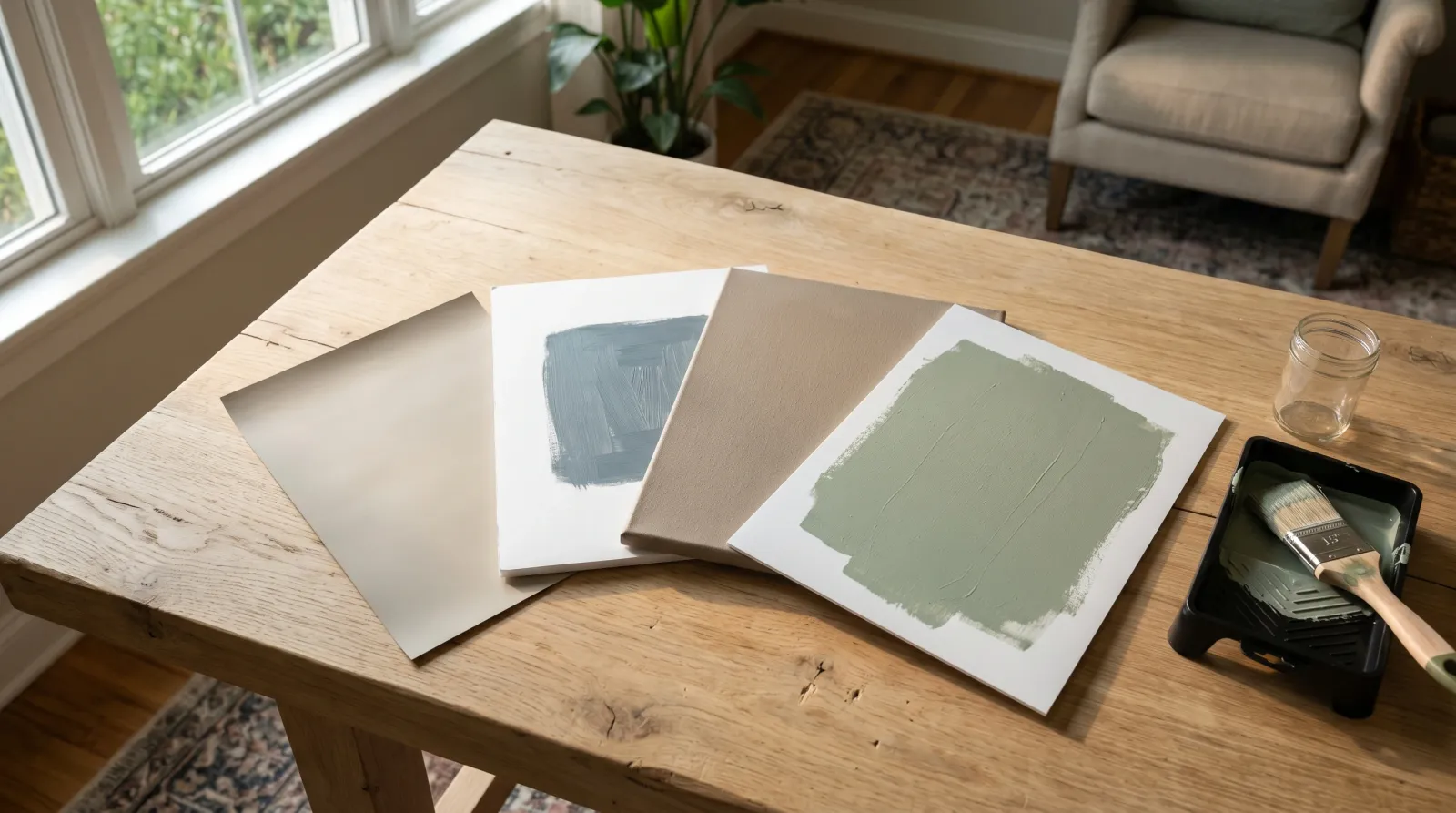
Five paint sample boards tested in real rooms across changing light. Top pick: Samplize peel-and-stick, two coats of real paint, no wall painting and no cleanup.

Disclosure: Some links below are affiliate links. We earn a commission if you buy through them, at no extra cost to you.
Top pick: Samplize peel-and-stick paint samples. About $7 a color, two real coats of paint on a movable board, and no wall to repaint when you’re done. It wins on the thing that actually matters when you test a color: real paint reads true under your own light, and a printed chip never does. It falls short on price if you’re cross-shopping eight shades, and it only carries Benjamin Moore, Sherwin-Williams, and Farrow & Ball. If you want to test any color, including a store-matched one, you paint a board yourself, and the FoamPRO 120 is the budget board to paint. For a sample that reads exactly like a wall, the Whearley canvas board is hand-painted in real Farrow & Ball. For testing at near-wall scale, Mighty Boards go 18 by 24 inches. For the cheapest real-paint route through a paint store, the Catalina board runs about two dollars.
There is no single right board. The split is simple.
Buy peel-and-stick if your color is sold by Samplize. Paint a board yourself if it isn’t.
The Real Question Is Real Paint vs Printed Ink
Every regret I hear about a paint color traces back to one mistake: someone trusted a printed chip. The chip is ink doing its best to imitate paint, and it misses worst on the colors people agonize over most. Deep navies, chalky greiges, color-shifting greens, anything with a strong undertone. The ink can’t reproduce how real pigment bounces light.
A sample board fixes that by putting actual paint in front of your actual windows. That’s the whole job. So the first thing I graded these on wasn’t size or price. It was whether the color you see is real paint or a stand-in for it.
Samplize, Whearley, and the Catalina board hand you real paint. The FoamPRO and Mighty boards are blanks you paint yourself, which means you can test any color on earth, including a store-match the pre-painted brands don’t carry. That trade defines the whole category, and it’s why this list has both kinds.
How I Tested These
I ran all five over one week in two rooms with opposite light: a north-facing home office that goes cool and flat, and a south-facing living room that swings warm at golden hour. I put the same three colors on every board type I could paint myself (a warm white, a mid greige, and a deep blue-green), bought the matching peel-and-stick and hand-painted versions, and moved every board to four walls at three times of day.
I scored on three axes. Color truth: how close the board read to a known wall painted in the same color, judged by eye against a control patch under raking daylight. Movability: weight, rigidity, and how cleanly it mounts and re-mounts. Surface honesty: whether the board’s own material added false sheen or let white bleed through.
I didn’t run a lab. I don’t have a spectrophotometer reading to hand you, and I won’t invent one. What I have is the same thing you’ll have at home: real paint, real light, and the difference between a board that tells the truth and a board that flatters.
One result surprised me. The board’s own surface matters almost as much as the paint on it. A bright-white art panel and a wall-primer-white board, painted with the same gallon, read as two slightly different colors side by side. The brighter base cooled the warm white and pulled a hint of pink out of the greige. That’s the case for testing on a board built for paint, not a craft-store panel built for acrylics.
What I Skipped, and Why
A few popular options didn’t make the cut.
Plain art-store canvas panels (the 8-by-8 cotton boards) work in a pinch, but the bright artist’s gesso underneath reads cooler than wall primer and skews pale colors. Poster board and manila folders, the classic cheap hack, curl the second the paint wets them and the warp throws shadows that fake an undertone. And paint-chip fan decks are for narrowing, not deciding. None of them are bad. They’re just beaten by a two-dollar Catalina board or a foam-core blank.
Comparison at a Glance
| Board / Model | Paint type | Size | Best for | Price tier |
|---|---|---|---|---|
| Samplize Peel-and-Stick | Real paint, pre-applied | 9 x 15 in (XL 15 x 18) | Testing BM, SW, F&B with zero work | Mid |
| FoamPRO 120 | You paint it | 10 x 12 in foam core | Cheap DIY testing of any color | Budget |
| Whearley & Co. | Real F&B, hand-painted | 12 x 16 in canvas | Color truth on deep, chalky shades | Premium |
| Mighty Boards | You paint it | 18 x 24 in styrene | Near-wall scale, reusable | Budget |
| Catalina Color Tester | Real paint, you roll it | Small sealed board | Cheapest real-paint route via a store | Budget |
1. Samplize Peel-and-Stick, Best Overall
Samplize is the board I now recommend first to anyone testing a Benjamin Moore, Sherwin-Williams, or Farrow & Ball color. It’s two coats of real paint applied to a thin flexible sheet with a repositionable backing. You peel it, stick it to the wall, and walk it from room to room with no tape and no holes. When the deep blue-green I’d been agonizing over went up on the north office wall, the Samplize read a shade grayer and cooler than the printed chip had promised. That gap is exactly the regret this product exists to prevent.
Movability is where it pulls ahead of every painted board. It weighs nothing, it re-sticks a dozen times without losing grip, and it sits dead flat against the wall with no shadow gap behind it. I had the same color on a wall in the cool office and the warm living room inside thirty seconds, which is the comparison that actually tells you something.
The standard size is 9 by 15 inches, with a 15-by-18 extra-large if you want more presence. Both are big enough to escape the small-chip illusion that makes every color look more saturated than it’ll be at scale.
The limits are real. At about $7 a color, testing eight shades costs more than a sample pint of paint plus a foam board would. And Samplize only carries the brands it carries. If your heart’s set on a Behr color or a custom store-match, this isn’t your tool.
| Spec | Value |
|---|---|
| Paint | Two coats of real paint, factory-applied |
| Size | 9 x 15 in standard; 15 x 18 in XL |
| Brands | Benjamin Moore, Sherwin-Williams, Farrow & Ball |
| Approx. price | $7 standard, $10 XL; overnight shipping on 10+ |
Buy it if: your finalists are sold by one of the three brands and you want the truest read with zero work. Skip it if: you’re testing a Behr, Valspar, or store-matched color, or cross-shopping so many shades the per-board cost stops making sense.
2. FoamPRO 120, Best Budget Board You Paint Yourself
When the color you want isn’t a Samplize color, you paint a board, and the FoamPRO 120 is the one I’d paint. It’s a 10-by-12 white foam-core board, light and stiff, with a printed label panel where you write the brand, color name, sheen, and date. That label sounds minor until you’re holding six near-identical greiges and can’t remember which is which. Write it down on the board.
Foam core has one habit you have to respect. It’s white, but it’s not sealed wall primer, so a single thin coat lets that bright white glow through and the color reads pale and weak. Two coats, full dry between them, and it reads honest. I brushed the warm white on in one coat as a test and it looked like a different, lighter color than the two-coat patch six inches away.
It leans on a baseboard, stands in a window, and travels to the furniture store to check the color against a sofa. For a couple of dollars a board, buy a stack and test everything.
Buy it if: you’re testing store-matched or off-brand colors and want the cheapest honest read. Commit to two coats.
3. Whearley & Co. Hand-Painted Board, Best for Color Truth
This is the board for someone who’s been burned by a color before and refuses to be burned again. Whearley hand-paints each board in real Farrow & Ball Estate Emulsion on acid-free 100% cotton canvas, in their studio, to order. The canvas surface is matte and slightly textured in a way that reads like a real wall, not like a glossy chip, so it doesn’t add the false sheen that makes a flat paint look richer than it is.
The standard board runs about 12 by 16 inches, big enough that a deep or chalky color shows its real face instead of looking artificially intense at chip scale. F&B colors are exactly the ones that fool people on printed chips (the green-grays and the warm off-whites shift hard under light), and seeing them in real Estate Emulsion settles the question.
The cost of that accuracy is money and patience. At $19 to $25 a board it’s the priciest single-color test here, it’s made to order so you wait a few days, and it’s final sale. This is a tool for the one or two finalists you’re serious about, not for casting a wide net.
Verdict: the most accurate sample on the list, and the one I’d buy for a whole-house F&B color I had to get right.
4. Mighty Boards, Best Large Format
The small-chip illusion is the quiet enemy of color testing. A color that looks bold on a 4-inch swatch can look washed out across a whole wall, because scale changes how saturated a color reads. Mighty Boards fight that with size: an 18-by-24-inch matte styrene sheet that shows a color at near-wall scale. Roll it out, tape it up, and you’re looking at something close to what the wall will become.
The styrene is waterproof and wipes clean, which makes it the one board here you can genuinely reuse. I rolled the greige on one, let it cure, scuffed it lightly, and put the blue-green over it without the first color bleeding through. It’s thin and flat too, so it tapes flush with no shadow gap.
Two things to know. A board this big wants a mini roller, not a brush, or you’ll be reading your own brush streaks instead of the color. And the styrene is slick; some flat paints need a light scuff or a thin primer coat to grip without crawling. Our mini roller round-up covers the small covers that lay these boards down without streaking.
Buy it if: you want to judge a color at real scale, or you test colors often enough that a reusable board pays for itself.
5. Catalina Color Tester Sample Board, Best Paint-Store Route
The cheapest way to get real paint on a real board, if you have a Benjamin Moore dealer nearby. The Catalina board is a small sealed white board sold for about two dollars, usually right next to the sample-size paint and mini-roller kits, so you walk out with the board, the paint, and the roller in one trip. The sealed white surface reads neutral and rolls out a smooth, even patch with none of the bleed-through you fight on raw foam core.
It’s smaller than the large-format boards, so a deep saturated color can still read a touch denser than it’ll look across a wall. And because it moves through independent paint stores rather than big-box shelves, getting one depends on having the right dealer in town.
Verdict: the budget pick when you’re already standing in a paint store buying a sample anyway.
Pre-Painted or Paint-It-Yourself
The fork in this category is whether your color is sold pre-painted. If it is, pre-painted wins almost every time.
A pre-painted board (Samplize, Whearley, Catalina if a store rolls it for you) takes your hand out of the equation. The coats are even, the dry is full, and the only variable left is the light in your room. A board you paint yourself adds a second variable: your application. A streaky brush-out or a thin single coat tells you about your technique, not about the color. That’s why I push two coats and a mini roller so hard on the FoamPRO and the Mighty boards.
So the buying logic is short. Check Samplize first. If your color’s there, order it. If it isn’t (Behr, Valspar, PPG, a store-match), buy a foam-core or styrene board and a sample pint, and paint it like you mean it.
The one place paint-it-yourself beats pre-painted outright is texture. Pre-painted boards are flat. If your wall is knockdown, orange peel, or popcorn, a flat sample reads brighter and cleaner than the bumpy wall ever will, because texture casts micro-shadows that gray a color down. On heavy texture, paint a hidden patch of the actual wall, or accept that the board will read a touch lighter than the finished room.
How to Actually Test a Color
The board is half the job. The other half is how you use it, and most people get this part wrong.
Two coats, every time. I’ll say it again because it’s the mistake that wrecks the most tests. One coat reads pale. Two coats and a full dry tell the truth.
Move the board. Tape it to the wall you’re painting, then look at it in morning light, at noon, and after dark under your own bulbs. A color shifts more between 9 a.m. and 9 p.m. than between two similar colors. The wall that worries you most (the north-facing one, the one by the window) is the wall to test on.
Hold it against the fixed stuff. Put the board next to the trim, the floor, the countertop, and the biggest piece of furniture. You’re not painting a color in a vacuum; you’re painting it next to things you can’t change.
Match the sheen. A color in matte and the same color in semi-gloss read differently, because gloss bends light and deepens the color. If your wall’s going eggshell, test in eggshell. The sheen guide covers how much a finish shifts the read.
Live with it. Two days minimum. First reactions to a new color are unreliable; the color you love at first glance is sometimes the one you tire of by day three. This goes double for a piece you’re refinishing; our best furniture paint round-up walks through testing a color on the actual wood before you commit.
Mistakes I Still See
- One coat, then judging it. The board’s white glows through and the color reads lighter than the gallon will. Two coats, always.
- Testing on a sheet of printer paper or a manila folder. It curls when wet, and the warp throws shadows that fake an undertone the paint doesn’t have.
- Judging the color while it’s wet. Wet paint is darker and glossier than cured paint. Wait for a full dry.
- One board, one wall, one time of day. A color that looks right at noon on the south wall can look cold and gray at 8 a.m. on the north wall. Move it, and check it across the day.
- Testing fifteen colors at once. Past five, you’re comparing colors to each other instead of to your room. Narrow on chips, then board your real finalists.
- Skipping the sheen match. Testing a matte sample for a satin wall hides how much the finish will deepen the color.
How Many Boards You Actually Need
For one room, one decision: three or four Samplize samples if your color’s covered, or three painted FoamPRO boards if it isn’t. Call it $20 to $25 either way.
For a whole-house palette: a stack of foam-core or styrene boards and sample pints of your finalists, so you can carry each color room to room and check it against every light condition in the house. The boards are the cheap part. The expensive mistake is buying gallons before you’ve seen real paint on a real board, under your own light.
Figure out the color before you figure out the gallons. Getting the color wrong costs a repaint. Getting the quantity wrong costs a return trip.
Ask a Question