Best Paint Brush Combs
Five paintbrush combs tested on latex and oil-soaked brushes over six weeks. Top pick: Wooster Painter's Comb 1832 for the brass-and-steel two-sided tool that saves brushes.

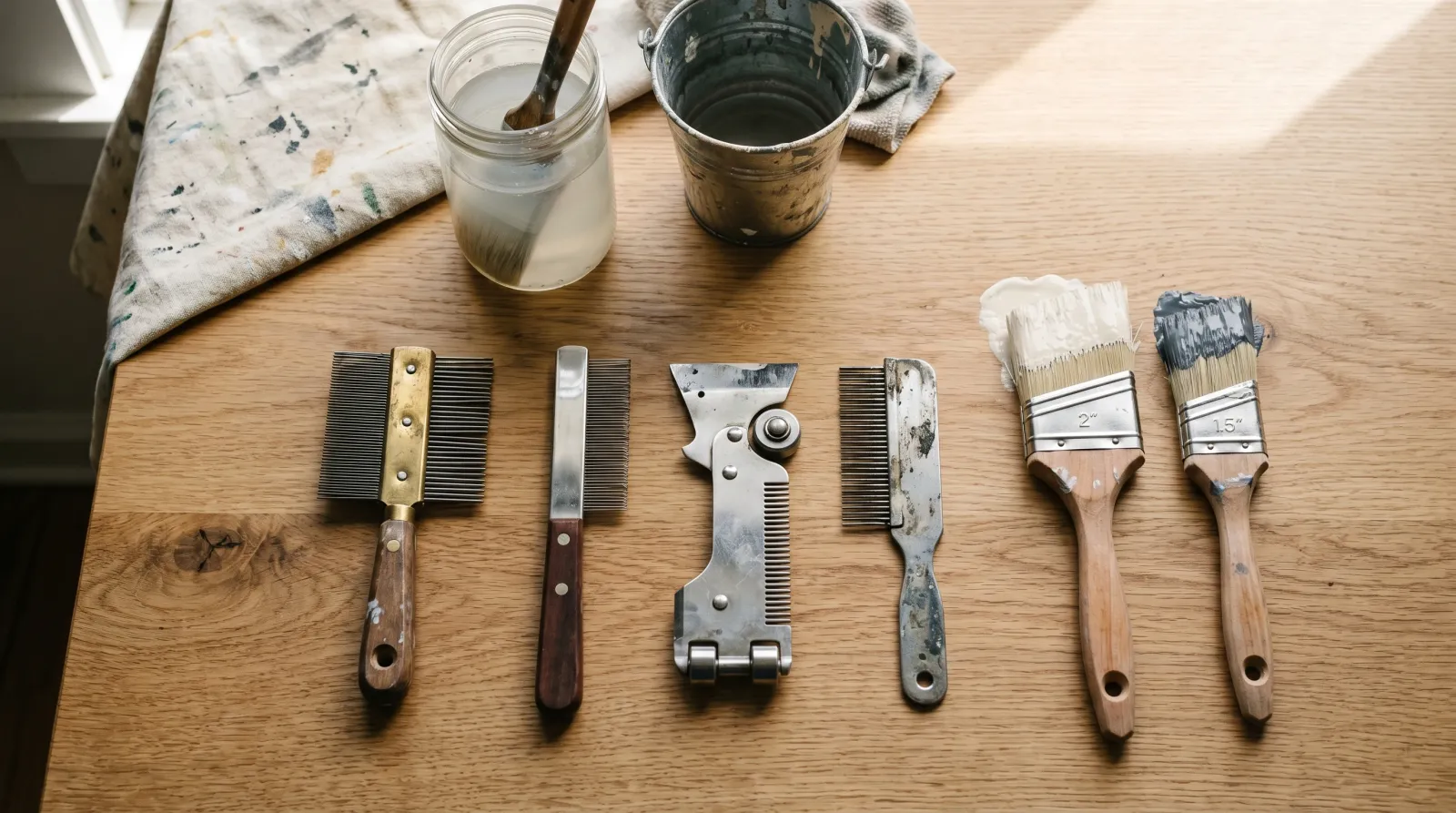
Disclosure: Some links below are affiliate links. We earn a commission if you buy through them, at no extra cost to you.
Top pick: the Wooster Painter’s Comb 1832. It costs about $6, has brass tufts on one side and stainless pins on the other, and it’s the only comb in this test that gets paint out of the heel and reshapes the bristle in the same two minutes. It wins on heel access and on rust resistance, brass and stainless both survive mineral spirits. It falls short on handle grip; the short polypropylene body slips in a wet glove. For the cheapest tool that still works, the Zibra Paintbrush Cleaning Tool does the job for nine dollars. For pros who strip roller covers too, the Purdy Contractor cleaner has a stainless blade that does both. For one tool that scrapes, strips, and cleans, the Hyde 17-in-1 replaces three.
A brush comb is the cheapest insurance you can buy for an expensive brush.
Most homeowners need one good two-sided comb and nothing else.
Why a Brush Comb Saves the Brush
Paint doesn’t kill a brush at the tip. It kills it in the heel, the inch where the bristle disappears into the metal ferrule. That spot is impossible to see and easy to skip. Rinse the brush, wring it out, hang it up, and you’ve left a ring of paint in the heel every single time. Wash after wash it builds, dries hard, and forces the bristle apart at the base. A few months in, the brush fans out, drops its sharp angle, and stops cutting a clean line. You blame the brush. It was the heel.
A comb fixes both halves of the problem. The teeth pull paint out from the heel forward, so it doesn’t pack in and harden. Then the same teeth comb the wet bristle straight, so the brush dries to its original chisel instead of a splayed fan. That’s the whole job. It takes two minutes, and it’s the reason a good $15 angled sash brush lasts five years instead of one season.
The combs below split into two real types. A true comb (Wooster, Zibra, Purdy Brush Comb) reshapes bristle and clears the heel. A stripping tool (Purdy Contractor, Hyde 17-in-1) pulls loaded paint off roller covers and scrapes, with brush combing as a secondary job. If you only clean brushes, buy a comb. If you run rollers too, the stripping tools earn their keep.
How We Tested These
Same routine every comb, every wash. After each coat on three real projects, the dirty brush got the same treatment before it touched water: comb the heel, comb the bristle, then rinse and comb again wet.
The projects gave us three paint types to clean off. A bedroom repaint in latex eggshell. An oil-based door-and-trim job, which is the real rust test, because solvent cleanup corrodes plain steel teeth fast. A cabinet refinish in waterborne enamel, the finickiest, because a splayed bristle ruins a cabinet door where it wouldn’t show on a wall.
We graded four things. Heel access: how much paint the comb pulled out of the bristle base, checked by squeezing the heel after combing and watching what came out. Bristle straightening: whether the brush dried back to a sharp chisel. Rust: every metal comb sat wet in a bucket overnight and went through the oil-paint cleanup, then we looked for corrosion. Recovery: we deliberately let one brush dry 24 hours and saw how close each comb brought it back.
We also ran each comb on a loaded roller cover, because half the combs claim to strip covers and half don’t.
How to Choose a Brush Comb
Two-Sided or One
A one-sided comb is just teeth. It combs bristle and clears the heel, and for a homeowner cleaning one or two brushes a year, that’s enough. The Purdy Brush Comb is this, and it works.
Two-sided is better. One side is metal teeth for the bristle and heel. The other is either brass tufts (Wooster) or a second tooth density (Zibra). The brass side scrubs paint off the ferrule and the handle and breaks up the thick buildup the teeth can’t, which is the part that actually saves a neglected brush. If you clean brushes more than a few times a year, buy two-sided.
Tooth Material and Rust
This is the spec that separates a comb that lasts from one that’s orange after the first oil job. Brass and stainless steel don’t rust. Plain plated steel does, and once a comb rusts the teeth get rough and start tearing bristle instead of combing it. Every metal comb here is brass or stainless on purpose. Plastic (the Zibra) never rusts, with the trade that it flexes on hardened paint.
The cleanup solvent is the test. If you only ever clean latex in water, a cheap comb survives. The minute you clean a brush in mineral spirits, you want brass or stainless. See the latex versus oil cleanup difference for why solvent is harder on tools.
Heel Reach
The whole point is the heel, so the comb has to get in there. Stiff metal teeth with enough length reach the bristle base. Short, soft, or widely spaced teeth ride on top of the bristle and never touch the paint that matters. When you shop, look at the teeth: stiff and close-set reaches the heel, floppy and wide doesn’t.
At-a-Glance Comparison
| Brand / Model | Type | Teeth | Best for | Price tier |
|---|---|---|---|---|
| Wooster Painter’s Comb 1832 | Two-sided comb | Stainless pins + brass tufts | Everyday brush care, the heel | Mid |
| Zibra Paintbrush Cleaning Tool | Two-sided comb | Plastic, two densities | Budget, water-based only | Budget |
| Purdy Brush Comb | One-sided comb | Stiff metal | Grab-and-go simple cleanup | Budget |
| Purdy Contractor Cleaner | Stripping tool | Stainless blade | Pros who strip roller covers | Mid |
| Hyde 17-in-1 | Multi-tool | Roller crescents + blade | One tool for the whole cleanup | Mid |
1. Wooster Painter’s Comb 1832, Best Overall
The 1832 is the comb you reach for first because it does both jobs on one tool. The stainless-pin side combs the bristle and clears the heel. Flip it, and the brass tufts scrub the ferrule and the handle and break up the caked paint the pins skate over. On the oil-paint door brush, the brass side pulled a ring of paint out of the heel that the pins alone left behind. That’s the buildup that ends brushes, and this is the only comb in the test that got it all.
Rust was a non-issue. Brass and stainless both came through the mineral-spirit cleanups and an overnight soak in a wet bucket with no corrosion. After six weeks the teeth are as straight and sharp as day one.
It’s the best at recovery, too. The brush we let dry 24 hours came back closest with the 1832: soak in warm water, work the brass side into the softened paint at the heel, then comb the bristle straight. Not every dried brush makes it back, but this gave the most a fighting chance.
The handle is the weak spot. It’s a short polypropylene block, and with a wet glove on it slips. You end up gripping the metal block instead of the handle. Minor, but on a long cabinet-cleanup session your hand notices.
| Spec | Value |
|---|---|
| Type | Two-sided comb |
| Teeth | Stainless steel pins + brass tufts |
| Rust resistance | Brass and stainless, no corrosion in test |
| Best for | Everyday brush care, getting the heel clean |
| Approx. price | $5–$7 |
Buy it if: you own a good brush and want one tool that reshapes the bristle and scrubs the heel. Skip it if: you only clean a $4 chip brush twice a year; the Purdy Brush Comb is enough.
2. Zibra Paintbrush Cleaning Tool, Best Budget
The comb I hand someone painting their first room. About nine dollars, two tooth densities on one tool, plastic that never rusts in a wet bucket. The fine side combs trim and sash brushes, the wide side handles a fat 3-inch wall brush. On fresh latex right after painting, it cleans as well as the metal combs. Comb the bristle, rinse, comb again, done.
Plastic is the trade. On a brush that dried overnight, the teeth flex and ride over the hardened paint in the heel instead of digging it out. For a fresh-off-the-wall brush that’s a non-issue. For rescue work, it’s the wrong tool.
It also has no brush or scrub side, so heavy ferrule buildup needs a second tool. For water-based paint cleaned promptly, none of that matters.
Buy it if: you paint with latex, clean the brush right away, and want the cheapest comb that actually works. About $9.
3. Purdy Brush Comb, Best Simple Comb
The no-frills metal comb that’s stocked next to the brushes at every paint counter. Stiff teeth, pull from heel to tip, paint comes out and the bristle straightens. There’s nothing to break and nothing to learn. On fresh latex and on the cabinet enamel brush, it combed as clean as the Wooster’s pin side.
What it doesn’t have is a second side. No brass tufts, no scrub face for the ferrule, so the worst of the heel buildup it leaves behind. And it’s a short tool with no leverage on a heavy loaded brush.
For most homeowners that’s fine. You’re not rescuing brushes, you’re keeping a good one in shape, and this does that for a few dollars while you’re already standing at the paint store buying the brush.
Verdict: the grab-it-with-your-brush comb. Simple, cheap, stocked everywhere.
4. Purdy Contractor Brush & Roller Cleaner, Best for Pros and Heavy Buildup
Different tool for a different problem. This is a curved stainless blade with a real handle, and it’s built to strip a loaded roller cover as much as to comb a brush. Pull a saturated roller cover through it twice and most of the paint comes off into the tray before you ever hit the sink, which saves real water on a big job.
The stainless blade resists rust through solvent cleanup, and the thumb-grip handle is the only one here you can lean on without it slipping. For a painter cleaning a dozen tools at the end of a day, that handle matters.
It’s coarser at the fine work. The blade strips and scrapes well; it won’t reshape a delicate trim bristle the way the Wooster’s pins do. If your day is rollers and wall brushes, that’s the right trade. If it’s finish trim and cabinets, keep a real comb alongside it.
Buy it if: you run roller covers and want one stainless tool that strips covers and cleans brushes.
5. Hyde 17-in-1 Painter’s Multi-Tool, Best Multi-Tool
This isn’t really a comb, and I’m including it because half of brush cleanup on a real job is the rest of the cleanup. The 17-in-1 has roller-cleaning crescents that strip both 9-inch and mini covers, a rust-resistant scraper blade, a nail set, a can opener, and a putty edge. It lives in a pocket and replaces three separate tools on the job.
The roller crescents are the standout. Pull a loaded cover through the matching crescent and it strips clean, mini-roller covers included, which the dedicated combs can’t do.
What it won’t do is reshape a fine bristle. It strips and scrapes; it doesn’t comb. So pair it with a true comb if you care about your trim brushes. As the one tool you carry for the whole prep-and-cleanup step, nothing here is more useful.
Buy it if: you want one tool for stripping covers, scraping, and odd jobs, and you’ll keep a comb for the brushes.
Combs We Tried and Dropped
- Bare wire brushes sold as “brush cleaners.” Fine for stripping rust off metal, too aggressive on paintbrush bristle. They tear synthetic filament.
- All-plastic dollar-store combs. Teeth too soft and too widely spaced to reach the heel. They comb the surface and miss the part that matters.
- 5-in-1 painter’s tools without a comb edge. The basic 5-in-1 scrapes and opens cans but has no real bristle comb. Useful tool, wrong category here.
Care, Cleanup, and How Long a Comb Lasts
A brush comb is the tool that outlasts everything else in the kit, if you don’t let it rust.
Rinse and dry it. The comb gets dirty too. Rinse the paint off the teeth when you rinse the brush, and don’t leave a metal comb sitting in a wet bucket for days. Brass and stainless resist rust, they don’t ignore it forever.
Use the right direction. Comb from the heel toward the tip, the way the bristle grows. Sawing back and forth or combing against the grain tears synthetic filament and snaps natural bristle. The motion matters more than the teeth.
Match the side to the job. On a two-sided comb, the teeth are for the bristle and the heel; the brass or scrub side is for the ferrule and the handle and caked buildup. Using the brass side on the bristle is too rough.
How long it lasts: effectively forever for the metal combs if you keep them dry, several years for the Zibra plastic before the teeth wear soft. These are buy-once tools. The brush is the consumable; the comb is what makes the brush last.
Mistakes We Still See
- Skipping the heel. Combing only the tip looks clean and leaves the paint where it does damage. Pull the teeth from the base of the bristle.
- Combing against the grain. Heel to tip, every time. Back-and-forth sawing breaks bristle.
- Letting a metal comb rust. A rusted comb tears bristle instead of combing it. Rinse it and dry it with the brush.
- Combing a bone-dry brush hard. If paint dried in the heel, soak it soft first. Forcing a dry comb through hardened paint splays the bristle you’re trying to save.
- Using a comb as your whole cleanup. The comb clears the heel and reshapes the bristle. It doesn’t replace soap, warm water, and a rinse until the runoff is clear. Comb, then wash, then comb wet, then hang handle-up.
A Two-Tool Kit That Saves Your Brushes
For a homeowner with a couple of good brushes: the Wooster Painter’s Comb 1832 ($6) and nothing else. It combs, it reshapes, it scrubs the heel. One tool covers it.
For someone who paints with both latex and oil and wants a backup: add the Zibra ($9) to keep at the latex sink, where rust never matters and the price doesn’t sting.
For a contractor running rollers too: the Purdy Contractor cleaner for stripping covers, plus a real comb for the finish brushes. The stripping tool and the comb do different jobs; one doesn’t replace the other.
The comb is two dollars of insurance on a fifteen-dollar brush. Don’t skip it and then wonder why the brush splayed.
Ask a Question