Best Mohair Rollers for 2026
Five mohair roller covers tested on cabinets, doors, and trim for a near-sprayed gloss finish. Top pick: Wooster Mohair Blend 1/4-inch nap for the smoothest enamel.

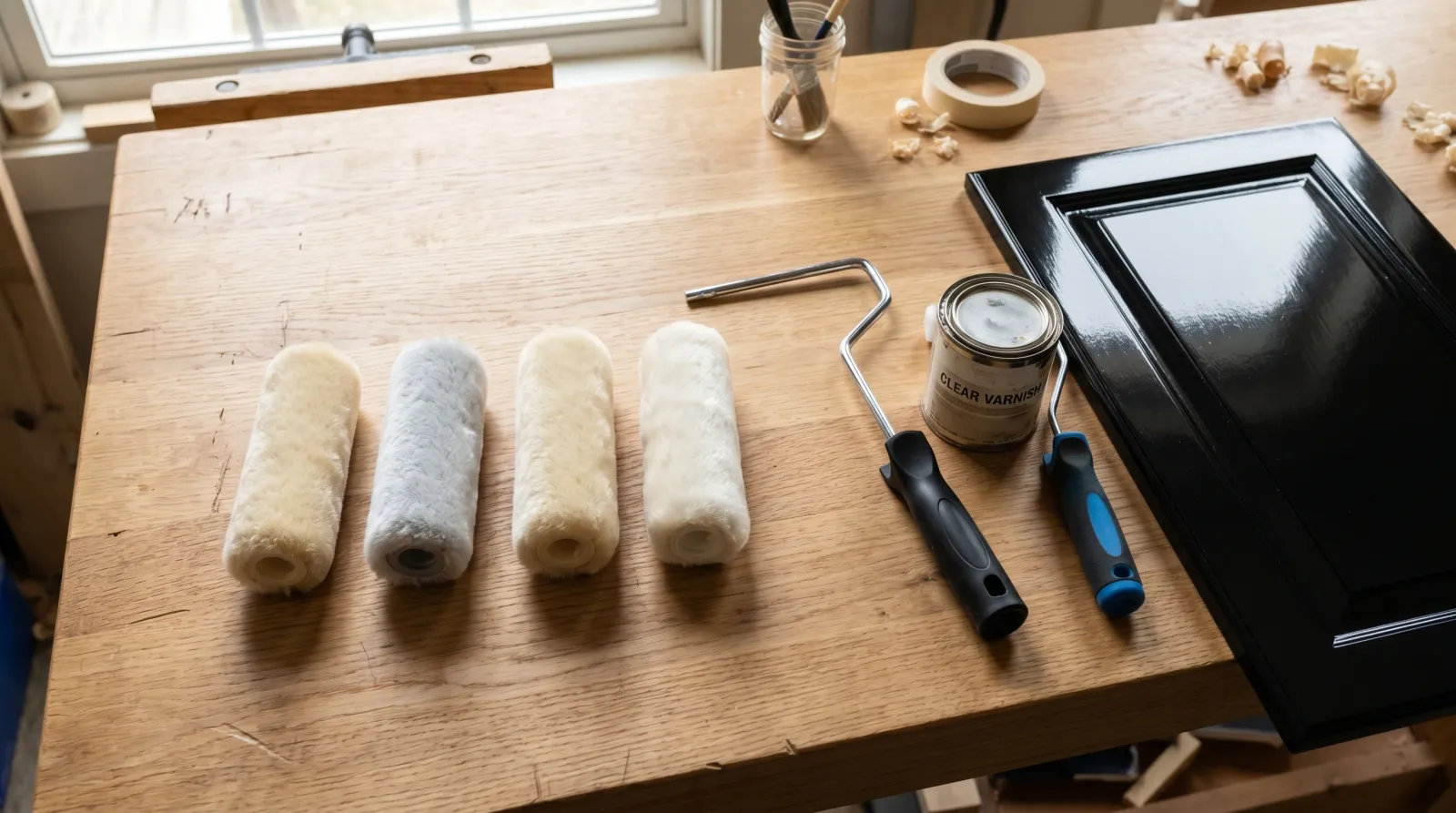
Disclosure: Some links below are affiliate links. We earn a commission if you buy through them, at no extra cost to you.
Top pick: Wooster Mohair Blend R207, 1/4-inch nap. It lays the flattest waterborne-enamel film of any cover I rolled, the core survives solvents, and it’s stocked at most pro paint counters for a few dollars. It wins on finish flatness and on being easy to actually buy. It falls short of pure mohair on a high-gloss oil panel under hard raked light, where the 100% woven Purdy Parrot lays a true mirror. For cabinet stiles and door panels the 9-inch can’t reach, the Wooster Jumbo-Koter mini in the same blend keeps the finish consistent across a whole kitchen. For oil varnish and floor coatings, the short 3/16-inch Redtree Deluxe Mohair lays the thinnest film and costs little enough to toss. For boat work, epoxy, and resin, the ArroWorthy Silky Mohair has the solvent-proof core that ordinary covers don’t.
There is no single right mohair cover. Most homeowners doing a cabinet weekend need exactly two: a 9-inch R207 for the boxes and the doors, and a Jumbo-Koter mini for the tight spots.
What a Mohair Roller Actually Does
Mohair is the long, silky fiber from Angora goats. Spun into a very short roller nap, it does one thing better than any other cover: it lays gloss flat. Gloss and semi-gloss paint punishes texture. Every stipple, every bubble, every ridge of paint catches light and shows. The short mohair nap holds a thin, even layer of paint and releases it in a film smooth enough to read as sprayed at arm’s length.
That’s the whole use case. Cabinet doors. Interior doors. Trim. Oil enamel. Varnish and spar urethane. Alkyd floor paint. Anywhere the sheen is satin or higher and the surface gets judged up close.
For flat and eggshell wall paint, mohair is the wrong tool. The short nap holds almost no paint, so you re-dip endlessly, and the flatness you paid for doesn’t matter on a low-sheen wall. Use a microfiber wall cover there and save the mohair for the finish work.
How I Tested These Five
I bought five mohair covers off the shelf and ran each through a real finish job over six weeks. A 14-door kitchen cabinet refinish in waterborne enamel on primed MDF. An oil-based varnish job on a solid-oak stair handrail and three balusters. A small alkyd floor coating on a primed concrete porch. Every cover saw a full project, not a swatch.
Four things mattered. Finish flatness, photographed under a raking LED at 30 minutes wet and again at 24 hours cured. Lint shedding, counted on a clean white control panel after the first dip. Paint load, measured as how far I could roll per dip before the film thinned. Solvent durability, judged by whether the core held shape after a mineral-spirit cleanup.
Mohair covers don’t shed the way cheap polyester does, so the gap between picks came down to two things: how flat the fiber lays gloss, and whether the core survives oil and epoxy. The Purdy Parrot lays the flattest film. The ArroWorthy survives the harshest chemistry. The Wooster R207 does both well enough to win overall on price and availability.
Picking a Mohair Cover, in Three Decisions
Nap: 3/16-inch or 1/4-inch
This is a short-nap category and that’s the point. Go shorter for thinner films, longer for a little more paint per pass.
3/16-inch is the varnish and floor nap. Spar urethane, oil enamel on metal, alkyd porch and floor paint, marine gloss. It lays the thinnest possible film, which is what you want when the paint self-levels on its own and you just need to spread it evenly. The Redtree and the ArroWorthy both run 3/16-inch.
1/4-inch is the cabinet and trim nap. Waterborne enamel, high-gloss and semi-gloss latex on doors and woodwork. The extra fiber depth holds a touch more paint, so you re-dip a little less often on a vertical door. The Wooster R207, the Purdy Parrot, and the Jumbo-Koter mini all run 1/4-inch.
Anything longer than 1/4-inch isn’t a mohair cover anymore in any way that matters. Long nap stipples gloss. If a listing says “mohair” and the nap is 3/8-inch or more, it’s a blend stretched past its purpose.
Fiber: Pure Mohair or Mohair Blend
Pure 100% woven mohair, like the Purdy Parrot, lays the flattest film of all. The natural fiber is fine and uniform, and on oil gloss it leaves a near-mirror. The trade is that natural fiber waterlogs in water-based paint and mats faster, so pure mohair is at its best in oil and needs prompt cleaning in latex.
A mohair-polyester blend, like the Wooster R207, mixes in synthetic fiber for resilience. It costs less, lasts longer, holds its shape in waterborne paint, and lays a film that’s almost as flat. For most people doing cabinets in modern waterborne enamel, the blend is the smarter buy. The pure mohair is the specialist’s pick for oil high-gloss.
Watch for foam covers sold under “smooth finish” marketing. Foam is not mohair. It bubbles gloss and tears at the edges. If smoothness on small pieces is the goal, see the foam roller round-up for where foam genuinely wins, and don’t confuse the two.
Core: Will It Survive Your Paint
The core is the part nobody checks until it fails. Mohair covers get used with the harshest paints in the house: oil enamel, varnish, urethane, two-part epoxy, alkyd floor coating. Those solvents swell and crack a cheap cardboard core, and the cover comes apart on the frame mid-stroke.
Look for a phenolic or polypropylene core rated solvent-resistant. The Redtree runs a phenolic core, the ArroWorthy a solvent-resistant core built for epoxy and resin, the Wooster a polypropylene core that resists water and solvents both. If you’re rolling anything that cleans up with mineral spirits, the core spec matters more than the fiber.
At a Glance
| Brand / Model | Nap | Fiber | Best for | Core | Price tier |
|---|---|---|---|---|---|
| Wooster Mohair Blend R207 | 1/4-inch | Mohair-polyester | Waterborne enamel, cabinets, trim | Polypropylene | Mid |
| Purdy Parrot | 1/4-inch | 100% woven mohair | Oil high-gloss, mirror finish | Solvent-resistant | Premium |
| Wooster Jumbo-Koter Mohair | 1/4-inch | Mohair-polyester | Cabinet stiles, door panels | Polypropylene | Budget |
| Redtree Deluxe Mohair | 3/16-inch | Mohair | Oil varnish, floor coatings | Phenolic | Budget |
| ArroWorthy Silky Mohair 7PBM | 3/16-inch | Mohair blend | Marine, epoxy, resin | Solvent-resistant | Mid |
1. Wooster Mohair Blend R207, Best Overall
The R207 is the cover I reach for first on a cabinet job and the one I’d hand anyone painting their first set of doors. The mohair-polyester blend lays waterborne enamel down in a film flat enough that, at arm’s length under a kitchen light, you’d guess it was sprayed. On the 14-door test kitchen it gave me a clean, level coat with no roller tracks and no bubbles, two coats sanded with 320 between.
What separates it from a generic “smooth finish” cover is the core. I ran a small oil job through one R207 and cleaned it in mineral spirits, and the polypropylene core didn’t swell or soften. A cardboard-core cover would have started coming apart.
The pure-mohair Purdy Parrot beats it by a hair on a high-gloss oil panel under hard raked light. The polyester in the blend leaves a faintly finer stipple that the Parrot doesn’t. At a normal viewing distance, on waterborne enamel, I can’t see it, and the R207 costs less and is far easier to buy.
The 1/4-inch nap holds little paint. Re-dip every 12 to 18 inches on a door. That’s the tax on every cover in this article, and the price of a flat finish.
| Spec | Value |
|---|---|
| Nap | 1/4-inch mohair-polyester blend |
| Width | 9-inch (also 3, 4, 7, 12, 18-inch) |
| Best for | Waterborne enamel, cabinets, doors, trim |
| Core | Polypropylene, solvent-resistant |
Buy it if: you’re refinishing cabinets or doors in waterborne enamel and you want one cover that does it flat and survives a solvent cleanup. Skip it if: you’re chasing a true mirror on oil high-gloss. Pay up for the Parrot.
2. Purdy Parrot, Best for a Mirror Finish
The Parrot is the cover for the job where the finish gets inspected at six inches. It’s 100% woven mohair, the long silky Angora fiber spun tight onto a solvent-resistant backing, and on oil high-gloss it lays the flattest film I’ve gotten from any roller. On the oak handrail in oil enamel, the Parrot left a surface with almost no orange peel and zero stipple. The blend covers came close. The Parrot got there.
The tight woven backing also sheds less than the blends. I counted zero lint on the control panel after the first dip.
Pure mohair has one weakness, and it’s water. Natural fiber waterlogs and mats faster than synthetic, so in waterborne paint the Parrot is happiest if you clean it the moment you stop. In oil, it’s in its element. It also costs more than the Wooster blend and you’ll mostly find it through Sherwin-Williams rather than the big boxes.
Buy it if: you’re rolling oil high-gloss or clear coats and you want the smoothest finish a roller can physically lay. The mini sizes are excellent for cabinet doors too.
3. Wooster Jumbo-Koter Mohair Blend 4.5-inch, Best for Cabinets and Doors
A 9-inch cover can’t reach into a cabinet stile or lay a clean panel inside a five-piece door without dragging onto the rails. That’s the mini’s job. The Jumbo-Koter mohair blend is the same R207 fabric on a 4.5-inch core, so the finish matches the big cover across a whole kitchen, and the closed end lets you run right up to an inside corner.
I rolled the panels and the narrow stiles on the test cabinets with the mini and the broad rails and door faces with the 9-inch. Same blend, same sheen, no visible seam between them. Buying two different fiber covers for one kitchen is how you get a patchy finish; matching the fabric is how you avoid it.
Tiny capacity is the cost. On a full door panel you’re re-dipping almost constantly. And the cover only fits Wooster’s Jumbo-Koter cage frame, not a standard threaded mini handle, so you’re buying into that frame.
Verdict: the partner to the R207, not a standalone. Buy the two-pack, plan a fresh cover per coat on a big job, and toss rather than fight the cleanup on a $3 mini.
4. Redtree Deluxe Mohair, Best for Oil Varnish and Floor Coatings
Different job, shorter nap. When the paint is spar urethane, oil enamel, or alkyd floor coating, you want the thinnest film you can lay, and the Redtree’s 3/16-inch nap lays it thinner than any 1/4-inch cover here. On the concrete porch in alkyd floor paint, it spread an even thin coat that leveled clean without the ridging a longer nap leaves.
The phenolic core is the reason this cover exists. It’s impervious to paint thinner and most solvents, so it survives the exact chemistry that wrecks ordinary covers.
Two quirks. The nap color varies between production runs (you’ll get red, white, or green, and it doesn’t change performance, but it surprises people). And the short nap holds so little paint that it’s slow on a big surface. For a porch floor or a handrail, the slowness is fine; for a whole room you’d want the 1/4-inch.
The Redtree is cheap. After an oil or floor job, I toss it rather than run it through two solvent baths. The cleanup time costs more than the cover.
Buy it if: you varnish, refinish with oil, or roll floor and porch coatings and want a thin, flat film from a cover you can throw away.
5. ArroWorthy Silky Mohair 7-inch, Best for Marine and Epoxy
This is the specialist. Two-part epoxy, polyurethane, and fiberglass resin destroy ordinary roller cores in minutes; the solvent get into the core, it swells, and the cover delaminates. The ArroWorthy 7PBM is built around a solvent-resistant core specifically for that chemistry, and the 3/16-inch nap leaves an extremely fine finish on gloss marine coatings.
The 7-inch width is deliberate. Boat work means hatches, transoms, lockers, and tight panels where a 9-inch won’t fit. Seven inches splits the difference.
It’s sold mostly through marine channels, not the home center, so it’s not a grab-on-the-way-home cover. And like all mohair, it’s only reusable if you clean it the minute you stop rolling epoxy, before it kicks.
Verdict: the cover for boats, epoxy floors, and resin work. Overkill for a kitchen, exactly right for a transom.
Care, Cleanup, and How Long These Last
Mohair covers live or die on how fast you clean them. The fiber is fine and packs paint deep, so a cover left to dry is a cover you’ve thrown away.
Waterborne paint. Scrape excess back into the can, then run warm water from the open end through the cover until the runoff is clear. Spin it dry in a bucket with a roller spinner. A blend cover like the R207 takes several wash cycles before the fiber mats; pure mohair like the Parrot mats faster in water, so be quick.
Oil, varnish, epoxy. Swish in mineral spirits, repeat in a clean second bath, then soap and warm water, then spin. The first solvent bath goes in a labeled dirty-solvent jar; the paint settles over a week and you pour the clean spirits off the top. Honestly, on a cheap Redtree or a Jumbo-Koter mini, I usually skip all of it and toss the cover. The solvent and the ten minutes cost more than a $3 cover.
Life expectancy. A well-cleaned Purdy Parrot or Wooster R207 survives a handful of finish jobs. The minis and the budget Redtree are consumables: one job, then toss. Don’t try to nurse a $3 cover through a second oil project.
Common Mistakes
- Using mohair on flat wall paint. The short nap holds almost no paint, you re-dip forever, and you gain nothing on a low-sheen wall. Save mohair for satin and higher.
- Rolling gloss too fast. Speed whips air into the film and you get bubbles that cure in. Lay the gloss slow, in one direction, light pressure, then tip it off.
- Skipping the pre-wet and tape. Every new cover sheds in the first minute. Dampen it (water for latex, spirits for oil), spin dry, run a strip of tape down the nap. The lint comes off on the tape, not in your gloss.
- Putting pure mohair in latex and walking away. Natural fiber waterlogs and mats. If you use a Parrot with waterborne paint, clean it the second you finish.
- Ignoring the core. A cardboard-core “mohair” cover delaminates in oil or epoxy. For solvent paints, buy a phenolic or polypropylene core.
- Loading past the rim of the tray. Soaks paint into the core and ruins the cover. Dip the bottom of the nap, roll it out on the ramp, then paint.
A Finish Kit That Earns Its Keep
For a homeowner refinishing a kitchen in waterborne enamel: one Wooster Mohair Blend R207 9-inch for the boxes and door faces, one Jumbo-Koter mini two-pack for the stiles and panels, a good 2.5-inch angled brush for cut-in, a sheen-appropriate enamel, and a roller spinner. The two mohair covers run under $15 together.
For oil varnish or a porch floor, swap in the Redtree 3/16-inch and plan to toss it. For boat or epoxy work, the ArroWorthy is the one that won’t fall apart on you.
The cover is the cheap part of a gloss job. Don’t economize on it and let stipple wreck a finish you spent a weekend sanding for.
Ask a Question