Best Synthetic Brushes for Latex Paint in 2026
Five synthetic brushes tested across latex walls, waterborne enamel trim, and primer. Top pick: Purdy XL Glide 2.5" — the all-rounder that earns its slot in every paint kit.

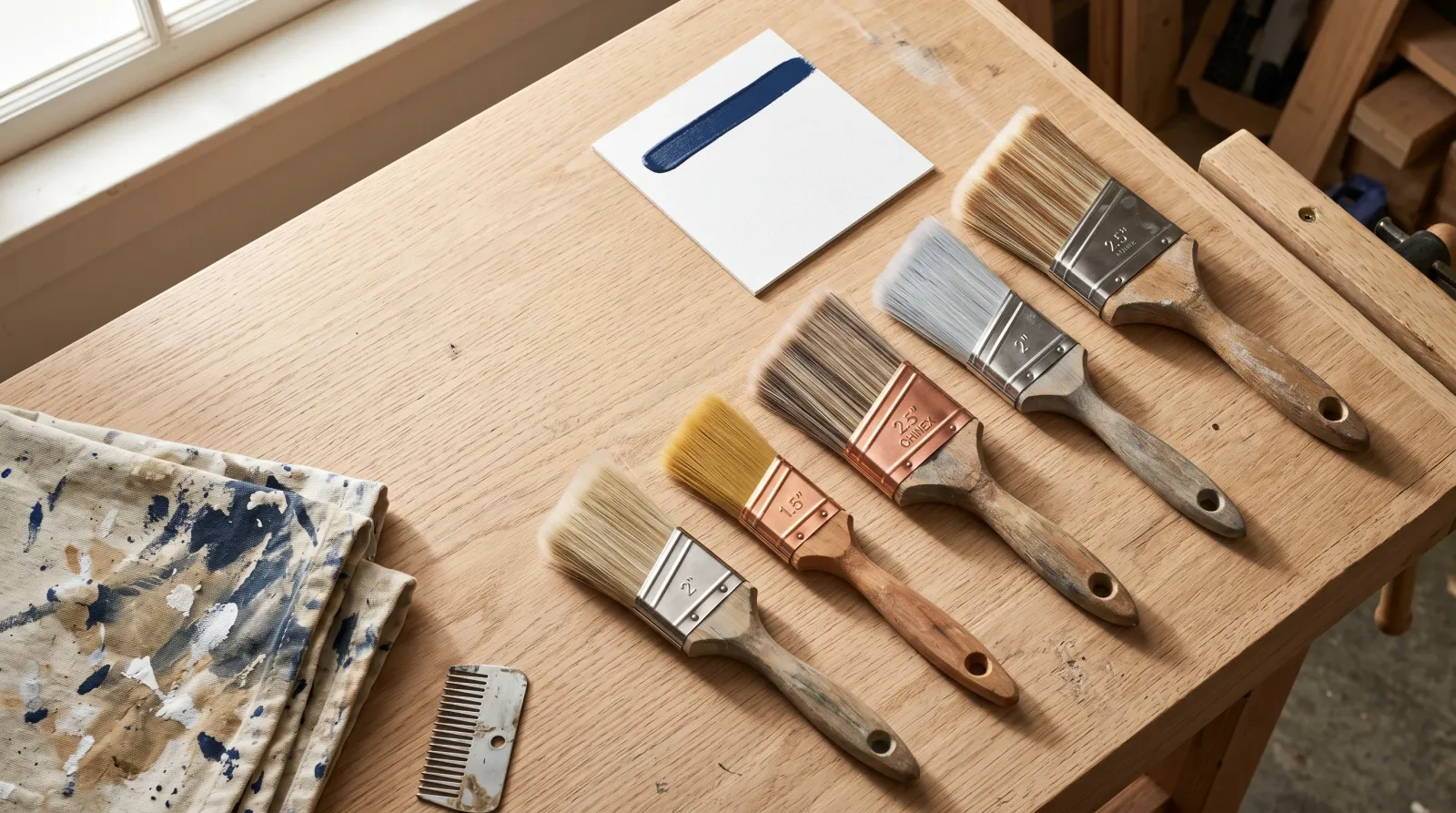
Disclosure: Some links below are affiliate links. We earn a commission if you buy through them, at no extra cost to you.
Top pick: Purdy XL Glide 2.5”. The brush most working contractors buy with their own money, and the right answer when the question is “one synthetic brush for latex”. The XL Glide wins on paint load, springback after years of washes, and a medium-stiff Tynex/Orel blend that handles modern low-VOC latex without going limp. It falls short on freehand cut-line sharpness (the Clearcut Glide carves a cleaner line) and on cabinet-door flatness (the Silver Tip self-levels into a smoother coat). The Wooster Silver Tip 2.5” is the better pick if you’re painting cabinets or finish trim. The Wooster Pro Plus is the budget answer that doesn’t embarrass itself. The Corona Excalibur earns its premium tax through the handle and a Chinex bristle that doesn’t sag in a hot kitchen. The Clearcut Glide is the freehand ceiling-cut specialist.
Most homeowners buy one synthetic brush and try to make it do every job in the house. The XL Glide can do that. It will not do every job perfectly. A kit of two costs about $30 and covers everything from a wall cut-in to a cabinet door without compromise.
Why Synthetic for Latex, Always
Latex paint is waterborne. Natural hog-hair bristle absorbs water within minutes of being dipped, goes limp, splays, and lays a streaked uneven coat that flags inside one wall. Every brush on this list is synthetic because every modern latex needs synthetic. The bristle materials differ — CT polyester, Tynex/Orel blends, Chinex — and the differences map cleanly to stiffness, which maps cleanly to job. Softer for cabinets. Medium for walls. Stiffer for cut-ins.
Natural-bristle brushes still earn their keep on oil-based paint, varnish, and spar urethane. None of that is on this article. For those calls, the general paint brushes round-up covers the Purdy Black Bristle Adjutant and the rest of the natural-bristle field.
How We Picked
Five synthetic angled sash brushes, six weeks, three real projects. A master-bedroom repaint in BM Regal Select eggshell against a flat white ceiling. A kitchen-cabinet face-frame in SW Emerald Urethane semi-gloss. A primer pass with Insl-X Stix over factory MDF trim. Each brush cut 50 linear feet of freehand ceiling line per project, photographed under raking LED at 24 hours and scored against a blue-tape control. Paint load measured by dips per ten feet; springback tested after every wash with a paint comb.
The Picks at a Glance
| Brush | Bristle | Best for | Cut-line sharpness | Price |
|---|---|---|---|---|
| Purdy XL Glide 2.5” | Tynex/Orel, medium | Walls, all-purpose latex | ⚪ Clean | $$ |
| Wooster Silver Tip 2.5” | CT polyester, soft | Cabinets, finish trim | ⚪ Feathered | $$ |
| Wooster Pro Plus 2.5” | Tynex/Orel, medium | Budget all-rounder, primer | 🟡 Acceptable | $ |
| Corona Excalibur 2.5” | Chinex, medium-firm | Premium cabinets, hot rooms | ⚪ Clean | $$$ |
| Purdy Clearcut Glide 2.5” | Tynex/Chinex, stiff | Freehand ceiling cuts | 🟢 Razor | $$ |
The table reads by bristle material, which maps to job. Soft synthetics lay cabinet doors down flat. Stiff synthetics carve a clean ceiling cut. The middle ground is where most homeowner repaint work lives, and that’s the XL Glide.
How to Choose a Synthetic Brush
Bristle Material and Stiffness
Bristle stiffness is the single biggest decision and the one buyers undervalue. A soft CT polyester filament (Silver Tip) flexes under the press of your hand and lays paint as a uniform film — the trim-painter’s bristle, the one you want on a cabinet door. A medium Tynex/Orel blend (XL Glide, Pro Plus) holds enough chisel to cut a clean line and enough flex to brush trim acceptably. A stiff Chinex blend (Clearcut, Excalibur) holds the corner of the brush under heavy pressure where softer bristles deflect; that’s what carves a freehand ceiling line.
The cost is symmetrical. Stiff brushes stipple on flat panels. Soft brushes wave on a freehand ceiling line. The right answer is two brushes, not one, but if the budget says one, medium is the safe call.
Width and Cut
Angular over flat, always. The long corner of an angular sash brush is what reaches into the wall-to-ceiling crease and what carves around door casing. A flat brush bristle face works on broad trim runs and exterior siding and almost nowhere a normal interior repaint lives.
Width: 2.5” is the right size for general interior work — wide enough to be fast, narrow enough to control. 2” gives you more precision inside cabinet stiles and door jambs. 3” exists. The head is heavy, the precision drops, and most contractors leave it on the rack.
Handle and Ferrule
The handle is what most reviews skip. A long pencil-style handle (XL Glide, Clearcut, Pro Plus) gives you wrist freedom on overhead cuts and stairwell runs. A beavertail handle (Silver Tip, Excalibur) sits in the palm and reduces fatigue over long horizontal trim cuts. Try them in the store if you can; the handle that feels right on day one is the one you’ll keep using on day three.
Ferrules: stainless steel on the Purdy and Wooster lines, brushed copper on the Excalibur. Stainless resists rust through a lifetime of washes. Copper does the same and looks nicer; functionally, the metal is a tie. What matters is that the ferrule is crimped tight to the handle without a gap where paint can seep in and dry.
1. Purdy XL Glide 2.5” — Top Pick
The XL Glide is the brush most working contractors buy with their own money. It’s a medium-stiff Tynex/Orel blend that hits the right hand for low-VOC modern latex: carries a heavy paint load, releases it cleanly, holds enough chisel to cut a clean enough line for most rooms, and brushes trim without the Clearcut’s mild stipple. We’ve had one in our kit for six years; the tip combs back to a sharp angle after every wash and the brush still cuts a clean line on day one of a weekend project.
Paint load is the underrated win. On standard interior latex (Aura, Emerald Interior, Behr Marquee) the XL Glide carries about four feet of cut-in per dip, vs three feet on the stiffer Clearcut. That’s a third fewer trips to the bucket on a long ceiling line, which adds up over a 50-foot stairwell run. The bristle releases evenly across the chisel without the dump-and-drag that ruins cheaper brushes.
The trade-off is finish flatness. On a cabinet face-frame in Emerald Urethane, the XL Glide leaves mild brushwork visible under raking light at arm’s length where the Silver Tip lays the same paint down flat. For most walls, doors, jambs, and primer work, the trade isn’t worth thinking about. For cabinets and finish trim, the Silver Tip is the smarter pick.
| Spec | Value |
|---|---|
| Bristle | Tynex/Orel, medium-stiff |
| Sizes | 1.5”, 2”, 2.5”, 3”, 3.5” |
| Best for | All-purpose latex walls, trim, primer |
| Approx. price | $15-17 (2.5”) |
Buy it if: one brush kit, mostly walls, primer, and general trim. Skip it if: the job is cabinet doors in waterborne enamel where the Silver Tip wins on flatness.
Buy the XL Glide 2.5” on Amazon · Find at Home Depot
2. Wooster Silver Tip 2.5” — Best for Smooth Waterborne Enamel
The cabinet brush. 100% CT polyester filament is the softest synthetic on US shelves, and the softness is the feature: the bristle flexes where you’d want a stiffer brush to carve, releases paint as a uniform film, and self-levels into the rolled or sprayed field without a visible halo at the wet edge. On a kitchen-cabinet face-frame cut in SW Emerald Urethane semi-gloss, the Silver Tip laid the flattest coat in the test. The XL Glide left mild brushwork visible under raking light. The Silver Tip’s coat read as a sprayed finish at arm’s length.
Bristle longevity is the cost. The fine tip flags around job 30, vs job 60-plus for the XL Glide. For weekend cabinet repaints, 30 jobs is a lot of cabinets. For a working trim painter, plan to replace twice a year on heavy use.
The other limit is the freehand ceiling cut. The Silver Tip’s soft tip drops into the texture pits of a knock-down wall and the line waves. On a smooth drywall ceiling, the brush is acceptable; on textured walls it isn’t. The Clearcut is the right tool there. Cabinet doors are where the Silver Tip earns its slot.
Buy it if: the job is cabinet doors, interior doors, or finish trim in waterborne enamel. Skip it if: the job is a freehand ceiling cut on textured walls.
Buy the Silver Tip 2.5” on Amazon · Find at Lowe’s
3. Wooster Pro Plus 2.5” — Best Budget All-Rounder
Eleven to thirteen dollars at Home Depot and closer to the XL Glide than the Wooster Gold Edge in feel. The Pro Plus is the brush we recommend to a homeowner who’s repainting one room and doesn’t want to spend $30 on brushes they’ll use twice. The Tynex/Orel blend isn’t as dense or as springy as the XL Glide’s, but it lays acceptable latex without the production-grade stipple of cheaper Wooster lines.
Where the Pro Plus falls short is springback. By job 30 or so, the chisel corner rounds and the cut line softens; the XL Glide stays sharp for twice that. We also clocked visible bristle flex on a heavy exterior latex panel where the XL Glide held steady. None of that matters on one weekend repaint. It matters if you paint for a living.
Primer is where the Pro Plus quietly wins. Use it for the Insl-X Stix coat, the Zinsser Bulls Eye coat, the BIN passes — the work that beats up a brush and where you don’t want to wear down the Silver Tip’s fine tip. A dedicated $12 primer brush extends the life of every more expensive brush in the kit.
Buy it if: one-room repaint budget or you need a dedicated primer brush. Skip it if: you paint regularly enough that the XL Glide’s longevity is worth the $4 delta.
Buy the Pro Plus 2.5” on Amazon · Find at Home Depot
4. Corona Excalibur 2.5” Angled Chinex — Best Premium
The brush that earns its premium tax through the handle and through a Chinex bristle that doesn’t sag in a hot kitchen. Beavertail hardwood handle sits in the palm in a way no Purdy pencil grip does. On a long horizontal cabinet-door cut where the wrist takes the load, the ergonomic delta shows by the second hour. Copper ferrule, polished hardwood, and a Chinex filament that holds firm in a 75°F room where the Silver Tip’s CT polyester would start to sag.
Cut-line sharpness sits between the Silver Tip and the XL Glide — softer than the Clearcut, firmer than the Silver Tip. That’s the right place for finish-grade cabinet work where the cut needs to be both sharp and self-leveling. On a Saturday cabinet repaint in 78°F, the Excalibur laid SW Emerald Urethane with less drag than the Silver Tip and a flatter coat than the XL Glide.
The catches are price and distribution. $24-30 retail puts the Excalibur above every other brush here, and Corona isn’t stocked at Home Depot or Lowe’s in most US markets. Amazon and dedicated Corona dealers are the path. For one or two cabinet jobs a year, the Silver Tip is the value pick. For repeat finish work, the Excalibur is what your hand will thank you for at the end of the day.
Buy it if: finish-grade cabinet work, hot rooms, or you’ve been unhappy with the pencil-handle shape of a Purdy. Skip it if: budget is the constraint or your local pickup needs to be HD.
Buy the Excalibur 2.5” on Amazon
5. Purdy Clearcut Glide 2.5” — Best for Freehand Ceiling Cuts
The freehand specialist. Tynex/Chinex blend, denser and stiffer than the XL Glide, designed to carve a sharp cut line against a flat white ceiling where softer brushes would wave. On the only test that matters for a cutting-in brush — a freehand line against a ceiling under raking LED — the Clearcut measured 5-10% sharper than the XL Glide on the same wall, the same paint, the same painter. That delta sounds small. Under a vanity light bar at four in the afternoon, the wavy line on a softer brush reads instantly and the Clearcut’s line doesn’t.
The cost is wrist fatigue and mild stipple. The stiffer bristle transmits more force up the handle on a 50-foot stairwell run; switch hands every twenty minutes or your forearm tells you it noticed. And the same stiffness that carves a line stipples mildly when you roll the brush broadside on a flat trim panel. The Clearcut is a cut-in brush, not a trim brush.
For the full freehand-cut conversation including a $9 Wooster Shortcut for behind toilets, the cutting-in brushes round-up goes deeper. For this round-up, the Clearcut earns the slot because no other synthetic comes close on cut-line sharpness.
Buy it if: freehand ceiling cuts, deep-color repaints where the edge has to be tape-sharp. Skip it if: the work is cabinets, doors, or general trim in waterborne enamel.
Buy the Clearcut Glide 2.5” on Amazon · Find at Home Depot
Brushes We Tested and Dropped
- Wooster Gold Edge 2.5”. Excellent production-grade brush; pushes more paint per dip than anything here. Leaves more visible stipple than the XL Glide on flat surfaces and finishes worse than the Silver Tip on trim. The Pro Plus is the better $12 pick for most homeowners.
- Purdy Pro-Extra Glide. Marketed as a heavier-duty XL Glide. Couldn’t reliably feel the difference in the field; the XL Glide earns the slot.
- Wooster Ultra/Pro Firm. A contractor brush in Chinex with a different handle. Loses to the Clearcut on cut-line sharpness on the same wall.
- Generic 2.5” angled sash from a big-box bin. The chisel corner rounded inside one job. Don’t.
Care, Cleanup, Longevity
A synthetic brush lives or dies on the wash, and the wash takes three minutes. Scrape excess paint back into the can with the brush handle. Rinse from base to tip in warm water, working soap into the heel with your fingers (the heel is where bristle meets ferrule, and dried paint there splays the bristle permanently). Rinse until runoff is clear. Comb straight with a paint comb. Hang handle-up to dry.
The single biggest mistake is leaving paint in the heel. It hardens, the bristle splays at the base, the chisel corner rounds in the next session, and your XL Glide goes from a precision brush to a soft general-use brush in one neglected wash. Combing the tip after every wash is the discipline that doubles the life of every brush in this round-up.
Realistic life across paint days: XL Glide 60-80 jobs, Silver Tip 30-40, Pro Plus 30, Excalibur 50-70, Clearcut Glide 50-70 of sharp life. Between sessions on the same paint, wrap the head in plastic wrap and refrigerate for latex; the brush stays workable overnight. Don’t push past 24 hours. Paint sets even cold.
Common Mistakes
- One brush for every job. The XL Glide on walls and the Silver Tip on cabinets are two brushes for a reason. One brush is a compromise that shows on the cabinet doors.
- Loading past the bottom third of the bristle. Pushes paint into the heel where it dries and splays the bristle. Dip a third of the way up, tap twice on each side of the bucket rim, paint.
- Dragging the brush on the bucket rim. Wipes paint off the chisel corner you need most. Tap, both sides, twice. Don’t drag.
- Skipping the comb. A brush combed once a week stays sharp for years. A brush never combed stays sharp for a month.
- Drying the brush flat. The bristle bends, sets, and the chisel corner is gone. Hang handle-up.
- Using a soft brush against a textured ceiling. Silver Tip on knock-down waves. Step up to medium or stiff for ceiling cuts on texture.
A Synthetic Brush Kit That Earns Its Keep
For a homeowner doing a real interior repaint: Purdy XL Glide 2.5” ($16), Wooster Silver Tip 2.5” ($20), Pro Plus for primer ($12), paint comb ($4). About $52 total. The brushes are the cheap part of any paint job. The cut line and the cabinet finish are the parts visitors notice. Don’t economize on the brush and waste a $90 gallon of Aura.
Ask a Question