Best Roller Trays and Liners
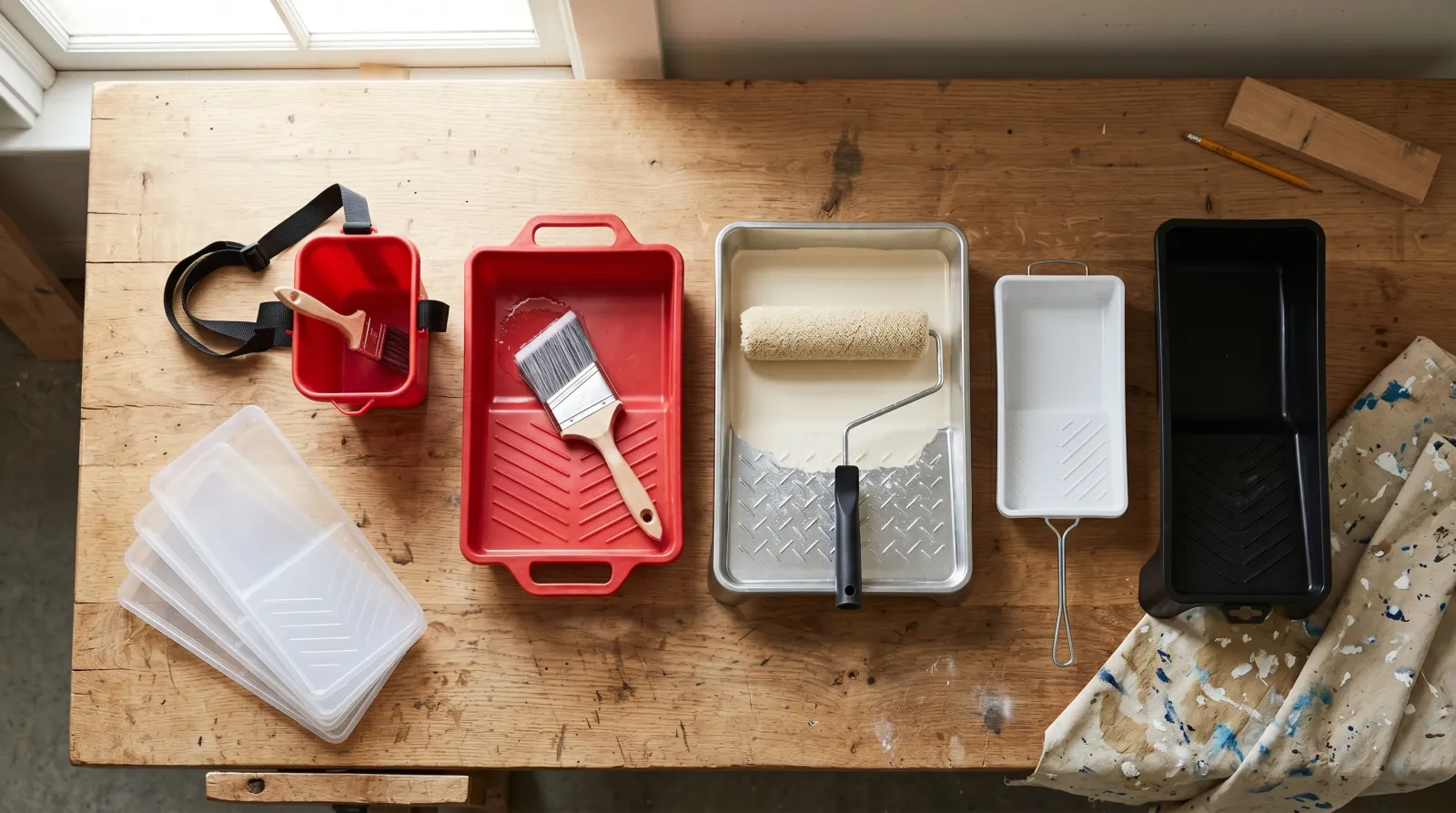
Five paint trays and liner systems tested across walls, ceilings, and cut-in work. Top pick: the Bercom HANDy Paint Tray for the hold-and-carry tray that doesn't spill.

Disclosure: Some links below are affiliate links. We earn a commission if you buy through them, at no extra cost to you.
Top pick: the Bercom HANDy Paint Tray. It holds a full gallon, it has a handle on each end, and you can carry it loaded up a ladder without sloshing paint down the rungs. It wins on capacity and on the thing nobody markets, which is balance. It falls short on bulk; it’s the biggest tray here and it crowds a small bathroom. For a one-wall job where you’d rather spend three dollars, the Wooster Deluxe Tray and a snap-in liner is the budget answer. For solvent-based paint and big rooms, the Wooster Hefty Deep-Well metal tray takes three quarts and doesn’t warp. For a multi-day repaint, the Big Ben’s snap-on lid keeps a gallon wet overnight. For cutting in off a ladder, the HANDy Paint Pail straps to your hand and frees the other one.
A tray is the cheapest tool in your kit and the one people think about least. That’s the mistake. The well capacity decides how often you climb down to reload, the roll-off ramp decides whether your first stroke floods, and the liner decides whether cleanup is ten seconds or ten minutes. The cover you pair with it matters just as much; see the best roller covers and frames for the nap-to-surface match.
Most homeowners do fine with two: a deep gallon tray for rooms and a small one for trim.
The Shortlist and Why These Five
I bought these off the shelf, the same channels a homeowner uses, and ran them through four real projects across six weeks. A 13 x 15 ft living room in eggshell. A flat-ceiling guest room. A ten-door cabinet refinish. An exterior porch ceiling painted off an extension ladder, which is where a tray either earns its keep or dumps paint on your head.
Four axes, weighted in this order: reload frequency (how much wall you cover per pour), spill resistance when carried loaded, roll-off ramp metering, and liner swap speed between colors. Use case anchors the role.
The porch ceiling sorted the field fast. A flat tray on a ladder shelf is a paint spill waiting to happen. The HANDy Paint Tray and the HANDy Pail were the two I trusted up there, and that’s most of why they’re in this article.
I also tracked reload trips, because that’s the number you feel in your knees by the end of a room. With a quart tray on the 13 x 15 living room, I climbed down to refill nine times for the first coat. With the HANDy gallon tray, twice. That gap is the whole argument for a deep tray on anything bigger than one wall.
A note on what I didn’t pick. The all-plastic 9-inch flat trays that come bundled in $20 roller kits flooded the first stroke every time, because the ramp is smooth and shallow and doesn’t grip the cover. I left them out on purpose. They’re the reason a lot of first-time painters think they can’t roll a clean wall.
How to Choose a Paint Tray
Three decisions, in order: how much it holds, whether it takes a liner, and how the roll-off ramp behaves.
Capacity and the Job
Trays come in roughly three sizes, and the right one is the one that matches your job, not the biggest one on the shelf.
Quart trays (the Wooster Deluxe) hold about a quart in the well. Right for a single accent wall, a small bathroom, or trim work where you don’t want a gallon of paint open. You’ll reload more often on a big wall.
Deep-well gallon trays (the HANDy Paint Tray, the Big Ben) hold close to a full gallon. This is the room-and-up tray. You pour once and roll a long time before climbing down for more. For a whole-house repaint, the reload math alone justifies the deep tray. Size the well to your job by working out how much paint you actually need first.
Metal deep-well trays (the Wooster Hefty Deep-Well) hold two to three quarts and survive solvents. If you’re rolling oil-based paint, stain, or anything you clean up with mineral spirits, plastic is the wrong material; it softens and warps. Metal doesn’t care.
Liners Are the Real Cleanup Story
A bare tray means you scrape and rinse every time you change color or break for the day. A tray that takes a fitted liner means you pull out a sheet of plastic and drop in a fresh one. The difference across a multi-room job is an hour of your life.
The catch is fit. Every tray here takes a liner made for it. Use that one. Generic 9-inch liners that “fit most trays” float on the paint, bunch under the roller, and trap paint behind the liner where it dries into a ridge. The fitted Wooster R408 liner snaps into the R405 metal tray and stays put; a generic doesn’t.
The Roll-Off Ramp
The ramp is the angled, usually ribbed surface above the well. Its job is to meter paint off the cover evenly before the roller touches the wall. Dip the bottom third of the cover in the well, roll it up and down the ramp four or five times, and the nap loads evenly through its depth. Skip the ramp and the first stroke floods, sheets, and runs.
Cheap flat trays have a smooth shallow ramp that doesn’t grip the cover. Every pick here has a ribbed ramp that does the metering for you. It’s the spec nobody puts on the package and the one that decides whether your wall has lap lines. An overloaded cover off a bad ramp is also a common cause of roller marks you have to fix later.
Comparison at a Glance
| Brand / Model | Capacity | Material | Liner system | Best for | Price tier |
|---|---|---|---|---|---|
| Bercom HANDy Paint Tray | ~1 gallon | Plastic | Snap-in fitted | Carry-up-a-ladder room work | Mid |
| Wooster Deluxe Tray | ~1 quart | Plastic | Snap-in fitted | One-wall and trim jobs | Budget |
| Wooster Hefty Deep-Well (R405) | ~3 quarts | Steel | R408 form-fit | Solvent paint, big rooms | Budget |
| Wooster Big Ben (BR412) | ~1 gallon | Plastic, lidded | Fitted | Multi-day repaints | Mid |
| Bercom HANDy Paint Pail | ~1 quart | Plastic | Fitted | Cutting in, ladder brushwork | Budget |
1. Bercom HANDy Paint Tray — Best Overall
The HANDy Paint Tray is the one I grab when I’m painting a room and don’t want to think about reloading. The deep well swallows a full gallon, so a single pour covers far more wall than a quart tray does before you climb down. The handles on both ends are the part that matters on a ladder. Loaded with a gallon of eggshell, I carried it up four rungs to the porch ceiling and it didn’t slop, because the weight sits low and centered instead of sliding to one rim the way a flat tray does.
The liners are where it pulls ahead. They snap in and lock; when I switched from the ceiling white to the wall color, I pulled the spent liner, dropped in a fresh one, and kept rolling. No rinse, no skin-flakes in the new pour.
It’s bulky. On a crowded drop cloth in a small bathroom it takes up real estate, and it’s heavier empty than a flat tray. The magnetic brush holder grips a 2-inch sash fine but a loaded 3-inch brush peels off under its own weight. Minor gripes on a tray that does the main job better than anything else here.
One practical note: pour your gallon straight from the can into the lined well, no funnel, no second container. The deep well and the wide rim make it a clean pour, and you can tip the leftover right back into the can at the end without losing a quart to a tray you can’t fully drain. That round-trip is part of why this tray wastes less paint than a shallow one.
| Spec | Value |
|---|---|
| Capacity | About 1 gallon |
| Material | Solvent-resistant plastic |
| Liner | Snap-in fitted, locks in place |
| Best for | Room and whole-house roller work, ladder jobs |
Buy it if: you’re painting rooms, you reload too often with a quart tray, and you work off a ladder. Skip it if: the whole job is one accent wall. A Deluxe tray and a liner is three dollars.
2. Wooster Deluxe Tray — Best Budget
The tray I hand a friend painting their first apartment. A few dollars, takes a cheap snap-in liner, and the ribbed 11-inch roll-off ramp meters paint as well as trays that cost five times as much. For a single wall or a small room, capacity isn’t the constraint and this is all the tray you need.
The no-tip legs are a real feature, not marketing. Set a loaded 9-inch roller across the ramp and it stays flat instead of see-sawing paint over the low rim, which is the failure mode of the truly cheap flat trays.
Quart capacity means you’ll reload more on a big wall. And the thin plastic warps if you leave it in the sun with paint in it; bring it inside or empty it. For the money, it does exactly what a tray should and nothing it shouldn’t.
Buy it if: you’ve got one wall, a small room, or trim, and you want cheap-plus-a-liner cleanup. About $4–$6.
3. Wooster Hefty Deep-Well Metal Tray — Best for Big Jobs and Solvents
Plastic and solvents don’t mix on a long job. Once you’re rolling oil-based paint, stain, or anything you clean with mineral spirits, you want metal, and the Hefty Deep-Well is the metal tray I reach for. Heavy-gauge rust-resistant steel, a three-quart deep well that fully submerges a 9-inch cover, and a ribbed ramp and level legs that load a roller evenly. I ran a solvent-based porch stain through it and the tray came out of the cleanup looking like it could do it again tomorrow. A plastic tray on that same job would have softened at the rim.
It’s heavy, and loaded with three quarts it’s heavier still. This is a floor tray, not a carry-it tray; for ladder work the HANDy is the better call. Pair it with the R408 form-fit liner if you want fast cleanup. Generic 9-inch liners float in the deep well and bunch.
Buy it if: you roll oil-based paint or stain, or you want a tray that outlives every plastic one in your garage. About $5–$8.
4. Wooster Big Ben Tray — Best for Multi-Day Jobs
The Big Ben earns its slot on one feature: the lid. A gallon-capacity tray with a 21-inch roll-off ramp is already a strong room tray, but the snap-on lid is what makes it the multi-day pick. On the living-room job I rolled a first coat, snapped the lid on the loaded tray, and the paint was still wet and workable the next morning. No full cleanup between days, no pouring a quart of leftover back into the can and losing it to a skin.
It takes a fitted liner, so a whole-house repaint cleans up in seconds per color change. The trade is footprint. A 21-inch tray is awkward in a tight stairwell or a small bathroom, and it’s flat overkill for a single accent wall.
Buy it if: you’re spreading a repaint across several days and want to skip cleanup between them. About $10–$14.
5. Bercom HANDy Paint Pail — Best for Cutting In
Different category, same maker, same idea done for the brush instead of the roller. Cutting in a ceiling line off a ladder with an open paint can balanced on the shelf is how you end up repainting the floor. The HANDy Pail fixes that. The adjustable strap slips over your hand so the pail rides with you, leaving your free hand on the ladder. The built-in magnetic rest parks the brush on the rim instead of dunking the ferrule, where dried paint splays the bristles. And a quart balanced close to your wrist fatigues you far less than holding a gallon can on a long cut-in run.
It’s a brush pail, not a roller tray; don’t try to load a 9-inch cover in it. The fitted liners are a recurring cost if you change colors a lot. For ladder cut-ins and trim brushwork, nothing here is more comfortable.
Buy it if: you cut in off a ladder or do a lot of trim brushwork. About $7–$10.
Care, Cleanup, and Liners
Liner first. If a tray takes a fitted liner, use it. Pull the spent liner, drop in a fresh one, done. The tray itself stays clean and lasts for years. This is the single biggest time-saver in the whole tray conversation.
No liner? Don’t let paint dry in the well. Scrape the bulk back into the can while it’s wet, then rinse a latex tray under warm water until the runoff is clear. Dried paint ridges in the well shed flakes into your next pour and ruin a finish. For an oil-based or stain tray, wipe the bulk with a rag, then a mineral-spirit rinse, then soap and water. Metal trays take this without complaint; cheap plastic ones can craze.
Storing paint in the tray overnight: snap a lid on if you have one (the Big Ben does). If not, press plastic wrap directly onto the paint surface in the well, then bag the whole tray and seal it. Keep it cool and out of sun. A skin still forms on the ramp, so wipe that and stir the well before the first dip the next day.
Common Mistakes
- Buying a flat bargain tray with a smooth ramp. The ramp doesn’t grip the cover, so the first stroke floods. The ribbed ramp on any pick here meters the cover for you. Spend the extra two dollars.
- Skipping the liner to save money. The liner costs less than the time you spend scraping a dried tray. Across a multi-room job, liners save an hour.
- Using a generic liner that doesn’t fit the tray. It floats, bunches under the roller, and traps paint behind it. Use the fitted liner made for your tray.
- Plastic tray for oil-based paint or stain. Solvent softens and warps it over a long job. Use a metal deep-well tray for anything you clean with mineral spirits.
- Overloading and skipping the ramp. Dip the bottom third of the cover, then roll it up and down the ramp four or five times. A cover that drips off the ramp has too much paint.
- Carrying a flat tray up a ladder. It slides paint to the low rim and dumps. Use a deep tray with handles, or a strap pail for brushwork.
A Starter Kit That Earns Its Keep
For a homeowner doing a couple of weekend projects a year: a Bercom HANDy Paint Tray with a few fitted liners ($16 plus liners) for rooms, a Wooster Deluxe Tray and a sleeve of liners ($6) for accent walls and trim, and a HANDy Pail ($9) for cutting in off a ladder. About $35 and it covers nearly every interior job.
Add the Wooster Hefty Deep-Well metal tray ($6) the first time you roll a stain or an oil-based paint. The trays last years. The liners are the consumable, and they’re the cheapest insurance against a slow cleanup you’ll find.
Ask a Question