Best Headlamps for Painting
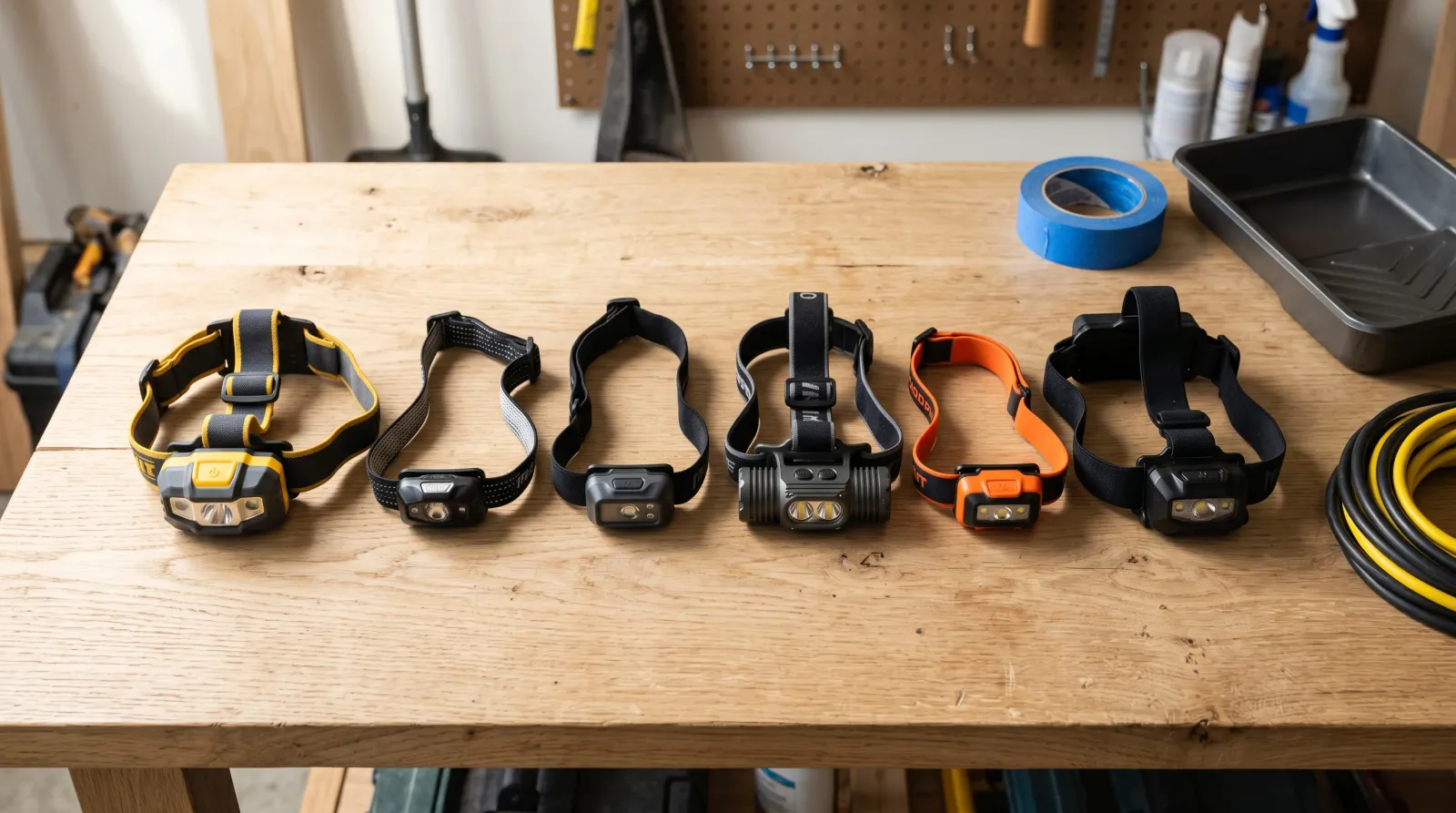
Six headlamps tested while painting walls, ceilings, and trim. Top pick: Coast FL85R for its wide flood beam, tri-color modes, and hard-hat fit.

Disclosure: Some links below are affiliate links. We earn a commission if you buy through them, at no extra cost to you.
Top pick: Coast FL85R. It floods wide, twists down to a spot, and its white beam reads warm enough to show your true wall color instead of a cold blue cast that hides missed spots. It wins on beam width, color, and a hard-hat fit that survives a full day. It falls short on weight, which you feel by hour eight, and on the built-in battery you can’t swap mid-job. If you paint a couple of weekends a year and don’t want to buy a charger, the Energizer Vision HD+ Focus floods well enough for under $20. For big open rooms and garages, the Fenix HM65R-T V2.0 throws more light than any interior job needs. For close work where a low-profile light matters, the Black Diamond Spot 400-R hugs the forehead. For an all-day ceiling marathon, the featherweight Petzl Actik Core is the one your neck forgives.
There is no single right headlamp for painting.
Most people doing interior work do fine with one good flood light and a spare set of batteries.
The Shortlist and Why These Six
I wore six headlamps through five weeks of real paint work, the kind of jobs where you reach for one in the first place. A windowless basement repaint where the only light was on my head. A walk-in closet too deep for the ceiling fixture. Three ceilings cut in under recessed cans that throw their own shadows right where you’re working. A stair stringer nobody could light from the floor. The light that earned the top slot is the one I kept grabbing without thinking about it.
These aren’t trail-running picks dressed up for a paint article. Painting asks for different things than hiking. You’re three feet from a white wall, not staring down a black trail, so reach matters less and a wide, even, true-color flood matters more. A 1,600-lumen spot that’s wonderful on a mountain glares off wet eggshell and washes out your read on coverage. I weighted the test for what actually helps you lay a clean coat.
Five things, in this order: flood-beam width and evenness, how true the wall color reads under the beam, glare bouncing back off wet paint, headband comfort across a full day, and battery life on the flood setting most painters use. The use case anchors each pick’s role.
Why a Headlamp Beats a Work Light for the Cut Line
A work light on a tripod lights the room. It also throws a hard shadow wherever your body, your arm, or the ladder blocks it. That shadow lands exactly where you’re cutting in, because you’re leaning into the work. You end up painting a ceiling line you can’t quite see, then finding the holidays the next morning when the sun comes up.
A headlamp puts the light at your eye line. The beam goes where you look. It follows your brush into the corner, behind the toilet tank, up under the cabinet lip, into the closet a floor lamp never reaches. The light and your eyes share the same angle, so there’s no shadow between you and the cut.
Use both. Work light for the room, headlamp for the spot you’re painting. The headlamp is the one that saves you the callback.
How to Choose a Headlamp for Painting
Beam Pattern: Flood, Not Spot
This is the spec that matters most and the one headlamp marketing buries. Spot beams are sold on reach: how many meters down a trail the light throws. Painting doesn’t need reach. It needs a wide, even wash across the surface in front of you. A flood beam lights the whole work zone; a spot lights one bright circle and leaves the edges dark, so you keep tilting your head to chase the light.
The lights here that do flood best are the Coast FL85R (twist it to Ultra View), the Petzl Actik Core, and both Black Diamond Spots. The Fenix HM65R-T has a separate flood emitter alongside its spotlight, which is the cleanest setup of the group. Buy for the flood. Treat the spot as a bonus for the far wall.
Color Temperature and CRI: Show the True Wall Color
A cold blue-white LED makes a warm beige wall look gray and hides the thin spot you left in the second coat. A warmer beam, closer to daylight, shows the real color and the real coverage. The spec to look for is CRI (color rendering index); higher is truer, and 90-plus is excellent, though most worksite headlamps don’t publish it.
You don’t need a lab number to feel the difference. Hold the beam on a painted chip you know well. If the color looks like itself, the light is warm enough. The Coast FL85R reads the truest of this group. The Fenix and Energizer run cooler, which is fine for finding texture and missed spots but less honest on color.
Comfort, Weight, and Power
You’ll wear this thing for hours with your head tipped back at a ceiling. Weight on the forehead becomes a neck ache fast. The Petzl Actik Core at about 2.6 ounces is the comfort champ; the Coast and Fenix are heavier and you notice. A silicone-lined or grippy band holds position over a hat and safety glasses without creeping up.
Power splits two ways. Rechargeable lights are brighter and you’re not buying AAAs, but a dead charge with no outlet ends your work. Battery lights swap in seconds for the cost of three cells. Hybrid lights (Petzl Actik Core, Black Diamond Spot 400) take either, which is the safest pick if you’re not sure.
At-A-Glance Comparison
| Brand / Model | Price tier | Beam | Power | Best for |
|---|---|---|---|---|
| Coast FL85R | Premium | Twist flood-to-spot, tri-color | Built-in rechargeable | Everyday all-rounder, true color |
| Energizer Vision HD+ Focus | Budget | Flood + spot, focusable | 3x AAA | Cheap, light-duty interior work |
| Fenix HM65R-T V2.0 | Premium | Dual flood + spotlight | USB-C rechargeable (swappable cell) | Big rooms, garages, exteriors |
| Black Diamond Spot 400-R | Mid | Flood + spot, low profile | Built-in rechargeable | Close trim and cabinet work |
| Petzl Actik Core | Mid | Wide flood + spot | Rechargeable or 3x AAA | All-day ceiling comfort |
| Black Diamond Spot 400 | Mid | Flood + spot, low profile | Rechargeable or 3x AAA | Dual-fuel reliability |
1. Coast FL85R, Best Overall
The FL85R is the light I reached for first on every job and the one I’d hand a painter who wants to buy once. Twist the bezel and it sweeps from a wide Ultra View flood that washes a whole closet to a tight bulls-eye spot for the far end of a basement. On the flood setting, the white beam is warm enough that a beige wall looks beige, not gray, which is the thing most worksite lights get wrong. You see your real color and your real coverage.
The tri-color setup earns its keep. White on its own button, red and green on theirs. Red preserves your night vision when you step out of a dark space, and the white is what you’ll live in. The hinged head tilts up to a ceiling line and locks there, and the silicone-lined strap doesn’t slide when you sweat into it. It’s hard-hat compatible, which matters if you’re working a real site and not just a spare bedroom.
The trade-off is mass. This is a chunkier light than a trail headlamp, and by hour eight with your head tipped back at a ceiling, you feel it on the forehead. The built-in battery is the other catch: there’s no slapping in three AAAs when it dies, so you charge it the night before or you stop early. For most interior painters, neither is a dealbreaker.
| Spec | Value |
|---|---|
| Beam | Twist-focus flood to spot; white, red, green |
| Output | Up to 1,000 lumens on high |
| Power | Built-in rechargeable, around 18 hours max runtime |
| Fit | Hard-hat compatible, silicone-lined strap |
Buy it if: you paint often, want one light that floods true-color and tightens to a spot, and you’ll charge it. Skip it if: you need a featherweight for all-day ceilings or a quick battery swap on the road. Look at the Petzl.
2. Energizer Vision HD+ Focus, Best Budget
The light I hand someone painting their first apartment who isn’t about to spend $60 on a headlamp. It ships with a focusable beam, and the move is to push it to full flood, which throws a wide, even wash that suits a wall far better than the spot mode the box photo shows. Five modes, a pivoting head, and a washable band, all for under $20 at most hardware stores.
It runs on three AAA cells, which is the budget pick’s quiet advantage. When it dims, you swap batteries for pocket change and keep going. No charger to leave at home, no dead light with no outlet nearby.
What you give up is toughness and beam quality. It’s IPX4 and drop-rated to a meter, so it’s a light-duty tool, not a jobsite light you can kick across a basement. The beam runs cooler and dimmer than the premium picks, so a faint missed spot on a white ceiling can hide from it. For a weekend repaint, none of that stops you.
Buy it if: you paint a few weekends a year and want a flood that works for the price of lunch. About $15–$20.
3. Fenix HM65R-T V2.0, Best for Bright, Heavy-Duty Work
Different category of light. The HM65R-T carries two emitters: a wide flood for the surface in front of you and a separate spotlight for the far wall, and you run them independently. That’s the cleanest beam setup in the group for a big space, because you flood your work and punch the spot across a garage without choosing one or the other. The magnesium body keeps it light for how bright it is, and the band holds through a long day without sagging.
On high it’s brighter than any interior paint job needs, and that’s the catch. Too much light glares off wet paint and flattens out the shadows you’re using to read coverage, so you dial it down indoors. The flood also runs cool-white rather than warm, which is great for raking out texture and missed spots, less honest when you’re judging the actual color. The cell pops out, so a spare battery in your pocket means it never dies mid-room.
Save this one for garages, basements, stairwells, and exterior work where the reach pays off. In a small bedroom it’s overkill, and it’s the priciest light here.
| Spec | Value |
|---|---|
| Beam | Separate flood + spotlight, run independently |
| Output | Up to 1,600 lumens on high |
| Power | USB-C rechargeable 21700 cell (swappable) |
| Body | Magnesium, IP-rated for jobsite use |
Buy it if: you light big open spaces and want flood and spot at the same time. About $90.
4. Black Diamond Spot 400-R, Best Compact Rechargeable
The Spot 400-R sits low and close to the forehead, and that shape is the point. It doesn’t snag on a door frame when you duck through, doesn’t catch a ladder rung when you climb, doesn’t bobble when you bend under a sink. Its dedicated flood LED throws a soft, even close-range wash that suits trim, cabinets, and any work where your face is a foot from the surface. PowerTap dimming lets you tap the side and drop the brightness fast when you’re up close to gloss and the glare bites.
It’s a close-work light, not a room light. At 400 lumens it runs out of reach in a big open space, so pair it with a work light or step up to the Fenix for a garage. And the R is rechargeable-only, so there’s no AAA fallback unless you buy the dual-fuel Spot 400 instead.
Buy it if: you do a lot of trim and cabinet work and want a light that disappears on your head. About $50.
5. Petzl Actik Core, Best for All-Day Comfort
The lightest pick by a wide margin, around 2.6 ounces, and on a full ceiling day that weight difference is the difference between a sore neck and a fine one. The flood beam is wide and even, the single-button interface works with paint on your gloves, and the hybrid design takes either the Core rechargeable pack or three AAA cells. That last part matters: it never strands you, because there’s always a battery you can find.
It’s a sport light pressed into work, and it shows in two places. It’s not hard-hat friendly and it’s not built for a wet, knock-around jobsite. And it has no dedicated red work mode beyond night-vision, so color rendering is fine but it’s not the light you grab to judge a tricky paint color. For a homeowner repainting their own rooms, the comfort wins out.
Buy it if: you’re cutting in ceilings all day and want the lightest thing on your head. About $70.
6. Black Diamond Spot 400, Best Dual-Fuel Pick
Same compact, low-profile body as the 400-R, with one change that earns it a separate slot: it runs on the rechargeable pack or three AAA cells. That’s the reliability answer for someone who hates a dead light mid-job. Charge it for everyday use, drop in AAAs when you forgot to charge or you’re far from an outlet.
The IPX8 housing shrugs off a drop into a paint tray or a damp basement floor, which the budget Energizer can’t claim. Its soft flood is the right tool for sorting a tray and reading coverage on trim up close. The reach is the same modest 400 lumens as the R, so it’s not the light for a two-story stairwell, and AAA mode runs dimmer and shorter than the lithium pack.
Verdict: the safe pick when you want compact and refuse to be stranded. About $50.
Headlamps We Tried and Dropped
- Coast FL75R. A strong worksite light, but the FL85R’s tri-color and wider flood edged it out for paint work.
- Petzl Tikka Core. Cheaper and lighter than the Actik Core, but the narrower flood and lower output left dark edges on a wide wall.
- Generic Amazon zoom headlamps. The focus rings rattle loose, the beam is cold and uneven, and the bands stretch out in a month. False economy.
- Pure spot-beam trail headlamps. Made for distance, wrong for a wall three feet away. They light a circle and leave the edges dark.
Care, Cleanup, and Longevity
These lights live in dust and overspray, so a little care doubles their life.
Keep paint off the lens. A fine mist of overspray fogs the beam and reads as a dimmer, yellower light. Wipe the lens with a damp microfiber when you pack up. Dried latex on a lens comes off with a fingernail and a drop of water; don’t use a solvent on the plastic.
Mind the battery. Rechargeable lights (Coast FL85R, Spot 400-R, Fenix) last longest if you don’t store them dead. Charge to about half if a light is going in a drawer for the season. AAA lights: pull the cells before long storage so a leak doesn’t ruin the contacts.
Wash the band. The strap soaks up sweat and paint. The Energizer and Petzl bands come off and wash; the Coast silicone strap wipes clean. A crusty band is the first thing that makes a headlamp annoying to wear.
A decent headlamp lasts years of weekend painting. The thing that kills them early is a swollen rechargeable cell from being stored flat, or a focus ring full of dried paint. Neither happens if you wipe the lens and top the charge.
Mistakes I Still See
- Buying for lumens. A 1,600-lumen spot is worse for painting than a 400-lumen flood. Buy the beam pattern, not the headline number.
- Wearing a cold-white light to judge color. A blue beam lies about your wall color. Use a warmer light, or check the real color in daylight before you call it done.
- Aiming the beam straight at the wall. Tip it to rake across the surface at a low angle. Raking light throws shadows off ridges and thin spots; straight-on light hides them.
- Skipping the work light. A headlamp is for the cut, not the room. Light the room too, or you’ll fight shadows everywhere your head isn’t pointed.
- Letting the rechargeable die mid-room. No outlet, no light, no finish. Charge the night before, or buy a hybrid that takes AAAs.
A Setup That Actually Works
For a homeowner repainting their own rooms: one Coast FL85R or, if budget’s tight, the Energizer Vision HD+ Focus, plus a corded work light for the room and a spare set of AAA cells in the toolbox. Under $40 if you go budget, around $60 if you go Coast.
For a painter on real sites, the Fenix HM65R-T for the big rooms and exteriors, the Petzl Actik Core for the all-day ceiling days, and a charger that lives in the truck.
The light is the cheap part of the job. Don’t cut a crooked line in the dark to save twenty dollars.
Ask a Question