Best Paint Mixing Paddles for Drills in 2026
Five paint mixing paddles tested on latex, oil-alkyd, epoxy, and joint compound — bend resistance, splatter, blend speed, drill compatibility. Top pick: Bosch RT500.

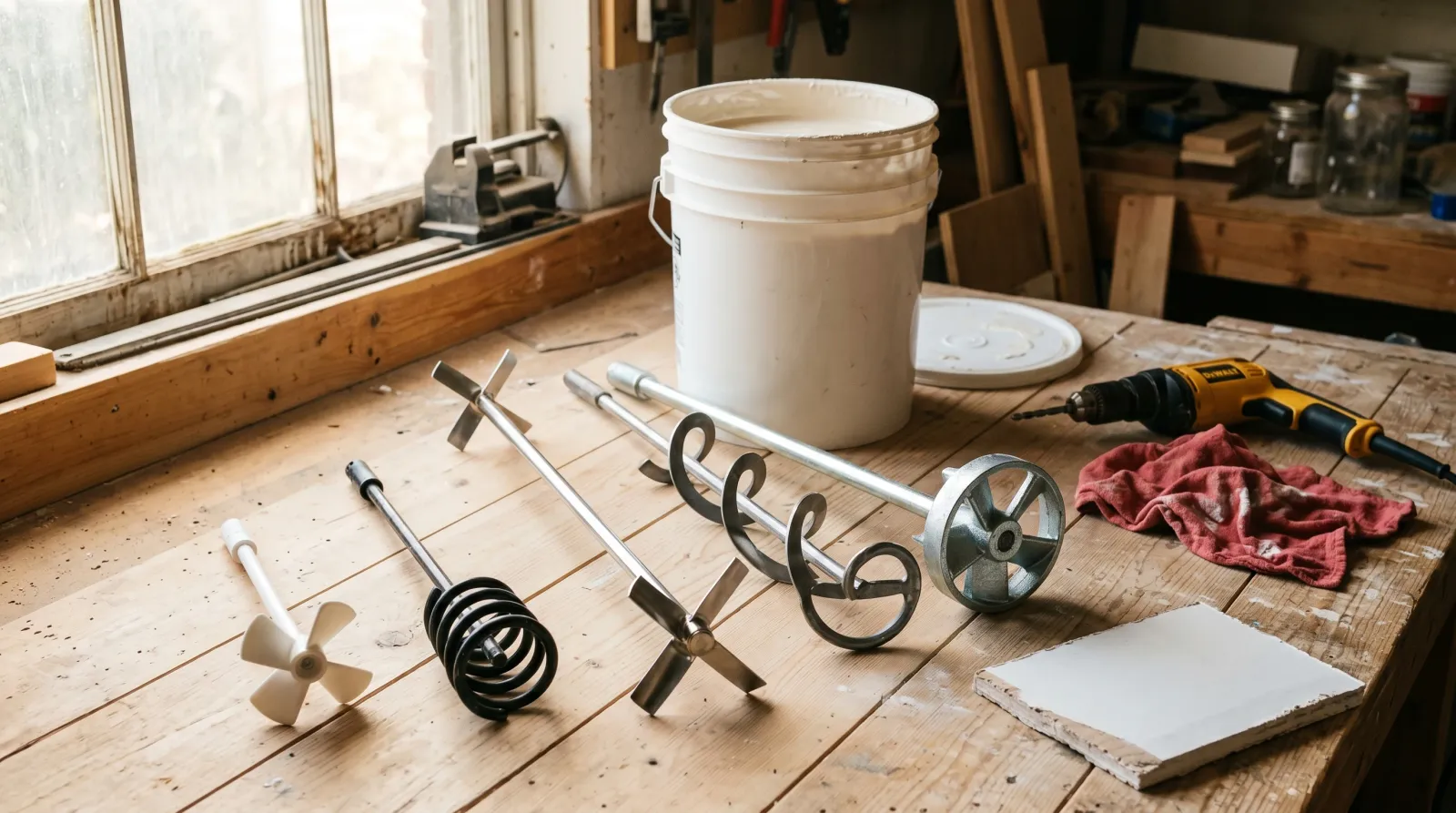
Disclosure: Some links below are affiliate links. We earn a commission if you buy through them, at no extra cost to you.
Top pick: Bosch RT500. At $28–$35 it’s three times the price of the hardware-store coil paddle, and for a homeowner who mixes more than two buckets a year, it earns the delta back the first batch. The Bosch wins on blend speed (90 seconds on a settled 5-gallon latex where coils take three minutes), shaft seating (3/8-inch hex doesn’t slip in the chuck at 600 rpm), and cleanup (polished stainless wipes off in one pass between chemistries). It falls short on small batches and on the heaviest mud-bucket and settled-epoxy work; for those, Trim Lock 3-inch plastic and ToolGuards heavy-duty take the slots. Whizz 5-inch coil is the latex-only budget pick. Allway Mix-N-Match dual-helix is the joint-compound specialist.
A heads-up. This article is about the paddle, not the drill. A great paddle in a 3/8-inch cordless drill stalls on a 5-gallon mud bucket no matter the brand. Match the chuck size to the shank, match the drill amperage to the chemistry, and the paddle does the work it was built to do.
The Paddle Is the Coat That Comes Off the Roller
Most “best paint mixing paddle” articles list five paddles and stop. That’s how you end up with a perfectly stirred 5-gallon pail that whipped foam into the topcoat, a settled bottom layer of pigment that the coil never reached, or a wobbling shaft that flicked paint up your forearm because the chuck didn’t grip the round shank. The paddle decides three things the brush and the roller can’t fix: whether the pigment is evenly suspended through the can, whether the wet film cures without micro-craters from entrained air, and whether the second gallon out of the pail looks like the first. A bad mix costs you a recoat. The rest of this article is which paddle for which chemistry, plus the drill and rpm pairing that decides whether the bead lays flat.
How We Picked
Five paddles run on identical batches across a settled 5-gallon Sherwin-Williams ProMar 200 latex, a thinned Benjamin Moore Advance alkyd, a 1-quart marine two-part epoxy, a 5-gallon USG Sheetrock joint compound, and a 1-gallon contractor primer with separated solids. Drill held at 500 rpm on latex, 800 on mud. The pick-specific finding lives in each review below.
The Picks at a Glance
| Paddle | Best for | Head geometry | Shank | Price |
|---|---|---|---|---|
| Bosch RT500 | Top pick, general purpose | 🟢 Cross-blade stainless | 3/8” hex | $$ |
| Whizz 5-Inch Coil | Latex topcoats, budget | ⚪ Tight coil | 3/8” round | $ |
| Trim Lock 3-Inch Plastic | Small batches, tint cans | 🟢 Propeller plastic | 1/4” hex | $ |
| Allway Mix-N-Match Dual Helix | Joint compound, mud | 🟢 Dual helix | 1/2” round | $$ |
| ToolGuards Heavy-Duty | Two-part epoxy, settled primer | 🟢 Cage impeller | 1/2” hex | $$$ |
The table is structured by chemistry, not by brand. Bosch and Whizz split standard paint duty on whether you want stainless durability or coil-and-cheap. Trim Lock takes the small batch and tint can, where a 5-inch head is the wrong tool. Allway owns the mud bucket. ToolGuards owns the heaviest pail chemistries. Read this as “pick the daily paddle plus the specialty paddle the work actually needs.”
Standard Paint: Bosch RT500, with a Latex-Only Runner-Up
Bosch RT500 Stainless Steel Mixing Paddle
The Bosch RT500 is the cleanest tool in this round-up. We loaded a settled 5-gallon ProMar 200, set a Milwaukee 0234-6 to 500 rpm, dropped the paddle three inches below the surface, and pulled a uniform vortex with no splatter rim above the pail edge. Time to homogeneous blend: 90 seconds. The same pail with the Whizz coil took just under three minutes and left a thin band of unmixed pigment at the bottom that re-suspended only after a second 60-second pass.
The cross-blade is the right geometry for general-purpose mixing. Four offset vanes pull paint inward and downward from both sides of the shaft, so a 5-gallon pail circulates instead of just spinning at the surface. The polished stainless is the unsung feature: between a batch of latex and a batch of alkyd, one rag wipe got the paddle clean enough to drop into the alkyd without cross-contamination. Coil and cage paddles trap residue in the vanes and hub; the Bosch doesn’t.
Shaft seating is the other call. The 3/8-inch hex shank seats square in a corded drill chuck and doesn’t rotate under load at 600 rpm; the Whizz coil’s round 3/8-inch shank slipped twice on a long mixing session and needed a chuck re-tighten. Cons are honest: $28–$35 is real money for a paddle, the cross-blade entrains air if you run it above 800 rpm on a half-empty pail, and the 21-inch shaft is overkill for a 1-quart can. Bosch RT500 Mixing Paddle.
Buy it if: you mix more than two buckets a year and want a paddle that handles latex, alkyd, light epoxy, and primer with one cleanup pass between. Skip it if: the work is mud-bucket only; the Allway is the specialist.
Whizz 5-Inch Coil Mixer
The latex-only budget pick. The tight-spiral coil pulls paint inward with the lowest air entrainment of any paddle we tested; the 24-hour foam-cell count on a poured-out latex sample was the cleanest in the field. For premium latex topcoats where the foam shows in the cured film as micro-craters, the Whizz is the right geometry. We rolled a panel from a Whizz-mixed batch and a Bosch-mixed batch side by side; the Whizz panel was visibly smoother under raking light at the 24-hour mark.
The 5-inch coil head fits through any standard 5-gallon pail rim without chipping the enamel; the geometry is built for the bucket. At $10–$14 it’s the impulse-buy paddle that actually deserves shelf space. Cons: the coil stalls on joint compound and 5-gallon thinset (the spiral flexes instead of pushing the mud), the black coating chips after a season of putty-knife cleanup and rusts at the chips, and the round 3/8-inch shaft slips in a drill chuck under load. Tighten the chuck twice. Whizz 5-Inch Coil Mixer.
Buy it if: latex topcoats are the whole job and the foam-in-the-film question matters. Skip it if: mud, epoxy, or heavy primer is on the list.
Small Batches: Trim Lock 3-Inch Plastic
The paddle most “best mixing paddle” round-ups skip. A 5-inch coil paddle does not fit in a quart can. A 3-inch plastic propeller does. For tint cans, custom color batches, glaze runs, and any time the batch is under a gallon, the Trim Lock is the right tool. We stirred a freshly tinted Benjamin Moore Aura quart with the Trim Lock at 400 rpm in a cordless impact driver and got an even color blend in 45 seconds without splashing paint over the can lip.
The nylon-plastic head matters for color work specifically. Metal paddles drag micro-flecks of zinc or steel coating into the batch; on a deep tinted color, those flecks show as specks in the wet film. The Trim Lock plastic doesn’t. At $4–$7 you can dedicate one each to latex, alkyd, and stain and skip the cleanup cross-contamination entirely. Cons: the plastic vanes shear at the hub if you put this in joint compound or epoxy (don’t), the 1/4-inch hex slips in a 1/2-inch corded drill chuck without a real crank on the jaws, and the plastic head wears at the leading edges after 20-some mix cycles. Replace it; it’s $5. Trim Lock 3-Inch Plastic Paint Mixer.
Buy it if: you tint, glaze, color-match, or batch under a gallon. Skip it if: the smallest container in your year is a 1-gallon; the Bosch is the better daily.
Joint Compound: Allway Mix-N-Match Dual Helix
Mud is a separate problem. A 5-gallon bucket of USG Sheetrock joint compound weighs over fifty pounds wet, and the bottom third of the bucket sets denser than the top within days. A single-spiral coil or cross-blade spins at the top of the bucket and never circulates the mud through. The Allway Mix-N-Match’s opposing helices fix it: the outer helix pulls material up at the rim, the inner pushes it down through the center, and the bucket circulates in 60 seconds where a single-spiral paddle takes two minutes plus a manual stir-back at the rim.
The 1/2-inch round shaft is the other call. Joint compound demands torque the 3/8-inch chuck class doesn’t deliver; the Milwaukee 0234-6 1/2-inch corded drill on the Mix-N-Match at 800 rpm pushed the mud cleanly where a cordless 3/8-inch drill stalled at the trigger. Carbon-steel construction handles thinset, plaster, and self-leveling underlayment without bending the shaft; it’s the second-best epoxy paddle in this round-up after the Bosch’s stainless. Cons: $22–$28 is real money for a homeowner who mudded one room a decade ago, carbon steel rusts at any chip in the coating (wipe within five minutes of pulling), and the dual-helix chews air on thin latex (keep it on mud and floor compounds). Allway Mix-N-Match Dual Helix.
Buy it if: drywall finishing, tile thinset, self-leveler, or floor compound is the work. Skip it if: latex topcoats are the entire year.
Heaviest Chemistry: ToolGuards Heavy-Duty
The ToolGuards earns its slot on the chemistries every other paddle in this round-up fails. Settled marine two-part epoxy at the bottom of a 1-gallon can. A 5-gallon contractor primer left in the truck for a month with solids hard at the bottom. Deck stain that separated overnight and needs the pigment chopped back into the vehicle. The welded cage-style impeller bites those solids off the bucket bottom where a coil or cross-blade slips over them.
The zinc-plated steel shaft and head survive solvent cleanup with mineral spirits and lacquer thinner without coating loss; the right paddle for oil-alkyd and shellac chemistries that eat plastic and chip paint off coated paddles. The 23-inch shaft reaches the bottom of a tall 5-gallon pail without dragging the drill chuck into the paint surface. That’s the small geometry call most paddles get wrong on tall buckets.
Cons are honest. A 1/2-inch chuck corded drill is the minimum; a 3/8-inch cordless will stall on a settled epoxy under load. The cage geometry whips real air into thin latex; this is the wrong paddle for topcoat mixing, the right paddle for primer and epoxy. $32–$40 plus the bulk make it a specialty tool, not the daily driver. Pair it with the Bosch RT500 for normal mixing. ToolGuards Heavy-Duty Mixing Paddle.
Buy it if: you mix two-part epoxy, contractor-grade primer, or deck stain solids more than a few times a year. Skip it if: the heaviest can in your year is a 1-gallon latex; the Bosch is enough.
Building Your Stack: Daily + Specialty
| Use case | Daily paddle | Specialty add-on |
|---|---|---|
| One bathroom every five years | Whizz 5-Inch Coil | — |
| Annual whole-house repaint | Bosch RT500 | Trim Lock 3-Inch (tints) |
| Drywall finishing and mud | Allway Mix-N-Match | Bosch RT500 (paint) |
| Tile install with thinset and self-leveler | Allway Mix-N-Match | — |
| Two-part epoxy floor or marine deck | ToolGuards Heavy-Duty | Bosch RT500 (topcoat) |
| Color matching and custom tints | Trim Lock 3-Inch | Bosch RT500 (base) |
| Production contractor work | Bosch RT500 + ToolGuards | Allway (mud days) |
| Beginner first paddle | Whizz 5-Inch Coil | — |
The case the table doesn’t capture: a freshly opened 1-gallon can of premium latex that was shaken at the store. The store shaker did the job; you do not need to paddle-mix that gallon at all. A 60-second stir with the can opener key or a wooden stick is plenty. Over-mixing a freshly shaken can entrains air the shaker didn’t. The paddle is for settled paint, large batches, and heavy chemistries.
Drill Pairing: rpm, Chuck Size, Amperage
A paddle in the wrong drill is the wrong tool. Three calls decide whether the paddle delivers what it’s built for.
- rpm range. 400–600 rpm on latex and stain, 600–900 rpm on joint compound and epoxy, never above 1,200 rpm in a half-empty bucket. High rpm pulls air at the surface, splatters paint up the shaft, and on a 5-gallon mud bucket can spin the bucket itself if the drill out-torques your grip on the handle.
- Chuck size and shank match. 1/4-inch hex (Trim Lock) fits cordless impact and small drills. 3/8-inch hex (Bosch) needs a standard 3/8 or 1/2-inch corded or 18V cordless drill at 6 amps or higher. 1/2-inch round or hex (Allway, ToolGuards) demands a real 1/2-inch corded drill (a Milwaukee 0234-6 or DEWALT DWD220 class tool) for the torque a 50-pound mud bucket actually pulls.
- Drill amperage. Six amps and up for general-purpose paint, eight amps and up for 5-gallon mud and epoxy. A 3/8-inch cordless drill at 18V will move a 1-gallon latex; it will stall on a settled epoxy or a fresh mud bucket and you’ll burn the motor inside a year if you push it.
The chuck mismatch is the most common reason a paddle wobbles at speed. Tighten the chuck twice before the first pull, especially on round shafts. A wobble at 600 rpm spreads paint in a 12-inch arc above the bucket and chews the chuck jaws into the shaft within minutes.
Cleanup, Storage, Cross-Contamination
Wipe the paddle within five minutes of pulling it out of the bucket. The residue that hides in the vane hub between the head and the shaft is the residue that contaminates the next chemistry. For latex, warm water plus dish soap on a brush at the hub; for oil-alkyd and shellac, mineral spirits on a rag before the residue cures; for joint compound, scrape with a putty knife before water cleanup. Cured mud is harder to remove than dried paint, and a single chunk of cured mud in your next paint batch shows in the wet film immediately.
Hang the paddle vertically by the chuck end to dry. Lying it flat traps water at the head and rusts coated paddles. The Bosch RT500’s polished stainless tolerates a wet shelf overnight; the Allway’s carbon steel and the Whizz’s coated coil do not. Dedicate one paddle per chemistry if you can: the cleanup time saved across a year is worth more than the second paddle.
Service life is honest. The Bosch RT500 is a decade tool with normal cleanup. The ToolGuards is a five-to-seven-year tool. The Allway is a three-to-five-year tool that depends on wipe-down discipline; chipped coating equals rust. The Whizz is a one-to-two-year tool by design at its price. The Trim Lock is a 20-cycle consumable; buy three at once.
Where Mixing Goes Wrong
- Foam in the cured topcoat. Drill rpm too high on a latex (over 800 rpm), or wrong paddle geometry (cross-blade in a half-empty pail). Drop the rpm to 500 and the paddle depth to three inches below the surface; switch to the Whizz coil if foam persists.
- Settled pigment at the bottom of the second gallon. Paddle didn’t circulate the full pail. On 5-gallon mud or heavy chemistries, switch to the dual-helix or cage geometry; on settled paint, run a longer 3-minute mix instead of a 60-second one.
- Paddle slipping in the chuck under load. Round shaft in a chuck that’s not gripped square. Tighten twice, or step up to a hex-shank paddle (Bosch RT500, ToolGuards) where the chuck has a flat to grip.
- Drill stalls in the bucket. Wrong drill class for the chemistry. A 3/8-inch cordless on a 5-gallon mud bucket will stall; step up to a 1/2-inch corded drill before you burn the motor.
- Paint flicked up the shaft and onto the drill. Paddle pulled too close to the surface, or rpm too high in a half-empty pail. Three inches below the paint line, 500 rpm, the splatter zone disappears.
- Cross-contamination between chemistries. Same paddle on latex and alkyd without a real wipe between. Latex chunks in alkyd show as white specks in the cured film; alkyd residue in latex shows as fish-eye craters. Dedicate paddles by chemistry.
Three things move outcomes more than the paddle. Match rpm to chemistry. Wipe the hub before the residue cures. Keep the paddle head three inches below the surface, not at the surface.
Tools We Considered and Cut
- Wagner Power Stir. Battery-powered handheld mixer for 1-quart batches; the Trim Lock plastic in a $50 cordless impact does the same job for a quarter of the price.
- Marshalltown helix mixer. Good single-helix paddle for thinset and small mud batches; the Allway Mix-N-Match’s dual helix circulates a full 5-gallon bucket more cleanly.
- Drillbrush mixing attachment. Cleaning-brush attachment marketed for paint mixing; the bristle geometry whips foam aggressively and the load rating is wrong for any 5-gallon pail.
Companion Guides
For the roller that goes on the wall after the paddle does its job, see the paint roller round-up. For the brush that cuts in before the roller, the paint brush round-up. For airless spray prep where a clean mix decides the first gallon’s consistency, the airless sprayer round-up. For the bathroom repaint where mix discipline keeps foam out of the topcoat, the bathroom paint round-up. For the sheen call that decides how visible foam-craters become, the sheen guide.
Ask a Question