Best Knee Pads for Painting in 2026
Five painting knee pads tested across baseboards, stair-tread cut-ins, hardwood, and tile — gel comfort, strap slip, floor-finish marking, and full-day fatigue. Top pick: Tommyco SuperSoft Gel.

Disclosure: Some links below are affiliate links. We earn a commission if you buy through them, at no extra cost to you.
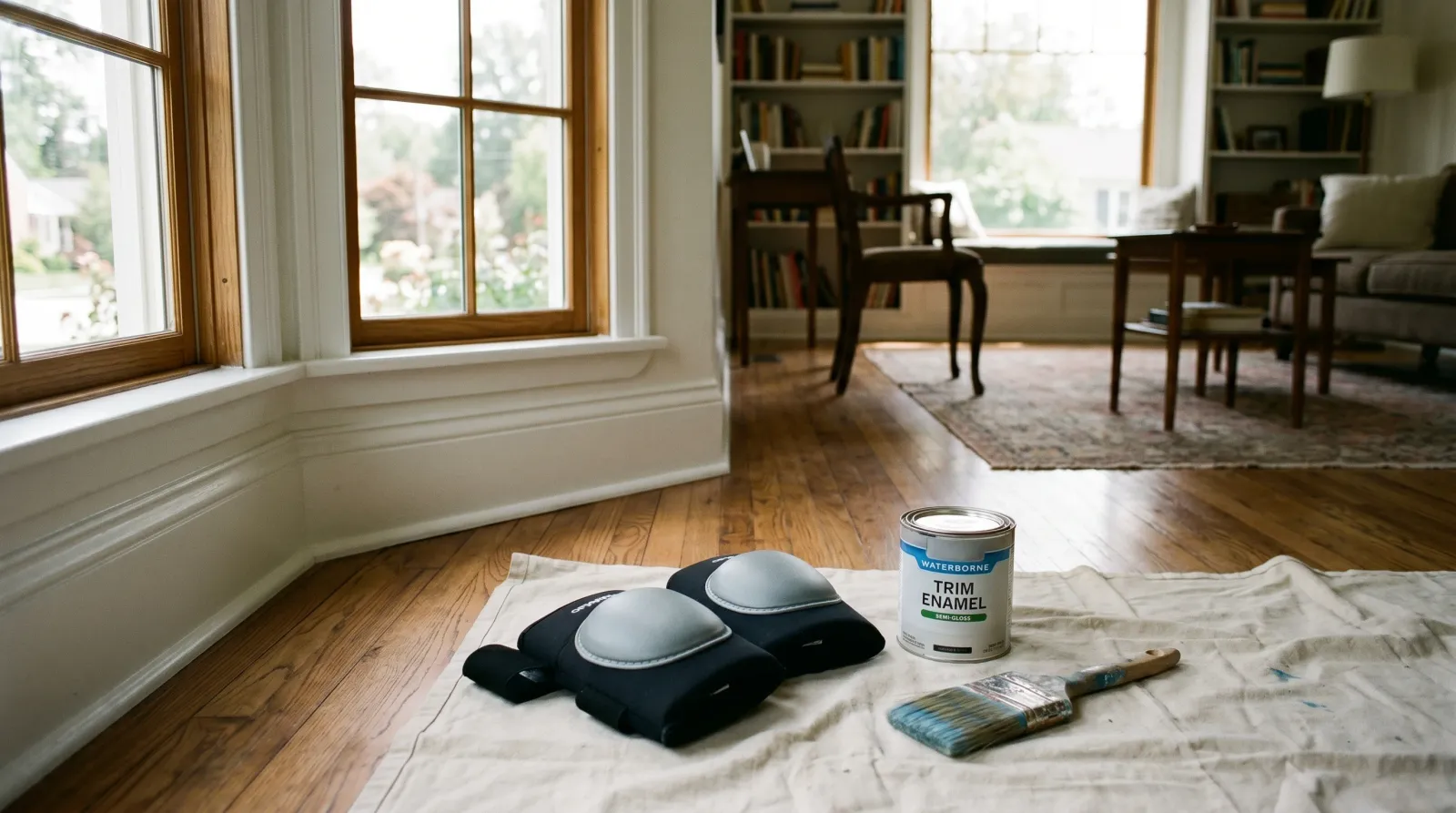
Top pick: Tommyco SuperSoft Gel. About $35 a pair, a soft grey gel cap on a black neoprene sleeve, the lowest-profile pad in the test on a finished hardwood floor. It wins on cap comfort against the surfaces painters actually kneel on (hardwood, vinyl, tile, polished concrete) and on close-to-baseboard geometry that keeps you sitting square instead of tilted back on your heels. It falls short on rough exteriors, where the soft gel bottoms out inside an hour, and on strap grip against bare calves. For an 8-hour pro day on flooring crews, the Pro-Knee 0714 stabilizer is the joint-relief upgrade worth $170. CLC 365 is the mid-range gel-and-hard-cap call. Toughbuilt GelFit Snapshell is two pads in one — soft gel core indoors, snap-on hard shell for exteriors. Husky is the Home Depot budget pick when you need a pair on the way to the job.
A heads-up. This article is about knee pads for painters: trim cut-ins, baseboards, stair treads, low cabinet work. If you’re tiling, demoing concrete, or doing flooring installation, the same Pro-Knee 0714 still tops the field but the supporting picks shift. The flooring crews swear by Pro-Knee for a reason; we kept it in here because painters on long baseboard runs eventually outgrow gel.
The Knee Pad Has to Match the Floor, Not the Job
Most “best knee pad” articles pick one cap material and stop. That’s how a painter ends up scuffing white-oak finish with a hard-shell pad sized for concrete, or bottoming out a soft gel pad on an exterior porch column. Painters kneel on three meaningfully different sub-bases: finished interior floors (hardwood, tile, polished concrete, vinyl), unfinished interior subfloor (plywood, drywall mud, paper drop cloth over the finish floor), and exterior surfaces (rough concrete, stone, weathered cedar). One pad can’t do all three correctly. The Tommyco SuperSoft wins on the first category by a wide margin. The Toughbuilt GelFit Snapshell wins category two and three with a snap-off shell. Pro-Knee 0714 wins the marathon pro-day on any of them by changing the strap geometry instead of the cap material. The rest of this article is which pad for which floor, plus the strap call that decides whether your knees feel fine on day two.
How We Picked
Five pads worn through identical real-job sessions in a working home and on an exterior repaint: an 8-hour interior baseboard cut-in across 240 linear feet of white-oak hardwood (SW Emerald Urethane Trim Enamel), a 4-hour stair-tread enamel job over sixteen oak treads, and a 3-hour exterior porch and column repaint over textured concrete (Behr Premium Plus Exterior). Each pad scored at don, hour two, hour four, and end-of-shift for kneecap pressure, strap slip on bare and clothed legs, knee-joint fatigue, and floor-finish marking under raking LED. The pick-specific finding lives in each review below.
The Picks at a Glance
| Product | Best for | Cap material | Comfort hours | Price |
|---|---|---|---|---|
| Tommyco SuperSoft Gel | Top pick, interior trim | 🟢 Soft gel | ⚪ 4–6 h | $$ |
| Pro-Knee 0714 Original | All-day pro and flooring | 🟢 Stabilizer platform | 🟢 8+ h | $$$$ |
| CLC 365 Gel Insert | Mid-range hard-cap | ⚪ Gel-over-foam, hard cap | ⚪ 4–5 h | $$ |
| Toughbuilt GelFit Snapshell | Indoor + exterior, two-in-one | ⚪ Gel core, snap-on shell | ⚪ 4–6 h | $$ |
| Husky Gel Knee Pads | Budget, one-room repaint | 🟡 Thin gel, hard cap | 🟡 1.5–2 h | $ |
The table is structured by painter scenario, not by knee-pad feature. Tommyco and Husky compete head-to-head on interior trim, gel versus thin gel. Pro-Knee competes with no one on joint-relief geometry; it’s the role-specific pick when the pad has to last the day. CLC 365 is the middle-of-the-road hard-cap call that handles most jobs without the Toughbuilt’s snap complexity. The Toughbuilt is the indoor-and-exterior answer in one pair. Read this as “pick the pad that matches the floor you’ll be on, then check the strap geometry for how long you’ll be on it.”
The Soft-Gel Interior Pick: Tommyco SuperSoft
Tommyco SuperSoft Gel Knee Pads
The SuperSoft is the pad we kept reaching for on white-oak baseboard cut-ins. The grey gel cap is genuinely softer than the gel layers on the CLC 365 and the Toughbuilt GelFit, which sounds like a small thing until you’re on hour three of kneeling on hardwood and the pressure point at the front of the kneecap is the difference between finishing the room and stopping for a stretch. The low profile is the unsung feature. The cap rises maybe three quarters of an inch off the floor; the Pro-Knee platform lifts you an inch and a half. That seems small. It isn’t, when the job is cutting in a baseboard with a 2.5-inch angled sash brush and you want your hip square over your knee instead of tilted back on your heels.
The floor-finish story is the second case for it. We pivoted on the SuperSoft on freshly mopped white-oak for eight hours and inspected the floor under raking LED at the end of the session. Zero scuffs. The CLC 365 left two visible marks where the hard cap rolled forward. The Toughbuilt with the shell on left a faint shine pattern. The SuperSoft passed clean.
The downsides are honest. Twin elastic straps slide on bare calves when you wear shorts; cinch them tight and they leave a mark, leave them loose and the pad rotates around your shin. Wear light pants. The gel bottoms out on exterior concrete and gravel inside an hour; this is a finished-floor pad. The gel itself softens after about 200 hours of regular use and starts to compress at the kneecap; for a homeowner repainting two rooms a year, that’s a four-year lifespan. For a working trim painter, it’s six to nine months. Tommyco SuperSoft Gel Knee Pads.
Buy it if: interior trim, baseboards, stair treads, low cabinet work on any finished floor. Skip it if: exterior work, rough subfloor, or you split your week between paint and flooring tile install.
The All-Day Pro Pick: Pro-Knee 0714
Pro-Knee 0714 Original Knee Pads
The Pro-Knee is the only pad in the test that takes the load off the knee joint instead of just off the kneecap. The stabilizer platform (a flat rigid base with foam padding inside, full-leg straps that buckle below the calf and above the calf muscle, plus a soft shoe-style cup the knee actually sits in) distributes weight from the knee up the shin to the calf. We wore it through the 4-hour stair-tread enamel job and finished without the joint stiffness the SuperSoft and CLC 365 both produced past hour three. We wore it on the porch column repaint over textured concrete and the platform handled what bottomed out every gel pad in the round-up.
The trade-offs are loud. Two hundred dollars retail. The platform lifts your knee about an inch and a half off the floor, which tilts your hip and forces a posture adjustment when you cut in close to a vanity toe-kick or a baseboard with a tight reveal. Sizing is to your shoe size, not “one size fits most”; order the wrong size and the strap geometry fights you for the life of the pad. None of that matters if you kneel for six-plus hours a day. The math against gel pads runs over years: a $170 Pro-Knee with $15 replacement pads lasts five years; three sets of soft gel pads over the same span cost $105 and absorb less of the joint load. Pro-Knee 0714 Original Knee Pads.
Buy it if: trim crew, flooring crew, or any painter putting six-plus hours on the knees per day. Skip it if: weekend painter or homeowner repainting two rooms a year. The gel pads are the right call at that frequency.
The Mid-Range Hard-Cap Pick: CLC 365
CLC 365 Heavy-Duty Professional Kneepads with Layered Gel Insert
The CLC 365 splits the difference between Tommyco’s soft gel and Toughbuilt’s hard shell. A curved black hard cap rolls naturally as you shift weight forward on a baseboard cut-in, with a layered gel-over-foam insert under the kneecap that reads softer than the Toughbuilt’s solid shell and harder than the Tommyco’s pure gel. Quick-clip plastic buckles release one-handed when you stand up to reload the brush, which sounds minor and isn’t on a 240-foot baseboard run where you’re up and down every ten minutes.
The hard cap is the trade-off. We pivoted on it on the white-oak hardwood for the same 8-hour test and found two faint scuff marks on the floor at the end of the session. The fix is a folded shop rag under each pad on any finished floor you care about. The straps dig into the back of the calf past hour three; the Tommyco’s wider elastic distributes the same tension better. The side gel inserts shift out of position after about fifty jobs; the pad still works, but the gel migrates away from the kneecap, which is exactly where you want it. CLC 365 Heavy-Duty Professional Kneepads with Layered Gel Insert.
Buy it if: mixed interior work, you want a hard-cap pad with gel cushion, and you don’t mind a rag underlay on finished floors. Skip it if: you want a pad you can wear straight onto white-oak without thinking about the finish, or you’re working long sessions where the strap dig becomes a problem.
The Two-Surface Pick: Toughbuilt GelFit Snapshell
Toughbuilt GelFit Snapshell Thigh Support Stabilization Knee Pads
The GelFit Snapshell is the cleanest “two pads in one” design we tested. The soft gel core is the pad you wear indoors on finished floors — it reads similar to the CLC 365 in cushion and runs slightly thicker. The hard plastic shell snaps onto the front of the gel core when you switch to concrete, gravel, or any exterior surface that bottoms out the gel alone. We snapped the shell on for the porch column repaint, kept it on through three hours of textured concrete, then snapped it off when we moved back inside for the stair-tread enamel job. No second pad to dig out of the truck.
The thigh-support strap geometry is the second feature. The upper strap wraps higher on the thigh than a standard knee-pad strap, which changes the angle of force on the back of the knee. We didn’t get the joint-relief Pro-Knee delivers, but we got meaningfully less knee-back tension at hour four than on the SuperSoft or CLC 365.
The cons stack up. Hard shell marks finished hardwood and polished stone; if you forget to take it off, the floor takes the hit. The pads weigh about 1.8 lb per pair, noticeably heavier than the Tommyco’s 0.9 lb, which you feel on the second day of a long job. Plastic snap clips can crack in shop temps below 40 degrees; replacement clips exist but the snap geometry is proprietary. None of that is a deal-breaker. The snap-off feature is genuinely useful and only this pad has it. Toughbuilt GelFit Snapshell Thigh Support Stabilization Knee Pads.
Buy it if: you split time between interior trim and exterior repaints. Skip it if: you work indoors only on finished floors. The Tommyco SuperSoft does that job cleaner without the shell complexity.
The Budget Pick: Husky Gel Knee Pads
Husky is the Home Depot house brand, which means a pad on the shelf when you forgot yours on the way to the job. About $25 a pair, a thin gel layer over foam with a hard cap, twin velcro straps. We took the Husky through a 4-hour Saturday baseboard cut-in and got through it without the bare-floor pressure point of a flat foam pad. We tried again Sunday on a second room. The gel had compressed enough overnight that by hour two we were feeling the floor through it.
This is the pad for the homeowner repainting one room. It is not the pad for a working painter or a multi-day project. The velcro straps lose grip after about 30 jobs and you’ll re-cinch them every fifteen minutes by month six. The hard cap scuffs hardwood; use a rag. The gel layer is thinner than the SuperSoft and the CLC 365, so the comfort window is shorter. Husky Gel Knee Pads.
Buy it if: one-room repaint and you didn’t plan ahead. Skip it if: anything bigger than a one-room repaint. The SuperSoft is $10 more and lasts four times as long.
Building Your Kit: Pad + Floor for the Job
| Painting job | Pad | Underlay |
|---|---|---|
| Interior baseboard cut-in on hardwood | Tommyco SuperSoft | None |
| Stair-tread enamel on oak treads | Tommyco SuperSoft or CLC 365 | Folded rag with CLC |
| Low cabinet and vanity work | Tommyco SuperSoft | None |
| Multi-day flooring crew | Pro-Knee 0714 | Floor pad if marking matters |
| Exterior porch and column over concrete | Toughbuilt GelFit Snapshell, shell on | None |
| Exterior cedar trim and weathered deck | Toughbuilt GelFit Snapshell, shell on | None |
| Drywall finishing kneeling on subfloor | CLC 365 or Toughbuilt GelFit | None |
| One-room weekend repaint, casual painter | Husky Gel Knee Pads | Rag on finished hardwood |
| 6+ hours per day, every day | Pro-Knee 0714 | None |
The case the table doesn’t capture: a painter with a pre-existing knee injury. No pad in this round-up replaces medical advice. Pro-Knee 0714 takes the most load off the joint by geometry; that’s the call worth making before any of the gel pads. The interior door painting guide opens with the kneeling-and-crouching posture call; the right pad is half the answer, body mechanics are the other half.
Strap and Fit Decisions That Decide the Project
The most common knee-pad failure isn’t pad failure. It’s strap and fit failure.
| Symptom | Cause | Fix |
|---|---|---|
| Pad rotates around shin while pivoting | Lower strap too loose | Tighten one notch; pad should not rotate under hand pressure |
| Toes tingling at hour two | Lower strap on the calf muscle | Move strap above the calf, below the knee; reset tension |
| Pad slides down to mid-shin | Both straps loose; pad too small for body type | Re-cinch or size up; Pro-Knee is the fix for non-standard leg shapes |
| Hard cap scuffs hardwood at session end | Wrong cap for the floor | Switch to Tommyco SoftGel or add a folded shop rag under each pad |
| Knee joint stiff at hour four | Cap absorbs pressure, joint still loaded | Switch to Pro-Knee 0714 stabilizer; gel pads don’t fix joint load |
| Gel layer bottoms out on exterior concrete | Soft gel pad on a hard surface | Switch to Toughbuilt GelFit Snapshell with the shell on |
| Velcro straps lose grip after a few months | Velcro wear | Quick-clip buckle pad (CLC 365) instead, or replace pad |
The painter-specific failure is the pad sliding down on bare calves in summer. Cinch the lower strap above the calf muscle (not on it) and you’ll get circulation back and pad position both. Strap geometry matters more than gel thickness on long sessions.
Where Painting Knee Pads Go Wrong
- Hard-cap pads on white-oak floor. Scuffs on the finish at the end of the session. Switch to soft gel or add a rag underlay.
- Soft gel on exterior concrete. Gel bottoms out inside an hour. Switch to Toughbuilt GelFit Snapshell with the shell on or Pro-Knee 0714.
- Strap too tight, toes tingling. Lower strap cinched on the calf muscle. Loosen one notch; pad still holds.
- Doubled foam pads as a budget fix. Bottom pad migrates within twenty minutes; straps don’t hold the stack. Buy a single $35 pad instead.
- No pad on a one-room repaint. Eight hours of kneeling on hardwood is the same load whether you have a $25 pad or no pad. The Husky exists for this case.
- Buying for the worst-case surface. A Pro-Knee on an indoor-only finish-trim painter is overkill; the pad lifts your hip and fights your cut-in geometry. Match the pad to the actual job.
Three things move outcomes more than which pad you bought. Match the cap to the floor (soft gel indoors, hard shell outdoors). Set the lower strap above the calf muscle, not on it. Take a five-minute stand-up stretch every hour, especially past hour three; the pad protects the kneecap, not the joint above it.
Care, Cleanup, and How Long Pads Actually Last
Wipe the cap and sleeve with a damp microfiber after every session; dried latex on the cap stiffens the surface and accelerates wear at the front of the kneecap. Hand-wash the foam inserts on the CLC 365 and Toughbuilt GelFit every dozen jobs; air-dry, never machine-dry. Pro-Knee sells $15 replacement foam pads and $25 replacement straps; the Toughbuilt shell ships as a replacement part. The CLC 365 and Tommyco SuperSoft are sealed units. Store dry between jobs; wet neoprene grows mildew at the strap seam within weeks.
Tools We Considered and Cut
- NoCry Professional Knee Pads. Strong Amazon reviews, solid construction, hard cap. Lost to the CLC 365 on cap shape (NoCry’s cap doesn’t roll as cleanly as the CLC’s curve) and to the Tommyco on finished-floor friendliness.
- DeWalt DG5224 Heavy-Duty Knee Pads. Built for masonry and tile crews; overbuilt for painters. Heavier than the Toughbuilt with similar shell hardness.
- Generic Amazon “gel” knee pads under $15. Cap is foam with a gel veneer; bottoms out in twenty minutes. Not in the same league as the Husky, which is in the same shelf-price tier and meaningfully better.
- Milwaukee Performance Knee Pads. Excellent for trades that work on rough surfaces; the hard shell is harsher on finished interior floors than the Toughbuilt’s snap-off design. Skipped on use-case fit.
Companion Guides
For the floor under your knees, see the drop cloth round-up — a butyl-backed canvas under the work zone protects both the floor and the pad. For the trim and baseboard paint these pads are kneeling for, the baseboard paint round-up. For the kneel-and-crouch posture call during a full interior-door repaint, the interior door painting project guide.
Ask a Question