Product review · Krylon · Updated August 7, 2026
COLORmaxxKrylon paint review
7.8/10The best color choice at the lowest aerosol price — on anything you look at rather than touch.
The cheapest way to get a specific Krylon shade across four real sheens. The catch is the film: it cures thinner than Rust-Oleum 2X and chips on anything you actually grab.

Maya Patel · Reviews Editor & Product Tester · Updated August 7, 2026
Maya spent five years running comparative product testing at a consumer testing nonprofit before joining CompositePaint. She built the round-up protocol the team uses, and she has sprayed enough rattle cans side by side to know which ones earn the extra two dollars. About the testing process →
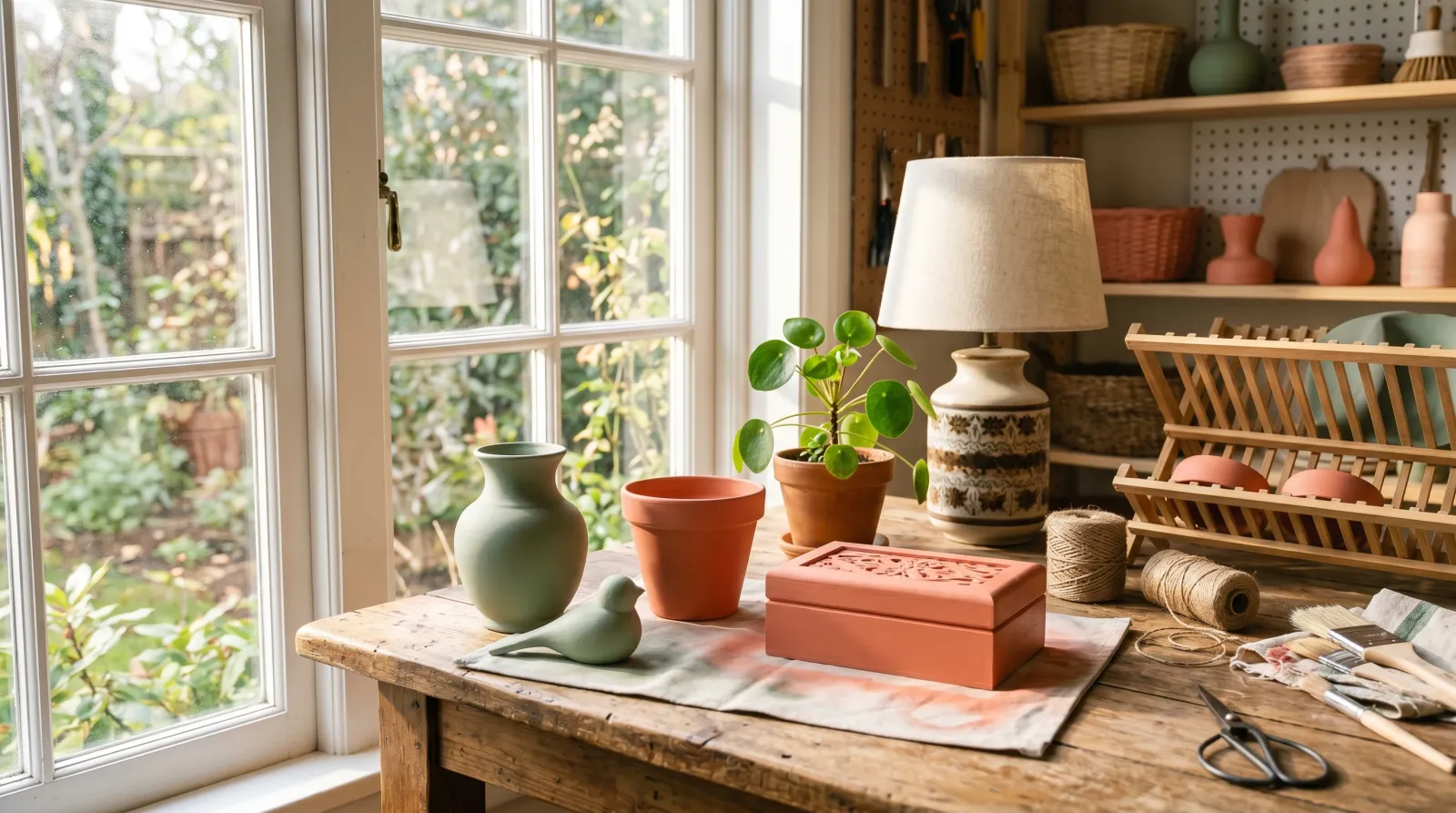
Krylon COLORmaxx4 sheens
Recoat windowWithin 1 hr or after 48 hr
VOCAerosol, not GREENGUARD or CARB rated
Full cure7 days
Sheens FlatSatinSemi-GlossGloss
Read this first
The Fast Verdict
Buy it for indoor decor. At $5 to $9 a can it is the cheapest way to get a specific Krylon shade across flat, satin, semi-gloss, and gloss, and it self-primes on clean wood and metal. The big-button tip sprays at any angle, even upside down. The honest knock is the film: it cures thinner than Rust-Oleum Painter's Touch 2X and chips on handled edges inside a year. It is also not the plastic specialist people assume — that is Fusion's job.
Best for
Picture frames · Lamp bases and vases · Shelf brackets and baskets · Craft pieces · Low-traffic indoor accents · Getting an exact shade cheap
Skip if
Chair seats and drawer pulls · Railings and tool handles · Flexible waxy plastic · Full-sun pieces that must last years · Anything you scrub
What it's good at
- Color range at the bottom price — forty-plus shades across flat, satin, semi-gloss, and gloss for $5 to $9 a can
- Finding the shade other brands miss, like a specific coral, a muted sage, or a dusty slate blue
- The big-button tip, which sprays at any angle including upside down and barely clogs
- Getting under a chair rung or into the inside lip of a planter without contortions
- Laying down smooth with little orange peel on dewaxed wood, clean metal, and rigid plastic
- Self-priming on the easy substrates, so you skip the primer can on clean wood and metal
- Fast handling — touch dry in 20 minutes, handleable in an hour, so a weekend project keeps moving
What it's not good at
- Handled surfaces — the thin film chips on knocked edges inside a year
- Flexible waxy plastic, where it peels the way most paints do; that is Fusion's job
- Outdoor life, which runs one to two seasons before dark colors chalk and lighten
- Scrubbing — it takes a dusting and a wipe, but the film scuffs under a fingernail
- Burying a dark base, since it is lighter-bodied than Rust-Oleum 2X and needs more passes
- Spot touch-ups on a cured surface, which flash unless you recoat the whole face
- Making the recoat timing obvious — the front label buries the one-hour-or-48-hour rule
Same shelf, different cans
Which COLORmaxx Are You Buying?
The COLORmaxx name covers more than one can and the labels look almost identical on the shelf. This review covers the standard paint plus primer can. Grab the wrong sibling and your project stalls.
COLORmaxx Paint + Primer
BasePaint and primer in one, self-priming on clean rigid surfaces
SheensFlat, Satin, Semi-Gloss, Gloss
RecoatWithin 1 hr or after 48 hr
Buy it if
You want color on decor, accents, or light-duty surfaces and you know the exact shade you are after. This is the can the review covers.
Avoid if
The surface is bare rusty metal or a glossy factory finish, or it is flexible plastic.
COLORmaxx Primer
BaseBase coat only, gray or white
SheensPrimer
RecoatWithin 1 hr or after 48 hr
Buy it if
You are going over bare rusty metal or a glossy factory finish and need a base under the color can.
Avoid if
You wanted color. There is none in this can — pair it with the paint, do not substitute it.
COLORmaxx Metallic
BaseMetallic decorative finish
SheensChrome, gold, and metallic
RecoatWithin 1 hr or after 48 hr
Buy it if
You want a metallic look on a decor piece rather than a solid color.
Avoid if
You are matching a flat shade across several pieces.
Numbers, not adjectives
Spec Sheet
- Coverage
- Up to 25 sq ft per 12-oz can across two to three light passes
- Sheens
- Flat, Satin, Semi-Gloss, Gloss (plus separate Metallic and Primer lines)
- Dry to touch
- 20 min
- Dry to handle
- 1 hr
- Recoat window
- Within 1 hr or after 48 hr — never in between
- Full cure
- 7 days
- Primer
- Paint plus primer in one; self-priming on clean, dewaxed rigid surfaces
- Surfaces
- Wood, metal, plastic, wicker, glass, ceramic, fabric, paper, masonry
- VOC
- Aerosol, not GREENGUARD or CARB rated; check your state's aerosol rules before ordering online
- Best conditions
- 55–75°F, humidity under 60%
- Sizes
- 12-oz aerosol can only
- Price
- $5–9 per 12-oz can; multi-packs run cheaper per can
Application Settings That Work
- Primer
- Usually no primer needed. On clean, dewaxed wood, metal, and rigid plastic the paint grips on its own and you save a step and a few dollars. Two exceptions: bare rusty metal and glossy factory finishes. There, scuff-sand and lay down a coat of the matching Krylon COLORmaxx Primer first, or the topcoat peels at the first knock. Keep passes light and your distance steady — the satin and gloss self-level nicely on a smooth substrate, but only if you resist loading it on.
Dry Times and the Recoat Dead Zone
Touch dry in 20 minutes, handleable in an hour, fully cured in 7 days. That fast turnaround is one of the real reasons to buy it — you can flip a frame and hit the back the same afternoon. The number that trips people is the recoat window. Krylon's guidance is recoat inside an hour or wait 48 hours, but the front label leads with 'paint + primer' and buries the timing. Spray a second coat at the four-hour mark, right in the dead zone, and the solvent in the new coat lifts and wrinkles the first. New sprayers hit this constantly. Work at 55 to 75°F with humidity under 60 percent, and remember the film needs the full week before it is as tough as it is ever going to get — which, on this can, is not very tough.
Mid-project panic
When It Goes Wrong, and How to Fix It
The finish chips on edges within a year
Why it happens. The cured film is thinner than Rust-Oleum Painter's Touch 2X, and it shows on any edge that gets knocked. Walmart and Lowe's reviews split hard along exactly this line: indoor decor owners are happy, and people who sprayed handled or outdoor pieces report scratches and chips inside a year. A chair seat, a gate latch, a tool handle — those wear through.
The fix. Draw the line by surface. Anything you look at, COLORmaxx is fine. Anything you grab, sit on, or scrape against, step up to Rust-Oleum 2X. If you are set on COLORmaxx for a borderline piece, two light passes of a clear acrylic or polyurethane over the cured color buys the abrasion resistance the color coat alone does not have.
Paint peels off a plastic chair or planter
Why it happens. People reach for any Krylon can to fix a faded plastic piece, but COLORmaxx is not tuned for it. On flexible, waxy plastics — the polyethylene and polypropylene that bend and feel slick — it peels the same way most paints do. Buying COLORmaxx for a bendy plastic planter is the most common mismatch we see.
The fix. Use Krylon Fusion All-In-One instead. That is the adhesion line, built to grip plastic and metal without sanding. If you have already sprayed and it peeled, strip it back to clean plastic and start over with Fusion.
The second coat lifts and wrinkles the first
Why it happens. You recoated in the dead zone. The rule is inside an hour or after 48 hours, and the four-hour mark is the worst possible time. The solvent in the fresh coat attacks a film that has skinned but not set.
The fix. Finish all coats inside the first hour, or walk away and come back after two full days. If it already wrinkled, let it cure the full 7 days, sand the lifted area flat, and respray inside a proper window.
Outdoor color goes chalky and pale
Why it happens. It carries a rust-protection and fade-resistance claim, but in practice dark colors chalk and lighten after a couple of summers of direct UV, and the thin film does not bridge the expansion and contraction of metal outdoors as well as a thicker enamel. It is a one-to-two-season outdoor coating, not a multi-year one.
The fix. Keep it on shaded or low-traffic outdoor pieces and pick gloss or satin, which hold color longer than flat. For a deck rail or anything that lives in full sun for years, a brush-on exterior enamel is the more honest pick.
A visible lap line where you ran out of paint
Why it happens. One 12-oz can covers about 25 sq ft, but only across two or three thin passes, never one heavy one. A small lamp or picture frame takes most of one can and a dining chair eats one to two. Run out mid-coat and finish a day later, and the seam shows.
The fix. Buy one extra can and have it shaken and open before you start. You cannot sand a lap line out of a thin aerosol film — the only real repair is recoating the whole face.
Side by side
COLORmaxx vs Fusion All-In-One vs Rust-Oleum 2X
Three 12-oz cans sit within a few dollars of each other on the same aisle, and they are genuinely built for different jobs. The surface you are spraying decides this, not the price.
| Krylon COLORmaxx | Krylon Fusion All-In-One | Rust-Oleum Painter's Touch 2X Ultra Cover | |
|---|---|---|---|
| Price per 12-oz can | $5–9 | $6–9 | $6–10 |
| Film toughness on handled edges | Thin. Chips on knocked edges inside a year. | Scratch-resistant once cured; passed a fingernail scratch and tape pull at week one. | The hardest of the three. Built to resist chips. |
| Color and sheen choice | Widest. Forty-plus shades across four true sheens. | Deep across gloss, satin, and matte, plus metallic, hammered, and textured. | Smallest decorator range of the three. |
| Coverage per can | Up to 25 sq ft over two to three light passes; lighter-bodied, so more passes over a dark base. | About 25 sq ft in one light pass; a molded chair still eats most of a can. | Better per can — closer to one-coat on a chair. |
| Outdoors in direct sun | One to two seasons. Dark colors chalk and lighten. | Fade and chalking on darks by the second summer. | Strongest of the three. Holds gloss longest. |
| Dry speed | Touch dry 20 min, handle 1 hr. | Touch dry 20 min, handle 1 hr. | Slower dry than either Krylon can. |
| Where it wins | Indoor decor, frames, lamps, baskets, craft pieces — anything you look at. | Slick plastic, resin chairs, and mixed-material pieces you do not want to sand. | Handled surfaces and outdoor furniture that has to last past a couple of seasons. |
Price per 12-oz can
Krylon COLORmaxx$5–9
Film toughness on handled edges
Krylon COLORmaxxThin. Chips on knocked edges inside a year.
Krylon Fusion All-In-OneScratch-resistant once cured; passed a fingernail scratch and tape pull at week one.
Rust-Oleum Painter's Touch 2X Ultra CoverThe hardest of the three. Built to resist chips.
Color and sheen choice
Krylon COLORmaxxWidest. Forty-plus shades across four true sheens.
Krylon Fusion All-In-OneDeep across gloss, satin, and matte, plus metallic, hammered, and textured.
Rust-Oleum Painter's Touch 2X Ultra CoverSmallest decorator range of the three.
Coverage per can
Krylon COLORmaxxUp to 25 sq ft over two to three light passes; lighter-bodied, so more passes over a dark base.
Krylon Fusion All-In-OneAbout 25 sq ft in one light pass; a molded chair still eats most of a can.
Rust-Oleum Painter's Touch 2X Ultra CoverBetter per can — closer to one-coat on a chair.
Outdoors in direct sun
Krylon COLORmaxxOne to two seasons. Dark colors chalk and lighten.
Krylon Fusion All-In-OneFade and chalking on darks by the second summer.
Rust-Oleum Painter's Touch 2X Ultra CoverStrongest of the three. Holds gloss longest.
Dry speed
Krylon COLORmaxxTouch dry 20 min, handle 1 hr.
Krylon Fusion All-In-OneTouch dry 20 min, handle 1 hr.
Rust-Oleum Painter's Touch 2X Ultra CoverSlower dry than either Krylon can.
Where it wins
Krylon COLORmaxxIndoor decor, frames, lamps, baskets, craft pieces — anything you look at.
Krylon Fusion All-In-OneSlick plastic, resin chairs, and mixed-material pieces you do not want to sand.
Rust-Oleum Painter's Touch 2X Ultra CoverHandled surfaces and outdoor furniture that has to last past a couple of seasons.
If the surface is clean wood, clean metal, glass, or rigid plastic and you care about the exact shade, COLORmaxx is the buy and the cheapest one on the shelf. If the surface is bendy plastic, an oily resin chair, or anything you doubt will hold paint, that is Fusion, and it is not close. If the piece gets grabbed, sat on, or left outside, pay the extra dollar or two for Rust-Oleum 2X and get the harder film. The mistake that costs people a redo is using COLORmaxx for the second and third jobs because the color was right.
If not this one
Honest Alternatives
RO
Rust-Oleum Painter's Touch 2X Ultra Cover$6–10 per can
The thicker, more durable rival. Better coverage per can — closer to one-coat on a chair — a harder cured film that resists chips, and stronger outdoor performance. The trade-off is a smaller decorator color range and a slower dry. The right pick when the surface gets handled or lives outside.
Full review →KF
Krylon Fusion All-In-One$6–9 per can
The adhesion specialist for plastic and metal you do not want to sand. Worse color choice than COLORmaxx, better grip on the slick surfaces COLORmaxx peels off of. Choose Fusion the moment the substrate is bendy plastic or an oily resin chair.
Full review →CA
Clear acrylic or polyurethane spray over the colorOne extra can
Not a replacement, a rescue. Two light passes of clear over the cured COLORmaxx buys real abrasion resistance the color coat alone does not have. It costs an extra can and an extra day, and it is the difference between a borderline piece surviving a year and not.
Questions people actually ask
COLORmaxx Questions, Answered
Is Krylon COLORmaxx worth it?
For indoor decor, yes. At $5 to $9 a can it is the cheapest way to get a specific Krylon shade across flat, satin, semi-gloss, and gloss, and it self-primes on clean wood and metal. It is not worth it on anything you grab, sit on, or leave outside — the cured film is thinner than Rust-Oleum 2X and chips on handled edges inside a year — and it is the wrong can for flexible plastic, which is what Fusion is for.
Is Krylon COLORmaxx good for outdoor furniture?
For a season or two on shaded or low-traffic pieces, it holds. The film is thin, though, so chairs and rails that get bumped and sat on will show chips inside a year. Gloss and satin keep color longer than flat. For a deck rail or anything in full sun for years, a brush-on exterior enamel is the more honest pick.
How is COLORmaxx different from Krylon Fusion All-In-One?
Both are 12-oz paint-and-primer aerosols. COLORmaxx is the wider color line, built for looks and indoor decor. Fusion is the adhesion specialist, tuned to bond on tricky surfaces like plastic and metal without sanding. If color is the goal, buy COLORmaxx. If sticking to a slick plastic chair is the goal, buy Fusion.
Does COLORmaxx need a separate primer?
Usually not. The paint has primer built in, and on clean, dewaxed wood, metal, and rigid plastic it grips fine on its own. Bare rusty metal and glossy factory finishes are the exceptions. There, scuff-sand and lay down a coat of the matching Krylon COLORmaxx Primer first, or the topcoat peels at the first knock.
How many cans do I need for one project?
One 12-oz can covers about 25 sq ft, but only across two or three thin passes, never one heavy one. A small lamp or picture frame takes most of one can. A dining chair eats one to two. Buy one extra. Running out mid-coat and finishing a day later leaves a visible lap line you cannot sand out of a thin aerosol film.
When should I spray the second coat?
Inside the first hour or after a full 48 hours. The four-hour mark is the dead zone, and a coat sprayed there lifts and wrinkles the one underneath. Krylon's own guidance says so, but the front label leads with 'paint + primer' and buries the timing, which is why new sprayers hit this constantly.
Can I make COLORmaxx tougher?
Yes, with a clear topcoat. Two light passes of a clear acrylic or polyurethane spray over the cured color buys real abrasion resistance the color coat alone does not have. It is an extra can and an extra day. For a borderline piece — a shelf you touch sometimes, a bracket that gets bumped — it is worth doing.
COLORmaxx or Rust-Oleum Painter's Touch 2X?
COLORmaxx if the color is the point and the piece is display-grade: frames, lamps, baskets, craft work. Rust-Oleum 2X if the piece gets handled or lives outside. 2X covers in fewer passes, cures harder, and holds up better in sun. It costs a couple of dollars more and gives you fewer decorator shades to choose from.
What temperature should I spray it at?
55 to 75°F with humidity under 60 percent. Outside that range the film sets unevenly and your timing on the one-hour recoat window gets unreliable. Keep your passes light and your distance steady, and the satin and gloss will self-level with little orange peel.
Keep exploring
Krylon brand and product line overviewBest multi-surface paint — tested round-upBrush vs spray — which finish for your project
We may earn a commission when you buy through the retailer link above. It never changes the score or the verdict.
Ask a Question