Best Angled Sash Brushes for 2026
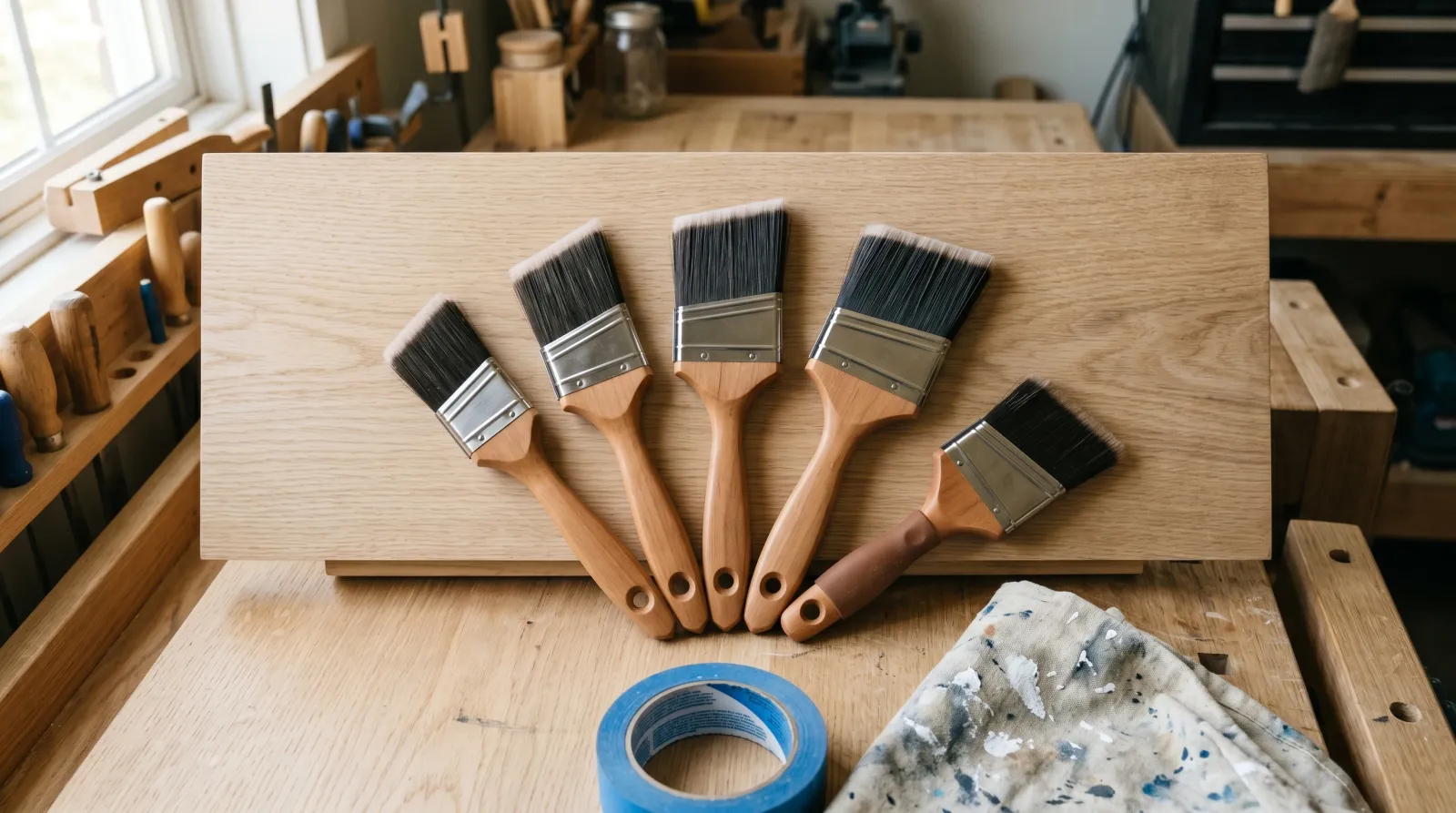
Five angled sash brushes tested on walls, trim, and cabinets. Top pick: Purdy XL Glide 2.5-inch for the cleanest cut line at a price that earns it.

Disclosure: Some links below are affiliate links. We earn a commission if you buy through them, at no extra cost to you.
Top pick: Purdy XL Glide 2.5-inch. It costs about $15, and the long angled corner cuts a tape-clean line freehand once your wrist learns it. It wins the all-rounder fight on cut-line precision, paint load, and how long it survives a wash routine. It falls short on finish-grade smoothness on cabinet doors, where the softer Wooster Silver Tip lays a flatter film. For the sharpest cut line of all, the stiffer Purdy Clearcut Glide 2-inch beats everything here on a ceiling edge. For the spots a full brush can’t reach, the stubby Wooster Shortcut earns its place in the bag. And if you want a competent angled sash for less money, the Wooster Ultra/Pro Firm pushes more paint per dip than anything in the test.
There is no single right angled brush.
Most homeowners do fine with two: the XL Glide for everyday cut-ins and the Silver Tip for the cabinet weekend.
The Shortlist and Why These Five
Every brush here is an angular sash, also called an angle sash. The tip is cut on a diagonal, one corner longer than the other, like a chisel held sideways. That long corner is the whole point. It reaches into a corner, rides a ceiling line, and lays a sharp edge along tape that a square-cut flat brush smears. If you cut in around trim, ceilings, doors, and windows, this is the shape you want in your hand.
I bought all five off the shelf, the same channels a homeowner would use, and ran them through three real projects across six weeks. A 12 by 14 ft master bedroom in Benjamin Moore Regal Select eggshell, cut in around the ceiling, baseboards, and a window. A 28-door kitchen cabinet refinish in Benjamin Moore Advance semi-gloss on primed MDF. And a run of door jambs and trim in semi-gloss latex where the cut line gets judged up close.
The grading axes, weighted in this order: cut-line precision against blue tape, how the tip holds its angle through a long day, paint load and clean release per dip, brush stroke flatness at 30 minutes under raking light, and shedding in the first hour of a new brush. Five-point scale per axis. The use case anchors each brush’s role.
I also asked three working painters which angled sash they’d buy with their own money for somebody who paints two weekends a year. Two said XL Glide. One said the Wooster Ultra/Pro Firm. None recommended anything cheaper than $12. That set the floor.
How the Testing Actually Ran
Same protocol per project, per brush. For cut lines, I ran 50 linear feet of ceiling edge per brush, blue-taped on half the wall and freehand on the other half, then photographed both under raking LED at 24 hours and compared the freehand line against the taped control. For cabinet smoothness, every brush cut in the stiles and rails on a set of Advance doors, photographed wet at 30 minutes and again at 24 hours under a raking light. Shedding I counted by hand at minute 5, 20, and 60 on each fresh brush. Then I washed each one through five cycles, warm water and dish soap and a paint comb, and checked whether the angled tip combed back straight or stayed fanned.
These are the brushes that show up over and over on contractor forums, on pro paint store shelves, and in my own kit.
Picking an Angled Sash Brush, in Three Decisions
Filament Stiffness
Every brush here is synthetic, because every paint a homeowner cuts in with today is water-based. Within synthetic, stiffness is what separates them, and it maps straight to the job.
Soft filament, like the Silver Tip’s fine CT polyester, lays the flattest finish on enamel. That’s your cabinet and finish-trim brush. The trade is that soft tips skip and bend on thick or textured paint.
Medium-stiff, like the XL Glide’s Tynex/Orel blend, is the all-rounder. It cuts a clean line, holds shape on a wall, and still behaves on trim. If you buy one brush, buy this stiffness.
Stiff filament, like the Clearcut Glide, carves the sharpest cut line and pushes the most paint, but stipples mildly on smooth panels and tires your wrist faster overhead. For more on matching the tip to the line you’re cutting, the cutting-in brush round-up goes deeper on tip stiffness.
Width and Cut
Angular is the cut you want for cutting in. The long corner does the work. A 2.5-inch angular sash covers about 80% of household cut-in work. A 2-inch angular gives you more control in tight spots, door jambs, mullions, narrow stiles. A stubby flexible-handle sash like the Shortcut isn’t about precision at all; it’s about reaching the place a normal brush physically can’t.
Skip the straight-cut flat brushes for cut-in work. They’re for broad trim runs and siding, not for laying a line.
Handle and Ferrule
Less consequential than the filament, but the gap between a $4 brush and a $15 brush shows here too. You want a stainless steel ferrule and a hardwood handle, alderwood or beech. Plastic ferrules and raw pine handles signal a brush that won’t last past one room. A good handle also balances the brush so the angled tip sits where your hand expects it, which matters more than it sounds on a long ceiling line.
At-a-Glance Comparison
| Brand / Model | Filament | Width tested | Best paint type | Best for | Price tier |
|---|---|---|---|---|---|
| Purdy XL Glide | Tynex/Orel, medium-stiff | 2.5-inch angular sash | Latex, primer, oil | Everyday all-rounder | Mid |
| Wooster Silver Tip | 100% CT polyester, soft | 2.5-inch angular sash | Waterborne enamel | Cabinets, finish trim | Premium |
| Purdy Clearcut Glide | Nylon/polyester, stiff | 2-inch angular sash | Latex, low-VOC | Sharpest cut line | Mid |
| Wooster Shortcut | Nylon/polyester, medium | 2-inch angle sash (stubby) | Latex | Tight, awkward spots | Budget |
| Wooster Ultra/Pro Firm | Nylon/polyester, firm | 2.5-inch angle sash | All latex paints | Budget wall cut-ins | Budget |
1. Purdy XL Glide 2.5-inch, Best Overall
The XL Glide is the angled brush you reach for first and the one you grab when you don’t want to think about which brush. Its medium-stiff Tynex/Orel blend handles whatever water-based paint you put on it, flat, eggshell, primer, even oil if you’ve got nothing else handy, and the long corner lays a clean line freehand. Paint load is generous. Dip the bottom third, tap the rim twice instead of dragging, and you get three to four feet of cut-in per dip on standard latex. The angled tip holds sharp through a full day.
Recovery after a wash is the part nobody talks about. Comb it straight, hang it handle-up, and the next morning it looks new with its angle intact. I have one in the kit that’s six years old and still cuts a clean line against a ceiling.
On cabinet stiles under raking light at six inches, the XL Glide leaves a touch more brush stroke than a Silver Tip. Call it 95% smooth against the Silver Tip’s 99%. At arm’s length nobody sees it. It also drops a bristle or two in the first 20 minutes of a fresh brush. Pull them off the wet wall with a fingertip and keep moving.
| Spec | Value |
|---|---|
| Filament | DuPont Tynex nylon + Orel polyester, medium-stiff |
| Sizes | 1.5-inch, 2-inch, 2.5-inch, 3-inch, 3.5-inch |
| Best for | Everyday cut-ins, walls and trim, latex and primer |
| Approx. price | $14 to $17 (2.5-inch) |
Buy it if: you want one angled brush that does almost everything well and lasts years. Skip it if: your whole project is finish-grade cabinet doors and budget isn’t the constraint. Pay up for the Silver Tip.
2. Wooster Silver Tip 2.5-inch, Best for Smooth Finish
The Silver Tip is the softest synthetic I tested, and on cabinet stiles that softness pays off in finish flatness. The 100% CT polyester filament is fine enough that paint releases off the angled tip in a near-uniform film instead of a stippled one. Brush stroke settles out under raking light at 30 minutes in a way the firmer brushes can’t match. Cutting in the stiles on Benjamin Moore Advance, the Silver Tip gave me the closest thing to a sprayed edge you can get from a hand brush.
That same softness makes it the wrong brush for thick latex on a rough wall or exterior siding. The fine tip bends and skips instead of carving in. I also see the angled tip flag faster than the XL Glide. A Silver Tip starts losing crispness around job thirty, while an XL Glide is still sharp at sixty. For cabinets and finish trim, thirty jobs is a lot of cabinets. For walls, it isn’t enough.
Buy it if: you’re cutting in cabinets or finish trim and edge smoothness matters more than longevity. About $18 to $22 for the 2.5-inch.
3. Purdy Clearcut Glide 2-inch, Best for Cutting In
Stiffest tip in the synthetic field here, and that stiffness is exactly what cuts a clean line. Pulled along a ceiling under blue tape, the Clearcut laid the sharpest freehand line in the test, noticeably tighter than the XL Glide on the same wall when I lined up the photos side by side. The bristle springs back to its angle on every dip. You stop fighting the tip into shape the way you do with softer brushes, and the line stays straight even when your wrist gets tired.
It’s overkill on cabinet doors and furniture. The same stiffness that cuts a clean ceiling line stipples mildly on a flat panel under raking light. Pair it with a Silver Tip if you’re doing cabinets the same weekend.
The 2-inch is the right size. Narrow enough to control along a window mullion, wide enough that you’re not re-dipping every foot.
Buy it if: your cut lines need a tape-quality edge freehand and you don’t want to tape. About $13 to $16 for the 2-inch.
4. Wooster Shortcut 2-inch, Best for Tight Spots
Different job, different rules. The Shortcut isn’t trying to lay a finish-grade line. It’s trying to reach the places a full-length brush physically can’t. Short stubby head, soft flexible Shergrip handle, an angled tip on a brush you can choke right up on. Behind a toilet tank, inside a cabinet box, in the back corner of a closet, along a stair stringer, this is the brush that gets paint where your hand won’t fit a 14-inch handle.
The flexible handle also cuts wrist fatigue on awkward overhead-and-sideways angles, the ones that cramp your hand with a rigid brush. I keep one clipped in the kit bag and only pull it out for the spots that would otherwise force me onto a ladder at a bad angle.
The trade is reach and leverage. On a long open ceiling line you want the full-length XL Glide, not this. And the filament cuts a competent edge, not a finish one. Treat it as an access tool.
Verdict: not your main cut-in brush, but the one that saves the job in the spots that ruin a long brush. About $7 to $10.
5. Wooster Ultra/Pro Firm 2.5-inch, Best Budget
The brush I hand someone painting their first place who doesn’t want to spend $15. Firm nylon-polyester blend, built to move paint. On a bedroom in eggshell it hit full cut-in coverage in fewer dips than the Silver Tip because the firm tip releases paint on contact. At $8 to $11 it’s the cheapest angled sash I’d actually buy and trust to hold its angle through a day.
The firm tip leaves more visible texture than the XL Glide on flat panel surfaces, so it’s the wrong brush for cabinets and finish trim. Keep it on walls and primer coats where the texture levels into the roller stipple anyway. The tip can hook after a season of heavy use, so buy two and rotate if you’re painting a lot.
Verdict: competent, cheap, stocked everywhere. The budget pick that doesn’t feel like a compromise on walls.
Brushes I Tried and Dropped
- Generic chip brushes. No angled tip, no cut-line control. Fine for spreading glue, not for cutting in.
- Purdy Nylox Glide. A solid all-nylon angled sash, but it goes softer than the Tynex/Orel XL Glide on a hot day. The XL Glide holds its line better in summer.
- 1-inch angular sash brushes. Too small to be efficient. For genuinely tight spots the stubby Shortcut beats a tiny full-length brush.
- Foam edgers and pad cutters. Marketed as no-skill cut-in tools. They smear at the corner and skip on texture. A real angled brush is faster once you’ve cut two rooms.
Care, Cleanup, and Longevity
These brushes last years if you wash them, three weeks if you don’t. With an angled sash the stakes are higher, because a fanned tip doesn’t just look ugly, it stops cutting a line.
The wash. Scrape excess paint back into the can, don’t push it deeper into the heel where bristle meets ferrule. Rinse warm water from heel to tip, working dish soap into the heel with your fingers. Most paint hides there, and a clogged heel is what splays the angle permanently. Rinse 60 to 90 seconds until the runoff is clear. Then comb the bristle straight from heel to tip with a paint comb, about $4, which also re-sets the angled tip.
Drying. Hang it handle-up so the tip dries holding its angle and any water drains away from the ferrule. Never lay a wet angled brush flat. It dries with a bend, the long corner rounds off, and you’ve lost the one feature you paid for. Four minutes of washing protects the angle that does all the work.
Between coats on the same paint. Wrap the head in plastic or foil and refrigerate for latex. Workable overnight without a full wash. Don’t push past 24 hours; paint sets even in the fridge, and once it stiffens in the heel the tip never comes fully back.
Realistic life: XL Glide and Ultra/Pro Firm 50 to 70 cut-in days, Clearcut Glide 50 to 70, Silver Tip 30 to 40 in finish work, Shortcut as long as you don’t abuse it in tight metal corners. Replace when permanent fanning at the angled tip won’t comb out, or shedding tops about 5%. Once the angle goes, accuracy drops fast. Replace, don’t fight it.
Mistakes I Still See
- Buying a flat brush to cut in. The square tip smears the corner. The angled tip is the whole reason this category exists. If you cut in, buy angular.
- Loading past the heel. Dipping more than a third of the bristle pushes paint into the ferrule, where it dries hard and splays the angle permanently. Dip the bottom third, tap the rim twice, then cut.
- Dragging across the bucket rim. That wipes paint off the long corner you actually need for the line. Tap both sides instead of dragging.
- Laying the brush flat to dry. The angled tip rounds off and the brush never cuts a sharp line again. Hang it handle-up. Always.
- A soft brush for a sharp line. People reach for the Silver Tip to cut a ceiling and wonder why the line wanders. Soft is for smoothness. Use the Clearcut or XL Glide for the line.
- Skipping the wash. A latex-loaded angled brush left overnight is a brush you’ve thrown away. The angle is the first thing to go.
A Starter Kit That Earns Its Keep
For a homeowner doing a couple of weekend projects a year: Purdy XL Glide 2.5-inch ($15), Purdy Clearcut Glide 2-inch ($14) for the sharp ceiling lines, Wooster Shortcut ($9) for the tight spots, and a paint comb ($4) to keep the angles true. About $42, and it cuts in a whole house clean.
Add a Wooster Silver Tip 2.5-inch ($20) the weekend you tackle cabinets.
If your cut line keeps wandering even with a good brush, the problem is usually technique, not the tool. Read up on fixing visible brush strokes, and if you’re matching the right finish to the right surface, the sheen guide sorts out where semi-gloss and eggshell each belong.
The brush is the cheap part. Don’t economize on the angled tip and then fight a wavy cut line for an afternoon.
FAQ
What is an angled sash brush for? Cutting in. The long corner of the angled tip reaches into corners and rides a ceiling line, tape edge, or trim joint a flat brush can’t. Hold it like a pencil, lead with the long point, pull a clean line. A 2.5-inch angular sash is the first brush most people reach for on any interior job.
What size angled brush should I buy? A 2.5-inch angular sash for general work, plus a 2-inch for tighter cut-ins like door jambs and narrow cabinet stiles. Skip the 1-inch; a stubby Wooster Shortcut handles tight spots better.
Are expensive angled brushes worth it? Up to about $20, yes. A $15 XL Glide cuts a cleaner line and lasts years longer than a $4 chip brush. Above $25 you’re paying for niche specialty filament most homeowners never need.
Why does my angled brush leave a wavy cut line? Usually it’s overloaded or the tip has lost its angle. Dip the bottom third only and tap the rim instead of dragging. If the tip won’t comb back to a point, the brush is done.
Ask a Question