The Best Bedroom Paint Colors
What color to paint a bedroom, answered: seven colors that hold up at 7am and at 10pm — Hale Navy, Revere Pewter, Sea Salt, White Dove, Stonington Gray, Cracked Pepper, Pigeon — plus a deeper palette for a master bedroom.

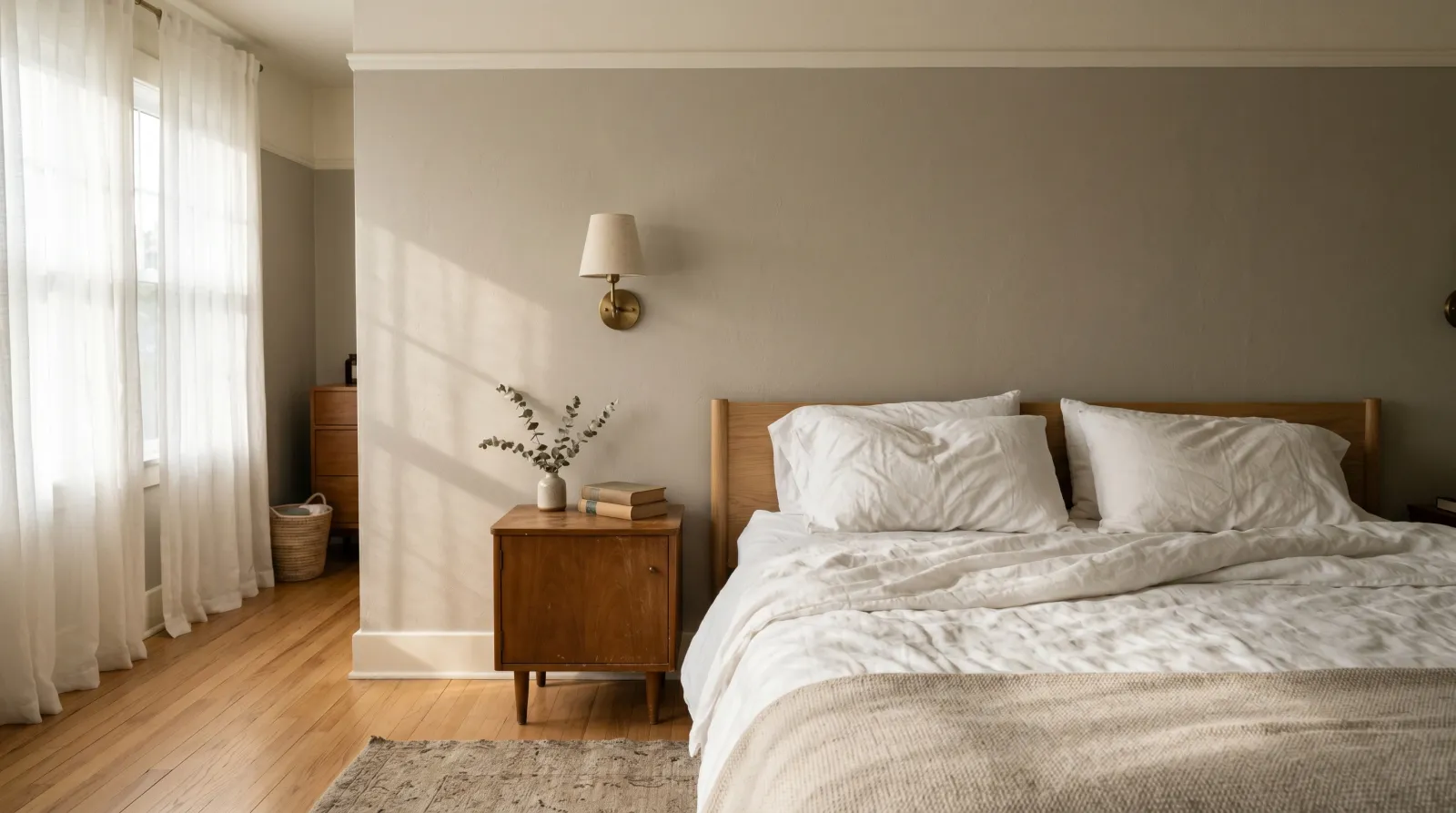
A bedroom color has a strange job. It has to be quiet enough to read at 10pm under a warm bedside lamp, and still flatter you in the mirror at 7am under cool morning light. Most “bedroom colors” round-ups skip that part and just hand you a chip. Light is the whole game in a bedroom.
The seven below all behave at both hours, but each one wants a particular room. North-facing rooms get a cool, dim, blue-tinged morning light that turns greys flat and whites clinical. South and west-facing rooms get warm, long afternoon light that flatters cream, greige, and deep blue. Match the color to the light you actually wake up in, not the light in the showroom.
I’ve paired each pick with a trim and ceiling suggestion. Bedrooms reward a quiet two-color scheme; they punish a busy one.
What Color to Paint a Bedroom: The Short Answer
Paint a bedroom a soft, muted, low-saturation color — a warm greige, a quiet blue-grey, or a soft sage — and let the direction your window faces decide which one. If you want a single name to go buy right now: Benjamin Moore Revere Pewter (HC-172) in a warm room, Benjamin Moore Stonington Gray (HC-170) in a cool one.
The reason is not taste, it’s saturation. A bedroom is the one room you use at both ends of the day, and the more pigment a color carries, the more it insists on being noticed at hours you don’t want to notice anything. Muted colors sit down and let the room be the room. That’s why almost every bedroom that photographs well is a neutral, a soft blue-grey, a soft green, or a deep quiet color that has gone past saturation into depth.
Then light decides. North-facing bedrooms get cool blue-tinged light all day, so they need warmth back — greige, cream, warm white. South and west-facing bedrooms get long warm afternoon light, so they can take blue, green, charcoal, and navy without going gloomy. East-facing bedrooms get the gentle bright morning and are the easiest rooms in the house to paint. If you’re not sure which way yours faces, our guide to how light direction changes paint color walks through it with a compass and five minutes.
Everything below is that answer, spelled out seven ways.
Benjamin Moore Hale Navy (HC-154)
Hale Navy is the deep bedroom color I trust most. It reads navy in daylight and almost black-blue at night, which is exactly what you want behind a bed — moody at 10pm, not theatrical at 7am. Against warm oak, brass, and unbleached linen it does the slow cocooning thing that designers chase and almost no other navy quite delivers.
It needs light. In a south or west-facing bedroom with afternoon sun, Hale Navy glows. In a small north-facing room it goes flat and slightly grey, which kills the mood. If your bedroom is dim, pick a different blue.
Trim and ceiling: Benjamin Moore White Dove (OC-17) in satin on the trim, the same color flat on the ceiling. The soft yellow cream of White Dove warms the navy without fighting it. Pure white ceilings against Hale Navy go icy.
Benjamin Moore Revere Pewter (HC-172)
Revere Pewter is the bedroom greige that almost never misbehaves. It carries enough warmth to feel held in morning light and enough grey to stay quiet at night. On a wall behind a bed with linen sheets and oak furniture, it does what people expect a “neutral” to do and so few of them actually do.
It sings in east and south-facing rooms. In a strong north-facing space it can drift slightly green under 4000K LEDs, which reads dusty. Check your bulbs. Under 2700K warm light it stays where you want it.
Trim and ceiling: Benjamin Moore Simply White (OC-117) in satin on the trim, same color flat on the ceiling. The crisp neutral white sharpens the soft greige without making it look dingy.
Sherwin-Williams Sea Salt (SW 6204)
Sea Salt is the bedroom color for people who want a hint of color without committing to one. It reads green in some light and blue-grey in other light, and that gentle shift is restful in a way a static color isn’t. In a coastal-leaning room or a room with linen drapes and pale wood, it drapes beautifully.
It is at its best in east-facing morning light, where the blue undertone settles down and the green warms up. In a hot south-facing room it can go a touch sickly green in midday glare. Best for the side of the house that gets the gentle light.
Trim and ceiling: Benjamin Moore White Dove (OC-17) in satin on the trim, same on the ceiling. A pure white trim makes Sea Salt look slightly hospital; a warm white lets it breathe.
Benjamin Moore White Dove (OC-17)
The warm white I recommend most for bedrooms. White Dove carries just enough yellow to feel inviting in north-facing morning light, without ever tipping into custard. On a wall behind the bed with brass sconces and linen sheets, it quiets the room instead of brightening it.
It works in nearly every orientation. In strong west-facing afternoon light it warms further; that’s a feature, not a bug, in a bedroom. The one room it sometimes struggles in is a very bright south-facing space, where it can read slightly creamy when you wanted neutral.
Trim and ceiling: Same color on the trim in satin, same color flat on the ceiling. A monochrome White Dove envelope is one of the most flattering wraps you can put around a bed.
Benjamin Moore Stonington Gray (HC-170)
Stonington Gray is the safest cool-grey bedroom color in the Benjamin Moore line. It reads quiet and slightly blue in north light and almost neutral warm in afternoon light. Against white linen, oak, and brushed nickel, it gives the room a soft modern stillness without going cold.
Strongest in north and east-facing bedrooms, where its faint blue undertone keeps the wall feeling fresh instead of muddy. In a very warm afternoon-only room it can drift slightly purple-grey at dusk. If you’re sensitive to that shift, sample at 6pm before committing.
Trim and ceiling: Simply White (OC-117) in satin on the trim, same color flat on the ceiling. The clean white keeps Stonington Gray reading as the soft cool grey it wants to be.
Behr Cracked Pepper (PPU18-01)
Cracked Pepper is the bedroom black for people who want drama without the chill of a true blue-black. It reads as a deep soft charcoal in daylight and as a near-black at night, with just enough warmth in the undertone to flatter linen, oak, and brass. The Behr Marquee version covers in two coats over a mid-tone existing wall, which most deep colors won’t.
It belongs in rooms with real light. South and west-facing bedrooms with strong afternoon sun, or any bedroom with layered warm bedside lamps — that’s where Cracked Pepper earns its keep. In a small dim room it reads as a closet, not a cocoon.
Trim and ceiling: Benjamin Moore Swiss Coffee (OC-45) in satin on the trim, same color flat on the ceiling. The warm cream against the soft black is what makes the scheme feel held instead of heavy.
Farrow & Ball Pigeon (No. 25)
Pigeon is the bedroom color you choose when you want the wall to do half the design work. It carries the chalky pigment depth F&B is known for, and it shifts gently through the day — slate-grey at breakfast, soft sage at noon, almost olive at dusk under warm lamplight. In a bedroom with panelled walls or historic millwork, nothing else looks quite right.
It needs daylight to be at its best. In a dim north-facing room it can flatten into a generic mid-grey and lose the green that makes it interesting. Best in east, south, and west-facing bedrooms with real light coming in.
Trim and ceiling: Farrow & Ball Pointing (No. 2003) in eggshell on the trim, same color flat on the ceiling. The warm yellow-cream of Pointing is what brings Pigeon’s soft green forward instead of letting it go grey.
Best Colors for a Master Bedroom
The best color to paint a master bedroom is a deeper, calmer version of whatever you’d put in a spare room — Hale Navy, Pigeon, or Cracked Pepper if the room has real daylight, Revere Pewter or Stonington Gray if it doesn’t. A master bedroom is almost always the biggest bedroom with the most window, and that extra light is permission to go darker than you would anywhere else in the house.
Here’s the part nobody explains. A deep color doesn’t make a room feel small; a deep color in a room without enough light makes a room feel small. Those are different problems. A master bedroom with two windows, a west exposure, and a pair of bedside lamps has light to spare, and a deep wall behind the bed spends that light instead of wasting it — the wall recedes, the bed comes forward, and the room reads bigger and quieter than the same room in builder beige.
The three I’d start with, all already above:
- Hale Navy (HC-154) for a master bedroom with afternoon sun and warm wood. It’s the safest deep color in the house because it’s a blue rather than a black, and blue is the one hue that reads restful even at full depth.
- Pigeon (No. 25) for a master bedroom with millwork, panelling, or a bay window. It’s the most sophisticated of the three and the one that changes most through the day, which keeps a big room from feeling static.
- Cracked Pepper (PPU18-01) for a master bedroom you use at night more than in the morning. It’s the warm-black option, and against Swiss Coffee trim it’s genuinely beautiful.
If you want calm rather than cocoon — and plenty of people do, especially if the master bedroom is where you also work or read — Revere Pewter and Stonington Gray are the two to sample. They give you the held, finished feeling without committing the room to a mood.
One master-bedroom-specific move worth knowing: because the room is big, a two-color scheme can leave it feeling chopped. Color drenching — running the same color across walls, trim, and ceiling in different sheens — is the fix, and it works better in a master bedroom than anywhere else in the house because there’s enough wall for the effect to read. White Dove drenched is the low-risk version. Pigeon drenched is the version that ends up on someone’s mood board.
And if the master bedroom has an en-suite opening straight off it, sample the color in both rooms. Bathroom light is usually harsher and cooler, and a greige that behaves over the bed can go green over the vanity.
What Colors to Paint a Bedroom for Better Sleep
Muted cool colors — blue, blue-grey, soft green — are the ones people consistently report sleeping best in. Travelodge surveyed 2,000 British households about bedroom color and sleep: blue bedrooms averaged about 7 hours 52 minutes a night, purple bedrooms about 5 hours 56 minutes. That’s a hotel chain’s survey, not a controlled trial, and I’d hold it loosely. But it lines up with the boring physiology — cool hues are associated with lower arousal, warm saturated hues with higher.
What I’d actually take from it is narrower than “paint it blue.” Saturation matters more than hue. A muted sage and a muted blue-grey behave the same way in a bedroom; a fire-engine red and a vivid violet also behave the same way, and neither belongs behind a bed. Sea Salt, Stonington Gray, and Hale Navy all sit on the restful side of that line. So does Revere Pewter, which isn’t cool at all — because it’s quiet.
The other half of sleep in a bedroom isn’t the color, it’s the bulbs. A 2700K warm bulb makes almost any of these seven feel restful at 10pm; a 4000K “daylight” bulb makes all seven feel like an office at 10pm. Change the bulbs before you blame the paint.
Bedroom Colors to Avoid
Short list, and it’s about intensity rather than taste.
- Saturated reds, oranges, and hot pinks. They stay visually loud in low light and give the wall behind the bed a permanent hum.
- Strong yellows. Beautiful in a kitchen, exhausting at 7am. A yellow wall bounces yellow light onto your face in the mirror.
- Vivid purple and magenta. The Travelodge survey’s worst performer, and in practice they’re the hardest colors to light well.
- Pure cold builder white. It goes blue and clinical in north light and grey at dusk. If you want white in a bedroom, use a warm white like White Dove — see our warm white round-up for the rest of that family.
- Very dark colors in a small north-facing room. Not a color problem, a light problem, but the result is the same: it reads as a closet.
Muted versions of every one of those are fine. A dusty terracotta, a soft mustard, a greyed plum — all workable. It’s the chroma that causes trouble, not the hue.
What Color to Paint a Small or Dark Bedroom
In a small or dim bedroom, use one light warm neutral on the walls, trim, and ceiling — White Dove is my default — rather than a light wall with a bright white ceiling. The single color removes the corner lines your eye reads as edges, and the room stops announcing its own size.
Reach for something with a light reflectance value above roughly 60 for a dim room. Of the seven here, White Dove (83), Sea Salt (63), Stonington Gray (60), and Revere Pewter (56) all qualify or come close. Below about 25 — Hale Navy, Cracked Pepper, Pigeon — you’re spending light the room doesn’t have.
Warmth matters as much as lightness. A dark bedroom is usually a north-facing one, and a cool light grey in a north-facing room comes out looking like wet cement. Warm greige and creamy white are what fix that. If you want color in a small dim bedroom, put it on the bedding and the curtains, not the wall.
Do Bedroom Paint Colors Affect Resale Value?
A little, and in a direction most people find surprising. Zillow ran a June 2026 survey of more than 4,400 recent and prospective homebuyers, showing each of them the same interiors painted in one of eleven colors. Bedrooms did best in chocolate brown, which drew offers about $2,277 above baseline, then charcoal grey at about $1,240 and sage green at about $1,035. Pale pink was in the bottom three. Sage green was the only color to place in the top tier in every room of the house.
I wouldn’t repaint a bedroom you love over one survey. But two things in it are worth acting on if you’re selling within a year or two: warm grounded tones beat all-white walls, and pale pink is the one popular bedroom color that actively costs you. Cracked Pepper is the charcoal in this round-up; Sea Salt and Pigeon are the closest things to the sage-green finding.
What Sheen to Use on Bedroom Walls
Matte or flat on the walls, satin on the trim, flat on the ceiling. Bedroom walls take almost no abuse, and matte does the one thing that matters in a room lit by lamps: it hides roller marks and drywall waves instead of raking light across them. Eggshell is the sensible upgrade for a child’s bedroom or any wall that gets touched.
Deep colors especially want matte. Hale Navy and Cracked Pepper in eggshell will show every lap mark from the second coat; in matte they read as a solid field of color. Our sheen guide covers where each finish earns its place, and the interior wall paint round-up covers which lines actually hold up in a matte finish.
How to Choose Between Them
If your bedroom faces north and you wake up there at 7am, pick White Dove, Stonington Gray, or Revere Pewter — they hold their character in cool morning light. If it faces west and you live there at dusk, Hale Navy, Cracked Pepper, and Pigeon will glow under afternoon and lamplight. Sea Salt sits in the middle and behaves best in east-facing morning rooms.
Buy three sample pots, paint A4-sized swatches on poster board, and look at them at 7am, 2pm, and 10pm before you commit. The color you fall for at noon will surprise you at breakfast.
Ask a Question