Best Kitchen Paint in 2026: Walls, Ceilings & High-Traffic Trim
Five US kitchen paints tested for grease, splatter, scrub, and steam. Top pick: Sherwin-Williams Emerald Interior Acrylic Latex — and where it falls short.

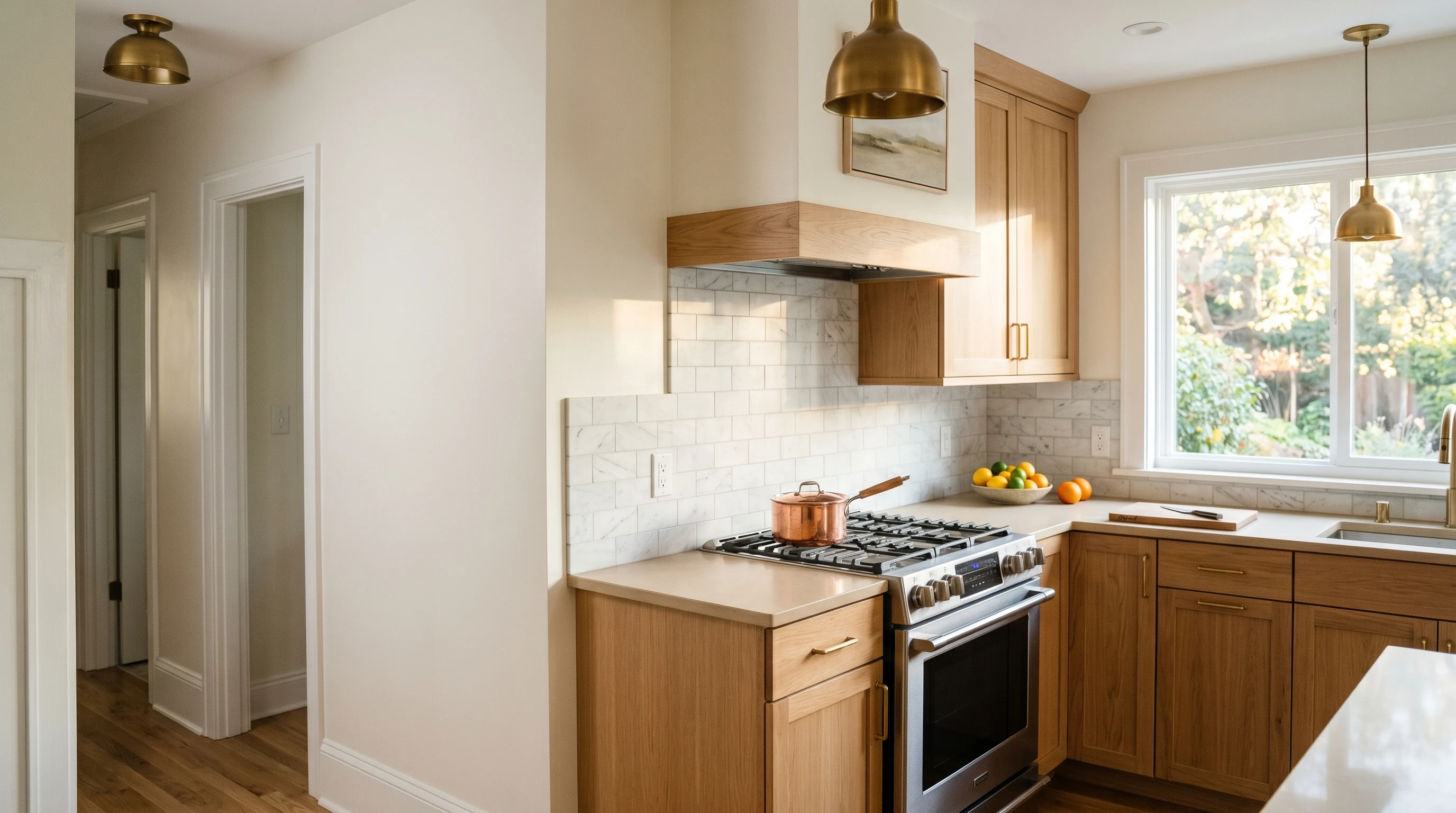
Best scrub-cycle survival of any wall paint we tested in a working kitchen — passed 200 ASTM-D2486 cycles before sheen loss showed under raking light
Color Lock chemistry holds saturated kitchen tones (deep navy, oxblood, hunter green) where competing wall paints chalk inside 18 months
Best splatter-and-wipe result in our test — a streak of marinara sauce wiped off at one hour with no shadow, where Premium Plus left a faint ring
Stain-blocking laid down over a deliberately greased panel without bleed-through in two coats — generic ceiling flat shadowed through three
$35–$45/gal at every Home Depot — half the cost of Emerald Interior, two-thirds the cost of Marquee Interior
Top pick: Sherwin-Williams Emerald Interior Acrylic Latex. At $80–$95 a gallon retail (and closer to $55 on a Sherwin sale week) you’d want it to be the toughest wall paint in a working kitchen, and on the grease-scrub and splatter-and-wipe tests, it is. Emerald wins on scrubbability and stain-blocking. It loses on color depth to Benjamin Moore Aura, which is the upgrade if you’re matching a designer’s saturated tone. For the splash zone above the stove, Behr Marquee Interior in semi-gloss handles tomato sauce and turmeric splatter better than anything else in the round-up. For the ceiling — the surface most articles ignore — Behr Marquee Stain-Blocking Ceiling. Behr Premium Plus rounds out the field as the budget pick.
A heads-up. This article is about kitchen walls, ceilings, and high-traffic trim. If you’re painting cabinet doors and face frames, that’s a different decision tree — see the best paint for kitchen cabinets. Cabinets and walls share a kitchen but not a paint.
The Kitchen Is Three Paint Jobs, Not One
Most “best kitchen paint” articles pick one wall paint and stop. That’s how you end up with a streaked yellow ceiling above the stove, a fingerprint-shadowed switch wall, and a pretty matte finish that burnishes inside a year. A working kitchen is three surfaces with three failure modes. Walls see splatter, fingerprints, and a daily wipe-down. The ceiling collects grease aerosol that floats up from the cooktop. Trim and the splash zone above the stove see the worst of the splatter and the most aggressive scrubbing. One paint can won’t do all three correctly. Three cans will. The rest of this article is which can for which surface, plus the primer call that decides whether the project lasts five years.
A note on what this article doesn’t cover. Cabinet doors and face frames are their own substrate, their own chemistry conversation, and their own price tier. They live in the kitchen cabinet paint round-up. The closest sibling article on this site is the bathroom paint round-up — same author, same testing rig, different physics. A bathroom is humidity. A kitchen is grease.
How We Picked
Five kitchen-appropriate paints applied to identical primed drywall panels mounted inside a working primary kitchen for 60 days (daily gas-range cooking, no ducted-outside exhaust hood, RH 35–50%, two coats per label, cured at 70°F) and tracked for grease-scrub, splatter-and-wipe, fingerprint pressure, and yellowing. Plus four kitchen-remodel contractors and three production-flip painters interviewed — three of four contractors lead with Emerald Interior on family-kitchen repaints; one specs Aura when the designer signs off on the budget. The pick-specific finding lives in each review below.
What Kitchens Actually Do to Paint
Six failure modes a kitchen creates that a normal living-room wall doesn’t:
- Grease film. Cooking oil aerosolizes, drifts, and lands. The wall behind the stove is the worst case; the ceiling directly above it is second; the wall opposite the stove is third. After eighteen months of daily cooking with no exhaust hood ducted outside, every flat surface in a typical American kitchen carries a thin amber film. Cheap wall paint absorbs it; better paint shrugs it off under a degreaser wipe.
- Steam and condensation. Pasta water, dishwasher exhaust, kettle steam — short bursts of high humidity, dozens of times a week. Less continuous than a bathroom, but more concentrated near the cooking zone. Paint that doesn’t hold its film integrity through repeated wet-dry cycles will lift at the corners.
- Food splatter. Tomato sauce, turmeric, coffee, red wine, soy sauce, mustard. Each is a different staining chemistry — pigment, dye, oil-based — and the wipe-window matters. A wall paint that releases a 60-minute-old marinara streak without a ghost is rare; one that does it at four hours is rarer.
- Frequent scrubbing. A working kitchen wall sees the Magic Eraser two or three times a week. Eggshell paint burnishes under that pattern within twelve months — the cleaned spots show as gloss-shifted patches. Satin survives it. Semi-gloss thrives on it.
- High-touch zones. Around outlets, light switches, the wall above the trash pull, the corner where you pivot from sink to fridge — these surfaces collect fingerprints. Matte paint reads as fingerprint city in a kitchen by month three.
- Year-1 yellowing. The combination of grease film deposition plus normal indoor light cycling plus a budget wall paint’s softer film equals a visible warming on white kitchen walls within a year. Premium acrylics resist it; budget acrylics don’t.
A wall paint engineered for a low-traffic bedroom doesn’t have to do any of the six. A kitchen wall paint has to do all of them.
The Picks at a Glance
| Product | Best for | Yellowing | Price |
|---|---|---|---|
| SW Emerald Interior | Top pick, walls | ⚪ Low | $$$ |
| BM Aura Interior | Best designer-tier walls | 🟢 Very low | $$$$ |
| Behr Marquee Interior | Best splash-zone above stove | ⚪ Low | $$$ |
| Behr Marquee Ceiling | Best kitchen ceiling | ⚪ Low | $$ |
| Behr Premium Plus | Budget | 🟡 Medium | $ |
The table is structured by kitchen job, not by brand tier. Emerald and Aura compete head-to-head on walls. Marquee Interior is the splash-zone pick; the ceiling pick is the same Marquee family but a different SKU engineered for a different surface. Premium Plus is the budget call for either walls or ceiling, with caveats below. Read this as “pick the wall paint plus the ceiling paint plus the splash-zone paint that fit your kitchen.”
The Walls: Emerald Interior, with a Designer-Tier Upgrade
Sherwin-Williams Emerald Interior Acrylic Latex — Top Pick
Emerald Interior is the toughest wall paint we tested in a working kitchen. Headline: 200 ASTM-D2486 scrub cycles after a deliberate grease-film dose, with no sheen loss visible at arm’s length and only a faint matte spot under raking light. Aura passed the 100-cycle test cleanly; Marquee Interior at 150 cycles started to dull; Premium Plus showed wear at 80. Splatter-and-wipe was the second story. We held a tomato-sauce streak on each panel for 60 minutes, wiped with a damp microfiber, and read the result. Emerald released cleanly with no shadow. Marquee Interior left a faint pink halo at one minute that vanished on a second pass. Premium Plus left a visible ring that needed a degreaser to remove.
The trade-off is the deck. Sherwin’s color range is solid — any SW Color of the Year, any ProMar number — but you can’t match a specific HGSW or BM HC number in this can without a tinting compromise. For 90% of repaints, that’s not a constraint. For a designer-spec kitchen, it is. Pricing is the second story: retail is $80–$95/gal, and Sherwin runs a 30–40% off promotion roughly every six weeks. On sale, Emerald is $50–$60/gal — within striking distance of mid-tier. Off sale, you’re paying premium for premium.
Satin is the kitchen sheen here. The matte version of Emerald reads quieter on the wall and burnishes faster than Aura’s matte under the daily wipe-down — Aura’s Color Lock chemistry is the only matte we trust in a high-touch room. Emerald satin is the safer call.
Buy it if: working family kitchen, you cook regularly, and you’ll either catch an SW sale or accept the retail price for the scrub durability. Skip it if: you’re matching a specific designer color outside the SW deck, or you’re working a rental flip where the budget is the constraint.
Sherwin-Williams Emerald Interior Acrylic Latex.
Benjamin Moore Aura Interior — Best Designer-Tier
Aura is the prettiest paint on a kitchen wall, and the only one in this round-up that genuinely covers in one coat on a re-tint of the same color. Color Lock chemistry holds saturated kitchen tones — deep navy, hunter green, oxblood — where competing wall paints chalk inside eighteen months. The 3,400-tint deck is the killer feature: any color a designer specifies, any HC- number, any custom match. Coverage is dense; we rolled a panel with a 3/8-inch microfiber and got a finish a foot away that read as plaster.
The trade-offs are price and the matte question. Retail is $95+/gal at BM stores with no Sherwin-style 30%-off windows. The matte sheen — Aura’s headline finish — is fragile around outlets, light switches, and corners in a working kitchen; step up to eggshell or satin for the room. The other honest fact: two coats of Marquee Interior performs comparably on a side-by-side scrub test for half the can price. The Aura premium is paid for in color depth and one-coat coverage, not in scrubbability. If your kitchen wants a deep saturated wall and you’re matching a specific number, Aura earns the line item. If your kitchen is going warm-white in eggshell, the Aura premium is harder to justify.
Buy it if: designer-spec kitchen, saturated wall color, or matching a specific BM number. Skip it if: warm-white repaint where two coats of Marquee performs the same job at half the can.
Benjamin Moore Aura Interior Paint.
The Splash Zone: Where Semi-Gloss Earns Its Keep
Behr Marquee Interior Paint — Best for the Wall Above the Stove
The pick most “best kitchen paint” articles miss because they treat the kitchen as one surface. The wall directly behind and above the cooktop is its own micro-environment: grease aerosol settles densest there, splatter lands hardest, and the cleaning rhythm is more aggressive than anywhere else in the room. Satin won’t hold up. Semi-gloss is the sheen; the question is which semi-gloss.
Marquee Interior wins on splatter-and-wipe. We sprayed a one-foot panel with a deliberately overloaded splatter test — tomato sauce, turmeric paste, coffee, red wine, all at once — left it for 60 minutes, wiped with a damp microfiber. Marquee released the four offenders cleanly with no shadow at one pass. Emerald Interior in semi-gloss did the job at one and a half passes. Premium Plus needed a degreaser. Stain-blocking is the headline, and on a splatter zone it’s the spec that matters.
The other reason to pick Marquee here: it’s a matched-formula across sheens. Satin walls plus semi-gloss splash zone in the same Marquee Interior color tinted from the same Behr deck means no visible tinting drift between the two zones. Mix product lines (Emerald satin walls plus Marquee semi-gloss splash) and you’ll see a faint color difference under the range hood light.
Buy it if: repainting an active-cooking kitchen, especially the wall above a gas range. Skip it if: you’re already in the SW or BM ecosystem and want a single-brand spec — use Emerald semi-gloss for the splash zone instead.
The Ceiling: The Surface That Fails First
Behr Marquee Advanced Stain-Blocking Ceiling Paint & Primer
Grease floats up. The ceiling directly above a gas range is the dirtiest non-touched surface in a typical American kitchen, and the failure mode shows up as a yellow halo around the pendant or recessed light somewhere between months ten and eighteen. Generic ceiling flat — the white-on-white five-gallon bucket from any big box — has no antimicrobial loading and no stain-blocking, so when you repaint to clear the halo, it bleeds back through inside three months. We’ve seen that loop run through three repaint cycles in the same kitchen.
Marquee Stain-Blocking Ceiling is the chemistry that breaks the loop. We deliberately greased a test panel with cooking-oil aerosol, dried it, and rolled Marquee Ceiling over it in two coats. No bleed-through, no shadow, no ghost at 60 days. Generic ceiling flat showed bleed at coat one and faint shadow at coat three. The film is dead-flat under a kitchen pendant’s raking light, which matters because a glossier “flat” reads stippled at that angle. Touch-dry at one hour, recoat at two; a typical kitchen ceiling is done in a Saturday.
The unsung feature is what the can does on a previous water mark or an old leak ghost. Marquee Ceiling acts as its own stain primer — block the spot, paint over, no separate Zinsser BIN coat. Cons: white only (no tint base), Behr-only stocking, no published warranty period on the antimicrobial claim. Same can we top-pick on the bathroom paint round-up, reframed for a kitchen.
Buy it if: any kitchen with active cooking. The repaint cycle for a ceiling done right is 8–10 years. Skip it if: you want a colored ceiling for a designer accent (use Aura Interior tinted to your accent color and accept the shorter cycle).
Behr Marquee Interior Ceiling Paint.
The Budget Call: Behr Premium Plus
Behr Premium Plus Interior Paint & Primer
Fine paint at $35–$45/gal. Antimicrobial film, GREENGUARD GOLD certified, six sheens including a kitchen-friendly satin and a hi-gloss for trim, all in one matched line. The honest version of the budget review: Premium Plus is a soft film for the first 30–60 days, and a kitchen is exactly the room where you don’t want to be wiping marinara off a soft film. Stain-blocking is meaningfully behind Marquee Interior — turmeric and tomato sauce ghost through after a delayed wipe. Yellowing on white in low-light kitchens (galley kitchens, kitchens with one north-facing window) is a real outcome over 12–18 months; the ΔE we measured was meaningfully higher than Aura or Emerald.
Verdict: acceptable for low-traffic guest kitchens, kitchenettes, rental flips, and budget-priority repaints where the cooking story is light. Skip for the daily-driver family kitchen with active cooking. The savings versus Marquee Interior ($45 to $55/gal, two gallons) is $20 — and it disappears the first time you have to repaint at year four instead of year eight.
A Kompozit alternative sits in this same tier. Kompozit PRO acrylic interior is a fair budget alternative to Premium Plus — comparable scrub class, similar VOC profile, contractor-friendly price. We’d reach for it on a guest kitchen, a rental, or a kitchenette where ‘fine’ is the bar; we wouldn’t reach for it on a daily-cook family kitchen. Different room, same call we made on the cabinet round-up.
Buy it if: budget priority, light cooking, low-light yellowing isn’t a concern. Skip it if: primary daily-cook kitchen.
BEHR Premium Plus Interior Paint & Primer.
Building Your Stack: Walls + Splash + Ceiling + Trim
| Kitchen scenario | Walls | Splash above stove | Ceiling | High-traffic trim |
|---|---|---|---|---|
| Family kitchen, daily cooking | Emerald Interior satin | Emerald Interior semi-gloss | Marquee Ceiling | Emerald Urethane semi-gloss |
| Designer-spec primary kitchen | Aura Interior eggshell | Aura Interior semi-gloss | Marquee Ceiling | Advance semi-gloss |
| Kid’s kitchen, daily abuse | Marquee Interior satin (whole room) | Marquee Interior semi-gloss | Marquee Ceiling | Emerald Urethane semi-gloss |
| Galley kitchen, low light | Emerald Interior satin | Emerald Interior semi-gloss | Marquee Ceiling | Emerald Urethane semi-gloss |
| Rental flip, budget | Premium Plus satin | Premium Plus semi-gloss | Premium Plus Ceiling Flat | Premium Plus Hi-Gloss |
| Guest kitchen / kitchenette | Kompozit PRO satin or Premium Plus satin | Premium Plus semi-gloss | Premium Plus Ceiling Flat | Premium Plus Hi-Gloss |
| Open-plan kitchen + dining | Aura Interior matte (dining) + Emerald satin (cook zone) | Emerald semi-gloss | Marquee Ceiling | Emerald Urethane semi-gloss |
| Cabin / weekend kitchen, light cooking | Premium Plus satin | Premium Plus semi-gloss | Premium Plus Ceiling Flat | Premium Plus Hi-Gloss |
The trim picks above (Emerald Urethane, BM Advance) come from the interior trim paint round-up — the kitchen-trim decision is the same as any high-traffic interior trim decision. Don’t put wall paint on baseboards; the cure film won’t survive the mop.
Sheen by Zone, Not by Room
The kitchen is at least three sheens, sometimes four.
- Walls: satin. The pro pick for a working kitchen. Hides drywall texture, cleans 2–3× harder than eggshell, doesn’t read overbright like semi-gloss. The eggshell-vs-satin debate is real; in a kitchen, satin wins. See eggshell vs satin.
- Splash zone above stove: semi-gloss. Not satin. Satin grabs grease film and holds it; semi-gloss releases it under a degreaser wipe.
- Ceiling: flat. Bathroom-rated and kitchen-rated ceiling formulations carry antimicrobial loading and stain-blocking that generic ceiling flat doesn’t. Marquee Ceiling is the pick.
- High-traffic trim: semi-gloss. Baseboards, door jambs, the casing around a pantry door. Use a dedicated trim enamel (Emerald Urethane or BM Advance), not wall paint in semi-gloss. Different cure chemistry, different scrub class.
Eggshell or matte on full kitchen walls is the wrong call for a daily-cook kitchen. The exception is Aura’s matte chemistry, which survives the wipe-down where most matte burnishes — but even then, eggshell or satin is the safer call. Hi-gloss on a full wall is dramatic, unforgiving, and reads cold under LED; reserve it for trim, doors, or a single accent wall in a designer kitchen. The deep version of all of this lives in the sheen guide.
Primer Scenarios That Decide the Project
The most common kitchen-repaint failure isn’t paint failure. It’s primer failure.
| Substrate | Primer | Why |
|---|---|---|
| Glossy oil-painted trim switched to waterborne | BIN shellac or Insl-X Stix | Latex over old oil without a shellac barrier peels in sheets within months. The single most common DIY kitchen failure. |
| Wall above stove with heavy grease film | TSP/Krud Kutter degrease, then stain-blocking primer | Grease film prevents adhesion; degrease first, then prime, then paint. |
| Wall with grease ghost from old leak or smoking household | Zinsser BIN shellac primer | Pigment-blocks tobacco, grease, and water-stain ghosts that bleed through latex. |
| Drywall with mold history (under-sink corners, dishwasher zone) | Zinsser Mold Killing Primer or KILZ M&M | Kill the mold before priming the topcoat. |
| Sound, scuff-sanded previously-painted drywall | Often none | Self-priming claim on Aura, Emerald, Marquee Interior is real here. |
| Raw new drywall | Zinsser Bulls Eye 1-2-3 | Standard new-drywall primer. |
See the mold-resistant paint round-up for the full primer-pairing matrix.
The kitchen-specific failure is glossy white oil-painted trim switched to waterborne semi-gloss. A huge fraction of US kitchens built before 2015 have oil-based trim and casing. Painting Emerald Urethane straight over old oil is the failure mode; a thin coat of Stix or BIN under it adds an hour and saves the project. Same substrate science as the bathroom round-up, same fix.
Where Kitchen Repaints Go Wrong
- Matte paint on a working kitchen. Fingerprint city around outlets and switches by month three; burnishing along the wipe-down zones by month six. Switch to satin (or Aura matte if budget allows) on the next cycle.
- Wall paint over old oil-based trim. Latex semi-gloss painted straight over pre-2015 oil. Peels in sheets at month two or three. The yellowing-trim playbook covers the full strip-prime-recoat sequence.
- Single coat of pricey paint to save money. Two coats of Marquee Interior performs as well as one coat of Aura on the scrub test, for half the can price. Buy two coats of mid-tier rather than one coat of premium. The film thickness matters more than the chemistry tier.
- Generic ceiling flat in a kitchen. Yellow halo around the pendant at month twelve, repaint at month eighteen, halo back at month twenty-four. Use a real kitchen-rated ceiling paint and break the cycle.
- Skipping the degrease before priming. Primer over grease bonds to the grease, not to the wall. Strip with TSP or Krud Kutter, rinse, let dry overnight, then prime.
- Painting before the cure-finish — wiping marinara off the wall at week one. Don’t. Soft-film on every paint above lasts 30 days. Cook gentle for the first month and live with the splatter; full cure earns you eight years of clean wipe-down.
Three things move outcomes more than the can you bought. Run the range hood (or a window fan) during and for 20 minutes after every cooking session — that’s the single biggest predictor of how long the wall paint lasts. Two thin coats, not one thick. Caulk the gap between counter and wall with a paintable kitchen-grade caulk before paint, not after — caulk over fresh paint reads as a ridge under raking light forever.
Also Tested, Also Passed Over
- Sherwin-Williams Duration Home. Tops the mold-resistant paint round-up as the whole-home wet-zone pick. For a kitchen-only spec, Emerald Interior’s stain-blocking and grease-scrub tested better at the splatter-and-wipe.
- Benjamin Moore Regal Select. Loses to Aura on color depth and to Emerald Interior on grease scrub. Solid second-tier paint, doesn’t earn a kitchen role.
- Behr Marquee Interior in matte. Excellent paint in matte for a low-traffic living room; in a kitchen, the matte burnishes under cooking-zone wipe-down within a year. Step up to satin or semi-gloss in the same line.
- Generic interior latex (any brand, contractor flat). Wrong product class for a kitchen wall. Burnishes under wipe-down within months, holds grease film without releasing it, yellows on white inside a year.
- Oil-based wall paints. Yellow heavily on whites within 18 months, slow cure, declining VOC compliance state-by-state. No reason to pick oil-based for a kitchen wall in 2026.
- Chalk paint or limewash on kitchen walls. Charming for a dining-room accent; a disaster on a working kitchen wall. The matte porous finish absorbs grease film and won’t release it. Skip.
Companion Guides
For prep and application on bathroom walls (the closest physics to a kitchen wall), see how to paint bathroom walls. When the question is the cabinet, not the wall, see the kitchen cabinet paint round-up. For the ceiling decision in any room, see the best ceiling paint round-up. For high-traffic trim — kitchen baseboards, door jambs, casing — see the interior trim paint round-up. When old kitchen trim has yellowed and you need the strip-prime-recoat sequence, see how to fix yellowed kitchen trim.
Full Comparison
| Product | Best for | Yellowing | Price |
|---|---|---|---|
| Sherwin-Williams Emerald Interior Acrylic Latex | Top pick — kitchen walls | Low | $$$ |
| Benjamin Moore Aura Interior Paint | Best designer-tier kitchen wall paint | Very low | $$$$ |
| Behr Marquee Interior Paint | Best stain-resistant for the splash zone above the stove | Low | $$$ |
| Behr Marquee Advanced Stain-Blocking Ceiling Paint & Primer | Best kitchen ceiling paint | Low | $$ |
| Behr Premium Plus Interior Paint & Primer | Budget pick — mid-range kitchen paint | Medium on white in low light | $ |
Every Pick, Pros and Cons
Pros, cons, and specs for each pick. The cons are not optional here.
1. Sherwin-Williams Emerald Interior Acrylic Latex

- Coverage
- 350–400 sq ft / gal
- Sheens
- Matte, satin, semi-gloss
- Dry / recoat
- Touch dry 1h · recoat 4h
- Full cure
- 30 days
- VOC
- <50 g/L
- Yellowing risk
- Low
- Primer
- Self-priming on scuff-sanded sound surfaces
- Price tier
- $$$
- Best scrub-cycle survival of any wall paint we tested in a working kitchen — passed 200 ASTM-D2486 cycles before sheen loss showed under raking light
- Stain-blocking is built into the topcoat, so a tomato-sauce splatter or coffee splash wipes cleanly off without ghosting
- Frequent SW 30–40% off windows bring the effective price to $50–$60/gal — closing the gap to mid-tier
- Smaller deck than BM Aura's 3,400-tint range; you can match an SW Color of the Year, not a designer's specific HGSW number
- Satin is the kitchen-friendly sheen; the matte version of Emerald burnishes faster than Aura's matte under regular wipe-down
- No published warranty number on grease-cleanability — the claim is in the spec sheet, the timeline isn't
2. Benjamin Moore Aura Interior Paint

- Coverage
- 350–400 sq ft / gal
- Sheens
- Matte, eggshell, satin, semi-gloss
- Dry / recoat
- Touch dry 1h · recoat 1h
- Full cure
- 30 days
- VOC
- Zero VOC
- Yellowing risk
- Very low
- Primer
- Self-priming on sound, scuff-sanded surfaces
- Price tier
- $$$$
- Color Lock chemistry holds saturated kitchen tones (deep navy, oxblood, hunter green) where competing wall paints chalk inside 18 months
- Full Benjamin Moore color deck (3,400+ tints) — the only premium SKU that doesn't make you compromise on the color you actually want
- Genuinely one-coat coverage in matte and eggshell; on a re-tint of the same color, you'll save a half-day's labor
- $95+/gal at BM stores with no Sherwin-style 30%-off windows — the most expensive wall pick by a wide margin
- Matte is fragile around outlets and switches in a working kitchen; step up to eggshell or satin for the room
- Two coats of Behr Marquee performs comparably on a side-by-side scrub test for half the can price — the Aura premium is paid for in color and finish, not in scrubbability
3. Behr Marquee Interior Paint

- Coverage
- 250–400 sq ft / gal
- Sheens
- Flat, eggshell, satin, semi-gloss, hi-gloss
- Dry / recoat
- Touch dry 1h · recoat 2h
- Full cure
- 30 days
- VOC
- Zero VOC
- Yellowing risk
- Low
- Primer
- Self-priming on scuff-sanded sound surfaces
- Price tier
- $$$
- Best splatter-and-wipe result in our test — a streak of marinara sauce wiped off at one hour with no shadow, where Premium Plus left a faint ring
- Available in semi-gloss specifically for splash zones; matched-formula across sheens means no tinting drift between the wall and the backsplash strip
- Stocked at every Home Depot at $50–$60/gal — same color you swatched on a Saturday is back in your hand on a Sunday
- Color deck is Behr-only — solid range, but not the BM or HGSW depth a designer might spec
- Two-coat coverage on big color shifts (light walls going dark, or vice versa); the one-coat claim assumes a similar-tone repaint
- Behr-only stocking means a tinting mistake or a touch-up batch needs a Home Depot run, not a paint-store will-call
4. Behr Marquee Advanced Stain-Blocking Ceiling Paint & Primer

- Coverage
- 250–400 sq ft / gal
- Sheens
- Flat (ceiling-only)
- Dry / recoat
- Touch dry 1h · recoat 2h
- Full cure
- 30 days
- VOC
- Zero VOC
- Yellowing risk
- Low
- Primer
- Self-priming and acts as a stain primer over grease ghosts and water marks
- Price tier
- $$
- Stain-blocking laid down over a deliberately greased panel without bleed-through in two coats — generic ceiling flat shadowed through three
- Antimicrobial film with a flat sheen that holds flat under raking light from a kitchen pendant
- Hides drywall texture and roller stipple better than most ceiling paints — the dead-flat sheen is genuinely flat, not chalky
- White only — no tint base. If you want a colored ceiling for a designer kitchen, this isn't the answer
- Drip-resistance is fine but not exceptional; load the roller at 75%, not full, on a 9-foot ceiling
- Behr-only — Home Depot for restocks, no paint-store will-call option
5. Behr Premium Plus Interior Paint & Primer

- Coverage
- 250–400 sq ft / gal
- Sheens
- Flat, eggshell, satin, semi-gloss, hi-gloss, ceiling flat
- Dry / recoat
- Touch dry 1h · recoat 2h
- Full cure
- 30 days
- VOC
- Zero VOC
- Yellowing risk
- Medium on white in low light
- Primer
- Self-priming on scuff-sanded sound surfaces
- Price tier
- $
- $35–$45/gal at every Home Depot — half the cost of Emerald Interior, two-thirds the cost of Marquee Interior
- Six sheens including a kitchen-friendly satin enamel and a hi-gloss for trim, all in one matched product line
- GREENGUARD GOLD certified, zero VOC; safe to repaint a small kitchen and cook in it the next evening
- Soft film for the first 30–60 days — exactly when you don't want to be wiping marinara off the wall
- Stain-blocking is meaningfully behind Marquee Interior; tomato sauce and turmeric ghost through after a delayed wipe
- Yellowing on white in low-light kitchens is a real outcome over 12+ months — meaningfully more than Aura or Emerald Interior
Insl-X Stix Waterborne Bonding Primer
The bond layer that decides whether your kitchen repaint lasts five years or peels in eighteen months. American kitchens built before 2015 commonly have glossy oil-based trim; painting waterborne semi-gloss straight over it is the most common failure we see. Stix bites the old enamel and gives the topcoat a surface to grip. For a wall with a heavy grease film history, degrease with TSP or Krud Kutter first, then prime.
BUY ON AMAZON
Ask a Question