How to Paint a Basement Wall (Block, Concrete, or Drywall)
Basement walls are the #1 paint failure environment. Diagnose moisture first, match the system to the wall type, and pick a mildew-resistant paint that survives a damp room.

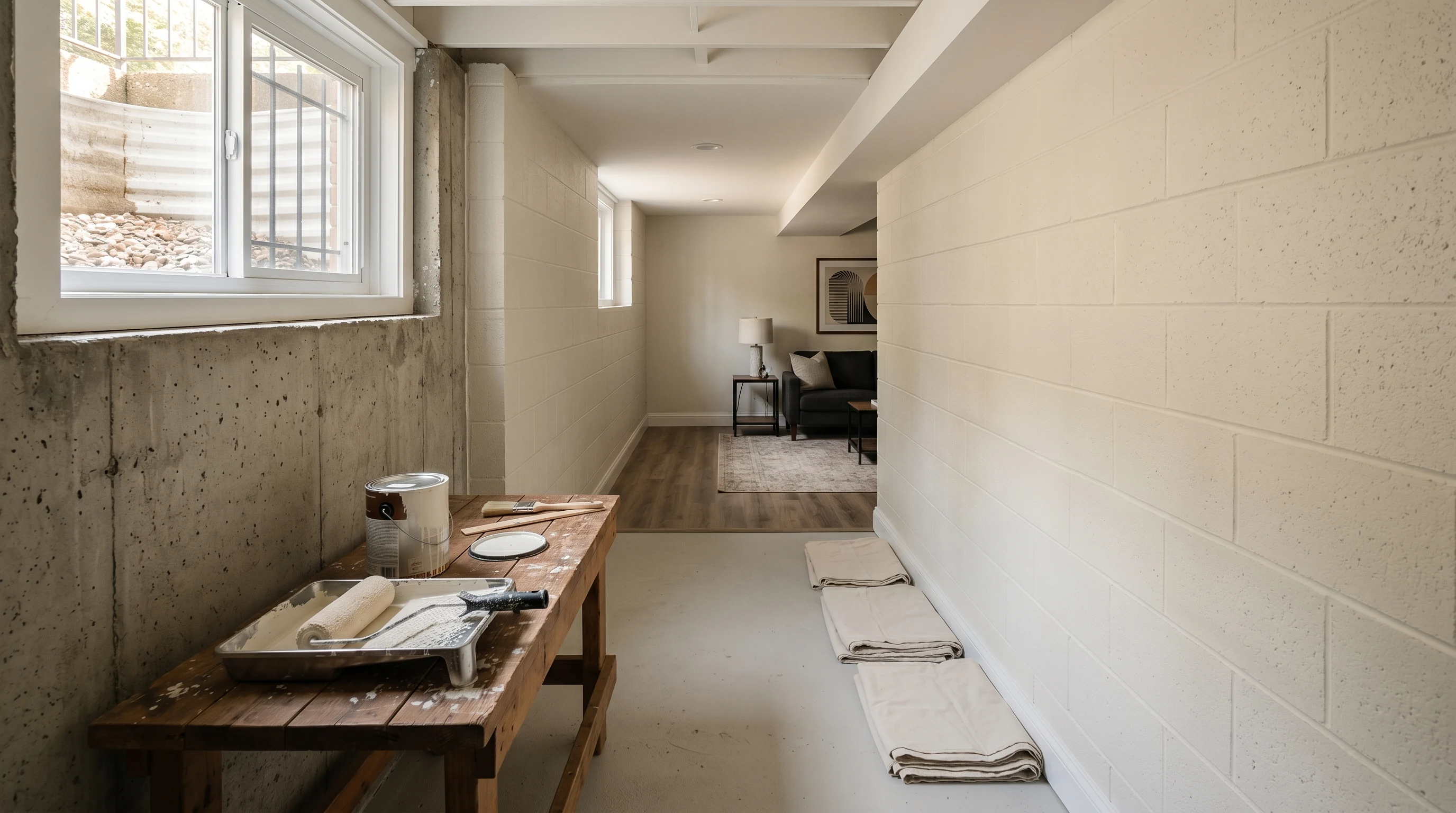
Okay so you’re standing in your basement with a roller in one hand and a can of whatever you had in the garage in the other, and the walls look terrible. Maybe there’s some old paint flaking off. Maybe there’s white powder near the floor. Maybe there’s a dark patch in the corner that you’re trying not to think about. Here’s the thing about basement walls. They are the worst paint environment in your entire house, and the fix isn’t a better roller. It’s a moisture test you haven’t run yet.
I’ll walk you through it. Don’t worry, none of this is hard. It just has to happen in the right order.
What You’ll Get
Two-coat painted basement walls in a light, mildew-resistant color, on whichever wall type you’ve got. Done over a weekend. Lasts five-plus years if your moisture diagnosis was honest.
Honest Take on Time
The painting itself is one Saturday. The thing that turns this into a multi-weekend project is moisture. If the plastic-sheet test (more on that in a second) comes back wet, you can’t paint until you fix the source. That might mean re-grading a downspout outside, running a dehumidifier for a few weeks, or in the worst case calling a basement waterproofer. So the realistic timeline is: one day to diagnose, however long it takes to dry the room out, then one weekend to paint.
If the moisture test comes back clean on day one, you can be on coat two by Sunday afternoon.
Run the Moisture Test First. Always.
This is the step almost everyone skips, and it’s the reason almost everyone repaints their basement every two years.
The plastic-sheet test (free, 24 hours). Tape a 2-foot square of clear 6-mil plastic sheeting flat to a bare wall on all four sides. Wait 24 hours. If the underside of the plastic is wet, or if the wall under it has darkened, your wall is passing vapor and any paint you put on is going to lift off. Run the test in three or four spots: corners, middle of the longest wall, and somewhere near a window well or a known damp area.
The calcium chloride test ($25 kit, 60–72 hours). A small dish of calcium chloride salt sealed under a clear dome, taped to the wall, weighed before and after. Gives you an actual number in pounds of vapor per 1000 square feet per 24 hours. The pass/fail line for most interior coatings is 3 lb. Above that, you need a true waterproofer (Drylok Masonry Waterproofer) or you cancel the project until the moisture is fixed.
If you’re seeing the white powdery bloom, that’s efflorescence. It’s salts being pushed out by moisture. The full fix lives in how to fix concrete efflorescence; the short version is that you brush it off, etch, and you don’t paint until the underlying moisture stops.
Paint won’t fix moisture. It’s important enough to say twice. Paint won’t fix moisture.
Match the System to the Wall Type
Three different basement walls, three different systems.
Bare Concrete Block (CMU)
The most common. Hollow concrete blocks stacked with mortar joints, porous and alkaline. Generic wall paint chemically attacks itself on this surface and powders off in a season.
What works: a masonry-rated primer first, then a mildew-resistant topcoat. Drylok Masonry Waterproofer is the go-to if you also need vapor blocking. It’s a thick, white, latex-based coating designed to grip block and resist hydrostatic pressure from the wall side. Behr Concrete & Masonry Bonding Primer is the cheaper option for walls that passed the moisture test and just need a bonding layer, not a waterproofer. Either way, follow with a 100% acrylic interior topcoat that’s labeled mildew-resistant. The SKUs in the anti-mold paint round-up are the ones I’d actually use.
Use a 1/2” to 3/4” nap roller. The thicker nap is what gets paint into the voids in the block face. A standard wall roller leaves the recessed pores bare and the wall looks like a moonscape.
Poured Concrete
Smoother than block. Same family of products, lighter prep, normal nap. The key difference is profile. Bare poured concrete is often glassy-smooth, especially if it was form-poured, and primer needs something to bite. Scuff with 80-grit on a pole sander and vacuum before you prime. Same masonry primer, same topcoat as block. You can use a 3/8” nap roller because the wall is flat enough.
Drywall Over Framing
This is the easy one. Treat it like any other interior wall. Spackle nail holes, sand smooth, vacuum, prime spots and stains with Zinsser BIN shellac-based primer (it blocks water-stain ghosts that bleed through latex), then two coats of a mildew-resistant interior acrylic.
The thing that makes basement drywall different from upstairs drywall is moisture history. If the previous owner ever had a leak, water heater failure, or window well overflow, prime the whole wall with BIN, not just the spots. Stains that don’t show up dry will show up wet, the first humid week of summer.
Mildew Under Existing Paint
If you can see dark fuzzy patches on the wall, kill it before you paint over it. Bleach, one part to ten parts water, in a pump sprayer. Mist the area, let it sit 15 minutes, scrub with a stiff nylon brush, rinse with clean water, let dry 24 hours. Wear gloves and safety glasses. Don’t mix bleach with anything. Crack a window.
Then paint with a mildew-resistant SKU. The pyrithione-zinc and IPBC additives in mildew-resistant paint don’t kill existing mildew; they prevent the next bloom. So the bleach step has to happen first, and the paint step second.
Pick a Light Color
Basements are dark. The lighting is bad, the windows are small, and the ceiling is low. Any color you fall in love with on a chip in the store is going to read two shades darker on the wall down here. Stick to warm whites, pale greiges, pale blues, pale greens. Save the deep navy for a room with three windows and recessed lighting on a six-foot grid.
If you have one ceiling bulb and two window wells, you want LRV 70 or higher. (LRV is light reflectance value, basically how much light the color bounces back. 100 is pure white, 0 is pure black.) White ceilings help a lot too.
How to Apply It
Cut in the corners and the wall-ceiling line first, with a 2.5” angled brush. On block, work the brush into the voids (a quick stab into each recessed area before the broad strokes) or you’ll see them through the rolled coat.
Roll the field. On block, a 1/2” to 3/4” nap roller, in a W pattern, slow enough to push paint into the voids. On poured concrete or drywall, a 3/8” nap and normal speed. Two coats is the rule on every wall type. One coat on bare masonry looks blotchy because the substrate drinks unevenly.
Caulk the wall-floor cove with polyurethane sealant (Sikaflex 1c SL) before the second coat. That joint is where capillary moisture wicks in, and it’s where the paint film fails first if you don’t seal it.
Failure Modes
These are the three you’ll see if something went wrong upstream.
- Peeling at the floor joint. The wall-floor cove is wicking moisture. Scrape the loose paint, caulk the cove, repaint that strip.
- White powdery bloom returning. Efflorescence is back. Moisture isn’t fixed. See the efflorescence fix; your downspout, grading, or interior humidity is feeding salts to the wall.
- Dark fuzzy patches under the paint film. Mildew growing under the paint. Means the bleach pre-treat didn’t kill it, or the room humidity is high enough to grow new mildew through a paint film. Run a dehumidifier at 50% RH year-round.
Common Mistakes
- Painting damp walls. They feel dry. They aren’t dry. Run the plastic-sheet test.
- Skipping the moisture test entirely. This is the single biggest reason basement paint fails. The kit is $25.
- Using upstairs wall paint on bare CMU. Latex on alkaline block powders off. Use a masonry primer first.
- Painting over visible mildew without bleaching. Mildew-resistant paint prevents new growth; it doesn’t kill existing colonies.
- Going dark. Dark colors in a basement turn into a cave. Light up first, or stay light.
- Skipping the wall-floor cove. That’s where it fails. Caulk it.
Cure Schedule
| Time after final coat | What’s safe |
|---|---|
| 4 hours | Touch dry |
| 24 hours | Hang shelving, lean things against the wall |
| 7 days | Normal scrubbing |
| 30 days | Full cure, mildewcide fully active |
Maintenance
A properly diagnosed and primed basement holds paint for 5–8 years before it needs a refresh. Run a dehumidifier at 50% RH during the cooling and heating seasons; that one habit doubles the life of any basement coating. Save a labeled quart of the topcoat for touch-ups. If a corner powders or a spot blooms, that’s the room telling you the moisture story changed. Re-test before recoating.
Cost for an Average Basement (400 Sq Ft of Wall)
| Item | $ |
|---|---|
| Drylok Masonry Waterproofer (1 gal) or masonry primer (2 gal) | $50 |
| Mildew-resistant acrylic topcoat (2 gal) | $80 |
| Polyurethane caulk + plastic + tape | $30 |
| Calcium chloride moisture test kit | $25 |
| Roller covers (3/4” nap, 3-pack) | $15 |
| Total | ~$200 |
Ask a Question