Exterior Paint Fading and Chalking — Why South Walls Lose Color First and How to Fix It
UV light degrades the resin in exterior paint, pigment loosens, rain washes it off as chalk. Diagnose the cause, run the chalk test, then dechalk, prime, and recoat with a UV-stable acrylic so it holds another 12 to 15 years.

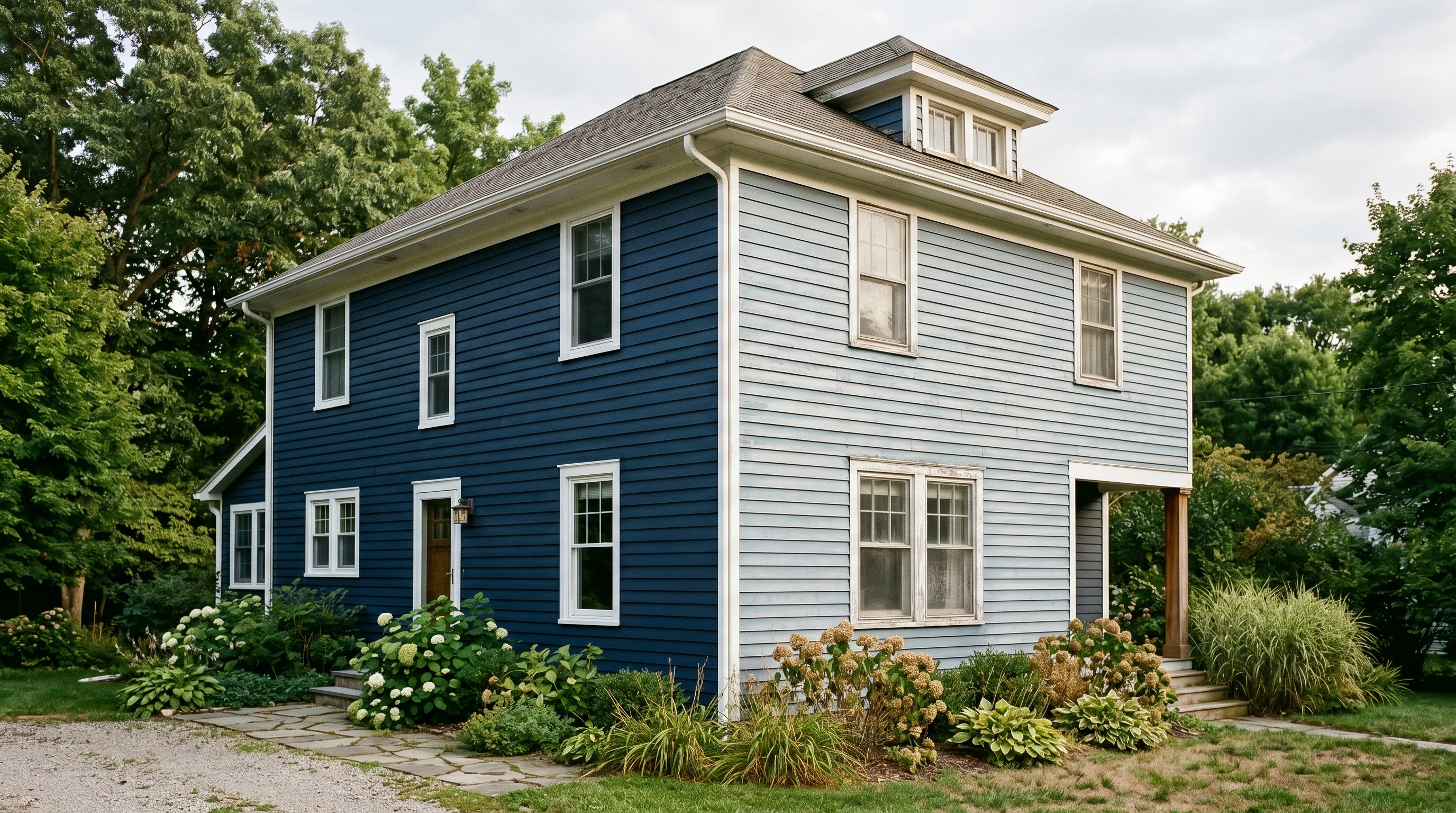
Faded paint isn’t a paint defect. It’s the resin running out of UV resistance, pigment going loose at the surface, and rain rinsing it off the wall a little at a time. Twelve years of sun does this on the south side of every house I’ve ever worked on. The diagnosis isn’t the hard part. The hard part is deciding whether the film has another five years in it or whether you’re already past the deadline.
Does This Match What You’re Seeing?
Look at the wall in raking light, then run the cloth test. The pattern tells you which fix you’re in.
- Color is duller than the original, no chalk on your hand: normal age fade. The resin is still bonded, the pigment has just photodegraded at the surface. Wash and recoat is the fix.
- Cloth comes back gray or colored after rubbing: active chalking. Resin has broken down, pigment is loose. Dechalk before any topcoat.
- South or west wall obviously paler than north or east in the same color: UV-driven divergence. Universal on saturated colors past year five.
- Reds shifted toward pink, navies toward gray, deep greens toward olive: organic pigment fade. Worse on standard exterior latex than on UV-stable lines.
- Fade plus peeling at edges or around trim: you’re past a fade fix. See peeling paint.
- Fade plus a network of fine cracks across the film: age plus UV. Encapsulation or strip job. See cracking and alligatoring.
If the cloth comes back clean and the color is just a little tired, you’re not actually due for paint. Pressure-wash and walk away.
How Serious Is This?
Cosmetic on most houses. Three triggers push it up.
- Peeling at the edges of the faded area. Adhesion is gone, not just color. Different fix.
- Dark wood substrate visible through the film on bare-wood walls. UV is hitting the wood, not just the paint. Recoat now or you’re replacing siding next year.
- Pre-1978 home. Chalk on aged paint is the dust hazard everyone forgets. Lead until tested. RRP rules apply during pressure washing and prep.
Why Exterior Paint Fades and Chalks (root Cause)
UV light is the cause. The mechanism is straightforward and worth understanding because it tells you which fix to run.
Exterior paint is pigment held in a resin binder. UV photons break the polymer chains in the resin a little at a time, day after day, on every sun-exposed surface. The resin loses cohesion. Pigment particles that were locked into the matrix come loose at the very top of the film. Rain washes the loose pigment off, and a fresh layer of pigment is exposed to the next round of UV. That’s chalking. That’s also why fade and chalk are the same failure at different stages — fade is what the eye sees, chalk is what your hand picks up.
Saturated colors fade fastest because the pigments themselves matter. Iron oxide (the pigment in most earth tones, browns, terracottas) and titanium dioxide (white) are mineral pigments with high UV stability. They hold their color for decades. Organic pigments — the dyes used for saturated reds, deep blues, vivid greens, oxbloods — have lower UV stability by chemistry. A south-facing oxblood will lose visible saturation on standard latex by year three to five regardless of brand. A white or beige in the same spot reads as original at year ten.
Three causes account for almost every fade complaint I see on jobsites. Ranked by frequency.
1. End-of-life paint. The film is 10 to 15 years old on a south or west wall. The resin has done its job. Doesn’t matter what brand you used; the next coat needs to go on. Repaint with a UV-stable 100% acrylic exterior. Benjamin Moore Aura Exterior, Sherwin-Williams Duration Exterior, Behr Marquee Exterior. The resin chemistry in these has held up against modern accelerated weathering tests where 1990s alkyd-acrylic blends gave up at year eight.
2. Wrong paint for the orientation. Vinyl-acrylic interior or contractor-grade builder-pack went on a south-facing exterior. Fails in three to five years. Diagnose by asking what was used on the last paint job. If the answer is “whatever was on clearance at the home center” or “the builder picked it,” that’s your cause. Strip the failing zones and rebuild with a real exterior product.
3. Saturated color on a sun side. Deep navy, oxblood, fire-engine red, hunter green on a south wall. The pigments themselves are running out of UV stability. The fix is accepting the math (repaint every 7 to 10 years on a fade-resistant line, every 3 to 5 on standard latex) or going with a higher LRV color that’ll hold longer. Lighter colors fade more slowly because there’s less pigment for UV to bleach.
North-Vs-South Divergence
The same paint on the same house in the same year fades at very different rates depending on orientation. South and west walls take direct afternoon sun for half the year. North walls see almost no direct UV. East walls take morning sun, which is cooler and lower-angle. Net result on a typical Midwest house: the south wall is at year 12 of resin life when the north wall is at year 4. I’ve walked job sites where the south side was visibly chalked and the north side still looked freshly painted.
This is why partial repaints make sense and why homeowners ask about them constantly. If your south and west walls are chalking and the north and east walls look good, the right call is often to repaint just the two sun sides. Walk the corners and confirm the paint can match (most modern can-tinting holds up well on common colors). Repaint corner-to-corner so the seam disappears at the architectural break, not mid-wall.
The wrong call is repainting one wall in isolation while the others stay. New paint on a sun-faded substrate landing next to fully-faded original paint creates a checkerboard that takes years to even out. If you can’t repaint at least the full side from corner to corner, wait until you can.
The Repaint Decision Tree
Three states, three procedures.
- Faded but sound, no chalking, film bonded: wash and recoat. One weekend. Pressure-wash with TSP, scuff-sand glossy areas, two coats of UV-stable topcoat. No primer needed if the existing film is sound and clean.
- Faded plus chalking: dechalk and recoat. Two weekends. Pressure-wash with TSP, run the cloth test, prime chalking areas with Zinsser Peel Stop, two coats of UV-stable topcoat.
- Faded plus peeling: full scrape, prime, paint. This isn’t a fade fix anymore. See how to fix peeling paint.
Don’t run the wash-and-recoat procedure on a chalking surface. New paint over loose pigment bonds to dust. Peels in 18 to 24 months and you’re back where you started.
The Fix
Step 1. Pressure Wash with TSP
Rent or own a pressure washer rated for at least 1500 PSI. Mix TSP or a TSP substitute at the dilution on the bottle (usually 1/2 cup per gallon for siding work). On shaded north walls where mildew is in the mix, swap in a 1:10 bleach solution for the wash step. Never mix bleach with vinegar, ammonia, or hydrogen peroxide. Toxic chlorine gas, full stop.
Wash from the bottom up, rinse from the top down. Hold the wand 12 inches off the wall, fan tip, never the zero-degree tip on siding. Let dry 48 hours minimum on exteriors before any other step.
Step 2. Run the Cloth Test
Clean white cotton cloth, not a rag with print on it. Rub firmly across the washed wall in a four-inch stripe. Look at the cloth.
- No smudge: the resin is still bonded. Skip Step 4.
- Light gray smudge: marginal. Wash again, retest. If it still smudges, prime.
- Heavy gray or colored smudge: active chalking. Prime in Step 4. Don’t skip it.
Step 3. Scuff-Sand Glossy Areas and Feather Any Peel
Scuff-sand any glossy or shiny areas of the existing film with 120 grit. Acrylic-on-acrylic adhesion is good but not unlimited; the scuff gives the new coat something to grab.
If you’ve got peel adjacent to the fade, feather every edge with 80 grit, then 120, until the transition is flush under your fingertip. A topcoat over a hard cliff edge telegraphs through forever. The feathering is the difference between a repair you see from across the street and one you don’t.
Step 4. Dechalking Primer (only If the Cloth Test Showed Chalk)
Zinsser Peel Stop is what I reach for. Water-based, applied by brush or roller, dries in 30 to 60 minutes, recoat in 4 hours. The Peel Stop binds the residual chalk down into a stable layer that the topcoat can grip. One coat over the chalking zones, not the whole house unless the whole house is chalking.
Alternatives if Peel Stop isn’t on the shelf: Sherwin-Williams Loxon Conditioner for masonry-substrate chalking, Insl-X Stix as a bonding primer if the chalk is light and the surface is also glossy in patches.
Skip this step on a chalking wall and the topcoat peels in two years. Not a maybe.
Step 5. Topcoat with a UV-Stable Acrylic
Two coats. Always. One-coat coverage on an exterior recoat is a marketing claim, not a system.
The picks for high-fade environments — south and west walls, saturated colors, full-sun orientations:
- Benjamin Moore Aura Exterior — Color Lock pigment-bonding chemistry, the longest fade hold I’ve seen on saturated colors. Premium price, premium product.
- Sherwin-Williams Duration Exterior — PermaLast resin, comparable fade life, available at every SW dealer.
- Behr Marquee Exterior — Home Depot’s flagship, advanced UV resin package, the budget pick that actually performs.
Cut in the corners and trim, roll while the cut-in is still wet, don’t stop in the middle of a wall. Stopping mid-wall is how you get lap marks, and lap marks show up the second the morning sun hits them.
Apply in spec: 50°F to 90°F ambient, surface temp under 100°F, no rain in the next 24 hours, no painting in afternoon sun on a south wall in summer. See the best exterior paint round-up for the full comparison.
Safety
Pressure washers throw debris hard. Eye protection, closed-toe shoes, no kids in the splash zone. P100 respirator if pre-1978 (lead until tested, and pressure washing aerosolizes everything in the existing film). N95 minimum on newer homes during sanding. Cross-ventilate enclosed porches and breezeways. Cover plants and shrubs you don’t want bleached or TSP-scorched.
Common DIY Mistakes
- Spot-painting one faded wall. New paint on a faded substrate doesn’t match the surrounding aged paint. Repaint corner-to-corner.
- Skipping the dechalking primer. Topcoat over loose pigment peels in 18 to 24 months. The cloth test costs you a paper towel and saves you a repaint.
- Using interior paint outside. Vinyl-acrylic interior on a south wall fails in three years. Real exterior paint exists for a reason.
- Painting in afternoon sun on a south wall in July. Heat blistering on top of fade. See paint bubbling for what that looks like.
- Saturated color on a south wall and expecting fifteen-year hold. Pigment chemistry sets the floor. Even Aura’s Color Lock is a 7-to-10 system on deep navy. Plan for it.
- Pressure-washing at 3000 PSI. Drives water behind cladding, debonds film that wasn’t actually failing yet. 1500 to 2000 is the working range on residential siding.
Recommended Product
Benjamin Moore Aura Exterior is the topcoat I reach for when the homeowner wants the fade to hold past year ten. The Color Lock pigment chemistry is the only fade-resistance system I’ve seen that actually performs at the marketing claim — saturated colors hold visibly longer than every other premium exterior I’ve put on a wall. Premium price (running $90 to $110 a gallon retail), but on a south-facing wall in a saturated color, it’s the difference between a 12-year recoat cycle and a 6-year one.
For dechalking before the topcoat, Zinsser Peel Stop is the working primer. Water-based, brush or roller, recoat in 4 hours. Binds the chalk so the topcoat grips wall instead of dust.
Prevention
- Pressure-wash every other year. Removes loose chalk and surface contamination before it accelerates film breakdown. A weekend with a rented washer extends the recoat cycle by years.
- Choose lighter LRV colors on south and west walls. Whites, beiges, taupes, light grays. The fade math is in your favor before you even pick a brand.
- Use UV-stable lines on saturated colors. If the deep navy is non-negotiable, BM Aura Exterior, SW Duration Exterior, Behr Marquee Exterior. Not standard contractor-grade.
- Plan a south-side repaint at year 7 to 10, north-side at year 12 to 15. The orientations don’t sync, the schedule shouldn’t either.
- Inspect every spring. Cloth test on south and west walls. Catch chalking before it becomes peel.
When to Call a Pro
- Pre-1978 home with widespread fade or chalk. Lead-paint RRP rules apply during pressure washing and prep.
- Two-story or higher exterior where the south wall is the worst and you don’t own scaffolding.
- Fade plus visible peel across more than 30% of a wall. Strip-and-rebuild territory.
- Whole-house repaint coming up where you’re choosing a saturated color and want the longest fade life. A pro applicator using BM Aura Exterior lays down a film that’ll outlast a homeowner application by years.
- Mold colony alongside the fade larger than 10 sq ft (EPA threshold for professional remediation).
What’ll Bite You in Two Years
Dechalking is the step homeowners skip and the reason their repaint fails. New paint over loose pigment is a peel job in 18 to 24 months. The cloth test takes thirty seconds and tells you whether you need the Peel Stop. Skip the test, skip the primer, and you’ll be back on the same ladder before the warranty card has hit the file. Run the test. Prime if it smudges. Then topcoat. That’s the whole trick.
Ask a Question