Benjamin Moore Aura vs Sherwin-Williams Emerald: A Chemist's Head-To-Head
Aura vs Emerald on cured film, scrub cycles, color retention, dry times, VOC, and the price reality of full retail vs an SW 30%-off day. Verdict by use case.

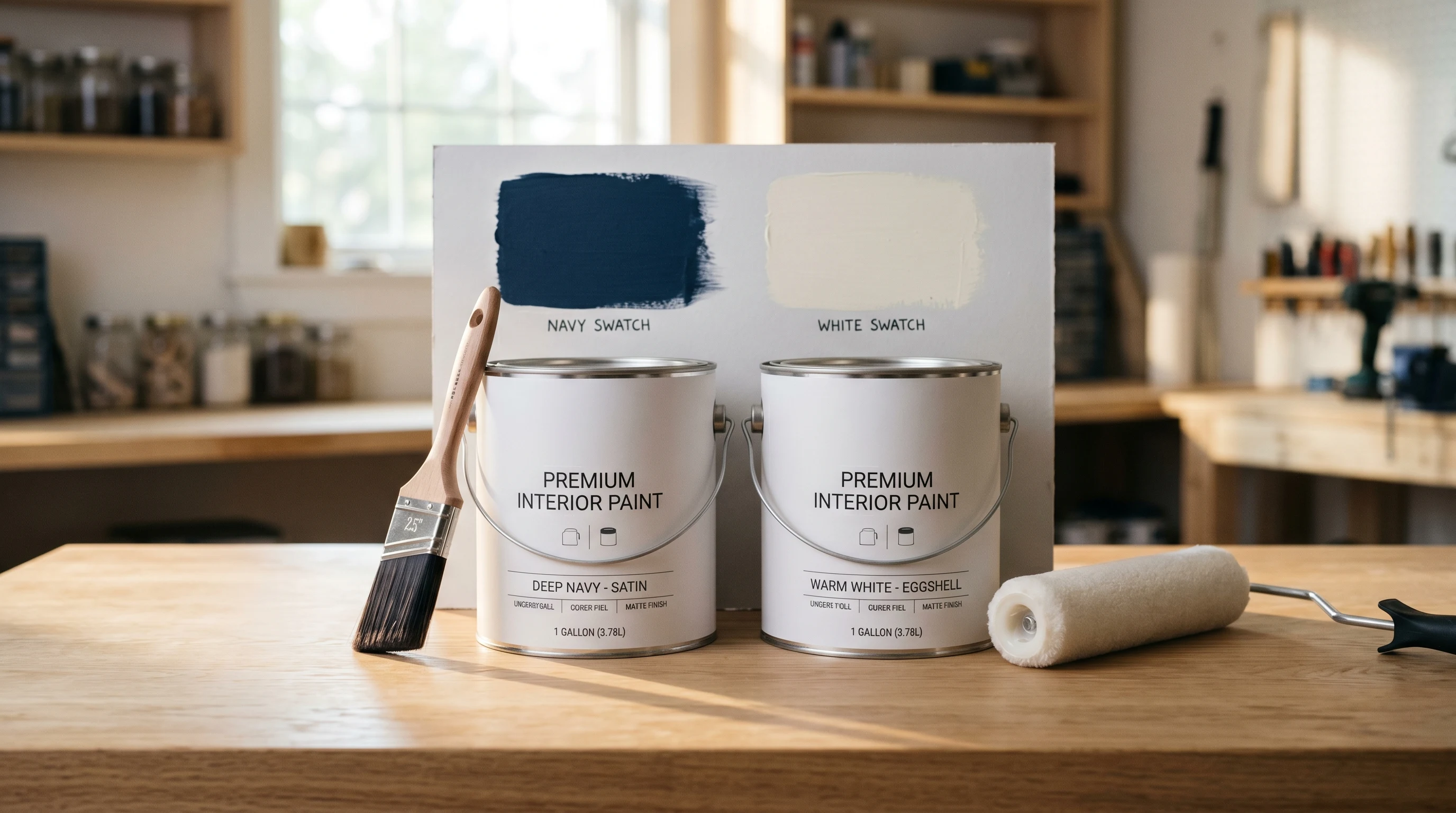
The 30-Second Answer
Aura wins on color, particularly saturated mid-tones and deep colors where its Color Lock chemistry holds tones that drift on every other premium paint. Emerald wins on washability and on price, especially during Sherwin’s frequent 30–40% off windows that bring the gallon to roughly $55–$65. Same product class (premium 100% acrylic interior paint, near-zero VOC, comparable coverage), different formulation balance. Pick Aura when the color is the headline. Pick Emerald when the wall gets touched.
At a Glance
| Benjamin Moore Aura | Sherwin-Williams Emerald | |
|---|---|---|
| Resin | 100% acrylic, proprietary Gennex colorant + Color Lock | 100% acrylic with proprietary self-cleaning film tech |
| Coverage | 350–400 sq ft / gal | 350–400 sq ft / gal |
| Sheens | Matte, eggshell, satin, semi-gloss | Flat, matte, satin, semi-gloss |
| Scrub cycles (ASTM D2486, satin) | ~500–650 | ~750–800 |
| Dry / recoat | 1h / 1h | 1h / 4h |
| Full cure | 30 days | 30 days |
| VOC | <5 g/L (Zero VOC) | <50 g/L (often 25–50 g/L per TDS) |
| Yellowing on white | Very low | Low |
| Color deck | 3,500+ tints, Color Lock loading | Full SW deck (~1,700) |
| Retail price (gal) | $95–$105 | $85–$95 retail; $55–$65 on sale |
| Sale frequency | None (BM rarely discounts) | 30–40% off roughly every 6–8 weeks |
How the Chemistries Actually Differ
Both paints are 100% acrylic waterborne films. The word “acrylic” hides a lot of formulation work, and the two cans solve the same problem with different priorities.
Aura’s headline is the colorant. Benjamin Moore’s Gennex system is a proprietary waterborne tint package, loaded heavy and chemically integrated with the resin rather than dropped in at the store. The reason for that matters. Pigment dispersed evenly through a binder matrix scatters light uniformly, holds saturation as the film ages, and resists the slow chalking that makes deep colors look dusty after two summers in raking light. Color Lock is the marketing name. The underlying chemistry is high pigment loading combined with a binder system designed to encapsulate every particle without leaving fines exposed at the surface.
Emerald takes a different bet. The binder-to-pigment ratio runs leaner on pigment, giving a slightly thinner cured film at the same wet mil but a denser polymer surface. Denser binder at the wear face is what gives Emerald its scrub numbers. The “self-cleaning” claim refers to the surface energy of the cured film: water beads up rather than wetting out, so splatter and grime sit on top of the film instead of settling into micro-pores.
Two ways to balance the same chemistry. Aura prioritizes the optical surface; Emerald prioritizes the wear surface.
Color Retention
This is where Aura earns the price.
Pull a deep navy, an oxblood, or a saturated terracotta and apply both paints to side-by-side panels. At day one, both look identical. At month six in a south-facing room, the Emerald panel reads slightly duller. The saturated tone has lost a few percent of its chroma to UV and oxidation at the surface. At month eighteen, the gap is visible without a comparator. Aura panels from the same period read close to day-one; Emerald panels show measurable ΔE drift on saturated colors.
The reason for that is pigment volume concentration and pigment quality. Aura runs more pigment per gallon and uses inorganic-stable colorants where possible. Emerald uses a leaner but well-protected pigment load. On pastels, off-whites, and most greiges, the difference is invisible. Both paints stay color-stable because the tint load is light to begin with. On reds, deep blues, deep greens, and saturated browns, Aura wins clearly.
Yellowing on white runs the other direction but ends in the same place. Both paints resist yellowing better than mid-tier latex, and both beat any oil-based paint by a wide margin. Aura’s published yellowing index is the lower of the two. In a low-light north-facing hallway, an Aura white at month eighteen still reads as the white you bought. An Emerald white in the same conditions drifts a hair warmer. You’ll only notice if you’re looking for it.
Winner: Aura. Strongly on saturated colors. Marginally on whites.
Washability
Emerald’s territory.
ASTM D2486 is the standard scrub test: a weighted brush with abrasive paste runs back and forth over a cured sample until the film breaks. Per published data sheets and our panel work, premium Emerald satin runs around 750–800 cycles. Aura’s standard interior satin lands around 500–650, and Aura matte drops to 350–500. Aura Bath & Spa’s matte is a different chemistry and runs higher; that’s a separate SKU.
The gap is real but tier-level, not generation-level. Both paints survive normal kitchen and hallway use without burnishing. The difference shows up at high-frequency wipe surfaces: behind a kitchen sink, the wall above a high chair, the corner where the dog turns into the hallway. Six months of weekly damp-microfiber on those zones, the Emerald panel still reads uniform. The Aura matte panel develops a faint sheen halo where the cloth touched most often. Burnishing, technically: the matte texture polished by friction.
If the wall gets cleaned, pick the higher scrub number. If the wall gets looked at, Aura’s matte chemistry is worth the trade.
Winner: Emerald.
Dry and Recoat Windows
Aura recoats in one hour. Emerald recoats in four. That’s the whole story, and it’s bigger than it sounds.
A one-hour recoat means coat-A in the morning, coat-B before lunch, room back online by dinner. A four-hour recoat means coat-A at 9am, coat-B at 1pm, the room wet through afternoon. On a single room you absorb the difference. On a whole-floor repaint, Aura saves a half-day per coat cycle.
Touch-dry is comparable (one hour both). Full cure is identical at 30 days. The meaningful gap is the recoat window, and it favors Aura for project pace.
Winner: Aura.
VOC and Odor
Both paints meet GREENGUARD GOLD. Aura’s published VOC sits below 5 g/L; Emerald’s runs under 50 g/L per the TDS, typically reading 25–50 g/L on actual gallons. Both are well under the California 50 g/L cap.
The applied-smell difference is the real signal. Aura has almost no odor; open the can and you get a faint plastic note and that’s it. Emerald has a mild glycol smell on application that fades within a few hours of recoat. Neither paint will give a healthy adult a headache in a normally ventilated room. For a chemically sensitive occupant, a nursery, or a room that can’t be ventilated overnight, Aura is the safer call.
For a typical adult repainting a living room with a window cracked, the difference is negligible. You’ll smell Emerald for the day, not the week.
Winner: Aura, marginally. Tied for most homeowners.
Price-To-Value, with the SW Sale Caveat
This is where the comparison gets interesting and where most articles get it wrong.
At full retail, Aura is $95–$105/gal at independent BM stores; Emerald is $85–$95/gal at SW stores. Coverage is identical to within a few square feet per gallon, so the per-square-foot delta on a typical living room is roughly $30–$45 for the whole job. Not a meaningful reason to choose one over the other.
Sherwin runs 30–40% off promotions every six to eight weeks. On those days, Emerald drops to roughly $55–$65/gal. Aura never runs sales; BM’s pricing model is “the price is the price.” So the real question on price-to-value is whether you can time your purchase to a Sherwin sale week.
If yes: Emerald at $60/gal versus Aura at $100/gal is a $40/gal delta, or roughly $120–$180 saved on a typical interior repaint. Real budget.
If no: the gap is small enough that the chemistry decision drives the purchase, not the price.
The sale-day reality is why most working contractors deploy Emerald on rentals and family-bath repaints and reserve Aura for designer-spec primary spaces.
Winner: Emerald on a sale day. Tie at full retail.
Verdict by Use Case
- Pick Aura if: the wall is a saturated color (deep navy, oxblood, terra cotta, deep green); the room is low-light or north-facing where yellowing on white shows; the project is a designer-spec primary space where finish quality outweighs the price gap; you need the one-hour recoat to compress a multi-room job into a weekend.
- Pick Emerald if: the wall gets touched, splashed, or scrubbed frequently (kitchen, hallway, kids’ room, mudroom); the budget is a real constraint and Sherwin is running a sale; the color is a soft neutral, off-white, or pastel where Color Lock isn’t doing meaningful work; you’re painting a rental, a flip, or any space where “looks great, cleans well, fair price” is the bar.
- It’s basically a tie when: the room is normal-light, mid-touch, mid-tone, and you’re paying full retail. Either paint gives a clean job that lasts. Pick on color-deck preference or on whichever store is closer.
What About the Role-Specific Cousins?
Both lines have specialty SKUs that solve different problems, and this head-to-head between flagship Aura Interior and flagship Emerald Interior leaves them out by design.
Aura Bath & Spa is the bathroom-specific matte. Different chemistry from standard Aura, engineered to survive wipe-down where Aura matte burnishes. For bathroom walls, see best bathroom paint.
Emerald Urethane Trim Enamel is SW’s waterborne alkyd for trim, doors, and cabinets. Closer in chemistry to Benjamin Moore Advance than to anything in the Aura wall line. For trim and cabinet projects, see best paint for kitchen cabinets.
Top Picks by Side
Going with Aura? The standard Aura Interior line covers most rooms. For bathrooms, step to Aura Bath & Spa via the bathroom paint round-up. Verify: Benjamin Moore Aura Interior product page. Find a gallon: Aura Interior on Amazon.
Going with Emerald? Emerald Interior covers walls; for trim, cabinets, and doors, Emerald Urethane Trim Enamel is the waterborne-alkyd companion. Verify: Sherwin-Williams Emerald Interior Acrylic Latex Paint product page. Find a gallon: Emerald Interior on Amazon.
Related
- Best bathroom paint — Aura Bath & Spa vs Emerald Interior in a humid room
- Best paint for kitchen cabinets — where Advance and Emerald Urethane belong
- Sheen guide — gloss-unit numbers for every interior sheen
- Oil-based vs water-based paint
- Eggshell vs satin — sheen-by-room companion
Frequently asked questions
Is Aura actually worth the $30+ premium over Emerald at full retail?+
What about Aura Bath & Spa or Emerald Urethane — are those the same comparison?+
Can I roll Emerald over a wall I previously painted in Aura?+
Does Emerald scrub better than Aura, or is that marketing?+
Both claim Zero VOC — what's the actual difference?+
- Best bathroom paint — Aura Bath & Spa vs Emerald Interior in a humid room
- Best paint for kitchen cabinets — where Advance and Emerald Urethane belong
- Sheen guide — gloss-unit numbers for every interior sheen
- Oil-based vs water-based paint — when chemistry still matters
- Eggshell vs satin — sheen-by-room companion