How to Paint Your House Exterior Yourself (Honest DIY Guide)
DIY exterior house paint — honest scope, weather windows, ladder safety, and a week-by-week flow for the ambitious first-timer painting their own home.

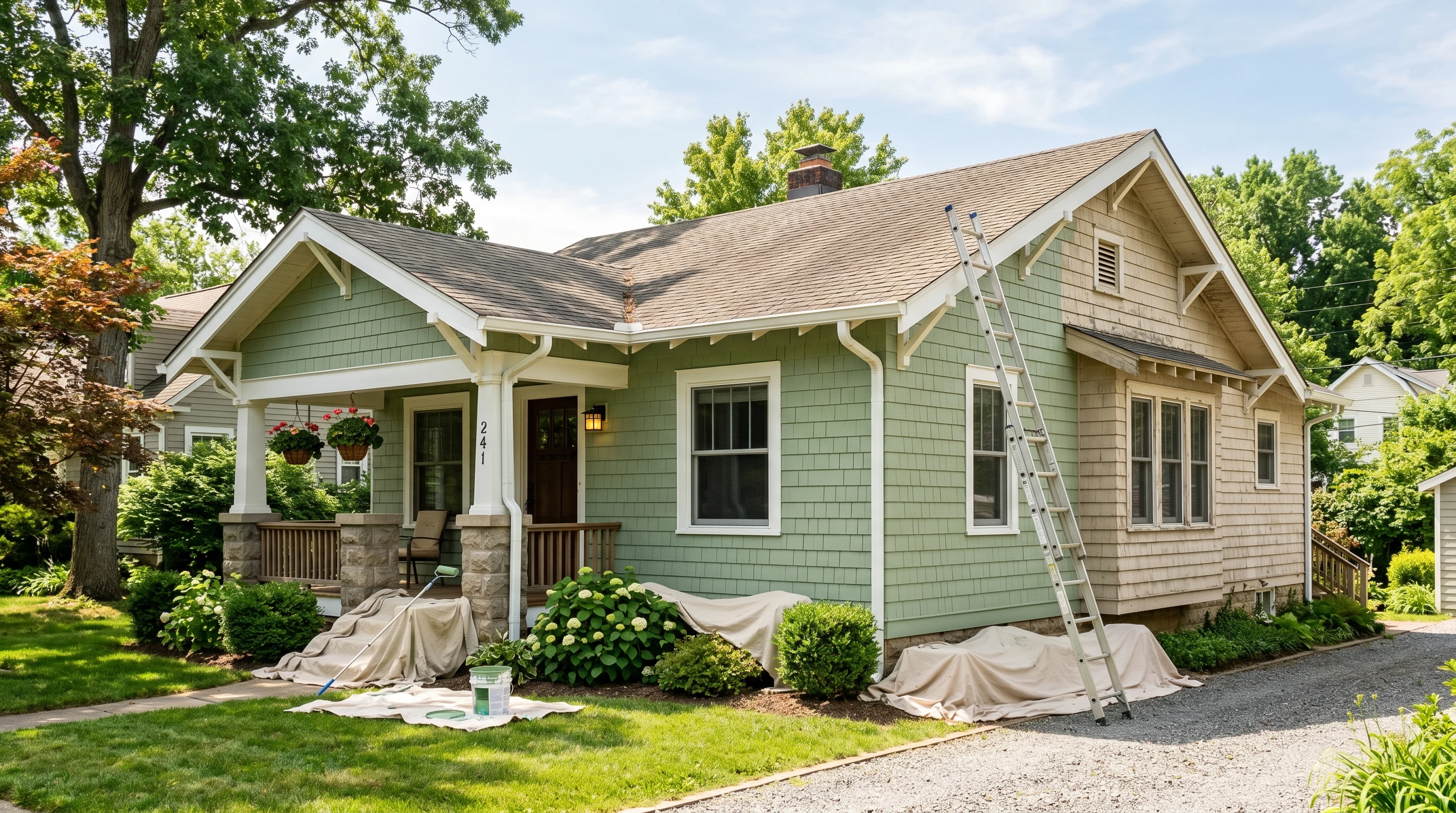
Okay, so you’re thinking about painting your own house. The whole thing. Outside.
Here’s the thing nobody tells you: this is the most ambitious DIY most homeowners ever take on. A 1,500–2,000 sq ft single-story takes five to ten days of actual work, spread across two to three weeks because you have to wait for dry weather. Two-story runs closer to three weeks, and the upper-floor ladder time is where the real risk lives.
I’m not saying that to scare you off. People who try this and fail almost all fail the same way: planned for a Saturday and Sunday, ran out of weather window, ended up with a half-painted house and an angry spouse. Go in with the real scope and you can do this.
TL;DR: the honest scope warning
- Time: 5–10 days active for a single-story; 2–3 weeks two-story. Double on the calendar for weather.
- Cost: $500–$1,100 materials DIY. Pro quote, same house: $4,000–$9,000.
- Skill: Hard. Prep is tedious; ladder work is dangerous if you rush.
- Don’t DIY if: three+ stories, steep grade, lead paint (pre-1978), or you’re not comfortable above twelve feet.
- What ruins it: painting over loose paint, skipping back-priming, painting when nights drop below 50°F.
Should you actually DIY this?
For some houses the right answer is “hire it out,” and that’s good judgment.
Single-story on flat ground. Yes. An ambitious first-timer with a 24-foot extension ladder, a free week or two, and comfort at moderate heights saves $3,000–$6,000.
Two-story on flat ground. Maybe. The upper level adds 16–24 feet of ladder work, where every serious DIY exterior injury happens. With prior ladder experience and a helper to foot the ladder, it’s possible. Otherwise hire the upper level and DIY the lower. Pros quote “second-story only” jobs.
Two-story on a slope, three-story, or steep grade. No. A ladder leveler doesn’t fix a 15-degree slope.
Pre-1978 home with lead paint. No, not without an EPA RRP-certified contractor on the prep. Scraping lead paint without containment is illegal in most jurisdictions and stays dangerous to children and pets in the soil for decades. Get the lead test first.
You hate ladders. No. People who white-knuckle ladder work are the ones who fall.
The honest timeline and cost
A realistic two-week schedule for a 1,500–2,000 sq ft single-story, working evenings and weekends.
| Day | Activity | Hours |
|---|---|---|
| Sat 1 | Pressure wash | 4–6 |
| Sun–Tue 2–4 | Dry down | 0 |
| Wed 5 | Scrape, sand | 4–8 |
| Thu 6 | Caulk, siding repair | 3–5 |
| Fri 7 | Spot-prime, back-prime | 3–5 |
| Sat 8 | Mask, tarp shrubs | 3–4 |
| Sun 9 | First body coat | 6–8 |
| Mon–Tue 10–11 | Cure | 0 |
| Wed 12 | Second body coat | 6–8 |
| Thu 13 | Trim, both coats | 4–6 |
| Fri 14 | Cleanup, hardware | 2–3 |
35–55 active hours across two calendar weeks. Weekends only, expect three. Vacation week compresses it to one eight-day push.
Cost breakdown:
| Item | Cost |
|---|---|
| Body paint, 10 gal premium | $400–$650 |
| Trim paint, 2 gal | $80–$140 |
| Stain-blocking primer, 1–2 gal | $40–$80 |
| Caulk, 8–12 tubes | $30–$50 |
| Ladder rental, 1 week | $40–$80 |
| Pressure washer rental | $50–$80 |
| Drop cloths, tape, sponges | $60–$100 |
| Brushes, frames, sleeves | $80–$120 |
| Misc | $40–$70 |
| Total | $820–$1,370 |
Own the ladder, brushes, and pressure washer already? Drop $150–$200. Behr Marquee instead of Aura trims more, but I’d push back: exterior paint is where saving $20/gallon costs years of life.
The weather window is the hard constraint
Read this twice. Most DIY exterior failures trace back to ignoring it.
Temperature. 50–90°F air and surface for the full dry-down (24+ hours after each coat). Modern acrylics are rated to 35°F on the can, but rated isn’t performs. Paint applied below 50°F doesn’t form a continuous film and peels off the first warm humid day next summer. Surface temp matters more than air; a south-facing wall in March sun hits 80°F while the air is 55°F.
Rain. No rain 24 hours before (wall must be bone dry) or 24 after (film needs to skin). BM Aura and SW Emerald claim shorter windows once touch-dry. I wouldn’t push it.
Humidity. Below 70% ideally, below 85% always. High humidity slows the cure and traps moisture under the film. The problem shows up six months later as soft spots and adhesion failure.
Sun on the wall. Paint the shaded side. Direct sun flashes the surface and you get lap marks. Chase the shade: east-facing afternoons, west-facing mornings, north-facing anytime.
The shoulder-season trap. Late April and late September look like painting weather: daytime 65°F, sun out. Then the night drops to 42°F and your barely-cured film cracks. Below 50°F overnight, you’re outside the window.
What you’ll need
Paint and primer. 8–12 gal premium exterior acrylic (Benjamin Moore Aura Exterior, Sherwin-Williams Emerald, or Behr Marquee for budget; see our exterior paint round-up →). 2–3 gal trim in semi-gloss or satin. 1–2 gal stain-blocking primer (Zinsser Cover-Stain for cedar and redwood; Bulls Eye 1-2-3 otherwise). 8–12 tubes paintable siliconized acrylic caulk. Pure silicone won’t take paint.
Tools. 24-foot extension ladder, plus a leveler if your ground isn’t flat. Pressure washer rental, electric 2,000–3,000 PSI. 5-in-1 tool, 80- and 150-grit sponges. A $15 dripless caulk gun. 9-inch roller frames, 1/2-inch nap for siding, 3/8-inch for smooth trim. Telescoping extension pole. Two 2.5-inch angled sash brushes (Wooster Silver Tip or Purdy XL). Canvas drop cloths, plastic for shrubs, painter’s tape. A helper for the ladder days.
Optional sprayer. A Graco Magnum X5 cuts active paint time roughly in half but adds a full day of masking. Overspray drifts ten feet on a still day. Pays off on your second exterior; for your first, brush and roll.
The week-by-week flow
Week 1: prep (this is most of the work)
Day 1: pressure wash. Top-to-bottom. 25-degree tip, 2,000–3,000 PSI for vinyl or hardboard, 1,500 for old wood. Don’t blast water under siding laps. Scrape any paint the water lifted. Wait 48 hours to dry; shaded sides need 72.
Day 3: scrape and sand. Walk every wall with the 5-in-1. Anything that lifts under moderate pressure comes off. Feather remaining-paint edges with 80-grit so the bare-wood boundary isn’t a hard ridge. You’ll see it through two coats otherwise.
Day 4: caulk and repair. Recaulk every joint where two materials meet. Cracked old caulk comes out first; new over old doesn’t bond. Replace rotted or split boards. Back-prime replacement boards before nailing so moisture can’t enter from behind. Skip this and the new boards fail in three years while the old ones around them last ten.
Day 5: spot-prime. Every bare-wood patch gets stain-blocking primer. Cedar and redwood need an oil-based blocker (Cover-Stain); tannins bleed through water-based primers. Patch coverage is enough. Dry overnight.
Week 2: paint
Day 6: mask. Tape and plastic around every window, door, and fixture; tarps over shrubs and AC units. Two hours of careful masking saves four hours of cleanup.
Day 7: first body coat. Start on the shaded side. Cut in around windows, corners, and trim; roll the field with a 1/2-inch nap. Keep a wet edge: don’t let one section dry before you blend the next, or you’ll see a lap mark. Work in 4-by-8 sections. Drop the ladder more often than feels necessary. Reaching too far sideways turns a fine afternoon into an ER visit. The first coat looks blotchy and uneven; that’s normal. Color reads true after the second.
Days 8–9: cure. Don’t paint over wet first coat. Most premium exteriors want 4 hours touch-dry, 24 to recoat. Stretch to 24–48 in cool or humid weather.
Day 10: second body coat. Same as day 7. Covers faster, looks dramatically better. That’s when you start enjoying this.
Day 11: trim. Cut in around every window, door, corner board, and fascia. Two coats. Trim is where the eye lands first, so slow brushwork pays off.
Day 12: cleanup. Pull tape while the trim is still slightly tacky (24 hours after the second coat); fully cured paint lifts topcoat with the tape. Reinstall fixtures. Walk around in late-afternoon raking light and mark holidays for touch-up tomorrow.
The tricky parts
Inside corners. Cut in from the corner outward about 4 inches each way, then roll up to the brushed edge. Don’t roll into a corner; the roller skips and leaves a thin spot.
Soffits and overhangs. Use the extension pole. Hand-rolling above your head ruins your shoulder and the coverage. If you own a sprayer, this is the one place to use it on an otherwise brushed job.
Second-story safety. Foot the ladder on flat firm ground or a leveler, never on dirt that shifts. Extend it so the top is 3 feet above the working point; never stand higher than the third rung from the top. Belt the paint can to the ladder, not your hand. Three points of contact always. Most falls happen on the climb down; descend slowly even when tired.
The shortcuts that ruin the job
Three mistakes account for almost every “I painted my house and it failed in two years” story I’ve heard.
Skipping back-priming. New cedar nailed up bare and painted only on the front face absorbs moisture from behind and cups within a year. Coat the back side and edges first. An hour buys you a decade.
Painting over chalky old paint. Old paint develops chalky residue as the binder weathers. New paint bonds to the chalk and the chalk lifts off with it. Rub a hand on dry siding; if your palm comes back white, it’s chalky. Pressure-wash harder, or use a chalk-binding primer (Zinsser Peel Stop) before topcoating.
Painting too late in the season. Daytime 65°F, overnight 45°F, you’re outside the window. Wait for spring.
One more, less catastrophic but common: starting on the front. Your day-one brushwork is your worst. Start on the back or a side wall; your best wall is the last one you paint.
Drying and cure schedule
| After final coat | What’s safe |
|---|---|
| 4 hours | Touch dry; don’t lean a ladder on it |
| 24 hours | Surface cured; light rain fine, no scrubbing |
| 7 days | Heavy fixtures, normal weather |
| 30 days | Full cure; pressure-wash, hard scrub OK |
Don’t pressure-wash for the first month. The film is still hardening, and high-pressure water will lift it.
Maintenance
A properly prepped exterior with premium acrylic lasts 8–12 years on the body, 6–10 on trim. Walk the house every spring. Look for caulk separation at joints, and peeling along the bottom 18 inches above grade. Bottom-edge peeling is almost always ground-moisture wicking, not paint failure; fix the moisture path before touching the paint.
Touch up early. A pint of leftover paint in a sealed quart jar (no air gap), dabbed on each spring, keeps the house looking 95% as good as new. Repaint when peeling shows on more than two walls.