Eggshell vs Satin Paint: Which Sheen Belongs Where
A chemist's head-to-head on the two most-confused interior sheens — gloss-unit numbers, scrub data, touch-up behavior, and a verdict by room.

The 30-second answer
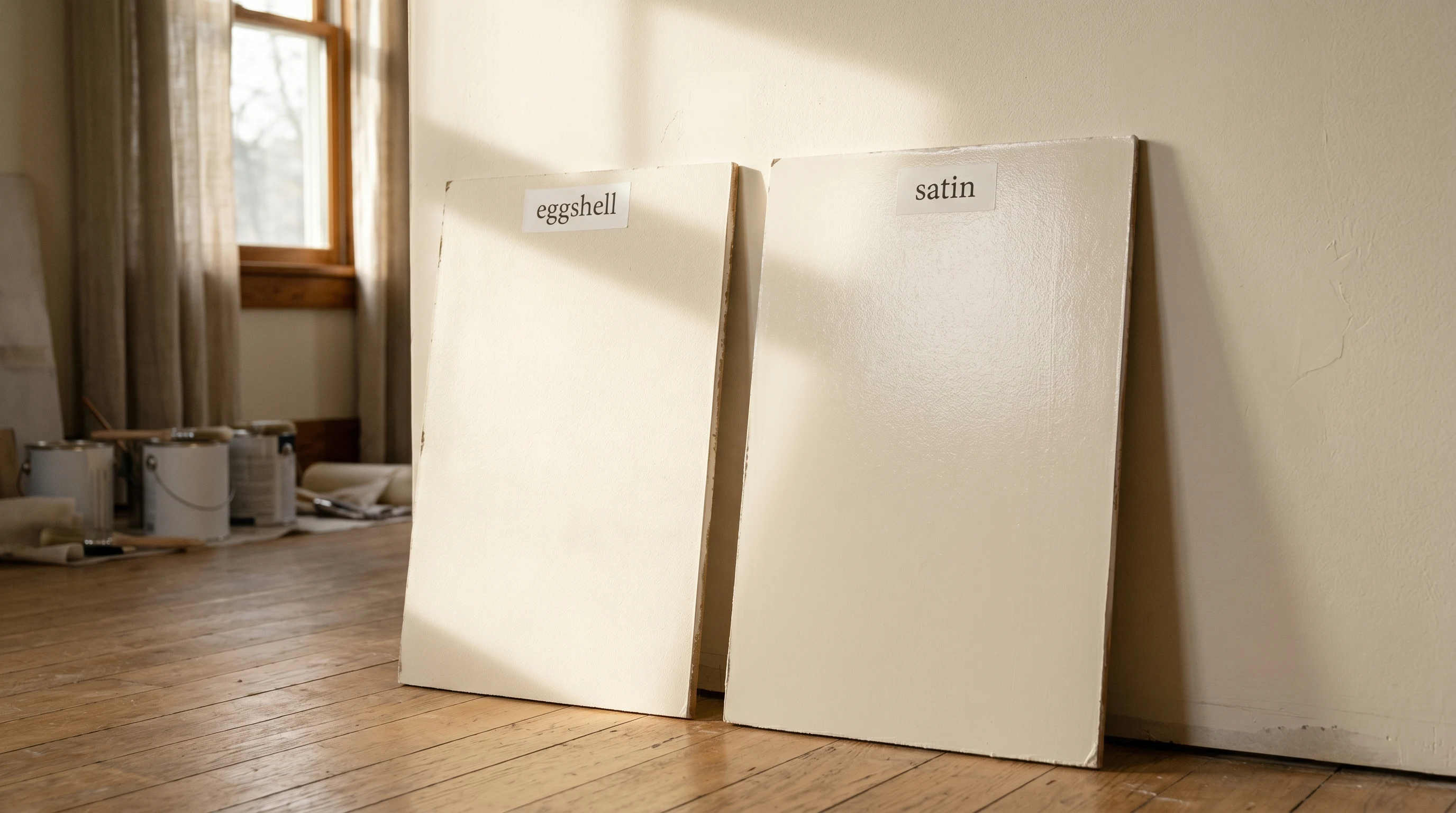
Walls people touch, splash, or scrub want satin. Kitchens, bathrooms, kids’ rooms, mudrooms. Anywhere else, especially living rooms and bedrooms with imperfect drywall and raking window light, pick eggshell. The two sheens sit one band apart on the gloss scale (eggshell 10–25 GU, satin 25–35 GU at 60°). The practical gap is bigger than the numbers suggest, because of how the eye reads reflected light off a flat plane.
At a glance
| Eggshell | Satin | |
|---|---|---|
| Gloss units (60°) | 10–25 | 25–35 |
| Hides drywall imperfections | ✓✓ | ✗ |
| Scrub resistance (ASTM D2486) | ✓ (300–500 cycles) | ✓✓ (600–1000+ cycles) |
| Touch-up appearance | ✓✓ | ✗ |
| Light reflection under raking light | Soft, diffuse | Sharp, directional |
| Best room | Living, hall, bedroom | Kitchen, bath, kids’ |
| Cost per gallon | $$ | $$ |
How to tell which one’s already on your wall
Stand parallel to the wall while a side light source (window or lamp) sits at 45°. Soft directional reflection with the room visible as a faint halo means satin or higher. Uniformly diffuse, no directional bounce, that’s eggshell or matte. A flashlight at 45° gives a diffuse oval on eggshell and a tighter hot spot on satin. The smaller the bright spot, the higher the sheen.
Drywall hiding
Drywall is rarely flat. Even a well-finished wall has taped seams that telegraph through the joint compound, spackled screw pops, roller texture from the previous coat, and filler patches around outlet boxes. Each one creates a few thousandths of an inch of micro-topology.
At low sheen, light scatters off those variations roughly equally and the wall reads uniform. Raise the gloss and the specular reflection starts tracking the topology: bumps catch light, dips fall into shadow. Your eye reads the contrast.
Eggshell at 15 GU is forgiving. Satin at 30 GU is not. In a room with raking light along the wall, the same drywall that looks fine in eggshell looks like a topo map in satin.
Winner: Eggshell.
Scrub resistance
The trade-off for that softer reflection is a softer film. ASTM D2486 measures it: a weighted brush with abrasive paste runs back and forth over a paint sample until the film breaks through. Cycle count is the spec.
Typical premium-line numbers from manufacturer data sheets, freshly cured panels:
| Brand & line | Eggshell cycles | Satin cycles |
|---|---|---|
| Benjamin Moore Regal Select | ~400 | ~800 |
| Sherwin-Williams Cashmere | ~350 | ~750 |
| Behr Marquee | ~500 | ~1000+ |
| Valspar Reserve | ~300 | ~600 |
The gap is real. Satin runs lower pigment volume concentration, which means more continuous binder film at the wear surface. Pigment is mineral filler. Binder is the polymer that takes abrasion. Denser binder, harder film, better scrub.
Winner: Satin.
Touch-up appearance
Patch a hole, prime, brush in fresh paint, and two things happen optically. The new paint cures with a slightly different film thickness than the surrounding wall, because you applied it locally. Film thickness shifts gloss: thicker reads glossier, thinner reads duller.
At eggshell sheen, that thickness-driven gloss difference sits below the threshold of human perception under most lighting. Feather the patch, dry-roll the area with the same nap as the original wall, and it disappears.
At satin sheen, the same variation crosses the threshold. The patch reads as a dull spot or a glossy spot depending on how heavy you laid it on. Under raking light, it stays obvious for the life of the paint job.
This is why pros say touching up satin walls means repainting the entire wall plane, corner to corner. There’s no quick fix.
Winner: Eggshell.
Light reflection under raking light
Raking light is the cruel test. South-facing windows in late afternoon, ceiling cans angled across a hall, sconces washing a stairwell wall.
Under raking light, the difference between 15 GU and 30 GU is visually massive. Eggshell continues to read as a uniform surface. Satin starts to act like a partial mirror, picking up directional reflections from the light source and revealing every plane variation in the drywall.
If your walls take strong raking light at any time of day, drop one sheen step from your instinct. A wall you wanted in satin should probably go in eggshell.
Winner: Eggshell.
Best room
| Room | Sheen | Why |
|---|---|---|
| Living room | Eggshell | Raking window light + imperfect drywall |
| Bedroom (adult) | Eggshell or matte | Low touch frequency, soft look |
| Hallway | Eggshell | Imperfect drywall, picture-hanger patches |
| Kitchen | Satin | Grease, splatter, daily wipe-down |
| Bathroom | Satin | Humidity, splashes, scrub frequency |
| Kids’ room | Satin | Crayons, hand smudges, food, life |
| Mudroom / laundry | Satin | Boots, dirt, regular cleaning |
| Dining room | Eggshell | Low touch, often takes raking light |
| Home office | Eggshell | Soft light read, monitor glare matters |
The brand-variation trap
A “satin” from one brand can read at 25 GU. A “satin” from another can read at 35. That’s a 40% difference in measured gloss between two cans labeled the same word. The category names are marketing buckets, not measurements.
We’ve measured 22 GU on a Sherwin-Williams Cashmere “satin” and 31 GU on a Behr Marquee “satin.” Behr’s eggshell at 14 GU reads brighter than Farrow & Ball’s “estate eggshell” at 7. The label tells you the bucket. The data sheet tells you the number.
If you’re matching the sheen of an existing wall, order a sample in the exact brand and line and compare under the actual lighting. Don’t assume “satin = satin.”
A word on the chemistry
The eggshell-vs-satin difference comes down to pigment volume concentration: the volume ratio of pigment particles to binder in the dried film. Eggshell runs higher PVC (roughly 35–40%), so pigment pokes through a thinner binder layer and the surface stays microscopically rough. Satin runs lower PVC (25–30%), the binder fully encases the pigment, and the surface packs smoother. Same chemistry, different formulation balance, identical gallon price.
Common pitfalls
Mixing sheens within a wall. Touch-up paint at a different sheen reads as an obvious patch in raking light. Even cans of “Sherwin satin” pulled from different batches drift in gloss. Pull from a different brand and the patch flashes forever. Keep the original can and label it with the wall.
Sheen-shopping by chip card. Stores show colors in eggshell. The same color in satin reads colder, harder, more saturated, because higher specular reflection brings out color depth. Order a sample in the exact sheen you’ll use, painted on a sample board, looked at under the room’s actual lighting.
Going one step too high “for durability.” The most common over-correction. A homeowner thinks “satin scrubs better, I’ll use satin everywhere.” Six months later, every drywall imperfection in the living room reads as a topographic feature. Step down one sheen and accept the slightly reduced wipe performance. It’s almost always the right call outside wet rooms.
Recommended products by side
Going with eggshell? A premium acrylic eggshell from any of the big-four brands (Benjamin Moore Regal Select, Sherwin Cashmere, Behr Marquee, Valspar Reserve) lands in the 12–15 GU sweet spot. Don’t drop to a contractor-grade line. The binder-quality difference shows up in scrub resistance, where eggshell is already weakest.
Going with satin? Same premium lines deliver in satin. For trim, doors, or cabinets, step up to semi-gloss in a waterborne alkyd. See best paint for kitchen cabinets → and the kitchen cabinet painting walkthrough →.
FAQ
Can I use eggshell in a bathroom if I run an exhaust fan? Marginally yes, but I wouldn’t. Bathroom walls take splash, condensation, and frequent wipe-down. Eggshell’s lower scrub resistance and more hydrophilic surface means you’ll see wear at the splash zones (around the sink, behind the toilet) within a year or two. Satin is the right answer. If you hate the sheen, pick a high-quality matte specifically formulated for bathrooms; some brands sell “matte enamels” engineered for wet rooms.
Will eggshell over old satin paint look weird? Only if you skip prep or skip a coat. Two coats of eggshell over satin will fully read as eggshell. The new film’s surface texture dominates the optical behavior; the substrate’s sheen doesn’t show through finished paint. Standard prep applies: scuff-sand the satin to break the gloss, wipe clean, prime if you’re going lighter or covering a stain.
Is satin paint shiny enough to use on trim? No. Trim wants 35–65 GU (semi-gloss) to read crisp against the wall. Satin at 30 GU looks soft and washed-out next to an eggshell wall. The contrast isn’t enough to make architectural detail pop. For trim and doors, use semi-gloss; see the full sheen guide →.
Why does my new satin paint look streaky? Three usual suspects. (1) Too thick a roll, leaving uneven film thickness that reads as gloss variation. (2) Working over a wet edge that started to skin, so the second pass laid on top instead of merging. (3) Raking light catching uneven wall texture that the satin sheen now magnifies. The first two are application. The third is a sheen mismatch with the wall: sand the wall flat or step down to eggshell.